
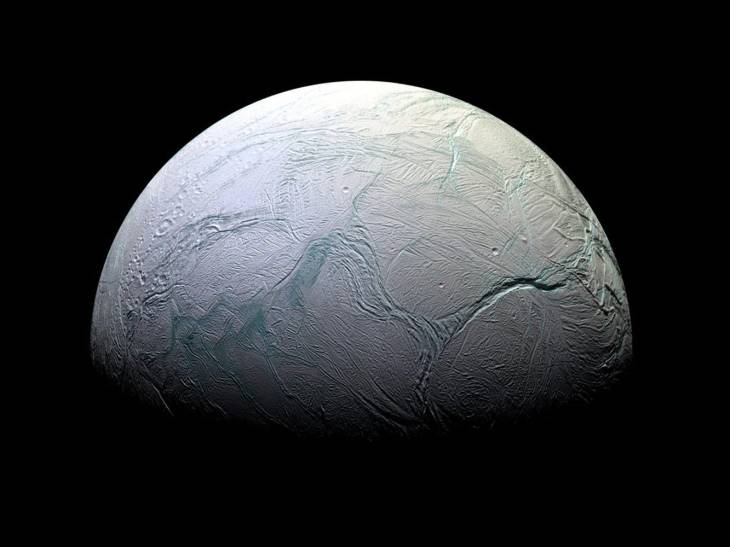
A photograph of Enceladus, an icy moon of Saturn, taken by NASA’s Cassini probe. NAS/JPL-Caltech
WAY TO GO! SUPER FANTASTIC NEWS!
An exciting News has beamed from NASA. But the real source is now for your viewing and these folks did the most amazing job of finding what all want to know. And what is it? Well, here’s an exert that needs your viewing from-
| Title: | Low-mass nitrogen-, oxygen-bearing, and aromatic compounds in Enceladean ice grains |
| Author: | Khawaja, N; Postberg, F |
| Publication: | Monthly Notices of the Royal Astronomical Society |
| Publisher: | Oxford University Press |
| Date: | 2019-10-02 |
| Copyright © 2019, Oxford University Press | |
https://academic.oup.com/mnras/article/489/4/5231/5573821/
Low-mass nitrogen-, oxygen-bearing, and aromatic compounds in Enceladean ice grains
ABSTRACT
1 INTRODUCTION
One of the many spectacular discoveries made by the Cassini–Huygens mission was a plume of icy particles and vapour emitted from the Saturn’s moon Enceladus (Dougherty et al. 2006; Hansen et al. 2006; Porco et al. 2006; Spahn et al. 2006a), connected to a global subsurface ocean (Thomas et al. 2016). Ocean material is ejected in the form of gas (Hansen et al. 2006, 2011; Waite et al. 2006, 2009, 2017) and water–ice-dominated grains (Hillier et al. 2007; Postberg et al. 2008, 2009a, 2011, 2018a; Hsu et al. 2015) from Enceladus, through warm cracks in the Enceladean south polar ice crust (Spencer et al. 2006). Most of the emitted ice grains are too slow to leave the moon’s Hill sphere, and fall back on to the surface (Kempf, Beckmann & Schmidt 2010; Southworth, Kempf & Spitale 2019). However, approximately 5–10 per cent of the emitted ice grains escape and enter the Saturn’s diffuse E ring (Spahn et al. 2006b; Kempf et al. 2010, 2018).
Cassini’s mass spectrometers – Ion and Neutral Mass Spectrometer (INMS) and Cosmic Dust Analyser (CDA) – have analysed ejected materials both inside the plume and the E ring. The discovery by CDA of sodium salts in E ring ice grains provided evidence that the Enceladean subsurface ocean is/was in contact with the rocky core (Postberg et al. 2009a, 2011) and constrained the ocean’s moderate salinity and alkaline pH. The detection of nanometre-sized silica (SiO2) particles in the E ring strongly suggested ongoing hydrothermal activity at Enceladus’ subsurface ocean (Hsu et al. 2015) and provided further evidence that the ocean has a relatively high pH. The detection of molecular hydrogen and methane by INMS not only confirmed subsurface water–rock interaction but also provided further evidence for serpentinization reactions, an exothermic, hydrogen-producing geochemical process (Waite et al. 2017). The hydrothermal activity is thought to occur inside the water-percolated, porous, rocky core of the moon (Sekine et al. 2015; Waite et al. 2017) and is probably maintained by heat generated by tidal dissipation (Choblet et al. 2017).
The CDA records time-of-flight (TOF) mass spectra of cations generated by high-velocity (v ≥ 3 km s−1) impacts of individual grains on to a rhodium target (Srama et al. 2004). Previous analyses inferred three different spectral types of Enceladean ice grains (Postberg et al. 2008, 2009a): Type 1 represents grains of almost pure water ice, Type 2 shows features consistent with grains containing significant amounts of organic material, and Type 3 is indicative of salt-rich water ice grains. This work focusses on a detailed analysis of Type 2 grains.
In contrast to Type 1 and Type 3, Type 2 spectra exhibit a more diverse compositional range, indicating the existence of different compositional subclasses and a wide variety of concentrations of organic compounds. A small subpopulation of Type 2 grains with specific spectral features (repetitive peaks, separated by 12–13 u in mass, extending from 80 u until at least CDA’s high-mass limit of approx. 200 u, known as High-Mass Organic Cations, HMOC) has already been investigated by Postberg et al. (2018a). The spectra were interpreted as due to ice grains carrying complex organic material, which had parent molecular masses in excess of 200 u at concentrations on the per cent level. The study provided evidence for the existence of aromatic and aliphatic substructures, identified as unsaturated and saturated cation fragments of the high-mass complex organic material, as well as oxygen-bearing functional groups in these grains. It was suggested that the detected high-mass organics originate from poorly soluble material concentrated in an organic-rich layer at the top of Enceladus’ oceanic water table.
Folks, do you have any idea how incredibly fantastic and super important the above exert is?
Its absolutely phenomenal. Man has finally found what man has been looking for every since the first intelligent person looked to the Heavens and wondered the same ole question-Where is there Life besides here on earth?
Well, these amazing folks have broken-thru the vast Outer Space and brought all of us closer to it. Yes, man is now super close to answering that question-Where is there Life?
Forget going to Mars, Saturn’s moon Enceladus appears to be our Next Best Friend for man and his devouring quest to live on another planet.
Yes, this is the place and who’s ready to sign-up to be the very first?
And here’s another NASA site for you to get more on this amazing discovery!
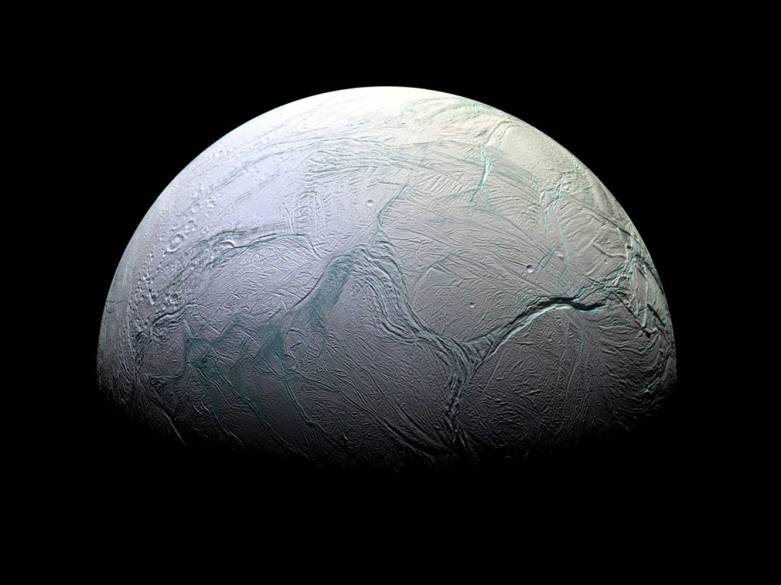
A photograph of Enceladus, an icy moon of Saturn, taken by NASA’s Cassini probe. NAS/JPL-Caltech
https://www.jpl.nasa.gov/news/news.php?feature=7510
News about this moon just keeps getting better and better. And this is the best so far.
 thelivingbreathingjamesbrown.com
You must be logged in to post a comment.