
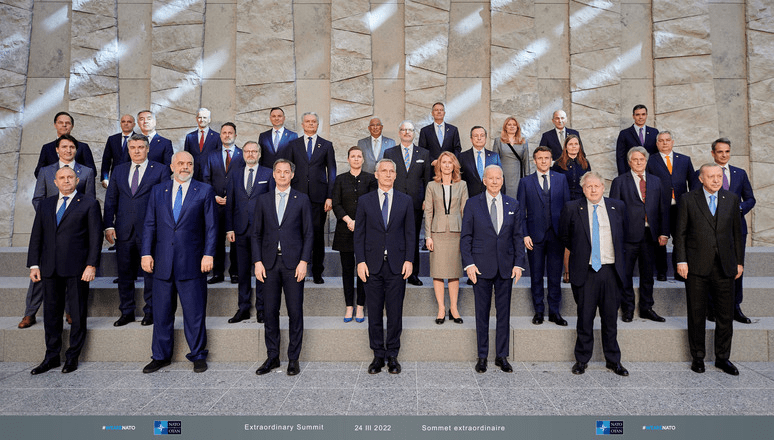
Can NATO legally intervene in Ukraine?
Even if states are a member of a bloc such as NATO, they can still legally act in self-defence independent of that bloc, so NATO members could legally intervene if Ukraine requests collective self-defence – which it has repeatedly done.
https://www.foreignaffairs.com/ukraine/why-nato-must-admit-ukraine
Here are the names of all 30 NATO member countries in alphabetical order:
- Albania
- Belgium
- Bulgaria
- Canada
- Croatia
- Czech Republic
- Denmark
- Estonia
- France
- Germany
- Greece
- Hungary
- Iceland
- Italy
- Latvia
- Lithuania
- Luxembourg
- Montenegro
- Netherlands
- North Macedonia
- Norway
- Poland
- Portugal
- Romania
- Slovakia
- Slovenia
- Spain
- Turkey
- United Kingdom
- United States of America
NATO’s mission is to promote the security and defense of its member countries through collective defense. This means that if one member country is attacked, it is considered an attack on all member countries, and all countries are expected to respond in defense of the attacked country.
If NATO were to face a major foe, each nation would contribute to the defense effort based on their capabilities and resources. For example, countries with strong military capabilities, such as the United States, France, and the United Kingdom, would likely contribute heavily to the military response. Other countries with strong diplomatic or intelligence capabilities, such as Germany or Canada, may contribute in different ways, such as providing diplomatic support or intelligence resources.
Ultimately, each nation’s contribution would be tailored to their individual strengths and resources in order to collectively confront the foe and protect the shared interests and security of all NATO member countries.
NATO (North Atlantic Treaty Organization) has sent troops to several regions in multiple conflicts over the years. Here’s a list of some of the most well-known instances:
- Kosovo, Yugoslavia (1999) – NATO carried out a 78-day air campaign against Yugoslav forces, leading to the withdrawal of Serbian forces from Kosovo and the establishment of a UN protectorate.
- Afghanistan (2001) – NATO invoked Article 5 for the first time in its history in response to the 9/11 attacks. The alliance led international forces in the country until 2014, when the combat mission ended.
- Iraq (2004) – NATO established a training mission in Iraq to help develop the country’s security forces.
- Libya (2011) – NATO carried out an air campaign in support of rebels fighting against Libyan leader Muammar Gaddafi. The intervention helped overthrow Gaddafi’s regime, leading to his death.
- Ukraine (2014) – NATO sent troops to the region as part of a multinational effort to provide reassurance and deterrence to NATO allies in Eastern Europe following Russia’s annexation of Crimea. This deployment included multinational battle groups in Estonia, Latvia, Lithuania, and Poland. 6. Afghanistan (2001-present) – NATO led the International Security Assistance Force (ISAF) in Afghanistan following the 9/11 terrorist attacks. The mission has shifted over time to focus on training and advising Afghan security forces.
Since Russia’s illegal and illegitimate annexation of Crimea in 2014, NATO has helped to reform Ukraine’s armed forces and defence institutions, including with equipment and financial support. Allies have also provided training for tens of thousands of Ukrainian troops. Ukrainian forces have also developed their capabilities by participating in NATO exercises and operations. Since 2016, NATO’s support has been organised through a Comprehensive Assistance Package (CAP), which includes a wide range of capacity-building programmes and trust funds, focused on key areas like cyber defence, logistics and countering hybrid warfare. Allied leaders agreed a strengthened CAP at the Madrid Summit in June 2022.
Since Russia’s full-scale invasion in February 2022, NATO and Allies have been providing unprecedented levels of support to Ukraine.
NATO is helping to coordinate Ukraine’s requests for assistance and is supporting Allies in the delivery of humanitarian and non-lethal aid. More broadly, NATO’s Article 5 security guarantee and its ironclad promise of collective defence provides Allies with the confidence that they can send weapons to Ukraine without diminishing their own security. Furthermore, the Alliance’s well-established structure of common standards and interoperable systems is allowing Allies to provide equipment with the assurance that materiel transferred to Ukraine can be backfilled by compatible equipment from other Allies.
Individual NATO member countries are sending weapons, ammunition and many types of light and heavy military equipment, including anti-tank and air defence systems, howitzers, drones and tanks. To date, NATO Allies have provided billions of euros’ worth of military equipment to Ukraine. Allied forces are also training Ukrainian troops to use this equipment. All of this is making a difference on the battlefield every day, helping Ukraine to uphold its right of self-defence, which is enshrined in the United Nations Charter.
Furthermore, Allies are providing billions of euros of financial assistance to Ukraine. Many Allies are also providing humanitarian aid to civilians and hosting millions of Ukrainian refugees. Allies are working with relevant stakeholders in the international community to hold accountable all those responsible for war crimes, including conflict-related sexual violence. Allies have also worked closely to support international efforts to enable exports of Ukrainian grain and to alleviate the global food crisis.
At the Madrid Summit in June 2022, Allied leaders agreed a strengthened package of support for Ukraine, which includes support in secure communications, combat rations, fuel, medical supplies, body armour, winter clothing, equipment to counter mines and chemical and biological threats, and portable anti-drone systems. Allies also agreed to help Ukraine transition from Soviet-era equipment to modern NATO equipment, boost interoperability with Allied forces, and further strengthen Ukrainian defence and security institutions.
 thelivingbreathingjamesbrown.com
You must be logged in to post a comment.