
Seems like something rotten is unfolding right before our eyes. Or just plain very odd? Most of us cannot put a finger on exactly what it is. Right?
Everyone wants to know why Grandpa and Grandma seem different? The older they get, the Odder they seem. But are the schools creating this oddity? Yep, it just Might be in what each of us were taught in school. What we were taught and exactly what you weren’t?
The second item coming out of the mouths of Politicians today are the Teacher/School Issues. Not the Reasons why they keep changing what is getting taught. Real or Generated out of political rhetoric? But as a parent, you want to know? But most of us DON’T know what to Ask or where to start.
What’s wrong with Schools now?
- Schools more and more are being Over-Analyzed by Politicians and their WOKE base. (WOKE is being aware of what Your Politician wants to go be aware about. And go out and beat the brush about).
- Teachers are Overworked.
- Teachers are Unappreciated.
- Teachers are Underpaid.
- Teachers are having their minds Broken thru seemingly nonsensical Acts placed upon them by Legislators who want their party line taught to students while in school during school hours.
- Teachers and School Officials are being attacked during school meetings by WOKE individuals from a political base.
- School Officials are taught to talk down to teachers instead of being all inclusive.
- Students are being LEFT BEHIND because teachers have burdensome workloads/workplaces placed on them today.
- Children cannot get the help they need to fully develop with all the possible potentials that a school could and should help them acquire because they aren’t being Helped because of all of the above.
- School Priorities are being ignored in your State Capital.
- RACE and inequality of Teachers of similar Ethnic Backgrounds and, I’ll say it, the same color of skin.
The presence of teachers with diverse skin colors and ethnic backgrounds in schools is important because it allows students to see themselves represented in adult figures of authority and provides opportunities for cultural understanding and awareness. This can lead to increased engagement, motivation, and better academic outcomes for students from diverse backgrounds.
On the other hand, having fewer teachers of the same skin color and ethnic background as the students can lead to feelings of disconnection, lack of belonging, and cultural misunderstandings. This can negatively impact students’ academic performance, self-esteem, and mental health.
Overall, promoting diversity among teachers can have a positive impact on student outcomes and experiences, while limiting diversity can have negative effects. Exactly what Austin is doing…especially in Colleges. But, enough said. We all knew that. Didn’t you? But-
What should be taught? What’s thought to be taught and what’s really taught? Do you as a parent have any input? No.
Here’s general information about what is commonly taught at each grade level in the United States. Please note that some may vary according to state and district standards. Here is a rough breakdown:
- Kindergarten: basic literacy and numeracy skills, social-emotional development, introduction to scientific concepts through play and exploration
- 1st-3rd Grade: phonics and decoding skills, math concepts and operations, social studies (e.g. neighborhoods, government), basic science (e.g. weather, animals), foundational writing skills
- 4th-6th Grade: advanced reading and comprehension skills, long-division and more complex math operations, social studies (e.g. geography, history), more detailed science (e.g. ecosystems, energy), expository writing
- 7th-8th Grade: literature analysis and critical thinking, algebra and geometry, history and social studies (e.g. ancient civilizations, U.S. government, economics), science (e.g. biology, chemistry, physics), language arts (e.g. reading, writing, grammar), and foreign languages should be taught at every grade level with increasing depth as students progress. Here is an overview of what could be taught at each grade level:
Grade 1-3: Basic reading, writing, and math skills, including addition and subtraction.
Grade 4-5: Understanding of decimals, fractions, and basic operation like multiplication and division. Also important geography, problem-solving skills, and basic science.
Grade 6-7: Introduction to algebra and geometry. Basics of world history and geography, English grammar and reading comprehension skills, and earth science.
Grade 8-9: In depth study of algebra and geometry, U.S. history, physics, chemistry, biology, and literature.
Grade 10-12: Advanced math courses like trigonometry and calculus. In-depth study of literature, economics, world history, politics, sociology, and environmental.
Here is an outline of topics that are typically taught in each grade level and in college:
Grade 1-5:
- English Language Arts: Reading, Writing, Phonics, Grammar, Vocabulary
- Mathematics: Numbers and Operations, Fractions, Geometry, Measurement, Data Analysis
- Science: Life Science, Earth Science, Physical Science
- Social Studies: Geography, History, Civics, Economics
Grade 6-8:
- English Language Arts: Reading Comprehension, Analyzing Literature, Writing Essays, Research
- Mathematics: Pre-Algebra, Algebra, Geometry, Probability, Statistics
- Science: Earth Science, Physical Science, Life Science, Environmental Studies
- Social Studies: World History, American History, Geography, Government and Economics
Grade 9-12:
- English Language Arts: Analyzing Literature, Writing Research Papers, Creative Writing, Advanced Grammar
- Mathematics: Algebra, Geometry, Trigonometry, Calculus
- Science: Biology, Chemistry, Physics.
Here’s what should be taught at each grade-
Grade 1-2: Basic language skills such as reading, writing, and comprehension.
Grade 3-5: Creative Writing, Basic Grammar, and Mathematics such as addition, subtraction, multiplication, and division.
Grade 6-8: Advanced Grammar, Mathematics such as Algebra, Geometry, and Trigonometry, and Science such as Biology, Chemistry, and Physics.
Grade 9-12: Advanced Mathematics such as Calculus, Advanced Science such as Biology, Chemistry, and Physics, and Life Skills such as Home Economics, Career Development, and Financial Planning.
College: Specialization in a particular field of study, such as Business, Science, or Engineering, and Professional Development such as Internships and Networking.
Who can afford College?
There are several things that were commonly taught in schools 50 years ago which are not so much today. Some of these include:
- Cursive handwriting: Learning how to write in cursive was a key part of the curriculum in many schools decades ago, but it is taught less frequently today. It doesn’t matter that Teachers from Overseas didn’t learn Cursive, so it got Dropped. Truth is thicker than Mud.
- Memory work and recitation: In many schools, students used to memorize poetry, speeches, and other literary works and would be required to recite them in front of the class. Lots more time for TikTok, Cell Phone, Laptop, or Video Games. Who needs it? Teach your ChiMud.keat? KEEP them in the dark. Keep them truly ignorant?
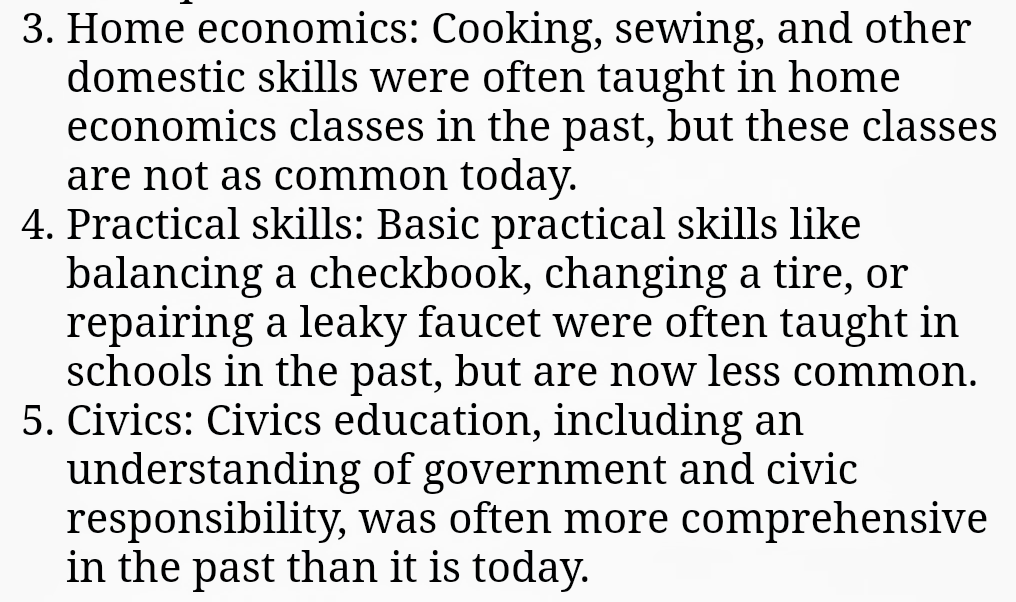
- Home economics: Cooking, sewing, and other domestic skills were often taught in home economics classes in the past, but these classes are not as common today. Who needs it? Teach your child to pick up food, don’t cook. Never Cook. Never sew.
- Practical skills: Basic practical skills like balancing a checkbook( who needs this? An App does it for you?) , changing a tire, or repairing a leaky faucet were often taught in schools in the past, but are now much less common.
- Civics: Civics education, including an understanding of government and civic responsibility, was often more comprehensive in the past than it is today.
Other topics that were commonly taught in schools 50 years ago but may not be emphasized as much today include:
- Home economics: cooking, sewing, household management, and personal finance
- Cursive handwriting: with the rise of digital communication, many schools have stopped prioritizing teaching cursive handwriting
- Geography: while still taught, it may not be given as much emphasis as it was in the past
- Memorization: rote memorization of facts, dates, and formulas was often a key part of learning in the past, but is less emphasized today in favor of critical thinking and problem solving skills.
But, let’s look further at the things that aren’t taught-
There could be several factors why memorizing and reciting poetry, speeches, and other literary works have become less common in schools. One reason might be that modern education focuses more on the development of other skills such as critical thinking, creativity, and problem-solving (but weren’t we being taught creativity and problem-solving?). Who makes these Decisions? The people in your State Capital do.
Additionally, some educators may believe that memorization is passive and does not provide students with a deep understanding of the texts they are reciting. But is it the Educators? Or are they being Ordered to do this?
Another factor might be the increasing emphasis on technology and multimedia in modern education. With so much digital content available, students may not see the benefit of memorizing works that they can easily access electronically. Additionally, some experts argue that memorization is not a crucial skill in today’s world as people can quickly look up information they need.
Memorization not good for you? Hmm…really? Getting up in front of the class not good for you? Hmm…
Regarding the psychological aspect of this, some students may feel uncomfortable reciting works in front of the class and may become anxious or nervous about memorizing and performing.
If they cannot do this, when will they ever learn to overcome their Fears? Making school as gentle as possible? No talking in front of the Class? Later in life, will these individuals ever become a member in the Armed Forces? Will they be afraid to speak up later in life? Building Followers, not Leaders? Are these children being weakened? On purpose?
Therefore, modern pedagogies tend to focus on student-centered and collaborative learning, where students work together to learn and develop their own ideas and opinions. While memorization and recitation can still be valuable exercises for students, there may be several reasons why they are not as heavily emphasized in modern pedagogies.
Firstly, memorization and recitation can be seen as more of a rote-learning exercise, where students are simply repeating words without truly understanding their meaning or significance. This type of learning may not be as effective in promoting the critical thinking and problem-solving skills that are necessary for success in the modern world.
Secondly, many educators (who exactly makes these decisions?) believe that memorization and recitation can be overly stressful for some students, particularly those with anxiety or public speaking concerns. These students may feel uncomfortable or overwhelmed with the expectation of performing in front of their peers.
Lastly, modern pedagogies may place a greater emphasis on the use of technology and multimedia in learning, which may not lend itself as well to memorization and recitation exercises.
Overall, while memorization and recitation can still be valuable tools for learning, there may be several factors contributing to the decrease in their use in schools.
One reason could be a shift in educational priorities towards more emphasis on critical thinking and problem-solving skills. While memorization can help with retention of information, it may not be seen as a necessary skill in a world where information is readily accessible through technology. Additionally, some educators may feel that the focus on memorization takes away from other important areas of learning such as creativity and innovation.
Another possible factor could be changes in classroom culture and student preferences. In today’s society, there is often more emphasis on individual expression and autonomy, and some students may find memorization and recitation exercises to be too structured and limiting.
Overall, it’s important to note that different educational methods work for different students and situations, and while memorization and recitation may not be as commonly used as they once were, they still have value and can be incorporated into classroom instruction in a way that benefits students.
Lol. The three items above don’t need to be taught in schools. No, these are taught in Prison. They’re happy to teach this in Prison. They need good seamstress to make a prison Clothes.
But maybe if you think about it, should the items no longer being taught be reintroduced? What purpose did it accomplish by dropping them in the 1st place? Useless then, useless TODAY?
Don’t ask the kids to memorize? More time for parent/child Video Games. Right?
Don’t Memorize, don’t read. More time to do what?
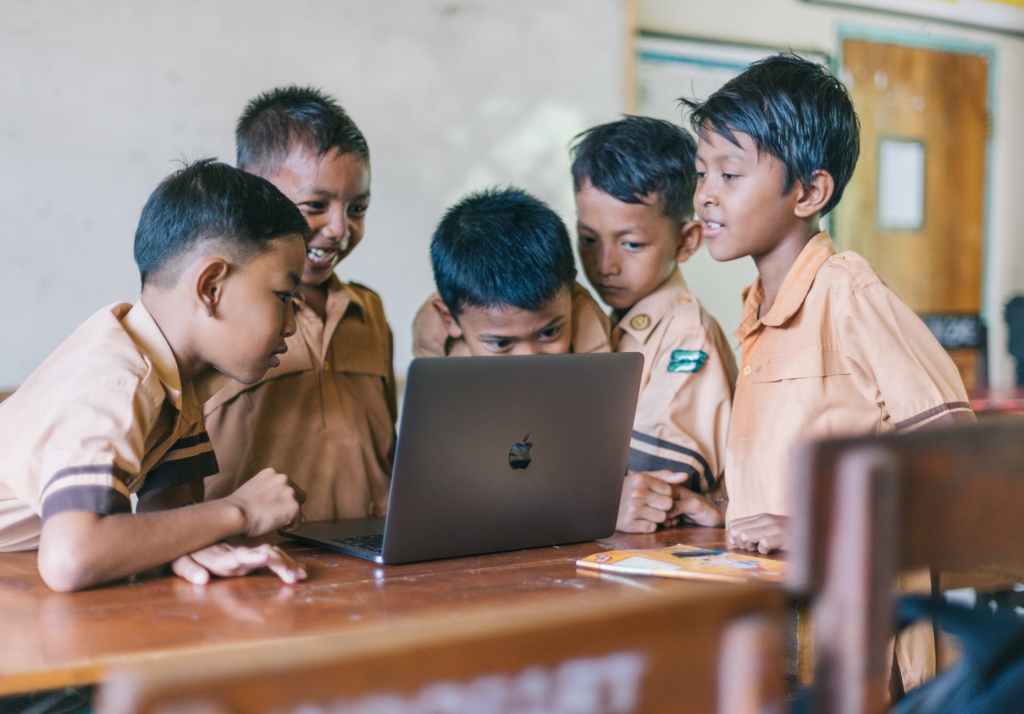
Now, the Cell Phone teaches your child more than teachers. Your child spends more time on their Cell Phone, Lap Top, or Computer doing things like watching as much Viral TikTok and Video Games. Skip the Books or Memory Work. Who needs for kids to learn how to memorize? What good does it do?
Lol…Lol…just try remembering stuff and see what’s up with what?
Seems like something rotten is unfolding right before our eyes. But oddly enough, it’s very difficult putting a finger on exactly what it is. Right?

Lord knows we sure need more people with Memory Issues. Teaching folks to rely on one App after another. Don’t Read a Map? Your Car App gonna get you somewhere…🎉🎉🎉🎉
With A.I., your child will be competing with A.I. for a job.
 thelivingbreathingjamesbrown.com
You must be logged in to post a comment.