
Worth the Watch? Absolutely!
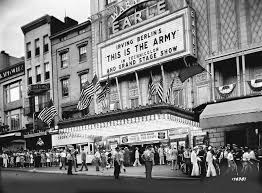
The film grossed $9,555,586 (equal to $161,599,660 today), which was donated to Army Emergency Relief,[7][8] and rentals of $8,301,000 in the United States and Canada and $2,144,000 overseas for a total of $10,445,000.[3][4] It was the highest-grossing musical film of all-time until it was surpassed by White Christmas in 1954.[9] The receipts from This Is the Army place it among the top 40 movies of all time in U.S. box office popularity, which considers both inflation and the size of the population when the movie was released.[10]
By the mid-1970s, the movie itself fell into the public domain, occasionally airing on television to a new generation of viewers. Renewed interest in some of the actors helped those players that might have been considered down-and-out, most notably Stump and Stumpy‘s Jimmy Cross and Harold Cromer.
No doubt my parents saw this Movie. My father, Grandfather, my Uncles and Aunts all were wearing Military Uniforms during WW-II. Make no mistake, AMERICA needed them all. And America was in a Huge 🌎 War. A Deadly War that everyone thought would be the last. But Putin’s War in Ukraine still has the potential to drag the 🌎 into another 🌎 War.
81% like THIS IS THE ARMY
Description
As the United States enters World War I in 1917, newly married actor Jerry Jones puts on an all-infantry musical to raise his fellow soldiers’ morale. At the dawn of World War II, as his own son, Johnny, ponders whether to marry his sweetheart, Eileen, Jerry and his old Army buddies — including Eileen’s father, Eddie Dibble– decide to put on a new show for the boys marching off to battle just as they did years ago.
Release date: August 14, 1943 (USA)
Directors: Michael Curtiz, Edward A. Blatt
Screenplay: Claude Binyon, Casey Robinson
Music composed by: Irving Berlin, Ray Heindorf, Max Steiner
Distributed by: Warner Bros.
THIS IS THE ARMY
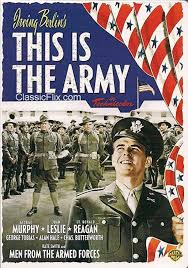
I have to admit, this movie is a true reflection of the times of the 1940s. Even with its Black Faced Skits in it that some will cringe seeing it. But what was the meaning back then?

This reproduction of a 1900 William H. West minstrel show poster, originally published by the Strobridge Lithographing Company, shows the transformation from a person of European descent to a caricature of a dark-skinned person of African descent.
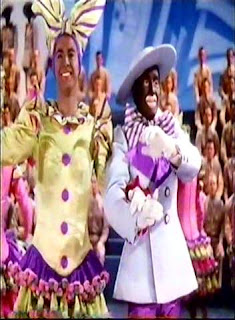
The minstrel segment was a part of the original “Yip, Yip, Yaphank” and Irving Berlin wanted it kept for the new show, despite attempts to persuade him that such entertainment was passé. The “Mandy” number performed by white men in blackface could have been performed without the minstrel makeup (as it was in “White Christmas” 1954). Performed with pretend glamor like something from a Ziegfeld show-stopper, it seems less exaggerated than the buffoonery of this scene in “Holiday Inn” discussed in this post.
When the men rush offstage, a pleased George Murphy says, “And you kids were worried about a minstrel number being too old fashioned. Why, it went just as well tonight as it did in the old show.” The words sound a bit hollow. This line might have been thrown in to appease Mr. Berlin, but the following number shows that if the minstrel scene wasn’t as painful to watch as the one in “Holiday Inn”, it was certainly made irrelevant by what followed.
The above is an exert from an excellent Description of the Movie-
https://anotheroldmovieblog.blogspot.com/2009/11/this-is-army-1943.html?m=1
The above site is well worth the read. But Watch the Movie for sure.
https://en.m.wikipedia.org/wiki/Blackface
But don’t fret, there are Black Actors in it too, even the great Boxing Champ Joe Louis-(Joe says, “I’m in Uncle Sam Army, and we on God’s side.”)
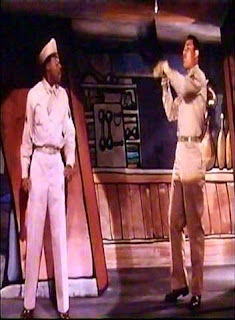
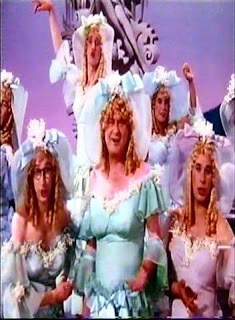
And the Drag Shows in it. Yes, you can say one is according to Today’s explanation of what is a Drag Show? Or not?
Drag shows are a form of entertainment in which female impersonators dress in elaborate costumes and makeup and perform singing or dancing. Some drag shows include comedy, skits and interaction with the audience.
But does Drag Show truly fit with this Movie?
Why is it called a drag show?
One suggested etymological root is 19th-century theatre slang, from the sensation of long skirts trailing on the floor. It may have been based on the term “grand rag” which was historically used for a masquerade ball. Some have suggested that drag stands for “dressed as a girl”.

What’s the Movie about?
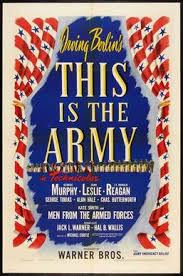
This Is the Army is a 1943 American wartime musicalcomedy film produced by Jack L. Warner and Hal B. Wallis and directed by Michael Curtiz,[5] adapted from a wartime stage musical with the same name, designed to boost morale in the U.S. during World War II, directed by Ezra Stone. The screenplay by Casey Robinson and Claude Binyon was based on the 1942 Broadwaymusical written by James McColl and Irving Berlin, with music and lyrics by Berlin. Berlin composed the film’s 19 song and sang one of them.
In World War I, song-and-dance man Jerry Jones is drafted into the US Army, where he stages a revue called Yip Yip Yaphank. It is a rousing success, but one night during the show orders are received to leave immediately for France: instead of the finale, the troops march up the aisles through the audience, out the theater’s main entrance and into a convoy of waiting trucks. Among the teary, last-minute goodbyes Jones kisses his newlywed bride Ethel farewell.
In the trenches of France, several of the soldiers in the production are killed or wounded by shrapnel from a German artillery barrage. Jones is wounded in the leg and must walk with a cane, ending his career as a dancer. Nevertheless, he is resolved to find something useful to do, especially now that he is the father of a son. Sgt. McGee and Pvt. Eddie Dibble, the troop bugler, also survive.
Twenty-five years later World War II is raging in Europe. Jerry’s son Johnny enlists in the Army shortly after Pearl Harbor. He tells his sweetheart Eileen Dibble that they cannot marry until he returns, since he doesn’t want to make her a widow.
Johnny reluctantly accepts an order to stage another musical, following in his father’s footsteps. The show goes on tour throughout the United States and eventually plays Washington, D.C., in front of President Roosevelt. During the show it is announced that this is the last performance: the soldiers in the production have been ordered back to their combat units.
Eileen, who has joined the Red Cross auxiliary, appears backstage. During a break in the show she brings a minister and persuades Johnny that they should marry now – which they do, in the alley behind the theater, with their fathers acting as witnesses.
Cast
- George Murphy as Jerry Jones
- Joan Leslie as Eileen Dibble
- Ronald Reagan as Corporal, later Lieutenant, Johnny Jones
- George Tobias as Maxie Twardofsky
- Alan Hale Sr. as Sgt. McGee
- Charles Butterworth as Eddie Dibble
- Dolores Costello as Mrs. Davidson
- Una Merkel as Rose Dibble
- Stanley Ridges as Maj. John B. Davidson
- Rosemary DeCamp as Ethel Jones
- Ruth Donnelly as Mrs. O’Brien
- John Princes Mendes as Corporal Mendes, magician
- Dorothy Peterson as Mrs. Nelson
- Gertrude Niesen as World War I vocalist
- Jack Young as Franklin D. Roosevelt (uncredited)
- As themselves:
- Irving Berlin
- Frances Langford
- Joe Louis
- Kate Smith
- Ezra Stone
So,if you can, pretend you are in 1943. And without any forethought of bigotry or other negative emotions, try and pop a large bowl of popcorn and then sit back and watch a great Movie. A Movie thus large with all of the dancing and singing and Super Sets didn’t happen overnight. America needed a Movie to help energize the War Recruitment and to make people feel good about a very scary War. Entire neighborhoods and schools were deserted of their eligible males who were Drafted or freely Joined the American War Effort.
Americans made tremendous sacrifices seldom discussed Today, but should be because We Cannot Forget 🌎 War 2 or We will be in 🌎 War 3.
During the Second World War, Americans were asked to make sacrifices in many ways. Rationing was not only one of those ways, but it was a way Americans contributed to the war effort.
When the United States declared war after the attack on Pearl Harbor, the United States government created a system of rationing, limiting the amount of certain goods that a person could purchase. Supplies such as gasoline, butter, sugar and canned milk were rationed because they needed to be diverted to the war effort. War also disrupted trade, limiting the availability of some goods. For example, the Japanese Imperial Army controlled the Dutch East Indies (today’s Indonesia) from March 1942 to September 1945, creating a shortage of rubber that affected American production.
On August 28, 1941, President Roosevelt’s Executive Order 8875 created the Office of Price Administration (OPA). The OPA’s main responsibility was to place a ceiling on prices of most goods, and to limit consumption by rationing.
Americans received their first ration cards in May 1942. The first card, War Ration Card Number One, became known as the “Sugar Book,” for one of the commodities Americans could purchase with their ration card. Other ration cards developed as the war progressed. Ration cards included stamps with drawings of airplanes, guns, tanks, aircraft, ears of wheat and fruit, which were used to purchase rationed items.
The OPA rationed automobiles, tires, gasoline, fuel oil, coal, firewood, nylon, silk, and shoes. Americans used their ration cards and stamps to take their meager share of household staples including meat, dairy, coffee, dried fruits, jams, jellies, lard, shortening, and oils.
 thelivingbreathingjamesbrown.com
You must be logged in to post a comment.