
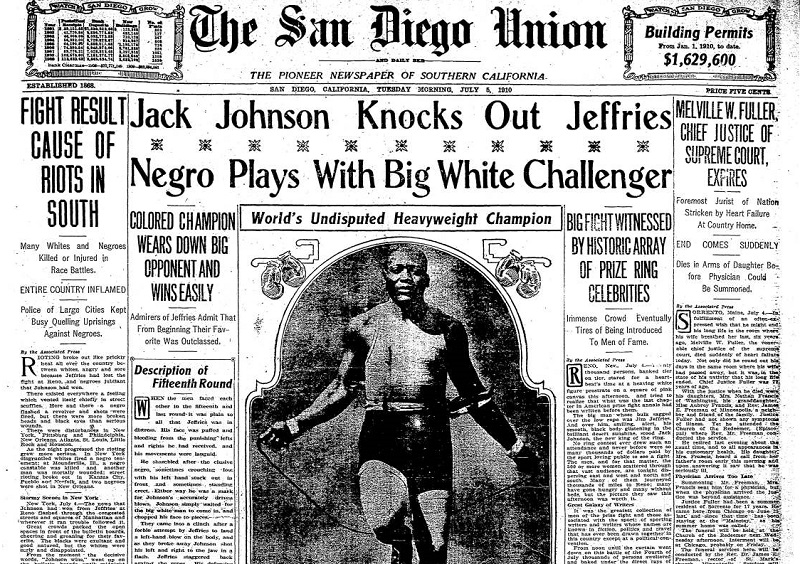
Immediately after, race riots broke out all over America. The dead were overwhelmingly black, and the violence precipitated calls to ban boxing in the United States. It would stand as the single worst day for race riots in American history until the unrest and violence of the late 1960’s. Johnson was afraid of no man.
White America was in Shock that their White Boy Champion was beaten by a Black Boxer. It was shocking of all the upheaval. But it happened. And few know about it. America is mostly concerned about Riots involving Minorities. But what happens when it is the Majority White Race? This had to be exceptionally scary. Unbelievably scary and frightening. 1910, White America went to rioting against the Black Person. All because of a boxing match…
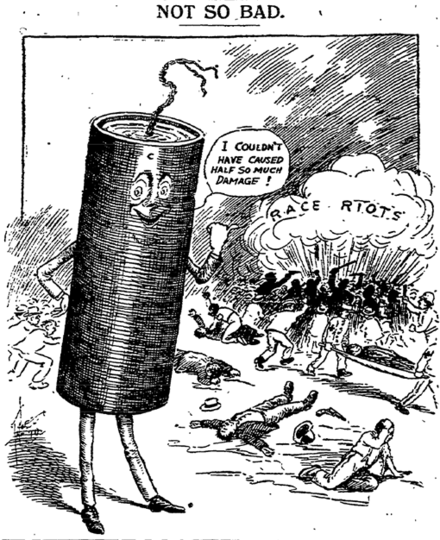

On July 7, 1910, the Los Angeles Times noted the explosive nature of Johnson’s victory by featuring this cartoon in which a stick of dynamite suggests that it would not have caused as much damage as the fight did.
The outcome of the fight triggered race riots that evening—the Fourth of July—all across the United States, from Texas and Colorado to New York and Washington, D.C., Johnson’s victory over Jeffries had dashed white dreams of finding a “great white hope” to defeat him. Many whites felt humiliated by the defeat of Jeffries.[19]
Blacks, on the other hand, were jubilant, and celebrated Johnson’s great victory as a victory for racial advancement. Black poet William Waring Cuney later highlighted the black reaction to the fight in his poem “My Lord, What a Morning”.[20]
Race riots erupted in New York, Baltimore, Pittsburgh, Philadelphia, New Orleans, Atlanta, St. Louis, Little Rock and Houston. In all, riots occurred in more than 25 states and 50 cities. At least 20 people were killed across the US from the riots,[21] and hundreds more were injured.[22][23][24][25][26][27][28][29][30][excessive citations]
https://en.m.wikipedia.org/wiki/Jack_Johnson_vs._James_J._Jeffries#Riots_and_aftermath
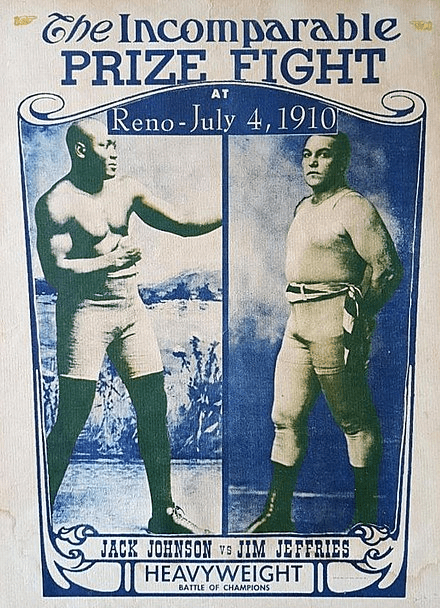
The Fight of the Century or the Johnson–Jeffries Prize Fight was a boxing match between the first African American World Heavyweight Champion of Boxing Jack Johnson and the previously undefeated World Heavyweight Champion James J. Jeffries on July 4, 1910, US Independence Day. It was highly significant in the history of race relations in the U.S., and led to the Johnson–Jeffries riots in which more than 20 people died.
https://en.m.wikipedia.org/wiki/Jack_Johnson_vs._James_J._Jeffries
Jack Johnson vs. James J. Jeffries fight.
The Fight of the Century was a boxing match between the first African American World Heavyweight Champion of Boxing Jack Johnson and the previously undefeated World Heavyweight Champion James J. Jeffries on July 4, 1910, US Independence Day. It was highly significant in the history of race relations in the U.S., and led to the Johnson–Jeffries riots in which more than 20 people died.
The fight was heavily anticipated, with betting odds significantly favoring Jeffries, who had come back from retirement for the fight. The lead-up to the bout was peppered with racist press against Johnson; author Jack London described Jeffries two days before the fight as “the chosen representative of the white race, and this time the greatest of them”, whilst a New York Times editorial wrote: “If the black man wins, thousands and thousands of his ignorant brothers will misinterpret his victory as justifying claims to much more than mere physical equality with their white neighbors.”
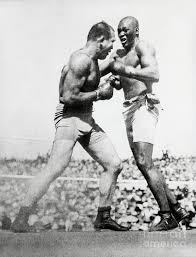
Johnson beat Jeffries in the fifteenth round, approximately one hour after the fight began at 1:30 pm PST. Jeffries—who boasted that he had never been knocked down in a fight—fell three times to Johnson’s punches, and was being counted out when his manager called the fight. Race riots broke out across the country over the following week—the first truly nationwide race riots in the history of the United States.
The fight was a watershed moment in American race relations, and it helped to solidify Johnson’s status as a symbol of black pride and defiance. It also led to a decline in Jeffries’ popularity, as he was seen by many as a symbol of white defeat.
Here are some additional details about the fight:
- The fight was held in Reno, Nevada, and was attended by over 20,000 spectators.
- The fight was broadcast live by radio, making it one of the first major sporting events to be broadcast live.
- The fight was estimated to have generated over $1 million in revenue, making it one of the most financially successful boxing matches of all time.
- The fight was also one of the most controversial boxing matches of all time, due to the racist rhetoric that surrounded it.
The Jack Johnson vs. James J. Jeffries fight was a significant event in American history, and it continues to be remembered today as a symbol of race relations in the United States.
Sources
thumb_upthumb_downuploadGoogle itmore_vert
Search related topics
search Https://en.m.wikipedia.org/wiki/Jack_Johnson_vs._James_J._Jeffries
Johnson–Jeffries riots were caused by a complex web of factors, including:
- Racial tensions. The United States was in the midst of a period of heightened racial tension at the time of the fight. Jim Crow laws were in effect in many states, and lynchings of African Americans were common. The fight was seen by many white people as a test of white supremacy, and Johnson’s victory was seen as a humiliation.
- The media. The media played a significant role in inciting the riots. Leading up to the fight, the press was filled with racist rhetoric, portraying Johnson as a threat to white womanhood and white supremacy. This rhetoric helped to create a climate of fear and resentment among white people, which made them more likely to riot after Johnson’s victory.
- The nature of the fight. The fight itself was seen by many as a spectacle of white defeat. Jeffries was a former heavyweight champion who had never been knocked out in a fight. His defeat at the hands of Johnson was seen as a sign of white weakness, which further inflamed racial tensions.
The Johnson–Jeffries riots were a dark chapter in American history. They were a reminder of the deep-seated racism that existed in the United States at the time, and they showed how easily violence can be sparked by racial tensions.
Jack Johnson was born in Galveston, Texas on March 31, 1878. He lived in Galveston until he was 16 years old, when he moved to New York City to pursue a career in boxing. However, he always considered Galveston to be his home, and he returned there often throughout his life.
Johnson was a complex and controversial figure, but he was also a significant figure in American history. He was the first African American to become heavyweight champion of the world, and his victory over James J. Jeffries in 1910 was a watershed moment in the fight for racial equality.
Johnson’s life and career were often overshadowed by his personal scandals, but he was a talented boxer and a charismatic figure. He was also a shrewd businessman, and he used his fame to promote himself and his causes.
Johnson died in Raleigh, North Carolina in 1946, but he is still remembered as one of the greatest boxers of all time. He is also remembered as a symbol of black pride and defiance, and his legacy continues to inspire people today.
THE MEDIA had a field day fueling the Ruit Flames. Here, look at some of these Newspaper Articles at the Library of Congress
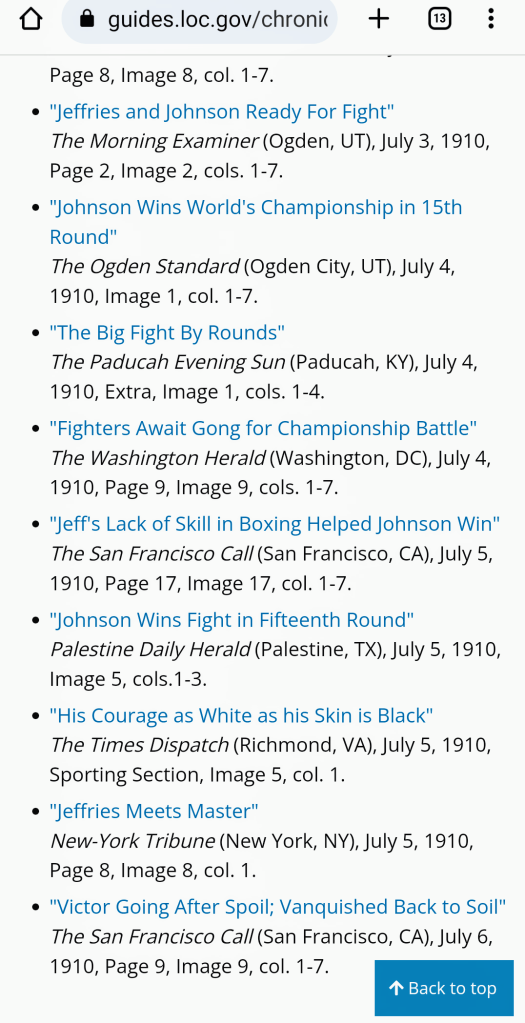
Articles entangled in White Man Privilege.
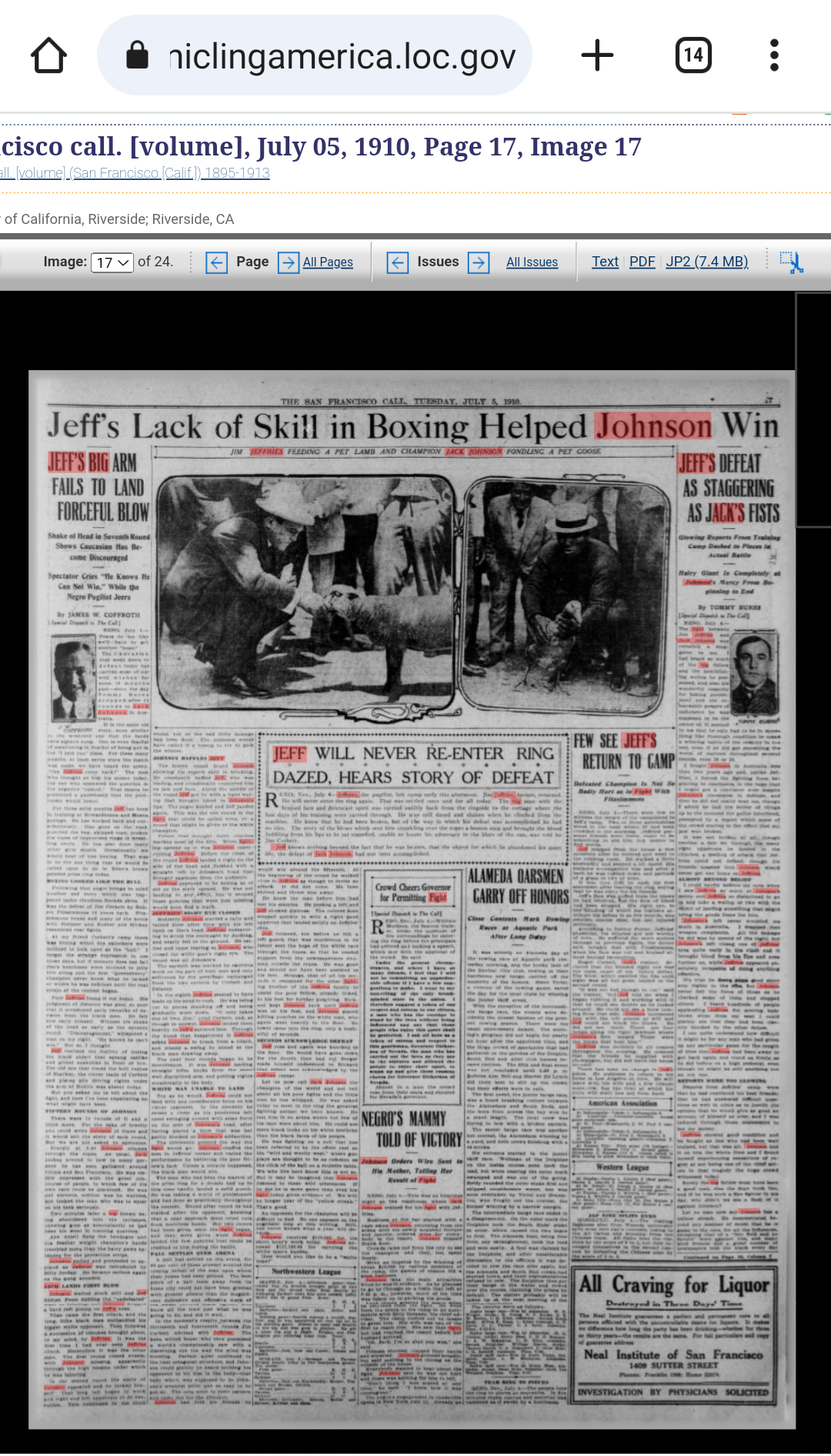
In below Newspaper Article, look at that one Title-
“NEGRO’S MAMMY TOLD OF VICTORY”

It’s all across America hidden from sight. Here’s an Article on New York Times
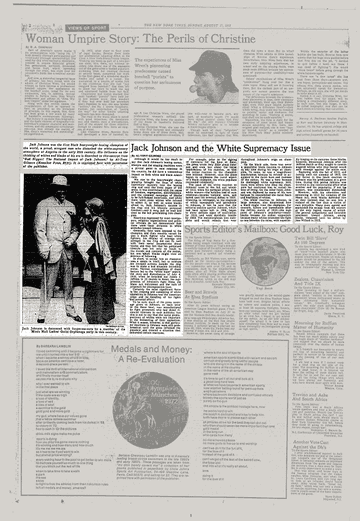
Read it. Opens your eyes doesn’t it? And that Hate still exists. Even today. Hate that exploded in 1910!
2023-1910=113 years ago.
Hopefully, you will take a moment and help sow the seeds of Peace and racial harmony. It starts and ends with a single individual. Please Join in saying now, Never Again will we take to the Streets to attack Blacks like they did in 1910. We do not need any of that Today.
Congress Members who stoke such Hateful Thoughts must be told to control their Mouths and get back to caring about all of us Americans. Not just their Party Only!
 thelivingbreathingjamesbrown.com
You must be logged in to post a comment.