
Most may have never heard of this great man, Cândido Mariano da Silva Rondon, out of Brazil. But in Brazil, he’s one of the Greatest of Men and his accomplishments are insurmountable and mind-boggling to think about. He is arguably the Greatest World Class Explorer EVER!
Cândido Mariano da Silva Rondon-
led explorations into the deepest and darkest of Jungles facing all manners of diseases, Malaria, unrelenting stinging and biting insects that cause feet to swell twice their size, Animals, Snakes, and even Hostile Indigenous People unknown to mankind until this one man took it upon himself to pursue that which seems impossible to most men and women Today. He is what Legends are made of. He is greater than himself.
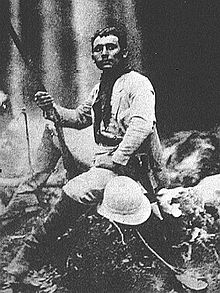
Most think that going to the North Pole or South Pole is all about Exploring. But immensely mounting Dangers and Dealing with one Crisis after another, purging thru darkened Jungles is unbelievable conditions is quite remarkable. Cândido Mariano da Silva Rondon did it and his exploits need the most congratulatory praise all of us can offer. Meeting and Dealing with Tribes of people that had never seen modern man with different languages and beliefs. But do you think you could muster up the courage to his level of Adventures? If you say Yes, I have to laugh as you have no clue how difficult a time the man and these explorations truly were. Far worse than you might ever consider. Here, I share Articles and even lost films from the Library of Congress that are exciting to view. But please come along and play our part in Cândido Mariano da Silva Rondon’s Lifetime Achievements. I am is awe of Cândido Mariano da Silva Rondon and an Aging President who did the impossible at his age by going along into the Wild. And his son too.
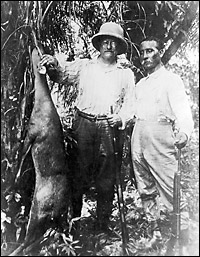
POTUS Theodore Roosevelt and approximately 100 men with Cândido Mariano da Silva Rondon as Leader went deep into the Amazon for 2500 miles beginning in Mid-December 1913 to April 1914. Mapping the River of Doubt.
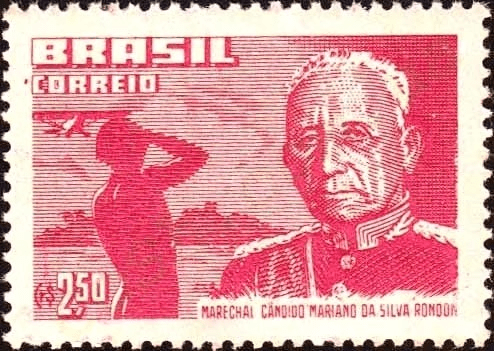
1958 Brazilian Stamp
https://www.npr.org/2005/11/03/4986859/tracing-roosevelts-path-down-the-river-of-doubt
https://en.m.wikipedia.org/wiki/C%C3%A2ndido_Rondon
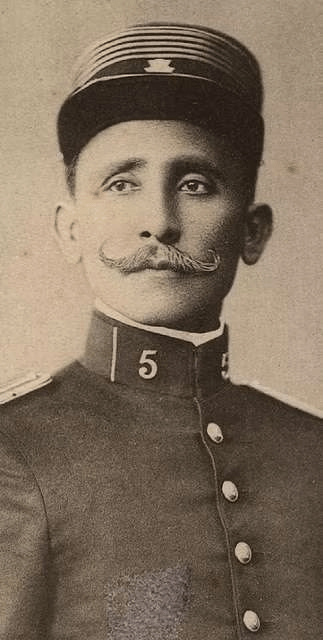
Cândido Mariano da Silva Rondon (1865-1958) was a Brazilian military officer, explorer, and champion of indigenous rights. He is best known for his work in opening up the Amazon rainforest to communication and development, while also protecting the native peoples who lived there.
Rondon was born in Mimoso, Mato Grosso, Brazil. He joined the Brazilian Army in 1881, and was soon assigned to the Telegraphic Commission, which was tasked with building a telegraph line across the Amazon. Rondon quickly became known for his skills as a frontiersman and his dedication to the indigenous peoples he encountered.
In 1913, Rondon led an expedition with U.S. President Theodore Roosevelt through the Amazon rainforest. The expedition was a success, and it helped to raise awareness of the plight of the indigenous peoples of the region.
After the expedition, Rondon became the first director of Brazil’s Indian Protection Service (SPI). The SPI’s MOTTO-
Die if you must, but kill never.
He served in this role for many years, and he worked tirelessly to protect the rights of indigenous peoples. He also helped to create the Xingu National Park, which is one of the largest protected areas in the Amazon rainforest.
Rondon was a true pioneer, and he helped to shape the course of Brazil’s history. He was a man of great courage and integrity, and he dedicated his life to the service of others. He is considered one of the most important figures in Brazilian history, and he is still revered by many people today.
Here are some of Rondon’s accomplishments:
- Led the Telegraphic Commission, which built a telegraph line across the Amazon rainforest.
- Led an expedition with U.S. President Theodore Roosevelt through the Amazon rainforest.
- Served as the first director of Brazil’s Indian Protection Service (SPI).
- Helped to create the Xingu National Park.
- Was awarded the Nobel Peace Prize in 1954.
Rondon was a true humanitarian, and he dedicated his life to helping others. He is an inspiration to us all, and his legacy will live on for many years to come.
As a result of Rondon’s competence in constructing telegraph lines, he was put in charge of extending the telegraph line from Mato Grosso to the Amazon. In the course of constructing the line, he charted the Juruena River (an important tributary of the Tapajós River in northern Mato Grosso) and, in addition, he made peaceful contact with the Nambikwara tribe, which had until then killed all Westerners they had come in contact with.[8] He also (in 1911) visited the ruins of the eighteenth century Real Forte Príncipe da Beira, the greatest historical relic of Rondônia, which had been abandoned in 1889, and was promoted as major of the Corps of Military Engineers, responsible for building the Cuiabá telegraph line to Santo Antonio do Madeira, the first to reach the Amazon region, which was called the “Rondon Commission”. His works developed from 1907 to 1915. At the same time, the Madeira-Mamoré Railroad was being built, which together with the Rondon telegraphic exploration and integration helped to occupy the region of the present state of Rondônia.
In May 1909, Rondon went on his longest expedition. He set out from the settlement of Tapirapuã in northern Mato Grosso heading northwest to meet up with the Madeira River, which is a major tributary of the Amazon River. By August, the party had eaten all of its supplies, and had to subsist on what they could hunt and gather from the forest. By the time they reached the Ji-Paraná River, they had no supplies. During their expedition they discovered a large river between the Juruena, and Ji-Paraná River, which Rondon named the River of Doubt. To reach the Madeira, they built canoes, and reached the Madeira on Christmas Day, 1909.
When Rondon reached Rio de Janeiro, he was hailed as a hero, because it was believed that he and the expedition had died in the jungle. After the expedition, he became the first director of the Brazilian Government’s Indian Protection Agency, or the SPI.
In September 1913, Rondon was struck by a poisoned arrow from the Nambikwara Indians. In 1914, with the Rondon Commission, he built 372 km of lines and five more telegraph stations: Pimenta Bueno, President Hermes, Presidente Pena (later Vila de Rondônia and present Ji-Paraná), Jaru and Ariquemes, in the area of the present state of Rondônia. On January 1, 1915, he completed his mission with the inauguration of the telegraph station in Santo Antônio do Madeira.
The 52nd meridian west is also a geographical reference for the history of communications in Brazil. Rondon was the second human being to receive in his honor a meridian in his name. He fulfilled missions by opening roads, clearing lands, launching telegraph lines, mapping the land, and establishing cordial relations with the Indians. He maintained contact with several indigenous peoples.
Part One
Part Two

At the end of the expedition, Roosevelt gave each of these laboring men on the Journey two Gold Sovereign. Worth about $685 Dollars each now or $1370.00
Expedition with Roosevelt
Main article: Roosevelt–Rondon Scientific Expedition
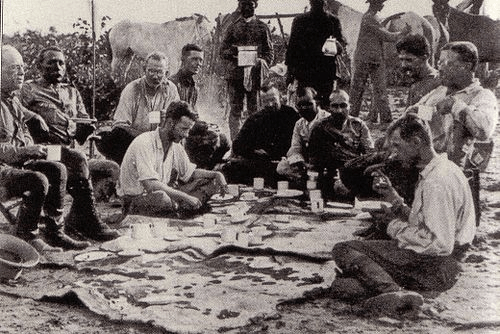
From left to right (seated): Father Zahm, Rondon, Kermit, Cherrie, Miller, four Brazilians, Roosevelt, Fiala. Photo taken in 1914.
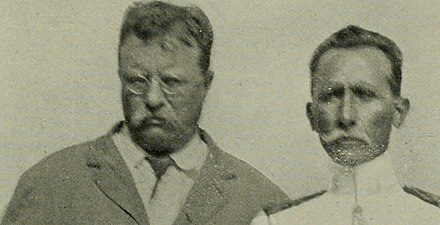
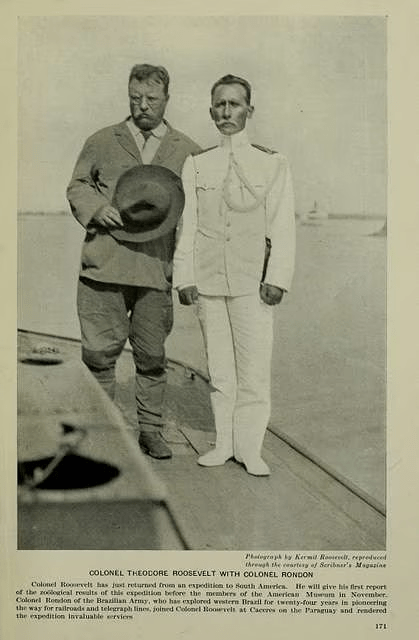
Theodore Roosevelt with Rondon
In January 1914, Rondon left with Theodore Roosevelt on the Roosevelt-Rondon Scientific Expedition, whose aims were to explore the River of Doubt. The expedition left the Tapiripuã, and reached the River of Doubt on 27 February 1914. They did not reach the mouth of the river until late April, after the expedition had suffered greatly. During the expedition, the river was renamed the Rio Roosevelt.
The Adventure down the River of Doubt was the most difficult of Roosevelt’s life. All the men except Rondon suffered from ailments and constant maladies. Roosevelt almost lost his life as Kermit, his son, almost lost his life as well.
https://en.m.wikipedia.org/wiki/Roosevelt%E2%80%93Rondon_Scientific_Expedition
The Roosevelt–Rondon Scientific Expedition (Portuguese: Expedição Científica Rondon–Roosevelt) was a survey expedition in 1913–14 to follow the path of the Rio da Dúvida (“River of Doubt”) in the Amazon basin. The expedition was jointly led by Theodore Roosevelt, the former President of the United States, and Colonel Cândido Rondon, the Brazilian explorer who had discovered its headwaters in 1909. Sponsored in part by the American Museum of Natural History, they also collected many new animal and insect specimens. The river was eventually named “Rio Roosevelt” for the former president. He nearly died during the voyage and his health was permanently damaged.[1]

After losing a bid for a third presidential term in the 1912 election, Roosevelt had originally planned to go on a speaking tour of Argentina and Brazil, followed by a cruise of the Amazon River organized by his friend Father John Augustine Zahm. Instead, the government of Brazil suggested that Roosevelt accompany famous Brazilian explorer Cândido Rondon on his exploration of the previously unknown River of Doubt, the headwaters of which had only recently been discovered. Roosevelt, seeking adventure and challenge after his recent electoral defeat, agreed. Kermit Roosevelt, Theodore’s son, had recently become engaged and did not plan on joining the expedition but did on the insistence of his mother Edith Roosevelt, in order to protect his father. The expedition started in Cáceres, a small town on the Paraguay River, in December 1913. They traveled to Tapirapuã, where Rondon had previously discovered the headwaters of the River of Doubt. From Tapirapuã, the expedition traveled northwest, through dense forests and then later through the plains on top of the Parecis plateau. They reached the River of Doubt on February 27, 1914. At this point, due to a lack of food supplies, the Expedition split up, with part of the Expedition, including Father Zahm and expedition quartermaster Anthony Fiala, following the Ji-Paraná River to the Madeira River. The remaining party – the Roosevelts, Colonel Rondon, American naturalist George Kruck Cherrie, and 15 Brazilian porters (camaradas) – then started down the River of Doubt.

Kermit Roosevelt, the President’s son who accompanied the River of Doubt Scientific Expedition.
https://en.m.wikipedia.org/wiki/Kermit_Roosevelt
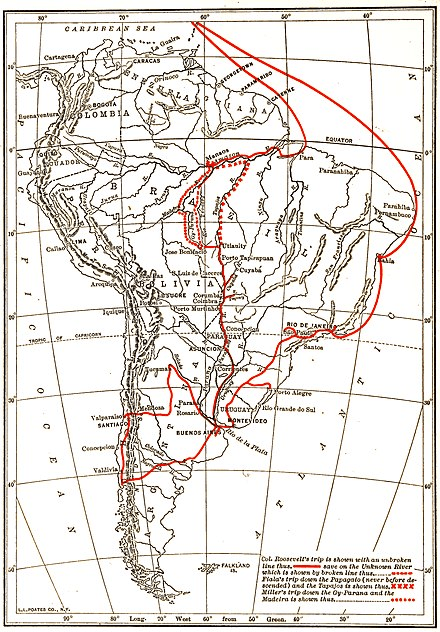
Map showing the complete route of the South American journey


Formerly called Rio da Dúvida (“River of Doubt”), the river is named after Theodore Roosevelt, who traveled into the central region of Brazil during the Roosevelt–Rondon Scientific Expedition of 1913–14. The expedition, led by Roosevelt and Cândido Rondon, Brazil’s most famous explorer and the river’s discoverer, sought to determine where and by which course the river flowed into the Amazon.[7]
Roosevelt and his son Kermit undertook the adventure after the former U.S. president’s failed attempt to regain the office as the “Bull Moose” candidate in 1912. The Roosevelt-Rondon expedition was the first non Amazonian-native party to travel and record what Rondon had named the “Rio da Dúvida”, then one of the most unexplored and intimidating tributaries of the Amazon. Sections of the river have impassable rapids and waterfalls, which hindered the expedition.
Roosevelt later wrote Through the Brazilian Wilderness recounting the adventure. After Roosevelt returned doubts were raised on his account of the expedition. Roosevelt promptly rebutted them in a public forum in Washington, D.C., sponsored by the National Geographic Society. In 1927 British explorer George Miller Dyott led a second trip down the river, independently confirming Roosevelt’s discoveries.[8]
Almost from the start, the expedition was fraught with problems. Insects and disease such as malaria weighed heavily on just about every member of the expedition, leaving them in a constant state of sickness, festering wounds and high fevers. The heavy dug-out canoes were unsuitable to the constant rapids and were often lost, requiring days to build new ones. The food provisions were ill-conceived forcing the team on starvation diets. The native Cinta Larga tribe shadowed the expedition and were a constant source of concern – the natives could have at any time wiped out the expedition and taken their valuable metal tools, but they chose to let them pass. (Future expeditions in the 1920s were not so lucky.)
Of the 19 men who went on the expedition, 16 returned. One died by accidental drowning in rapids (with his body never recovered), one was murdered and buried at the scene, and the murderer was left behind in the jungle; presumably swiftly perishing there.
By the time the expedition had made it only about one-quarter of the way down the river, they were physically exhausted and sick from starvation, disease, and the constant labor of hauling canoes around rapids. By its end, everyone on the expedition except for Colonel Rondon was either sick, injured, or both. Roosevelt himself was near death, having received a gash in his leg that had become infected, and the party feared for his life each day. Luckily, they came upon seringueiros (“rubber men”), impoverished rubber-tappers who earned a marginal living from the forest trees driven by the new demand for rubber tires for automobiles. The seringueiros helped the team down the rest of the river (less rapid-prone than the upper reaches). The expedition was reunited on April 26, 1914, with a Brazilian and American relief party led by Lieutenant Antonio Pyrineus, an officer from Rondon’s Telegraph Commission. The party had been pre-arranged by Rondon to meet them at the confluence with the Aripuana River, where they had hoped to emerge from the tributary. Medical attention was given to Roosevelt as the group returned to Manaus. Three weeks later, a greatly weakened Roosevelt made it home to a hero’s welcome in New York. His health never fully recovered after the trip, and he died less than five years later of related causes.[2]
https://www.britannica.com/biography/Candido-Rondon
Brazil, officially Federative Republic of Brazil, Portuguese República Federativa do Brasil, country of South America that occupies half the continent’s landmass. It is the fifth largest country in the world, exceeded in size only by Russia, Canada, China, and the United States, though its area is greater than that of the 48 conterminous U.S. states. Brazil faces the Atlantic Ocean along 4,600 miles (7,400 km) of coastline and shares more than 9,750 miles (15,700 km) of inland borders with every South American country except Chile and Ecuador—specifically, Uruguay to the south; Argentina, Paraguay, and Bolivia to the southwest; Peru to the west; Colombia to the northwest; and Venezuela, Guyana, Suriname, and French Guiana to the north. Brazil stretches roughly 2,700 miles (4,350 km) from north to south and from east to west to form a vast irregular triangle that encompasses a wide range of tropical and subtropical landscapes, including wetlands, savannas, plateaus, and low mountains. Brazil contains most of the Amazon River basin, which has the world’s largest river system and the world’s most-extensive virgin rainforest. The country contains no desert, high-mountain, or arctic environments.
 thelivingbreathingjamesbrown.com


You must be logged in to post a comment.