
Will the AMOC collapse eradicate Mankind?



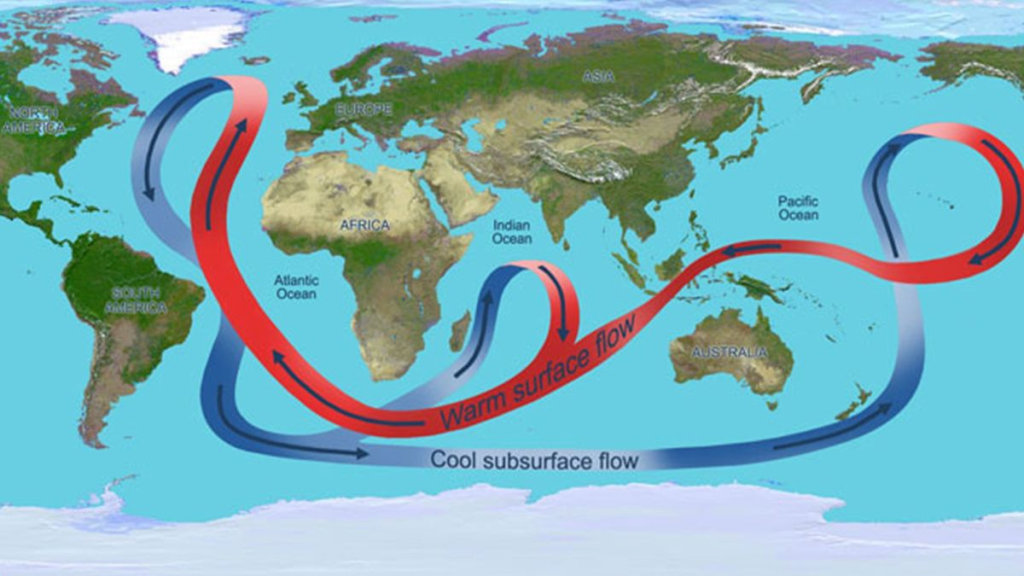
Learn this Quickly-The Atlantic Meridional Overturning Circulation (AMOC) is a major ocean current system that transports warm water from the tropics to the North Atlantic.
This warm water helps to keep Europe warm in the winter, and it also plays a role in regulating global climate.
If the AMOC were to collapse, it would have a number of negative consequences. These include:
- Cooler winters in Europe: The warm water that is currently transported by the AMOC would no longer reach Europe, which would lead to cooler winters in this region.
- Increased risk of drought in the Mediterranean: The AMOC also helps to bring moisture to the Mediterranean region. If the AMOC were to collapse, this would lead to an increased risk of drought in this region.
- Rising sea levels in the North Atlantic: The AMOC helps to transport warm water to the North Atlantic, which helps to keep the sea level in this region relatively stable. If the AMOC were to collapse, this would lead to a rise in sea levels in the North Atlantic.
- Changes in ocean currents that could disrupt marine life: The AMOC is a major driver of ocean currents. If the AMOC were to collapse, this would lead to changes in ocean currents that could disrupt marine life.
It is important to note that we don’t know for sure if or when the AMOC will collapse. However, the evidence suggests that it is becoming weaker, and that the risk of collapse is increasing.
The collapse of the AMOC would be a major climate disaster, and it would have a significant impact on people and ecosystems around the world. We need to take action to reduce our emissions and prevent this from happening.
Here are some things we can do to help. But have we been so overburdened with such for·bid·ding consequences and now, we simply choose to completely ignore them all? Things like:
- Reduce our energy use: We can reduce our energy use by making changes to our homes and businesses, such as weatherizing our homes, using energy-efficient appliances, and driving less.
- Drive less and walk, bike, or take public transportation more often: We can reduce our emissions by driving less and using more sustainable transportation options.
- Eat less meat and more plant-based foods: The production of meat is a major contributor to climate change. By eating less meat and more plant-based foods, we can reduce our impact on the environment.
- Support businesses that are committed to sustainability: We can support businesses that are committed to sustainability by shopping at these businesses and investing in their products and services.
- Get involved in our community and advocate for climate action: We can get involved in our community and advocate for climate action by contacting our elected officials, attending climate change events, and volunteering for organizations that are working to address climate change.
Like cows led to the slaughter, we are sickened in hearing these same prevention words over and over again.
But we can’t ignore the real Proof, can we?
- “AMOC decline inferred from observed changes in the meridional transport of heat across 26°N in the Atlantic.” (2022) by Zhang et al.
- “The Atlantic meridional overturning circulation: Past, present, and future.” (2021) by Rahmstorf et al.
- “Weakening of Atlantic overturning circulation linked to reduced freshwater export from the Arctic.” (2020) by Zhang et al.
These papers all provide evidence that the AMOC is weakening, and that the risk of collapse is increasing. They also discuss the potential consequences of an AMOC collapse, and the need for action to reduce our emissions and prevent this from happening.
Here are some other scientific papers that you may find interesting:
- “Projected 21st century changes in the Atlantic meridional overturning circulation.” (2018) by Ishii et al.
- “The Atlantic meridional overturning circulation in the twenty-first century: Insights from climate models.” (2017) by Sen Gupta et al.
- “The Atlantic meridional overturning circulation: A review of current status and projections.” (2016) by Johns et al.
The collapse of the Atlantic Meridional Overturning Circulation (AMOC) would not cause the world to collapse entirely. However, it would have a number of significant consequences that would affect people and ecosystems around the world. Bull Corn! This isn’t the mainstream view now with the new Studies.
Some of the most likely consequences of an AMOC collapse include:
- Cooler winters in Europe: The warm water that is currently transported by the AMOC would no longer reach Europe, which would lead to cooler winters in this region.
- Increased risk of drought in the Mediterranean: The AMOC also helps to bring moisture to the Mediterranean region. If the AMOC were to collapse, this would lead to an increased risk of drought in this region.
- Rising sea levels in the North Atlantic: The AMOC helps to transport warm water to the North Atlantic, which helps to keep the sea level in this region relatively stable. If the AMOC were to collapse, this would lead to a rise in sea levels in the North Atlantic.
- Changes in ocean currents that could disrupt marine life: The AMOC is a major driver of ocean currents. If the AMOC were to collapse, this would lead to changes in ocean currents that could disrupt marine life.
In addition to these direct consequences, an AMOC collapse could also have a number of indirect consequences, such as:
- Changes in agricultural yields: Cooler winters in Europe could lead to lower agricultural yields in this region.
- Increased risk of wildfires: Droughts in the Mediterranean region could increase the risk of wildfires in this region.
- Disruption of shipping routes: Changes in ocean currents could disrupt shipping routes in the North Atlantic.
The Real Truth? The collapse of the AMOC would be a major climate disaster, but it would not be the end of the world. Bull Corn! However, it would have a significant impact on people and ecosystems around the world, and we need to take action to prevent it from happening.
Here are some things we can do to help:
- Reduce our emissions: We can reduce our emissions by making changes to our homes and businesses, such as weatherizing our homes, using energy-efficient appliances, and driving less.
- Drive less and walk, bike, or take public transportation more often: We can reduce our emissions by driving less and using more sustainable transportation options.
- Eat less meat and more plant-based foods: The production of meat is a major contributor to climate change. By eating less meat and more plant-based foods, we can reduce our impact on the environment.
- Support businesses that are committed to sustainability: We can support businesses that are committed to sustainability by shopping at these businesses and investing in their products and services.
- Get involved in our community and advocate for climate action: We can get involved in our community and advocate for climate action by contacting our elected officials, attending climate change events, and volunteering for organizations that are working to address climate change.
THE TRUTH-
WE are sick of prevention words…here’s the jolly old Truth:
There is more research that reveals the potential horrors of an AMOC collapse. Scientists believe that it could lead to a “global climate catastrophe,” with devastating consequences for people and ecosystems around the world.
For example, a 2021 study by the Potsdam Institute for Climate Impact Research found that an AMOC collapse could cause a global average temperature drop of 2-3 degrees Celsius, which would lead to widespread crop failures, mass migrations, and other disruptions. The study also found that an AMOC collapse could increase the risk of extreme weather events, such as hurricanes, droughts, and floods.
Another study, published in the journal Nature Climate Change in 2022, found that an AMOC collapse could lead to a sea level rise of up to 2 meters in the North Atlantic. This would inundate coastal cities and towns, displacing millions of people.
The potential consequences of an AMOC collapse are truly horrifying. However, it is important to remember that these are just potential consequences. The actual impacts of an AMOC collapse would depend on a number of factors, such as the severity of the collapse and the rate at which it occurs.
It is also important to remember that we are not powerless to prevent an AMOC collapse. By reducing our emissions and transitioning to a clean energy economy, we can help to slow the pace of climate change and reduce the risk of an AMOC collapse.
The Above Article also discusses the possibility that an AMOC collapse could lead to a “global climate catastrophe.” This is a serious possibility, and it is important to take action to prevent it from happening.
The article concludes by calling for urgent action to reduce our emissions and transition to a clean energy economy. This is the best way to slow the pace of climate change and reduce the risk of an AMOC collapse. But they don’t hit us with Pie in our Face. Being treated as Adults goes a long way. Doesn’t it?
I agree with the article’s conclusion. We need to take action now to prevent an AMOC collapse. The future of our planet depends on it.
The above is a recent article from The Guardian that discusses a new study that suggests the Atlantic Meridional Overturning Circulation (AMOC) could collapse as early as 2025.
The new study, which was published in the journal Nature Climate Change, found that the AMOC has been weakening for the past few decades, and that it is now at its weakest point in at least 1,600 years. The study also found that the AMOC is more likely to collapse if global temperature continue to rise.
Hey, what’s gonna stop it? Man has made his bed and now, he must lie in it starting right now. It’s almost comical that everyone is racing around like ants living their lives and we worry about this or that and the End may be coming sooner than most had hoped. Or thought possible. None, 99% of 🇺🇸 or the 🌎 took the Ocean Current as being of any real concern. A great concern? Did you? And looks like it’ll be the biggest slap in our Faces in a hundred years.
 thelivingbreathingjamesbrown.com
You must be logged in to post a comment.