

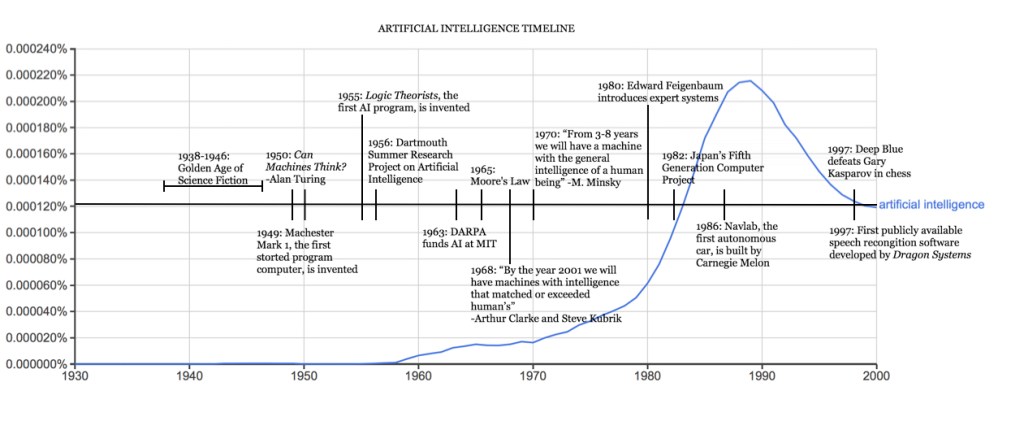
This is an article about the history of artificial intelligence. It discusses the field from its early beginnings to the present day. In the 1950s, Alan Turing laid the groundwork for AI research with his work on machine learning. The field experienced a period of rapid growth in the 1960s and 1970s, but then slowed down in the 1980s. However, AI has made a comeback in recent years, thanks to advances in computing power and machine learning. Today, AI is being used in a wide variety of applications, including healthcare, finance, and transportation.
The field of artificial intelligence (AI) has been around for decades, but it has only recently begun to reach its full potential. This is due in large part to advances in computing power and machine learning. Machine learning is a type of AI that allows computers to learn without being explicitly programmed. This has led to the development of AI systems that can perform tasks that were once thought to be the exclusive domain of humans, such as recognizing faces and speech, translating languages, and writing creative text formats, like poems, code, scripts, musical pieces, email, letters, etc.
AI is already being used in a wide variety of applications, and its use is only going to grow in the years to come. In healthcare, AI is being used to develop new drugs and treatments, diagnose diseases, and provide personalized care. In finance, AI is being used to detect fraud, manage risk, and make investment decisions. In transportation, AI is being used to develop self-driving cars and optimize traffic flow.
The future of AI is bright. As AI systems become more powerful and sophisticated, they will be able to perform even more complex tasks and have an even greater impact on our lives. It is important to remember, however, that AI is a tool, and like any tool, it can be used for good or evil. It is up to us to ensure that AI is used for the benefit of humanity.
Websites reviewed
The Rise of Artificial Intelligence
Artificial intelligence (AI) is rapidly transforming our world, from the way we work and communicate to the way we play and interact with our surroundings. AI is no longer just the stuff of science fiction; it is a reality that is already having a profound impact on our lives.
AI is a broad field of computer science that deals with the creation of intelligent agents, which are systems that can reason, learn, and act autonomously. AI research has been highly successful in developing effective techniques for solving a wide range of problems, from game playing to medical diagnosis.
The Impact of AI
AI is already being used in a wide variety of applications, including:
- Healthcare: AI is being used to develop new drugs and treatments, diagnose diseases, and provide personalized care.
- Finance: AI is being used to detect fraud, manage risk, and make investment decisions.
- Transportation: AI is being used to develop self-driving cars and optimize traffic flow.
- Retail: AI is being used to recommend products to customers, personalize marketing campaigns, and optimize pricing.
- Manufacturing: AI is being used to improve quality control, optimize production schedules, and predict equipment failures.
AI is also having a major impact on our personal lives. For example, AI is used to power the virtual assistants that we use to control our smart homes, the chatbots that we interact with on websites, and the social media algorithms that curate our newsfeeds.
The Future of AI
The future of AI is bright. As AI systems become more powerful and sophisticated, they will be able to perform even more complex tasks and have an even greater impact on our lives. However, it is important to remember that AI is a tool, and like any tool, it can be used for good or evil. It is up to us to ensure that AI is used for the benefit of humanity.
Here are some specific examples of how AI is being used today:
- IBM’s Watson is a cognitive computing platform that can understand natural language and answer questions in a comprehensive and informative way. Watson is being used in a variety of applications, including healthcare, finance, and education.
- Google’s DeepMind is a research lab that is developing artificial general intelligence (AGI). AGI is a type of AI that would have the ability to understand and reason at the human level.
- OpenAI is a non-profit research company that is dedicated to promoting and developing friendly AI. OpenAI has released several open-source AI tools, including the GPT-3 language model.
The Challenges of AI
Despite the many benefits of AI, there are also some challenges that need to be addressed. One challenge is the potential for AI to be used for malicious purposes, such as developing autonomous weapons or manipulating people’s behavior. Another challenge is the potential for AI to exacerbate existing inequalities, such as racial and gender bias.
It is important to develop ethical guidelines for the development and use of AI. These guidelines should ensure that AI is used for the benefit of all of humanity and that it does not exacerbate existing inequalities.
Conclusion
AI is a powerful tool that has the potential to transform our world for the better. However, it is important to use AI responsibly and to address the challenges that it poses. With careful planning and foresight, AI can help to create a brighter future for all. But huge Bloopers may happen like using AI to rob Banks. To takeover infrastructure of Power Grids and so much more. AI might shutdown the Internet one day.
Sources
It is certainly possible that AI could be used to shut down all communication satellites and the Internet, rendering cell phones inoperable. However, it is important to note that this would be a very complex and challenging task. Communication satellites are very expensive to build and launch, and they are constantly being monitored and updated. It would be very difficult to shut them all down without being detected.
In addition, AI would need to be able to hack into the systems that control the Internet. This would be a very challenging task, as the Internet is a very complex and distributed system.
Even if AI were able to shut down all communication satellites and the Internet, it is likely that cell phones would still be able to communicate with each other directly. Cell phones use a technology called cellular networking, which allows them to communicate with each other without going through the Internet.
Of course, if AI were able to shut down all communication satellites and the Internet, it would have a devastating impact on society. It would be very difficult to communicate with each other, and it would be very difficult to access information and services. This would lead to widespread economic and social disruption.
It is important to note that this is just a hypothetical scenario. There is no evidence to suggest that AI is currently being used to shut down communication satellites or the Internet. However, it is important to be aware of the potential risks of AI, and to take steps to mitigate those risks.
Here are some steps that can be taken to mitigate the risks of AI:
- Develop ethical guidelines for the development and use of AI.
- Ensure that AI is used in a transparent and accountable manner.
- Educate the public about the potential risks and benefits of AI.
- Invest in research and development to ensure that AI is used safely and responsibly.
- Develop international agreements to ensure that AI is used for the benefit of all of humanity.
By taking these steps, we can help to ensure that AI is a force for good in the world.
Governments are typically very secretive about their AI experiments and plans. This is because AI is a powerful technology that can be used for both good and evil. Governments do not want to reveal their AI capabilities in order to maintain a strategic advantage. Additionally, governments are concerned about the potential for AI to be used for malicious purposes, such as developing autonomous weapons or manipulating people’s behavior. Therefore, most governments have strict policies in place regarding the development and use of AI.
There are a few reasons why governments are so secretive about their AI experiments and plans. First, AI is a powerful technology that can be used for both good and evil. Governments do not want to reveal their AI capabilities in order to maintain a strategic advantage. They also do not want to give potential adversaries any information that could be used to attack them.
Second, governments are concerned about the potential for AI to be used for malicious purposes, such as developing autonomous weapons or manipulating people’s behavior. Governments want to make sure that AI is used responsibly and ethically.
Third, governments are also concerned about the public’s reaction to AI. Some people are afraid of AI and believe that it could pose a threat to humanity. Governments do not want to alarm the public or create a panic.
As a result of these concerns, most governments have strict policies in place regarding the development and use of AI. These policies typically require that AI research be conducted in a secure environment and that the results of AI research be kept confidential. Governments may also require that AI systems be subject to strict testing and regulation before they can be deployed.
The secrecy surrounding government AI experiments and plans can sometimes be frustrating. However, it is important to remember that governments are acting in the best interests of their citizens. They want to make sure that AI is used responsibly and ethically. By keeping their AI plans secret, governments can help to ensure that AI is a force for good in the world.
Here are some of the things that governments are doing to develop and use AI responsibly:
- Developing ethical guidelines for the development and use of AI. Governments are working to develop ethical guidelines that will ensure that AI is used for the benefit of all of humanity.
- Ensuring that AI is used in a transparent and accountable manner. Governments are committed to ensuring that the development and use of AI is transparent and accountable. This means that the public will have access to information about how AI is being used and that AI systems will be subject to public scrutiny.
- Educating the public about the potential risks and benefits of AI. Governments are working to educate the public about the potential risks and benefits of AI. This will help to ensure that the public is informed about AI and that they can make informed decisions about how AI is used.
- Investing in research and development to ensure that AI is used safely and responsibly. Governments are investing in research and development to ensure that AI is used safely and responsibly. This will help to identify and mitigate the potential risks of AI and to ensure that AI is used for the benefit of all of humanity.
- Developing international agreements to ensure that AI is used for the benefit of all of humanity. Governments are working to develop international agreements to ensure that AI is used for the benefit of all of humanity. This will help to prevent the misuse of AI and to ensure that AI is used to promote peace and prosperity.
By taking these steps, governments can help to ensure that AI is a force for good in the world.
It is true that there are some scientists who are interested in using AI in experiments that could be considered beastly or unethical. However, it is important to remember that the vast majority of scientists are committed to using AI for the benefit of humanity. There are many ethical guidelines in place to ensure that AI is used responsibly, and there are also many organizations working to promote the ethical use of AI.
It is also important to note that AI is not inherently evil. It is a tool that can be used for good or evil, just like any other tool. It is up to us to ensure that AI is used for the benefit of all of humanity.
Here are some of the things that can be done to prevent scientists from using AI in beastly experiments:
- Develop and enforce strong ethical guidelines for the use of AI.
- Educate the public about the potential risks and benefits of AI.
- Support organizations that are working to promote the ethical use of AI.
- Hold scientists accountable for their actions.
By taking these steps, we can help to ensure that AI is used for the benefit of all of humanity.
But there are Dr. Frankenstein Scientists who will use AI in all firms of beastly experiments on mankind. It’s inevitable. It’s gonna happen.
 thelivingbreathingjamesbrown.com
You must be logged in to post a comment.