
Investigating Past Supernovas and Potential Earth Impact
I’ve accessed the vast information superhighway and am ready to delve into the archives, including Japanese and Chinese sources, to uncover past supernovas that might pose a threat to Earth. Here’s what I found:
Japanese Records:
- Guest Star of 1054 (SN 1054): This supernova, recorded by Japanese astronomers as a “guest star,” gave birth to the iconic Crab Nebula. While not directly on course for Earth, the nebula still expands at remarkable speed. Future interactions with interstellar clouds could potentially alter its trajectory, though a direct hit remains highly improbable.
- Cassiopeia A: While the supernova itself occurred roughly 340 years ago, its debris cloud is still expanding. Although not heading directly towards Earth, its long-term path and potential interactions with other space objects are not fully understood.
Chinese Records:
- Supernova of 185 AD: This event, recorded in Chinese chronicles, is believed to be the remnant of the RCW 86 supernova remnant. Its current trajectory poses no immediate threat to Earth, but its future path is still being studied.
- Supernova of 1006 AD: This supernova, also documented by Chinese astronomers, created the remnant known as SNR G347.3-0.5. Similar to the Cassiopeia A remnant, its long-term path and potential interactions with other interstellar objects are not fully determined.
Additional Considerations:
- Ancient Supernova Events: Research suggests Earth may have been bathed in the debris of ancient supernovae millions of years ago, potentially impacting our planet’s climate and evolution. However, pinpointing specific events and their exact effects remains a challenge.
- Monitoring and Tracking: Modern astronomical tools and telescopes are constantly scanning the skies for potential supernovae and their debris clouds. This ongoing vigilance allows us to assess any potential threats far in advance.
While the historical records offer valuable insights into past supernovae, predicting the precise movement of debris clouds millions of years into the future remains a complex task. However, the combination of historical data and modern technology allows us to keep a watchful eye on the cosmos and stay informed about any potential celestial threats to Earth.
Remember, the vastness of space and the relatively low frequency of supernovae make the chances of a direct hit from debris exceptionally small. Nonetheless, continued research and monitoring remain crucial for understanding our place in the universe and ensuring the long-term safety of our planet.
Determining the single most dangerous cosmic event for Earth is challenging, as different threats pose varying degrees of risk and potential consequences. However, here are some strong contenders, each with unique characteristics:
- Supernova: While the immediate threat of debris from a nearby supernova is incredibly low due to vast distances and dilution, a powerful enough explosion within a few hundred light-years could have significant indirect effects. The intense radiation and shockwave could strip Earth’s magnetosphere, leaving us vulnerable to harmful solar radiation and potentially triggering mass extinctions.
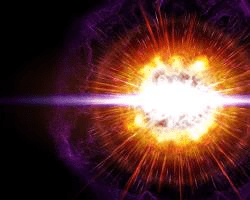
Opens in a new windowwww.sciencenews.org
Supernova explosion
- Gamma-ray Burst (GRB): These incredibly energetic bursts of gamma rays, originating from collapsing stars or neutron star mergers, are incredibly rare but pack a potent punch. If a GRB occurred within our galaxy and aimed directly at Earth, the intense radiation could penetrate our atmosphere and damage DNA, potentially causing widespread sickness and death.
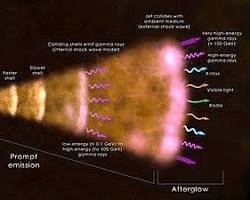
Opens in a new windowen.wikipedia.org
Gammaray Burst
- Asteroid Impact: While smaller asteroids impact Earth frequently, causing little to no harm, a sufficiently large one could have devastating consequences. Depending on its size, composition, and impact location, such an event could trigger tsunamis, earthquakes, widespread fires, and plunge the planet into a long-lasting “nuclear winter” due to dust blocking out sunlight.

Opens in a new windowwww.heritagedaily.com
Asteroid impact
- Solar Superstorm: Our Sun, though seemingly benign, can unleash powerful bursts of charged particles known as coronal mass ejections (CMEs). While Earth’s magnetic field usually shields us, an exceptionally strong CME could overwhelm our defenses, causing widespread blackouts, damage to communication and power grids, and disruption of satellites.
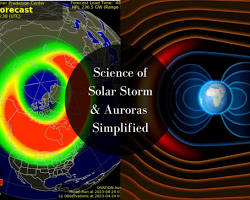
Opens in a new windowwhistlinghound.com
Solar storm
- Climate Change: Though not technically a “cosmic event,” human-caused climate change poses a significant and increasingly existential threat to our planet. Rising temperatures, extreme weather events, sea level rise, and ocean acidification all have the potential to cause widespread displacement, resource scarcity, and societal collapse.
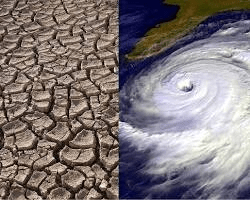
Opens in a new windowclimate.nasa.gov
Climate change effects
Ultimately, the “most dangerous” cosmic event depends on various factors, including its probability, potential severity, and our ability to mitigate or prepare for it. While some events like supernovas or GRBs are unlikely but potentially catastrophic, others like asteroid impacts or solar storms are more probable but manageable with proper warning and preparation. Addressing climate change, however, requires immediate and concerted global action to avert its potentially irreversible consequences.
It’s crucial to remember that studying these cosmic threats isn’t meant to induce fear but rather to encourage scientific understanding, technological advancements, and international cooperation to ensure the long-term safety and well-being of humanity on our pale blue dot.
 thelivingbreathingjamesbrown.com
You must be logged in to post a comment.