
Below are two images of Angels generated by Google’s Gemini AI. All other images and most words were done by the same. This write is not meant to offend but help us understand.

In Today’s free-spinning World of Multifaceted Interpretations of NEWS EVENTS makes it challenging to know How to Understand and even Feel? And let me Ask you this-

Has the Invasion into Ukraine by Russia and now, the War in Israel caused you moments of self-suffering? Or enraged, exasperated, fuming, furious, incensed, infuriated, irritated, livid, raging, and resentful?
Lush green Paradise with flowing rivers and fruits (Quran 56:21-23)

I know, too much War-related thoughts on our plates is not good for us. It’s hard to wrap our heads around the tremendous buildings being destroyed so quickly and seeing all of the Deaths and injuries. It hurts not being able to Stop the War. Wave Your Wand and Stop the War. No, nope, it just doesn’t work that way. And cutting off Aid is a huge suppository to swallow.
So, why can’t these Groups claiming to be Religious come out and Prove it. They cannot because they left God so far in the Dirt that God cannot get His Head above their Shit!
A dazzling night sky with constellations (Quran 81:1-2)

Hiding behind a BIBLE or QURAN and getting their Clergy to back you is a Dastardly foul JOKE against GOD. So, please don’t go there. God is Great and All Powerful. Only God decides what actually Happens, not you or I in either War. But here’s a look at the QURAN-
A towering mountain split open (Quran 89:20-22)

The Quran and Non-Violence: A Scholarly Exploration
The Quran, revered as the central religious text of Islam, presents a multifaceted perspective on the issue of violence and non-violence. While certain verses are often cited to justify defensive measures or particular historical contexts of conflict, the Quran also contains numerous passages advocating for peace, tolerance, and the preservation of human life. This scholarly investigation delves into the Quranic teachings on non-violence, dissecting key verses and interpreting them through the lens of renowned Islamic scholars.
Verses Promoting Peace and Coexistence:
- Quran 2:190 (English): “And fight in the way of Allah against those who fight you, but do not transgress limits [in aggression]; for Allah loveth not transgressors.” (Sahih International translation)
This verse is frequently invoked to validate defensive warfare, stressing the importance of restraint and proportionality in conflict. It delineates the boundaries within which Muslims are permitted to engage in defensive actions, cautioning against excessive aggression.

- Quran 60:8 (English): “Allah does not forbid you from dealing justly and kindly with those who fought not against you on account of religion and did not drive you out of your homes. Verily, Allah loves those who deal with equity.”
Highlighting the principles of fairness and benevolence, this verse urges Muslims to treat non-combatants, irrespective of their faith, with dignity and compassion. It counters the notion of religiously motivated hostility and advocates for harmonious coexistence based on mutual respect.
- Quran 29:46 (Arabic): وَلا تُفسِدُوا فِي الأَرضِ بَعْدَ إِصْلاحِهَا (Wa la tufsidee fil-ardi ba’da islahiha)
English Translation: “Do not corrupt the earth after it has been set in order.” (Sahih International translation)
This verse underscores the imperative of preserving societal order and stability, cautioning against actions that disrupt peace and harmony. It implies a rejection of wanton violence and emphasizes the importance of maintaining social cohesion.

Scholarly Interpretations:
- Imam Ibn Taymiyyah (d. 1328 CE): A preeminent Islamic scholar, Ibn Taymiyyah contended that warfare in Islam is permissible solely in self-defense or to combat oppression. He stressed the primacy of pursuing peace and reconciliation whenever feasible, underscoring the Quran’s overarching message of harmony and justice.
- Dr. Khaled Abou El Fadl (Contemporary scholar): An eminent authority on Islamic jurisprudence, Dr. Abou El Fadl advocates for a contextual approach to understanding Quranic verses pertaining to violence. He underscores the significance of historical context in interpreting early Islamic conflicts and underscores the contemporary relevance of prioritizing peaceful resolutions in line with Islamic principles.
Limitations:
While the Quran espouses principles of non-violence and peaceful coexistence, certain verses have been subject to varying interpretations, seemingly conflicting with the overarching message of harmony. These verses often address specific historical circumstances faced by the early Muslim community, necessitating nuanced scholarly analysis that considers contextual factors and the broader thematic coherence of the Quran.
In conclusion, the Quran offers a nuanced discourse on the interplay between violence and non-violence, advocating for the preservation of peace, justice, and the sanctity of human life. By examining key verses and engaging with scholarly interpretations, it becomes evident that the Quran serves as a reservoir of guidance for promoting non-violent conflict resolution and fostering harmonious relations among diverse communities.
Resources:
- The Holy Quran (Sahih International translation)
- “Islam and the Question of Violence” by Dr. Khaled Abou El Fadl
- “War and Peace in Islam: Historical and Legal Aspects” by Mohammad Hassan Khalil
- “The Sealed Nectar: The Life of the Prophet Muhammad” by Safiyyur Rahman al-Mubarakpuri
Sources:
- isogs.org/does-islam-teach-hatred-and-violence/
A calming seascape with gentle waves (Quran 16:1

The Questionable Actions by non-Religious Groups such as Hezbollah and HAMAS?
Hamas, as a Palestinian militant group and political organization, operates within a complex socio-political landscape shaped by historical grievances, territorial disputes, and aspirations for self-determination. While Hamas draws upon Islamic rhetoric and symbols to mobilize support and justify its actions, its approach to conflict and governance reflects a combination of religious ideology, nationalist aspirations, and pragmatic considerations.
- Political Objectives: Hamas emerged in the late 1980s amidst the Palestinian resistance movement, aiming to challenge Israeli occupation and assert Palestinian rights. Its primary goals include the establishment of an independent Palestinian state with Jerusalem as its capital, the right of return for Palestinian refugees, and the end of Israeli settlements in occupied territories. These objectives, rooted in Palestinian nationalism, often take precedence over religious considerations in Hamas’s decision-making.
- Utilization of Religious Rhetoric: While Hamas invokes Islamic principles to legitimize its struggle against Israel, its interpretation of Islam is contested and not universally accepted among Muslims. Hamas portrays itself as a defender of Palestinian Muslims against perceived Israeli aggression, framing the conflict in religious terms to mobilize support from both Palestinians and the broader Muslim world. However, critics argue that Hamas’s use of religion is selective and instrumental, serving its political agenda rather than adhering strictly to Islamic teachings.
- Pragmatic Considerations: Hamas’s tactics and strategies are influenced by pragmatic considerations, including military capabilities, regional dynamics, and diplomatic imperatives. The group has engaged in armed resistance, including rocket attacks and suicide bombings, as well as political efforts to gain international recognition and support. While some within Hamas may advocate for a more conciliatory approach, others prioritize armed struggle as a means of resisting perceived Israeli oppression and advancing Palestinian interests.
- Internal Dynamics: Hamas’s ideology and decision-making are also shaped by internal dynamics, including ideological divisions, generational shifts, and competition with rival Palestinian factions, such as Fatah. Within Hamas, there are differing views on issues such as governance, ceasefire agreements, and negotiations with Israel, reflecting a broader spectrum of perspectives within the organization.
- External Influences: External factors, including regional dynamics and international interventions, also impact Hamas’s behavior and strategic calculations. Relations with countries like Iran, Qatar, and Turkey, as well as interactions with other Islamist movements, shape Hamas’s alliances, funding sources, and geopolitical positioning. Additionally, efforts by external actors to mediate between Hamas and Israel, such as Egyptian-led ceasefire negotiations, influence the group’s decision-making regarding conflict escalation and de-escalation.
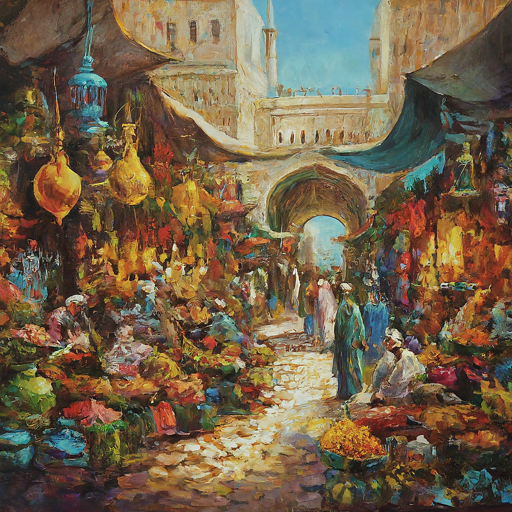
A marketplace bustling with merchants and goods (Quran 2:269)
In summary, Hamas’s approach to conflict and governance is multifaceted, shaped by a combination of political, ideological, pragmatic, internal, and external factors. While Islamic rhetoric and symbolism play a significant role in Hamas’s discourse and mobilization efforts, its actions are driven by a complex interplay of nationalist aspirations, strategic calculations, and organizational imperatives.

A vast garden with diverse flowers (Quran 55:66)

Helping Hand in Nature: A close-up of a helping hand formed by cascading sunlight through leaves, symbolizing God’s presence in the natural world.
 thelivingbreathingjamesbrown.com
You must be logged in to post a comment.