
To fully know, we must research the present, and dig deeply into the past. Some Question where the China-Taiwan Issue is headed? Good Question and it rests deeply in the meaningfulness of 2049 to the Chinese and especially, China’s Governing Body. 2049 when the People’s Republic of China (PRC) marks its centenary. It is a Chinese Dream of achieving the great rejuvenation of the Chinese nation. The Chinese Dream is to make the country strong. China’s armed forces take their dream of making the military strong as part of the Chinese Dream. Without a strong military, a country can be neither safe nor strong. In the new historical period, aiming at the CPC’s goal of building a strong military in the new situation, China’s armed forces will unswervingly adhere to the principle of the CPC’s absolute leadership, uphold combat effectiveness as the sole and fundamental standard, carry on their glorious traditions, and work to build themselves into a people’s military that follows the CPC’s commands, can fight and win, and boasts a fine style of work.
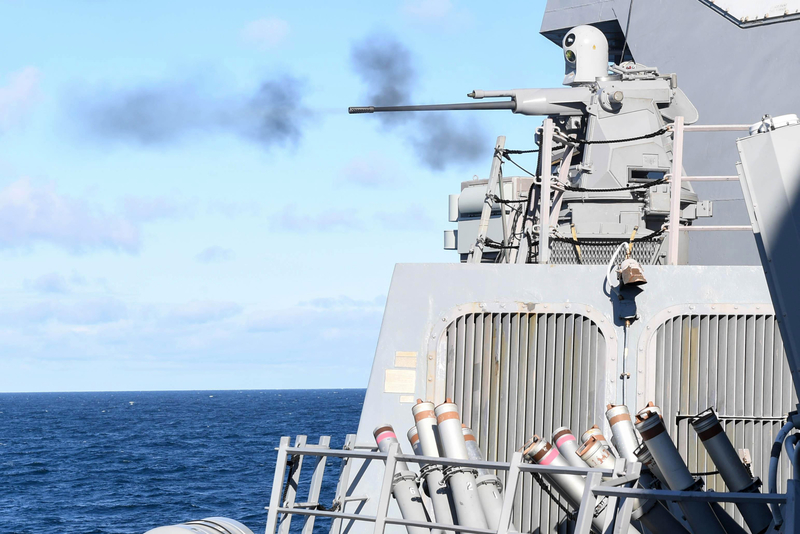
The largest, most Dominate Chinese Warships ever Displayed on the High Seas.

In the new circumstances, the national security issues facing China
https://english.www.gov.cn/archive/white_paper/2015/05/27/content_281475115610833.htm
In the upcoming years, several factors could influence the situation between China and Taiwan:
- China’s Rising Power: China’s growing economic and military might will likely continue to shape the region’s dynamics. This could lead to increased pressure on Taiwan, potentially through economic coercion or military intimidation.
- Taiwan’s Democratic Development: Taiwan’s continued democratic development and growing international recognition could further solidify its sense of identity and strengthen its resolve to maintain its autonomy.
- International Support: The level of international support for Taiwan, particularly from the United States, will be crucial in deterring any potential aggression from China. The US commitment to Taiwan’s security, whether through formal alliances or informal agreements, could play a significant role in shaping the future of the Taiwan Strait. Economic Interdependence: The economic interdependence between China and Taiwan could act as a stabilizing factor, as both sides benefit from trade and investment ties. However, any disruption to this economic relationship could escalate tensions.
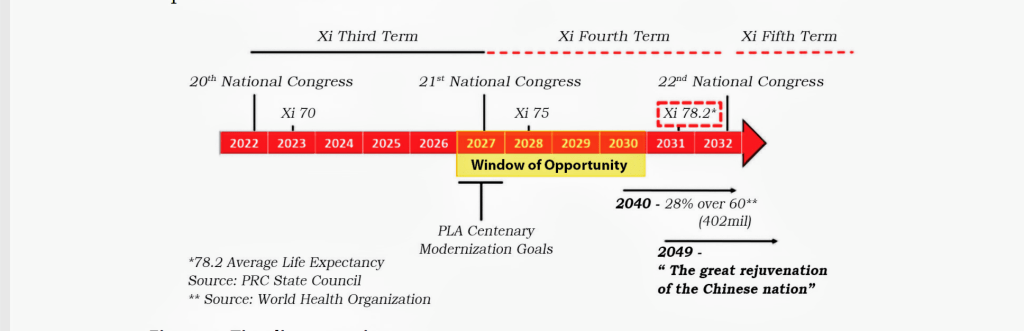
The Above Image is very important. It is a visual timeline for speeding-up the Taiwan Issue. Make no mistake, this Issue is not going away. It is barreling down the gun barrel and going to blow up right in the World’s Face.

China’s armed forces mainly shoulder the following strategic tasks:
— To deal with a wide range of emergencies and military threats, and effectively safeguard the sovereignty and security of China’s territorial land, air and sea;
— To resolutely safeguard the unification of the motherland;
— To safeguard China’s security and interests in new domains;
— To safeguard the security of China’s overseas interests;
— To maintain strategic deterrence and carry out nuclear counterattack;
— To participate in regional and international security cooperation and maintain regional and world peace;
— To strengthen efforts in operations against infiltration, separatism and terrorism so as to maintain China’s political security and social stability; and
— To perform such tasks as emergency rescue and disaster relief, rights and interests protection, guard duties, and support for national economic and social development.
The truest Statement:
“We will not attack unless we are attacked, but we will surely counterattack if attacked.”
But I question this statement because Chinese Forces attacked UN Forces without Warning in the Korean War. So, they will Attack First. 1940s & 1950s Ideas on how to deal militarily with certain situations still remain very embedded in Chinese Mentality. Only a person Ignorant of His History would ever disregard the previous already said.
Nuclear counterattack is a retaliatory strike with nuclear weapons in response to a nuclear attack. It’s a key concept in nuclear deterrence, the idea that the threat of mutually assured destruction (MAD) can prevent nuclear war.
There are two main types of nuclear counterattack:
- Second-strike capability: The ability to launch a nuclear strike after absorbing a first strike. This ensures that even if an enemy launches a surprise attack, they will face devastating retaliation.
- Counterforce strategy: Targeting an enemy’s nuclear weapons and delivery systems to disarm them and prevent further attacks.
Nuclear counterattack is a highly destructive and dangerous concept, and it’s essential to understand the potential consequences of such actions.
As of July 20, 2024, the United States has 3,748 nuclear warheads in its stockpile. This is an 88% reduction from the peak of 31,255 warheads in 1967. The United States has also dismantled 12,088 warheads since 1994, and about 2,000 more are scheduled for dismantlement.
The United States’ nuclear weapons are deployed in several ways, including:
- Strategic warheads: 1,419 strategic warheads are deployed on 662 delivery systems.
- Tactical warheads: 100 tactical warheads are deployed in Europe.
- Submarines: Some weapons are stored in submarines.
- Missile silos: Some weapons are stored in 80-foot-deep missile silos in the Great Plains.
- Air bases: Some weapons are stored at air bases and can be loaded onto long-range bombers.
The United States’ nuclear weapons infrastructure is managed by the National Nuclear Security Administration.
As of November 2024, the Federation of American Scientists (FAS) estimates that Russia has 1,710 deployed nuclear warheads:
- Land-based ballistic missiles: About 870
- Submarine-launched ballistic missiles: About 640
- Heavy bomber bases: Possibly 200
Russia’s nuclear arsenal also includes: About 5,580 nuclear warheads in total, About 1,200 retired warheads that are largely intact, About 4,380 stockpiled warheads, and 1000-2000 non-strategic nuclear warheads.
Russia’s nuclear arsenal is the largest in the world, accounting for 47% of the global stockpile. Russia and the United States have more than 90% of the world’s nuclear weapons combined.
Russia’s nuclear arsenal is growing, while the United States’ is shrinking. Russia suspended its participation in the New START arms reduction treaty in February 2022, but has vowed to abide by its limits until 2026.
According to recent Pentagon reports, China currently has over 500 operational nuclear warheads, which means that a significant number of nuclear weapons are likely pointed at China from other countries, primarily the United States and its allies; however, the exact number of weapons aimed specifically at China is not publicly disclosed due to the sensitive nature of military strategy.
Key points about China’s nuclear arsenal:
- Estimated size: Over 500 operational warheads
- Rapid expansion: The Pentagon reports that China is rapidly expanding its nuclear arsenal
- Projected future size: Some estimates suggest China could have over 1,000 nuclear warheads by 2030
Isn’t it just so gosh darn lovely and heartwarming seeing the Nuclear Weapons Count along with all of this Blog? And Trust This! It costs more to Keep these Nuclear Weapons Operational than to dismantle them. And America helped Russia get back on its feet by giving them money to dismantle so many if their Nuclear Weapons after the Soviet Union went Broke.
 thelivingbreathingjamesbrown.com
You must be logged in to post a comment.