
Legacy and Evolution of Birthright Citizenship in the United States: An Analysis of the Fourteenth Amendment
Abstract
Birthright citizenship, enshrined in the Citizenship Clause of the Fourteenth Amendment to the United States Constitution, has played a pivotal role in shaping national identity and the legal landscape of citizenship within the United States. This paper explores the historical context leading to the amendment’s ratification in 1868, its implications for citizenship, and its judicial interpretations through significant Supreme Court cases. In examining these elements, the paper also addresses ongoing debates surrounding the principles of birthright citizenship in contemporary America.
Introduction
The Fourteenth Amendment to the United States Constitution stands as a cornerstone of civil rights, fundamentally altering the landscape of American citizenship. Ratified in 1868, amidst the

tumultuous aftermath of the Civil War( April 12, 1861 – April 9, 1865) , it aimed to secure rights for formerly enslaved individuals and ensure that citizenship encompassed a broader demographic. The Citizenship Clause explicitly states:
“All persons born or naturalized in the United States, and subject to the jurisdiction thereof, are citizens of the United States and of the State wherein they reside.”
This provision guarantees that birth within U.S. territory automatically confers citizenship, a principle that has remained largely unchallenged until recent decades.
Historical Context
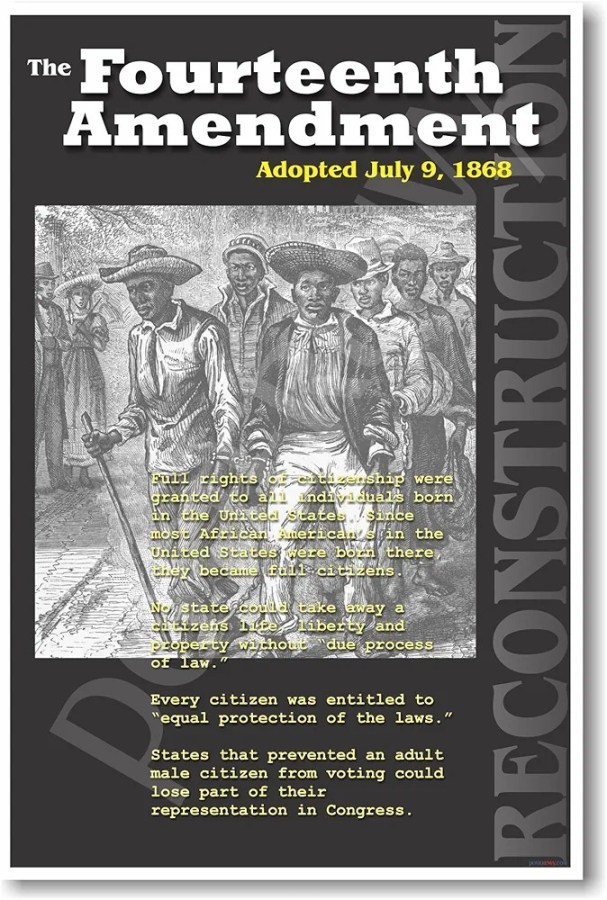
Before the ratification of the Fourteenth Amendment, citizenship in the United States was often restricted by race, class, and ethnicity. The Naturalization Act of 1790 exemplified this, allowing citizenship only to “free white persons.” Such limitations showcased the racial and ethnic boundaries that defined citizenship in early America. The exigencies of the Civil War highlighted the need for a legal framework that included newly freed enslaved individuals and their descendants. Thus, the Fourteenth Amendment was ratified as a response to these historical injustices.
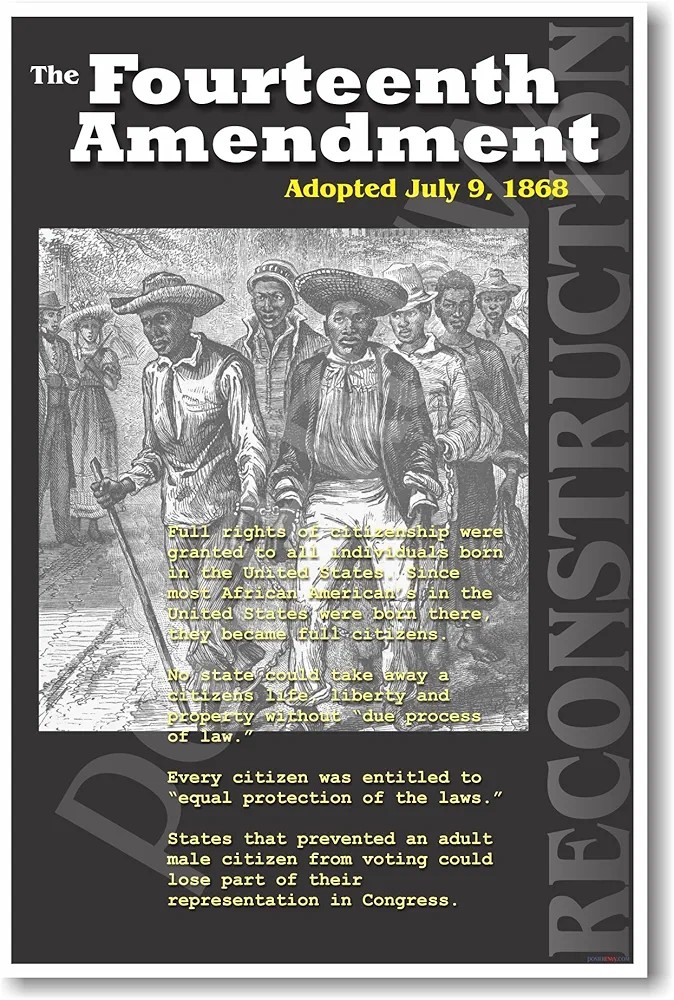
Below Classroom Poster is available at Amazon-
Birthright Citizenship: The Fourteenth Amendment
The Citizenship Clause effectively dismantled previous restrictions based on race or nationality. By asserting that all persons born on U.S. soil are citizens, this clause marked a significant expansion in the understanding of citizenship. This principle is rooted in the notion of jus soli, or right of the soil, which asserts that citizenship is granted by place of birth, regardless of parental citizenship status.
Exceptions to Birthright Citizenship
While the Fourteenth Amendment provides broad protections, there are exceptions. Notably, children born to foreign diplomats and, in some interpretations, to enemy soldiers during wartime, are not granted birthright citizenship. These exceptions highlight the nuanced application of the Citizenship Clause in specific contexts.
Judicial Interpretations
The principle of birthright citizenship has been upheld by the Supreme Court in various landmark cases. One of the most significant is United States v. Wong Kim Ark (1898), where the Court ruled that a child born in the United States to Chinese immigrant parents was indeed a U.S. citizen. This decision reaffirmed that the Citizenship Clause applies to all individuals born on American soil, irrespective of their parents’ immigration status.
The Ongoing Debate
Despite the constitutional guarantee of birthright citizenship, the principle has been contested in the political sphere, particularly in the last two decades. Movements advocating for its repeal argue that birthright citizenship encourages illegal immigration and burdens public resources. Nevertheless, the Supreme Court has consistently upheld the interpretation of the Fourteenth Amendment, reaffirming the significance of birthright citizenship in maintaining the United States’ commitment to inclusivity and equality.
Conclusion
The Fourteenth Amendment serves as a critical legal foundation for birthright citizenship, marking a significant evolution in the American understanding of citizenship. From its historical roots aimed at rectifying past injustices to its current standing amidst contemporary debates, birthright citizenship remains a pivotal topic in discussions about national identity in the United States. As the nation continues to grapple with issues of immigration and citizenship, the principles established by the Fourteenth Amendment will undoubtedly remain at the forefront of legal and societal discourse.
References
- United States Constitution, Amendment XIV – Citizenship Clause. Retrieved from constitution.congress.gov
- Wong Kim Ark, 169 U.S. 649 (1898). Retrieved from supreme.justia.com
- “Amdt14.S1.1.1 Historical Background on Citizenship Clause.” Constitution Annotated – Congress.gov. Retrieved from constitution.congress.gov
- “Chapter 3 – U.S. Citizens at Birth (INA 301 and 309).” USCIS. Retrieved from uscis.gov
- Naturalization Act of 1790. Retrieved from archives.gov
This paper outlines the critical aspects of birthright citizenship, highlighting its historical significance, judicial interpretations, and ongoing debates, making it essential for understanding citizenship in the United States today.
Repealing birthright citizenship in the United States would be a complex process. Birthright citizenship is primarily established by the 14th Amendment to the U.S. Constitution, which states that “all persons born or naturalized in the United States, and subject to the jurisdiction thereof, are citizens of the United States.” Here’s how the government could approach the repeal:
- Constitutional Amendment: The most straightforward way to repeal birthright citizenship would be through a constitutional amendment. This requires a two-thirds majority vote in both the House of Representatives and the Senate, followed by ratification by three-fourths (38 out of 50) state legislatures(Today, Republicans control 27 State Houses, while Democrats have control of 21). This is a challenging route due to the need for broad bipartisan support.
- Legislation: While a simple congressional act could not effectively repeal the 14th Amendment, Congress could pass laws defining “jurisdiction” to limit birthright citizenship. However, such laws would likely face significant legal challenges and might be deemed unconstitutional by courts.
- Judicial Interpretation: The government could seek a Supreme Court ruling to interpret the 14th Amendment in a manner that alters its application regarding birthright citizenship. This would require a legal case to reach the Supreme Court that challenges the current understanding.
- Executive Action: While an executive order could address policies related to immigration and citizenship practices, an executive order would not have the power to change the Constitution or effectively repeal the birthright citizenship established by the 14th Amendment.
- Public Campaign and Advocacy: Building public support for the repeal through advocacy groups could create political pressure for lawmakers to consider changes to citizenship laws. However, widespread public support is necessary to motivate legislative action.
Repealing birthright citizenship would encounter significant legal, political, and public hurdles, as it touches on fundamental constitutional principles and human rights issues.
Read a great book-





 thelivingbreathingjamesbrown.com
You must be logged in to post a comment.