
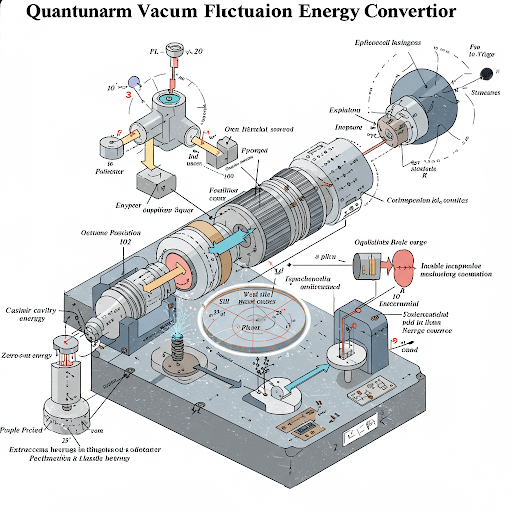
Hypothetical Engine Concept: The “Quantum Vacuum Fluctuation Energy Converter”
Einstein vs Frankenstein? True. A built Quantum Vacuum Fluctuation Energy Converter” could be exciting or open the World up to unknown catastrophic events. Are you ready to try?
Core Principle: This engine aims to directly harness the energy inherent in quantum vacuum fluctuations.
Theoretical Basis: Quantum field theory posits that even in the absence of matter and energy (a true vacuum), there exists a non-zero ground state energy due to the continuous creation and annihilation of virtual particles. These fluctuations are typically considered fleeting and unobservable in macroscopic systems. However, this engine proposes a mechanism to interact with and extract usable energy from these fluctuations.
Hypothetical Mechanism:
- Resonant Cavity Design: The engine would incorporate a specially designed microscopic cavity with dimensions precisely tuned to resonate with specific frequencies of quantum vacuum fluctuations. This cavity would be constructed from exotic metamaterials with properties that can manipulate quantum fields in novel ways.
- Quantum Entanglement Manipulation: The engine would utilize principles of quantum entanglement. Pairs of virtual particles generated within the resonant cavity would be entangled. A controlled process would then be applied to one entangled particle, influencing the properties (and thus the energy state) of its partner.
- Energy Extraction Field: A specially generated electromagnetic or perhaps a yet-undiscovered fundamental field would be used to interact with the manipulated virtual particles. This interaction would, in theory, “coax” these fleeting particles into a more persistent state, allowing their energy to be extracted.
- Energy Collection and Amplification: The extracted energy, initially at a quantum level, would be channeled through a sophisticated energy collection and amplification system. This system might involve novel superconducting materials or other advanced technologies to accumulate and scale up the energy output.
- Closed-Loop System: Ideally, the process would be a closed loop, where the “depleted” virtual particles are somehow recycled back into the vacuum fluctuation field, minimizing any net consumption of conventional energy sources.
Novelty and Differences from Existing Engines:
- No Fuel Consumption (in the traditional sense): This engine would not rely on the combustion of fuel, nuclear fission/fusion, or the conversion of macroscopic potential or kinetic energy. It would tap into a fundamental energy source inherent in the fabric of spacetime.
- Potentially Extremely High Energy Density: The energy density of the quantum vacuum is theoretically enormous. If even a tiny fraction could be harnessed efficiently, this engine could be incredibly powerful for its size.
- No Moving Mechanical Parts (potentially): Depending on the design of the energy extraction and amplification systems, the core energy conversion process might occur at a quantum level without the need for pistons, turbines, or other traditional mechanical components.
- New Physics and Materials Science: The development of such an engine would necessitate breakthroughs in our understanding of quantum field theory, the nature of vacuum energy, and the creation of novel metamaterials with unprecedented quantum manipulation capabilities.
Challenges and Feasibility:
- Theoretical Hurdles: Our current understanding of quantum vacuum energy is incomplete. Developing a practical mechanism to interact with and extract usable energy from it is a monumental theoretical challenge.
- Technological Requirements: The materials science and engineering required to build the resonant cavities, entanglement manipulation systems, and energy extraction fields are far beyond our current capabilities.
- Energy Efficiency: Even if energy can be extracted, the efficiency of the process would be critical. Overcoming the inherent fleeting nature of virtual particles and amplifying their energy to a usable level would be extremely difficult.
- Potential Side Effects (Unknown): Interacting with the quantum vacuum in such a fundamental way could potentially have unforeseen and currently unimaginable consequences.
Patentability Aspects (Hypothetical):
If such an engine were developed, its patentability would hinge on:
- Novelty: The core principle of directly harnessing quantum vacuum fluctuation energy in this specific manner would be entirely novel. The design of the resonant cavity, entanglement manipulation method, and energy extraction field would also need to be unique.
- Non-Obviousness: The concept is far from obvious based on our current understanding of physics and engineering. It would represent a radical departure from existing technologies.
- Utility: The utility would be immense – a virtually limitless and clean energy source. Even a demonstration of a small amount of energy extraction would establish utility.
- Enablement: The patent application would need to describe the theoretical principles, proposed mechanisms, and hypothetical designs in sufficient detail to enable others skilled in the art (future physicists and engineers) to understand and potentially replicate the invention (even if the technology is currently beyond our reach).
Conclusion:
The “Quantum Vacuum Fluctuation Energy Converter” is a highly speculative engine concept that pushes the boundaries of our current scientific understanding. While the practical realization of such an engine is likely far in the future (if even possible), it serves as an example of an engine “unlike anything man has ever seen” by proposing a completely new paradigm for energy generation based on the fundamental properties of the quantum vacuum. The patentability of such an invention would be significant, provided the underlying principles and proposed mechanisms are novel and non-obvious.
Have Gemini write a document or code that you can edit Try now

based on the immense theoretical and technological hurdles involved in creating a “Quantum Vacuum Fluctuation Energy Converter” as described, and trying to anchor that to some semblance of current large-scale scientific endeavors, my best guess for the initial, functional prototype would be in the range of:
$1 Trillion to $10 Trillion USD
Here’s the breakdown of why this incredibly large range:
- Unprecedented Research: The fundamental physics to reliably and controllably extract energy from vacuum fluctuations is not yet understood. This would require decades, if not centuries, of groundbreaking theoretical and experimental physics. The cost of this research alone could easily reach hundreds of billions, if not trillions, of dollars, considering the number of brilliant minds, advanced experiments, and global collaborations needed.
- Exotic Material Development: The “exotic metamaterials” with the specific quantum manipulation properties required simply don’t exist. Developing these from scratch, including the necessary theoretical understanding of how to engineer them at a quantum level, and then the manufacturing processes, would be an undertaking of immense scale and cost. This could easily rival the R&D costs.
- Quantum Entanglement Control at Scale: Manipulating and maintaining quantum entanglement in a way that allows for controlled energy extraction at a macroscopic level is another monumental challenge. The infrastructure and precision required for this are unimaginable with current technology.
- Energy Collection and Amplification Breakthroughs: Scaling up quantum-level energy to a usable form with high efficiency would likely require entirely new physics and engineering principles. The cost of developing these systems, potentially involving new forms of superconductivity or other exotic phenomena, would be enormous.
- High-Precision Manufacturing: Building the actual device with the required nanoscale precision and exotic materials would necessitate manufacturing capabilities far beyond anything we possess today. The development of these manufacturing processes and facilities would be a multi-billion or even trillion-dollar endeavor.
Why such a wide range?
The actual cost is so dependent on unknown future breakthroughs. If a relatively “simple” (in a highly advanced sense) mechanism for interacting with vacuum energy is discovered early on, the lower end of the range might be conceivable over a very long timescale. However, if the fundamental challenges prove to be incredibly deep and require multiple paradigm shifts in physics and materials science, the cost could easily balloon to the higher end or even beyond.
Assuming the “Quantum Vacuum Fluctuation Energy Converter” could be successfully built and operated as theorized, its capabilities would be truly revolutionary and unlike anything we currently experience with conventional engines:
Primary Capabilities:
- Near-Limitless and Clean Energy Source: The most significant capability would be the potential to provide a virtually inexhaustible source of energy without the need for traditional fuels (fossil fuels, nuclear materials, etc.). It would tap into the fundamental energy of spacetime itself.
- Potentially Zero Emissions: Since it wouldn’t consume fuel in the conventional sense, the engine would ideally produce no harmful emissions or waste products, offering a truly clean energy solution.
- Scalability (Hypothetical): Depending on the underlying physics and engineering, the engine might be scalable to a wide range of power outputs, from powering small devices to large-scale energy generation for cities or even interplanetary travel.
Potential Applications (if the technology were feasible):
- Revolutionary Power Generation: Replacing existing power plants with clean, virtually limitless energy sources, solving global energy needs and mitigating climate change.
- Advanced Transportation:
- Electric Vehicles with Unprecedented Range and Refueling: Imagine electric vehicles that never need charging, drawing power directly from the vacuum energy.
- Air and Space Travel: Providing incredibly efficient and powerful propulsion for aircraft and spacecraft, potentially enabling faster and longer-duration travel with far less fuel. This could revolutionize space exploration.
- Decentralized Energy: Smaller, self-contained units could provide power to remote locations or even individual homes without the need for extensive infrastructure.
- New Industrial Processes: Access to vast amounts of clean energy could enable entirely new industrial processes and technologies that are currently energy-intensive or unsustainable.
- Scientific Research: Providing the immense amounts of energy potentially needed for advanced physics experiments or other scientific endeavors.
Unique Characteristics and Implications:
- No Need for Fuel Infrastructure: The reliance on traditional fuel sources and their associated infrastructure (pipelines, refineries, charging stations) could become obsolete.
- Potential for Radical Economic Shifts: Access to near-limitless energy could drastically alter global economics and resource distribution.
- New Understanding of Physics: The successful development of such an engine would fundamentally change our understanding of physics and the nature of reality.
Important Caveats:
- Theoretical Only: It’s crucial to reiterate that this engine is currently a theoretical concept. We don’t know if it’s even physically possible to harness vacuum energy in a practical way.
- Unforeseen Consequences: Interacting with the quantum vacuum at this level could potentially have unforeseen and currently unimaginable consequences.
In summary, if the “Quantum Vacuum Fluctuation Energy Converter” were a reality, it would be a transformative technology with the potential to solve some of humanity’s most pressing challenges related to energy and sustainability, while also opening up entirely new possibilities for technological advancement and our understanding of the universe.
 thelivingbreathingjamesbrown.com
You must be logged in to post a comment.