
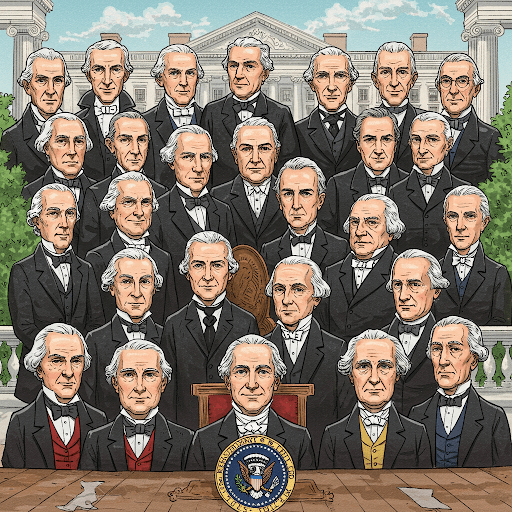
What every American is asking? How did every U.S. President do in their First 100 Days in Office? And there were recurring themes as well.
Recurring Themes:
- Economic Crises: The impact of economic downturns (Panics, Depressions, recessions) heavily influences public opinion.
- Wars and Conflicts: The handling of wars or major conflicts (Civil War, World Wars, etc.) is a critical factor.
- National Unity/Division: Presidents facing deep national divisions (slavery, civil rights, etc.) see polarized public opinion.
- Scandal and Corruption: Scandals can severely damage a president’s reputation and public trust.
- Transitions and Inherited Issues: Presidents inheriting difficult situations (assassinations, economic crises, wars) face unique challenges.
- Expansion and Territorial Issues: Especially in the 19th Century, westward expansion and territorial disputes heavily influence public opinion.
- Domestic Reforms: Large domestic programs and reforms greatly affect public sentiment.
- Foreign Policy: Foreign policy can greatly sway public sentiment.
Presidential Summaries:
- George Washington (1789):
- Summary: Focused on establishing the new government and national unity. 1 1. Presidency of George Washington – Wikipedia en.wikipedia.org
- Public Opinion: Overwhelmingly positive; national hero.
- John Adams (1797):
- Summary: Faced challenges with foreign relations (France) and domestic dissent (Alien and Sedition Acts).
- Public Opinion: Mixed and declining due to political divisions.
- Thomas Jefferson (1801):
- Summary: Emphasized agrarianism, limited government, and westward expansion (Louisiana Purchase).
- Public Opinion: Generally positive, especially after the Louisiana Purchase.
- James Madison (1809):
- Summary: Led the nation through the War of 1812.
- Public Opinion: Mixed during the war, improved afterward.
- James Monroe (1817):
- Summary: Ushered in the “Era of Good Feelings,” focused on national unity and the Monroe Doctrine.
- Public Opinion: Highly positive due to national harmony and expansion.
- John Quincy Adams (1825):
- Summary: Focused on national improvements and infrastructure, but faced political opposition.
- Public Opinion: Mixed; his vision was ambitious, but he struggled to gain widespread support.
- Andrew Jackson (1829):
- Summary: Ushered in a new era of populist politics, with a focus on expanding presidential power and removing Native Americans.
- Public Opinion: Polarized; strong support from his base, but significant opposition from established elites.
- Martin Van Buren (1837):
- Summary: Inherited the Panic of 1837, leading to economic hardship.
- Public Opinion: Declined rapidly due to the economic crisis.
- William Henry Harrison (1841):
- Summary: Died shortly after taking office; no significant policy actions in his first 100 days.
- Public Opinion: Initial high hopes cut short by his sudden death.
- John Tyler (1841):
- Summary: Became president after Harrison’s death; his policies differed significantly from the Whig agenda that elected Harrison.
- Public Opinion: Declined as he clashed with his own party.
- James K. Polk (1845):
- Summary: Focused on westward expansion (“Manifest Destiny”).
- Public Opinion: Mixed; supported by those favoring expansion, opposed by those concerned about slavery and war.
- Zachary Taylor (1849):
- Summary: Focused on the issue of slavery in newly acquired territories.
- Public Opinion: Mixed due to the divisive issue of slavery.
- Millard Fillmore (1850):
- Summary: Became president after Taylor’s death; supported the Compromise of 1850.
- Public Opinion: Mixed due to his role in the Compromise of 1850, which aimed to address but also inflamed tensions over slavery.
- Franklin Pierce (1853):
- Summary: His administration was marked by increasing tensions over slavery.
- Public Opinion: Declined due to his handling of the slavery issue.
- James Buchanan (1857):
- Summary: Presided over the escalating crisis leading to the Civil War.
- Public Opinion: Widely criticized for his perceived inaction.
- Abraham Lincoln (1861):
- Summary: Focused on preserving the Union as the Civil War began.
- Public Opinion: Initially divided, but grew in support as the war progressed and his leadership became evident.
- Andrew Johnson (1865):
- Summary: Focused on Reconstruction after the Civil War, leading to clashes with Congress.
- Public Opinion: Highly negative due to his Reconstruction policies and subsequent impeachment.
- Ulysses S. Grant (1869):
- Summary: Focused on Reconstruction and dealing with corruption.
- Public Opinion: Initially high due to his war hero status, but declined due to scandals within his administration.
- Rutherford B. Hayes (1877):
- Summary: His presidency began with the end of Reconstruction.
- Public Opinion: Mixed due to the controversial election and the end of Reconstruction.
- James A. Garfield (1881):
- Summary: Assassinated early in his term; no significant policy actions in his first 100 days.
- Public Opinion: Mourning and shock over his death.
- Chester A. Arthur (1881):
- Summary: Focused on civil service reform after Garfield’s assassination.
- Public Opinion: Initially skeptical, but gained respect for his commitment to reform.
- Grover Cleveland (1885):
- Summary: Focused on fiscal conservatism and limited government.
- Public Opinion: Mixed; praised by some for his principles, criticized by others for his policies.
- Benjamin Harrison (1889):
- Summary: Supported higher tariffs and federal spending.
- Public Opinion: Mixed; economic policies were debated.
- Grover Cleveland (1893) – Second Term:
- Summary: Dealt with the Panic of 1893.
- Public Opinion: Declined significantly due to the economic crisis.
- William McKinley (1897):
- Summary: Focused on economic recovery and expansionism.
- Public Opinion: Generally positive due to improving economic conditions and the Spanish-American War.
- Theodore Roosevelt (1901):
- Summary: Became president after McKinley’s assassination; focused on trust-busting and conservation.
- Public Opinion: Strong and enthusiastic support.
- William Howard Taft (1909):
- Summary: Continued some of Roosevelt’s policies but faced growing political divisions.
- Public Opinion: Declined due to his handling of tariff reform and conservation.
- Woodrow Wilson (1913):
- Summary: Implemented significant domestic reforms (“New Freedom”) and navigated the early stages of World War I.
- Public Opinion: Initially strong support for his reforms.
- Warren G. Harding (1921):
- Summary: Promised a “return to normalcy” after World War I.
- Public Opinion: Initially positive, reflecting the desire for stability.
- Calvin Coolidge (1923):
- Summary: Continued Harding’s pro-business policies and emphasized fiscal conservatism.
- Public Opinion: Generally positive during a period of economic prosperity.
- Herbert Hoover (1929):
- Summary: His presidency began with the stock market crash, leading to the Great Depression.
- Public Opinion: Plummeted due to his handling of the economic crisis.
- Franklin D. Roosevelt (1933):
- Summary: Faced the Great Depression and implemented the New Deal, focusing on economic recovery.
- Public Opinion: High approval ratings due to immediate action and optimism.
- Harry S. Truman (1945):
- Summary: Truman’s first days were marked by ending World War II and transitioning from wartime to peacetime policies.
- Public Opinion: Mixed; some appreciated his decisiveness, while others were uncertain about post-war challenges.
- Dwight D. Eisenhower (1953):
- Summary: Focused on the Korean War armistice and domestic stability.
- Public Opinion: Generally positive; Americans appreciated his leadership and calm demeanor.
- John F. Kennedy (1961):
- Summary: Launched initiatives like the Peace Corps; faced challenges with Cuba.
- Public Opinion: Strong support drawn from hope and an inspiring vision for America.
- Lyndon B. Johnson (1963):
- Summary: Entered office after JFK’s assassination; focused on civil rights and the War on Poverty.
- Public Opinion: High approval due to the ambitious Great Society programs and continuation of JFK’s legacy.
- Richard Nixon (1969):
- Summary: Focused on domestic issues and foreign policy, particularly Vietnam.
- Public Opinion: Initially positive, but soon declined due to rising tensions over the Vietnam War.
- Richard Nixon (1973) – Second Term:
- Summary: His second term was dominated by the Watergate scandal.
- Public Opinion: Collapsed due to the unfolding scandal.
- Gerald Ford (1974):
- Summary: Took office amidst Watergate; prioritized restoring trust in government.
- Public Opinion: Mixed; many were unsure of his ability to heal the national wounds.
- Jimmy Carter (1977):
- Summary: Emphasized human rights and energy conservation.
- Public Opinion: Initially positive; public interest in ethical governance.
- Ronald Reagan (1981):
- Summary: Advocated for tax cuts, deregulation, and a strong military.
- Public Opinion: Strong initial approval fueled by a charismatic persona and optimism.
- George H.W. Bush (1989):
- Summary: Focused on the end of the Cold War and the Persian Gulf War.
- Public Opinion: High approval after the Gulf War, but later declined due to economic concerns.
- Bill Clinton (1993):
- Summary: Focused on economic reform and health care.
- Public Opinion: Mixed; challenges with health care reform affected perceptions.
- George W. Bush (2001):
- Summary: His presidency began with the 9/11 attacks, shifting focus to national security.
- Public Opinion: High approval ratings immediately following 9/11, but later mixed due to ongoing conflicts.
- Barack Obama (2009):
- Summary: Inherited the financial crisis and focused on the Recovery Act.
- Public Opinion: High approval stemming from hope and recovery efforts.
- Donald Trump (2017):
- Summary: Enacted executive orders and promoted economic initiatives, including a tax overhaul.
- Public Opinion: Highly polarized; strong support among his base, but significant opposition.
- Joe Biden (2021):
- Summary: Focused on COVID-19 recovery, passing stimulus packages and infrastructure plans.
- Public Opinion: Strong approval initially due to pandemic response, though it fluctuated with economic challenges.
Conclusion:
The “First 100 Days” offer a fascinating glimpse into the immediate reactions to a new presidency. While each president faced unique circumstances, common threads emerge. Economic stability and national security are consistently major drivers of public opinion. The ability of a president to inspire confidence, take decisive action in the face of crises, and articulate a clear vision for the nation often correlates with higher initial approval. However, this early sentiment is not always indicative of long-term success, as unforeseen events and policy outcomes can significantly alter public perception throughout a president’s term.

 thelivingbreathingjamesbrown.com