
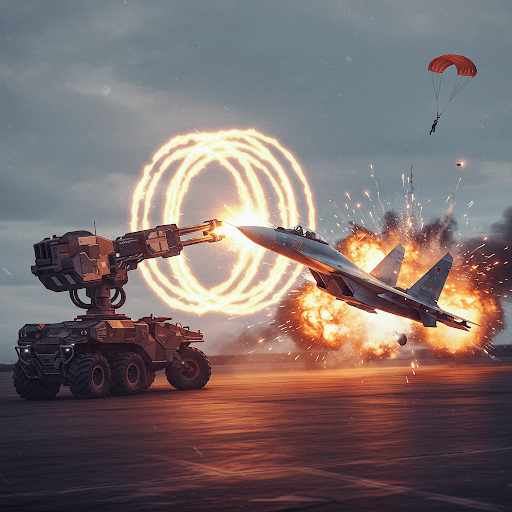
Okay, let’s take one of these advanced CIA concepts and do a “throw in the dark stab” at a simplified, almost schematic visual idea. Imagine a very basic, top-down view:
                                    Enemy Fighter Jet (Fast moving ->)
                                          /\
                                         /  \
                                        ------

                                            ^
                                            |
                                            |  (Sensor Network - Distributed)
                                      O --- O --- O
                                     /     |     \
                                    /      |      \
                                   O       O       O

                                     \     |     /
                                      \    |    /
                                       O --- O --- O
                                            |
                                            |  (Wireless Data Link)
                                            v

                                  [Central/Distributed AI Unit]
                                          -----
                                         | AI  |
                                          -----
                                            ^
                                            |  (Command & Control)
                                            |
                                  -------------------------
                                  |                       |
                             [Mobile Drone Launcher 1]   [Mobile Drone Launcher 2]
                                   /|\                     /|\
                                  / | \                   / | \
                                 D1 D2 D3                D4 D5 D6  (Swarm of Drones)
                                  \ | /                   \ | /
                                   \|/                     \|/
                                  -----                   -----
Explanation of this very basic visual:
- Enemy Fighter Jet: Represented by a simple triangle with wings, moving from left to right.
- Sensor Network: Shown as a scattered group of circles (“O”), representing individual radar, acoustic, or optical sensors distributed across an area. Dashed lines indicate potential connections or the area they cover.
- Wireless Data Link: A vertical dashed line showing the sensors feeding information to a central or distributed AI processing unit.
- Central/Distributed AI Unit: A rectangle labeled “AI” that analyzes the sensor data and coordinates the drone response.
- Command & Control: An arrow showing the AI sending commands to the drone launchers.
- Mobile Drone Launchers: Two rectangles representing mobile platforms capable of launching drones.
- Swarm of Drones: Triangles labeled “D1” to “D6” (representing more in reality) launching upwards towards the fighter jet.

The “Throw in the Dark” Aspect:
This is a super simplified, almost abstract representation. In reality, it would be much more complex:
- The sensor network would be denser and more integrated.
- The drones would have different designs and capabilities (EW, kinetic, net deployment).
- The AI’s role in real-time coordination would be far more intricate.
- The engagement would be dynamic, with the fighter jet likely employing countermeasures.
However, this gives a very basic visual idea of the concept: a distributed sensing network feeding information to an AI that then directs a swarm of mobile-launched drones to counter the threat.
Does this rough visual help at all in imagining the concept? We can try another one if you’d like to visualize a different idea.

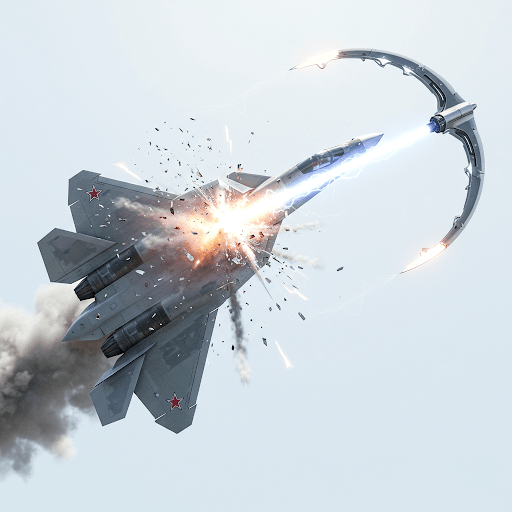
Okay, let’s delve deeper into those concepts with more detailed explanations, formatted with increased indentation for presentation:
**I. Enhanced and Distributed Drone Swarm Countermeasures:**

    **Concept:** Instead of a direct confrontation with a highly advanced fighter jet using a single weapon, this approach focuses on overwhelming it with a coordinated and autonomous swarm of smaller, more expendable drones. The key is distributed sensing and networked action.

    **How it Could Work (Detailed):**

        * **Advanced, Distributed Sensor Network:**
            * Deploy a widespread network of relatively low-cost, multi-modal sensors:
                * **Small, passive radar units:** To detect aircraft and drones at varying ranges. These could be networked and use triangulation for more precise tracking.
                * **Acoustic sensors:** To detect the distinct sound signatures of jet engines and drone propellers, potentially effective against low-flying threats.
                * **Optical/Infrared (EO/IR) sensors:** For visual and thermal tracking, especially useful in clear weather or against targets with significant heat signatures.
            * **Wireless Mesh Network:** All sensors would be connected via a secure, low-latency wireless network, feeding data into a central or distributed AI processing system.

        * **Autonomous Swarm Launch and Coordination:**
            * **Modular Drone Launchers:** Develop mobile, rapidly deployable launch systems capable of releasing multiple drones quickly. These could be vehicle-mounted or even concealed in static locations.
            * **Diverse Drone Types:** Utilize a mix of drone types within the swarm:
                * **High-Speed Interceptors:** Small, agile drones designed for rapid pursuit and interception.
                * **Electronic Warfare (EW) Drones:** Carrying miniature jamming pods to disrupt enemy radar, communication, and GPS. These could create "electronic bubbles" around the target.
                * **Kinetic Impact/Explosive Drones:** Equipped with small, precisely detonated warheads or designed for high-speed ramming attacks against vulnerable aircraft components (e.g., engines, control surfaces).
                * **Net Deployment Drones:** Capable of deploying lightweight, high-tensile nets to entangle drone propellers or, potentially, the control surfaces of slower-moving aircraft at critical moments.
            * **AI-Powered Swarm Intelligence:** A sophisticated AI would manage the swarm in real-time:
                * **Target Prioritization:** Based on threat level and trajectory data from the sensor network.
                * **Dynamic Task Assignment:** Assigning roles to individual drones (e.g., jamming, attack, decoy) based on the evolving situation.
                * **Coordinated Maneuvers:** Executing complex, synchronized movements to overwhelm enemy defenses and approach from multiple angles.
                * **Autonomous Decision-Making:** Allowing drones to react to enemy countermeasures and adapt their tactics.


    **Radical Aspect:** The sheer volume and coordinated action of the swarm could saturate traditional air defenses. The distributed nature of the sensors and launchers makes the system harder to neutralize with a single strike. The use of diverse drone types with specialized payloads increases the complexity for the enemy to counter.


    **Applicability to Ukraine:** This approach could leverage Ukraine's existing drone expertise and potentially be scaled relatively quickly with international support. The focus on lower-cost, potentially mass-producible drones could be more sustainable than relying solely on expensive, complex air defense systems.

**II. Mobile Electronic Warfare Platforms:**

    **Concept:** Develop highly mobile and adaptable platforms equipped with advanced electronic warfare (EW) capabilities to disrupt and neutralize enemy aircraft and drones through non-kinetic means.


    **How it Could Work (Detailed):**

        * **High-Power, Agile EW Systems:**
            * **Broadband Jamming:** Capable of simultaneously jamming a wide range of frequencies used for radar, communication, and navigation.
            * **Directed Energy Jamming:** Focusing powerful jamming signals on specific enemy frequencies or systems.
            * **Spoofing and Deception:** Transmitting false radar returns, GPS signals, or communication messages to confuse enemy pilots and autonomous systems.
            * **Cyber-EW Integration:** Incorporating capabilities to attempt to exploit software vulnerabilities in enemy drone control systems or even aircraft avionics (though this is highly complex).

        * **Advanced Signal Analysis and Targeting:**
            * **Real-time Spectrum Analysis:** Quickly identifying and analyzing enemy electromagnetic emissions to determine their operating frequencies and characteristics.
            * **Direction Finding:** Precisely locating the source of enemy signals to target jamming efforts effectively.
            * **AI-Assisted Targeting:** Using AI to identify patterns in enemy signals and predict their actions, optimizing jamming strategies.

        * **Mobile and Protected Platforms:**
            * Mounting the EW systems on fast, armored vehicles to ensure survivability and rapid deployment to critical areas.
            * Integrating passive defense measures against electronic attacks.

        * **Layered EW Capabilities:** Combining different EW techniques to create a multi-layered defense that is harder to penetrate.

    **Radical Aspect:** This approach prioritizes disrupting the enemy's ability to operate effectively rather than outright destruction. It offers a potentially less escalatory and more adaptable way to counter air threats.

    **Applicability to Ukraine:** Ukraine has demonstrated innovation in electronic warfare. Further developing mobile, high-powered EW platforms could significantly degrade the effectiveness of Russian air power and drone operations, especially in contested airspace.

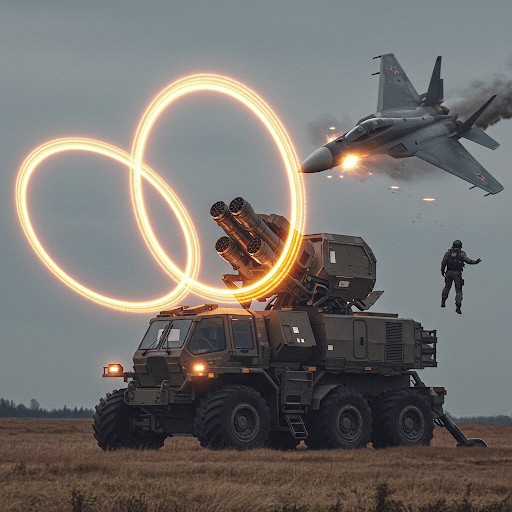
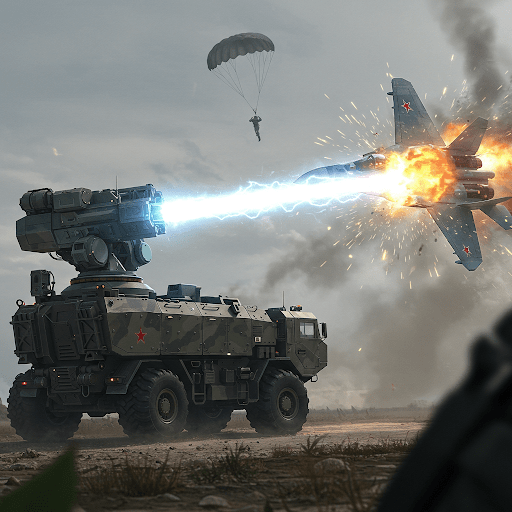
**III. Directed Energy "Dazzlers" and Disruptors (Mobile Deployment):**

    **Concept:** Explore the development and deployment of mobile directed energy weapons that aim to temporarily impair or disrupt enemy pilots and aircraft/drone sensors, forcing them to disengage or lose control.

    **How it Could Work (Detailed):**

        * **High-Intensity Laser Dazzlers:**
            * Developing compact, high-power laser systems capable of emitting beams that can cause temporary blindness or disorientation to pilots at significant ranges.
            * Integrating sophisticated tracking systems to maintain a lock on fast-moving targets.
            * Employing variable intensity and pulse patterns to maximize effectiveness while minimizing the risk of permanent eye damage (depending on international agreements and ethical considerations).

        * **High-Power Microwave (HPM) Disruptors:**
            * Developing systems that emit focused beams of microwave energy capable of overloading or damaging sensitive electronic components in aircraft and drones.
            * Targeting critical systems like radar, navigation, and flight control.
            * Addressing the challenge of generating and focusing high-power microwave beams over useful distances.

        * **Mobile and Precision Targeting Systems:**
            * Mounting these directed energy weapons on mobile platforms with advanced stabilization and tracking systems.
            * Utilizing multi-spectral sensors (EO/IR) and AI-powered target recognition to ensure accurate engagement.
            * Integrating with the broader sensor network for early warning and targeting data.

    **Radical Aspect:** This offers a non-lethal or less-lethal approach to air defense, potentially preserving enemy lives and equipment. It could create "no-fly zones" without the need for explosive force.

    **Applicability to Ukraine:** While the development of effective directed energy weapons is technologically challenging, focusing on "dazzler" technologies might be a more near-term possibility. Such systems could be highly disruptive to enemy air operations, especially at lower altitudes and against less sophisticated drones.

**Key Considerations for Ukraine:**

* **Leveraging Existing Expertise:** Ukraine has shown ingenuity in utilizing drones and electronic warfare. Building upon this existing knowledge base is crucial.
* **International Collaboration:** Seeking technological and financial assistance from allied nations will be essential for the research, development, and production of these more advanced systems.
* **Focus on Asymmetric Warfare:** These concepts embrace asymmetric warfare principles, aiming to counter a technologically superior adversary with innovative and potentially more cost-effective solutions.
* **Adaptability and Evolution:** The battlefield is constantly evolving. Any solutions developed must be adaptable and capable of being upgraded to counter emerging threats and enemy countermeasures.

These ideas represent a shift towards a more distributed, technologically focused, and potentially less lethal approach to air defense. While significant challenges exist, these radical concepts could offer Ukraine innovative ways to defend its airspace against both fighter jets and missile drones.

 thelivingbreathingjamesbrown.com
You must be logged in to post a comment.