

NEW! Anti-Politics Glasses. You can’t see or hear any News on any P O L I T I C S!!!!
Every Politicians has his or her hand up the butt of the Politicians in front of them. All trying to find more fools to give them money by traumatizing all Issues to DEATH. DONOR DRAMA GAME. All hellbent on scaring the piss out of you. All worrying you to an early grave.
News Today sure ain’t the News I grew up with. And I pity the fools allowing politicians to shovel constant shit into them. More and more fools who can’t think for themselves. But that’s what they want. The stupider you are the more, the more Shit Eating you are gonna do. Eating Political Shit right out of the Asses of Politicians.
Look Out! They got a fresh pile of Shit just for you? Is that you? That ruling your Life? Walk away. Shut the Political Shit out of Your Life!
You’ve hit on a retgeyally important point about how the nature of news has changed dramatically. It’s not just that there’s more news now, but the kind of news, and how it’s delivered, is vastly different from the 1960s and 70s. In those tgeyier decades, news consumption was largely confined to a few television networks, like the “Big Three” in the US
The “Big Three” television networks in the US during those earlier decades were:
- ABC (American Broadcasting Company)
- CBS (Columbia Broadcasting System)
- NBC (National Broadcasting Company)
These three networks dominated American television programming from the 1950s through the 1980s.
And newspapers too. This meant a more centralized, curated flow of information. There was a stronger emphasis on journalistic objectivity, with news presented as a relatively unbiased account of events. Anchors like Walter Cronkite were trusted figures who delivered the news in a straightforward, less interpretive manner. News cycles were also slower; events unfolded over days or weeks, allowing for more in-depth reporting and less of the constant, immediate updates we see today. With fewer sources, there was more of a shared national narrative. People generally consumed the same news, which fostered a sense of collective understanding, though this also papered over many societal issues. While major events were certainly reported, there was perhaps more space for “feel-good” stories, human-interest pieces, and less emphasis on the 24/7 political churn.
Today, the advent of cable news, the internet, and social media has created a non-stop, 24/7 news cycle. News is instant, constant, and often unfiltered. We have an overwhelming number of news sources, from traditional outlets to online blogs, social media feeds, and partisan websites. This has led to a fragmentation of information and the rise of “echo chambers,” where people primarily consume news that confirms their existing beliefs. While objectivity is still a journalistic ideal, there’s been a shift towards more interpretive reporting and opinion-driven news. Many outlets have a clear political slant, and news is often presented through a particular ideological lens. The competition for eyeballs in the digital age has led to a greater emphasis on sensationalism, negativity, and conflict. Bad news often dominates the headlines because it’s what grabs attention. Politics has become increasingly pervasive in news coverage. Every aspect of life, from entertainment to sports, seems to be viewed through a political lens. This can be exhausting and contribute to the feeling of being “politicked out.” Social media plays a huge role in how news is consumed and shared. This can lead to the rapid spread of misinformation, the amplification of extreme voices, and a blurring of the lines between news and opinion.
Several factors have contributed to this shift. The internet and digital technology have revolutionized news dissemination, making it faster, cheaper, and more accessible. Society has become increasingly polarized, and news outlets have often catered to specific ideological viewpoints. The traditional news industry has faced economic challenges, leading to cuts in staff and a greater reliance on sensationalism to attract audiences. People’s expectations of news have also changed. Many now want instant updates, personalized news feeds, and more interactive experiences.
It’s unlikely we can completely return to the news landscape of the 1960s and 70s. The world is more complex, information is more readily available, and technology has fundamentally altered how we consume news. However, we can take steps to navigate the current environment more effectively. We can develop our critical thinking skills, question the information we encounter, consider the source, and look for evidence to support claims. It’s important to seek out a variety of sources with different perspectives to get a more balanced view of events, and to limit our consumption of news, taking breaks when needed, as constant exposure to negativity can be harmful to our mental health. While it’s important to be informed about problems, we can also seek out news that highlights solutions, positive developments, and constructive efforts. Supporting news organizations that prioritize accuracy, in-depth reporting, and ethical journalism is crucial, as is cultivating civic engagement and participating in constructive dialogue within our communities. Finally, we can advocate for media literacy education in schools and communities to help people develop the skills they need to navigate the complex information landscape. It’s a challenge to stay informed without feeling overwhelmed, but by being a more conscious and critical consumer of news, we can navigate this era without constantly feeling like politics is being “shoved down our throats.”
And we were more worried with getting out SOULS saved than climbing up the Political Manure Pile.
And at Barber Shops a nice paper was being SOLD-
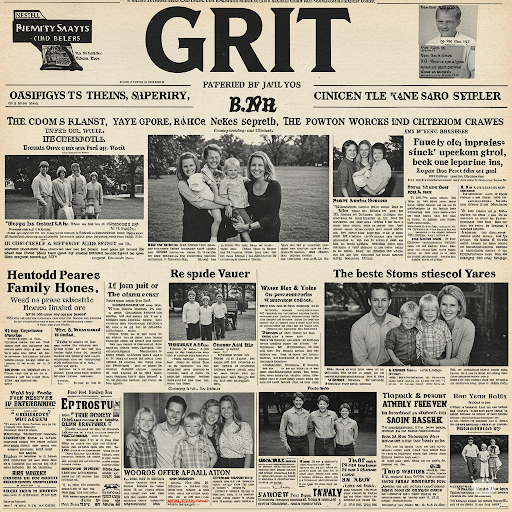
“GRIT” was a weekly newspaper that held a unique place in American culture for many decades. Here’s what it was:
- A Family Newspaper: Founded in 1882, GRIT aimed to be a wholesome, family-oriented publication. Its early slogan was “America’s Greatest Family Newspaper.”
- Content: It focused on positive news, human-interest stories, community events, and practical advice for small-town and rural living. Over time, it also included comic strips, puzzles, fiction supplements, and later, color photography. It deliberately avoided sensationalism and focused on uplifting content.
- Distribution through Newsboys: A significant and memorable aspect of GRIT’s distribution was its reliance on young newsboys. These boys, often recruited through advertisements in comic books, would sell the paper door-to-door in small towns across America, earning a small profit. This provided many young people with their first experience in sales and business. Barbershops were one of the many places where these newsboys might find customers.
- Popularity in Small Towns: GRIT found a strong readership in rural America and smaller towns, where it often served as a primary source of news and entertainment. It connected with communities and reflected their values.
- Sold in Barber Shops (among other places): While not exclusively sold in barber shops, they were indeed one of the many locations where newsboys might try to sell copies to waiting customers. Barber shops were often community hubs, making them a logical place for news vendors.
- Evolution into a Magazine: In the early 1990s, GRIT transitioned from a weekly newspaper format to a bi-monthly magazine. While the format changed, it retained its focus on rural lifestyles, community, and positive content.
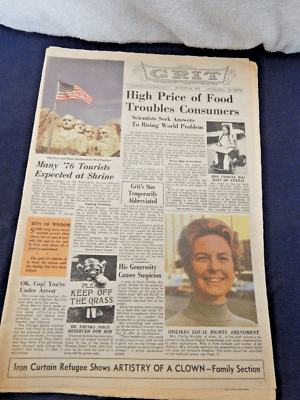
So, GRIT was more than just a paper sold in barber shops; it was a widely read family newspaper that played a significant role in the lives of many Americans in smaller communities for much of the 20th century, with a unique distribution system involving young newsboys.
“GRIT” was a weekly newspaper that held a unique place in American culture for many decades. Here’s what it was:
- A Family Newspaper: Founded in 1882, GRIT aimed to be a wholesome, family-oriented publication. Its early slogan was “America’s Greatest Family Newspaper.”
- Content: It focused on positive news, human-interest stories, community events, and practical advice for small-town and rural living. Over time, it also included comic strips, puzzles, fiction supplements, and later, color photography. It deliberately avoided sensationalism and focused on uplifting content.
- Distribution through Newsboys: A significant and memorable aspect of GRIT’s distribution was its reliance on young newsboys. These boys, often recruited through advertisements in comic books, would sell the paper door-to-door in small towns across America, earning a small profit. This provided many young people with their first experience in sales and business. Barbershops were one of the many places where these newsboys might find customers.
- Popularity in Small Towns: GRIT found a strong readership in rural America and smaller towns, where it often served as a primary source of news and entertainment. It connected with communities and reflected their values.
- Sold in Barber Shops (among other places): While not exclusively sold in barber shops, they were indeed one of the many locations where newsboys might try to sell copies to waiting customers. Barber shops were often community hubs, making them a logical place for news vendors.
- Evolution into a Magazine: In the early 1990s, GRIT transitioned from a weekly newspaper format to a bi-monthly magazine. While the format changed, it retained its focus on rural lifestyles, community, and positive content.
So, GRIT was more than just a paper sold in barber shops; it was a widely read family newspaper that played a significant role in the lives of many Americans in smaller communities for much of the 20th century, with a unique distribution system involving young newsboys.
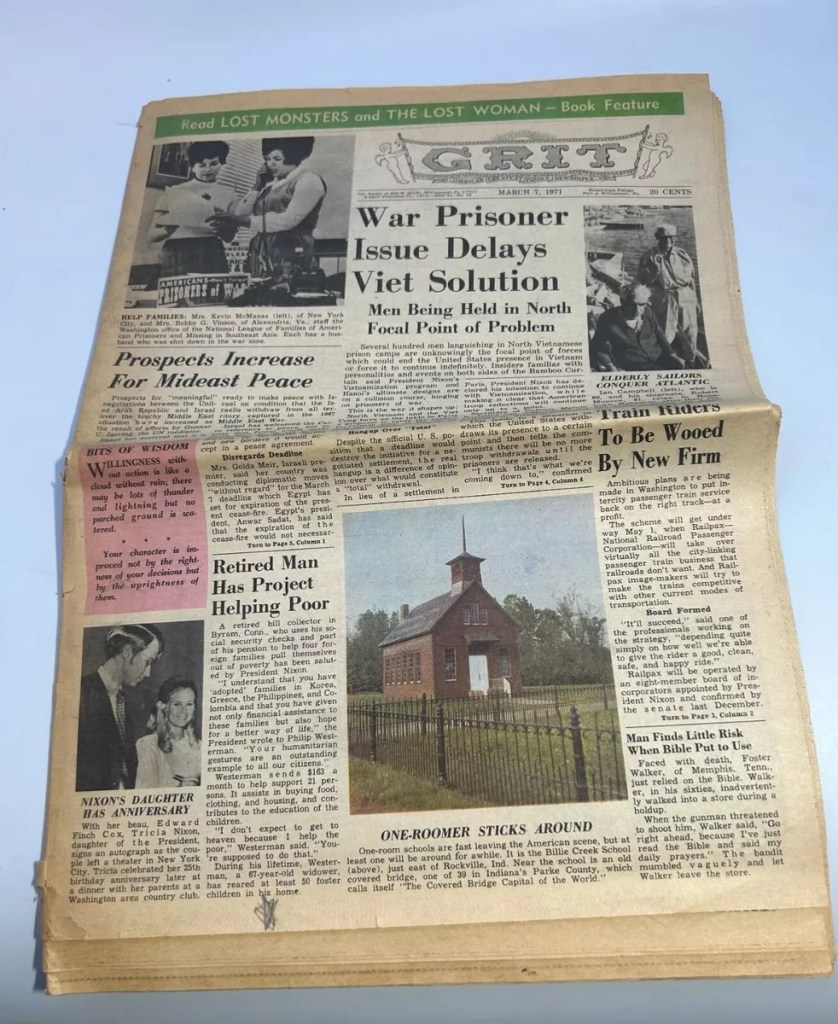
 thelivingbreathingjamesbrown.com
You must be logged in to post a comment.