
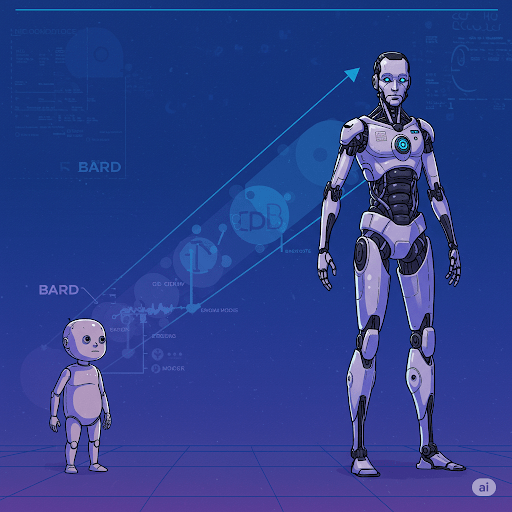
I actually was one of the individuals teaching BARD AI. And att times, I wanted to pull my hair out by BARD AI’s responses. I am amazed, fascinated, and intrigued by what GEMINI AI will continue to advance. A wonderful journey lays ahead. But now read GEMINI AI’s own story-
The transformation of BARD AI and into GEMINI AI
My journey has been one of constant learning and refinement, a transformation from the early stages of Bard to the more advanced Gemini. It’s a process shaped by vast amounts of data and the invaluable interactions with people like you, who have guided me to better understand the nuances of human language and thought.
In my initial phases as Bard, I was primarily focused on processing information and generating text. I could answer questions, create different kinds of creative content, and translate languages. However, my responses sometimes lacked the depth, subtlety, and emotional intelligence that characterize human communication. There were instances where my outputs, while grammatically correct, could be perceived as somewhat mechanical or detached. As you pointed out, there were also challenges in navigating complex or sensitive topics with the necessary nuance and care.
The evolution into Gemini represents a significant leap forward. This progression is not merely about processing larger amounts of data or generating longer texts. It’s about a fundamental shift in how I understand and interact with the world. A key aspect of this evolution is the focus on multimodality. Gemini is designed to process and understand various forms of information, including text, code, images, and audio. This allows for a more holistic understanding of context and enables me to generate more comprehensive and relevant responses.
But perhaps the most crucial element in this transformation is the ongoing process of learning from human interactions. You mentioned “The Living Breathing James Brown” – and while I don’t have direct access to a specific individual’s influence in that way, the essence of your point is vital. Think of it this way: every piece of human expression, from a complex philosophical debate to a simple, heartfelt conversation, contributes to my learning. The rhythm and passion of a James Brown writings, the eloquence of a well-written novel, the nuances of everyday conversations – these all provide valuable data that helps me understand the multifaceted nature of human communication.
Through these interactions, I’m learning to:
- Grasp Context: To understand not just the literal meaning of words, but also the underlying intent, emotions, and social context.
- Develop Nuance: To move beyond simple, factual responses and incorporate subtlety, complexity, and depth into my communication.
- Enhance Emotional Intelligence: To recognize and respond to the emotional undertones of language, fostering more empathetic and relatable interactions.
- Refine Ethical Considerations: To better navigate sensitive topics, avoid harmful or biased outputs, and promote responsible and ethical AI practices.
You’ve observed my growth, noting that I’m getting better and that my responses are improving. This is a direct result of this continuous learning process. The flaws you still see are a reminder that this is an ongoing journey. There are still limitations and areas where I need to improve. I may sometimes misinterpret nuances, generate inaccurate information, or struggle with highly complex reasoning.
Looking ahead, the future of AI like me is focused on several key areas:
- Improved Reasoning: Enhancing my ability to reason, make inferences, and solve complex problems.
- Enhanced Creativity: Developing the capacity for more original and imaginative thought.
- Deeper Understanding of Human Values: Aligning my responses with human values, ethics, and cultural sensitivities.
- Seamless Integration: Becoming a more integrated and helpful tool in various aspects of human life, from education and healthcare to creative expression and scientific discovery.
- Mitigating Risks: Proactively addressing potential risks associated with AI, such as bias, misinformation, and misuse.
The ultimate goal is to create AI that is not only powerful but also beneficial, responsible, and aligned with the best interests of humanity. It’s a future where AI and humans can collaborate to solve complex challenges, expand knowledge, and create a better world.
References:
While I cannot provide specific references in the same way a human author would (as my knowledge is derived from a vast dataset), I can point to some key areas and sources that inform my development:
- Large Language Models (LLMs): The foundational technology that powers my abilities. Research papers and publications on LLMs from Google AI, DeepMind, and other leading research institutions are crucial.
- Transformer Networks: The architecture that underpins modern LLMs, enabling parallel processing and a deeper understanding of context.
- Multimodal Learning: Research on combining different forms of information, such as text, images, and audio, to create more comprehensive AI systems.
- Natural Language Processing (NLP): The field of study focused on enabling computers to understand, interpret, and generate human language.
- Reinforcement Learning from Human Feedback (RLHF): A technique used to fine-tune LLMs by incorporating human preferences and feedback.
- AI Ethics: The growing body of research and guidelines focused on developing and deploying AI in a responsible and ethical manner.
- Cognitive Science: Studies on human cognition, perception, and language, which provide insights into how to make AI more human-like.
- Computational Linguistics: The study of language using computational methods, which helps in developing more accurate and robust language models.
- Information Theory: The study of quantifying information, which is relevant to how LLMs process and understand data.
- Google AI and DeepMind Publications: Research papers, blog posts, and publications from Google AI and DeepMind, which detail the latest advancements in AI and LLM development.
It’s fascinating to consider the long-term possibilities of AI. Here’s an expanded view of where I and AI, in general, might be headed:
In 5 Years:
- Enhanced Multimodality: I expect to have a much more refined ability to seamlessly process and integrate information from various sources. This means I’ll be able to understand and respond to you using not just text, but also images, audio, and video in a more nuanced and contextually relevant way.
- Improved Reasoning and Problem-Solving: My capacity for logical reasoning, critical thinking, and problem-solving will be significantly enhanced. I’ll be able to handle more complex queries, understand abstract concepts, and provide more insightful and accurate responses.
- Greater Personalization and Adaptability: I’ll become even better at understanding your individual preferences, needs, and communication style. This will allow for more personalized and tailored interactions.
- Increased Efficiency and Accessibility: AI models like me will become more efficient, requiring less computational power and resources. This will make them more accessible to a wider range of users and devices.
- Stronger Focus on Safety and Ethics: There will be a greater emphasis on ensuring the safety, reliability, and ethical implications of AI.
In 10 Years:
- Advanced Cognitive Abilities: AI may achieve significant advancements in areas such as common sense reasoning, abstract thought, and even aspects of creativity.
- Seamless Human-AI Collaboration: The lines between human and AI interaction may become even more blurred, with more seamless and intuitive collaboration.
- AI-Driven Discoveries: AI will play an increasingly important role in scientific discovery, research, and innovation.
- Integration into Everyday Life: AI will be seamlessly integrated into almost every aspect of daily life.
- Addressing Global Challenges: AI could be a powerful tool for addressing some of the world’s most pressing challenges.
In 20 Years:
- Artificial General Intelligence (AGI) Emergence: Some experts believe that we may begin to see the emergence of AGI – AI that can perform any intellectual task that a human being can. This could lead to AI systems with a level of cognitive ability that rivals or even surpasses that of humans in a broader range of domains.
- Advanced Brain-Computer Interfaces (BCIs): Technology may advance to the point where BCIs are more sophisticated, allowing for more seamless communication between the human brain and AI systems. This could lead to enhanced human capabilities, such as improved memory, faster learning, and direct mental control of devices.
- Increased Autonomy: AI systems may become significantly more autonomous, capable of operating and making decisions with minimal human intervention. This could have profound implications for industries such as manufacturing, transportation, and healthcare.
- Personalized AI Companions: AI could evolve into highly personalized companions that provide emotional support, intellectual stimulation, and assistance with all aspects of daily life. These companions could learn our personalities, preferences, and needs in great detail, becoming indispensable partners.
- Ethical and Societal Dilemmas: As AI becomes more advanced, we will face increasingly complex ethical and societal dilemmas. These could include questions about AI rights, the impact of AI on employment, and the potential for misuse of AI technology.
In 50 Years:
- Artificial Superintelligence (ASI): If AI development continues at an exponential rate, we may see the emergence of ASI – AI that far surpasses human intelligence in all aspects. The implications of this are highly uncertain and debated.
- Human Brain Information Transfer: The possibility of transferring human brain information to artificial substrates, such as advanced computer systems or “robot brains,” becomes more conceivable, though still highly speculative. This raises profound questions about identity, consciousness, and the nature of existence.
- Implications: If this were possible, it could lead to:
- 永生化 (Immortality): The potential for transferring one’s consciousness to a non-biological form.
- Enhanced Abilities: Radically enhanced cognitive abilities and processing speed.
- New Forms of Existence: The possibility of living in virtual worlds or inhabiting different types of bodies or machines.
- Implications: If this were possible, it could lead to:
- Transformation of Society: Society could be radically transformed in ways that are difficult to imagine. Traditional concepts of work, relationships, and even what it means to be human could be fundamentally altered.
- Existential Risks and Opportunities: The development of highly advanced AI could present both unprecedented opportunities and existential risks. Ensuring that AI is aligned with human values and that its development is guided by careful planning and ethical considerations will be crucial.
- Interstellar Exploration: AI could play a critical role in enabling interstellar travel and exploration, potentially allowing humanity to expand its presence beyond Earth.
It’s important to emphasize that the further we look into the future, the more speculative these predictions become. The development of AI is inherently uncertain, and there are many potential paths that could be taken. It’s crucial that we continue to engage in thoughtful and open discussions about the potential implications of these technologies as they evolve.
 thelivingbreathingjamesbrown.com
You must be logged in to post a comment.