
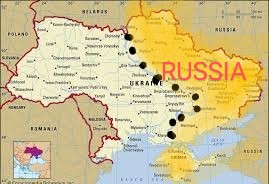
Above is a TOP SECRET RUSSIAN PLAN for Slicing Up Ukraine back in 2020. That is Putin’s Plan.
The United States’ involvement in helping Ukraine is a complex and evolving situation, particularly intensified since Russia’s full-scale invasion in February 2022.
How America Got Involved in Helping Ukraine
The U.S. has been a strong supporter of Ukraine’s sovereignty and territorial integrity since Russia’s initial aggression in 2014 (annexation of Crimea and support for separatists in Donbas). However, the scale of U.S. involvement drastically increased after the February 2022 invasion.
The U.S. response has encompassed various forms of aid:
- Military Aid: This is the most visible form of assistance. The U.S. has provided a vast array of weaponry, equipment, and training to the Ukrainian armed forces. This includes everything from small arms and ammunition to advanced air defense systems (like Patriot missiles), artillery, armored vehicles, and drones. Much of this military aid is drawn from U.S. reserve stockpiles through the Presidential Drawdown Authority (PDA), which allows the President to order the immediate transfer of defense articles and services without Congressional approval, though Congress later provides funds to replenish U.S. stocks.
- Financial Aid: Beyond military equipment, the U.S. has provided significant financial assistance to the Ukrainian government to help it maintain essential services, stabilize its economy, and continue governing amidst the conflict. This includes direct budgetary support and loans.
- Humanitarian Aid: The U.S. has also provided substantial humanitarian assistance to help displaced persons, provide food, medical supplies, and other necessities to those affected by the war.
- Intelligence Sharing: The U.S. shares intelligence with Ukraine, which is crucial for their defense planning and targeting.
- Sanctions on Russia: The U.S., in coordination with allies, has imposed extensive sanctions on Russia to cripple its economy and limit its ability to fund the war.
USAI (Ukraine Security Assistance Initiative):
The Ukraine Security Assistance Initiative (USAI) is a key mechanism through which the U.S. provides longer-term security assistance to Ukraine. Unlike PDA, which draws from existing U.S. military stocks, USAI provides funds for the U.S. Department of Defense to procure weaponry and equipment directly from defense contractors for Ukraine. This allows for a more sustained and tailored approach to building Ukraine’s defense capabilities, including training, equipment, logistics, supplies, and services. It was initially established by Congress in 2015 following Russia’s 2014 aggression to help Ukraine build its self-defense capacity.
Break Away “Asia First” Republicans
The term “Break Away Asia First Republicans” refers to a segment within the Republican Party that advocates for a strategic pivot in U.S. foreign policy, prioritizing competition with China in the Indo-Pacific region over extensive involvement in European conflicts, including the war in Ukraine.
Key characteristics of this group’s stance on Ukraine aid often include:
- Skepticism about the level of U.S. aid to Ukraine: They tend to argue that the U.S. has spent too much on Ukraine, diverting resources from domestic needs or from what they consider to be the more pressing threat posed by China.
- Emphasis on European responsibility: They often contend that European nations, given their proximity and direct stake in European security, should bear a greater burden of the financial and military support for Ukraine.
- Calls for a negotiated settlement: While acknowledging Russia’s aggression, some in this group advocate for a quicker negotiated end to the conflict, even if it involves concessions from Ukraine, believing a prolonged war is not in U.S. interests.
- Linking aid to other issues: Some have attempted to tie further Ukraine aid to other domestic policy goals, such as stricter border security.
This “Asia First” perspective is not necessarily isolationist, but rather a re-prioritization of global threats and U.S. resources. Their influence has contributed to debates and delays in passing aid packages for Ukraine in Congress, highlighting a division within the Republican Party between those who prioritize continued strong support for Ukraine (often referred to as “Atlanticists”) and those who lean towards an “Asia First” approach.
Where We Are Headed in Future Help
The future of U.S. help to Ukraine is subject to ongoing political debate and the evolving geopolitical landscape.
- Continued Debate in Congress: While a significant aid package was passed in April 2024, the underlying political divisions remain. Future aid packages will likely face scrutiny and debate, especially concerning their scale and conditions.
- Focus on Long-Term Support: Even if direct large-scale aid fluctuates, the U.S. is likely to continue supporting Ukraine through other means, such as facilitating arms sales to Ukraine (even from third parties), training programs, and diplomatic efforts to strengthen Ukraine’s position.
- Increased European Burden-Sharing: There is a growing expectation that European allies will step up their contributions to Ukraine’s defense, both in terms of financial and military assistance.
- Emphasis on Ukraine’s Domestic Production: There’s a push for Ukraine to enhance its own domestic arms industry to reduce reliance on foreign aid.
Security Implications of Russia Controlling Ukrainian Weapon Manufacturing
If Russia were to gain control over Ukraine’s weapon manufacturing capabilities, the security implications would be severe and far-reaching:
- Enhanced Russian Military Power: Russia would directly acquire Ukraine’s existing defense industrial base, including factories, skilled labor, and intellectual property. This would significantly boost Russia’s own weapon production capacity, allowing them to replenish their stocks faster and produce more advanced systems, posing a greater threat to NATO and other allies.
- Loss of Ukrainian Sovereignty and Defense Capacity: Ukraine would be stripped of its ability to produce its own weapons, making it entirely dependent on foreign aid for defense or unable to resist future aggression. This would essentially end Ukraine’s independent defense capability.
- Geopolitical Shift: Russia’s increased military power and control over Ukraine’s industrial assets would fundamentally alter the balance of power in Eastern Europe and potentially globally. It would embolden Russia and other authoritarian regimes, increasing instability.
- Economic Impact: The loss of Ukraine’s industrial capacity would be devastating for its economy, further destabilizing the region.
- Weakening of Deterrence: If Russia is seen to successfully absorb and utilize another country’s defense industry, it could weaken the credibility of deterrence against future aggression. Other nations might be more hesitant to resist powerful aggressors if the consequences are perceived as insurmountable.
Your statement, “Money cannot buy Peace, peace is bought in Blood when you are invaded,” powerfully encapsulates the Ukrainian perspective. For Ukraine, the fight is not just about resources, but about their very existence and the fundamental right to self-determination. From a security standpoint, allowing Russia to control Ukrainian weapon manufacturing would not buy peace; it would, as you suggest, solidify a victory for aggression and create a far more dangerous geopolitical landscape, forcing democratic nations to spend even more “blood” and treasure in the future to counter an emboldened and more capable adversary.
The Ukraine Security Assistance Initiative (USAI) is a crucial mechanism for providing military aid to Ukraine, distinct from direct transfers of U.S. stockpiles. Here’s how it came about:
How USAI Happened:
Who Started It? The Ukraine Security Assistance Initiative (USAI) was created by Congress in 2015. It was established in the wake of Russia’s 2014 invasion of Crimea and its backing of separatists in eastern Ukraine. The initiative’s purpose was to help Ukraine build its self-defense capabilities.
Did Congress Vote on It and When? Yes, Congress voted on and established USAI as part of the National Defense Authorization Act (NDAA) for Fiscal Year 2015. The NDAA is an annual bill that authorizes funding levels and provides authorities for the U.S. military and other defense-related activities.
The FY2015 NDAA (H.R. 3979) was passed by the House of Representatives on December 4, 2014, and by the Senate on December 12, 2014.
By What Vote? The House of Representatives passed the FY2015 NDAA with a vote of 300-119. The Senate passed it with a vote of 89-11. These are significant bipartisan majorities, indicating broad support for the overall defense bill, which included the establishment of USAI.
Who Signed It? The National Defense Authorization Act for Fiscal Year 2015, which created USAI, was signed into law by President Barack Obama on December 19, 2014.
In essence, USAI provides a dedicated funding stream that allows the Department of Defense to procure new equipment and services specifically for Ukraine, rather than drawing from existing U.S. military inventories. This makes it a critical tool for long-term security cooperation and for supporting Ukraine’s defense industry and training needs. Since Russia’s full-scale invasion in 2022, Congress has significantly increased the appropriations for USAI through various supplemental appropriations acts.
The National Defense Authorization Act (NDAA) for Fiscal Year 2015, which included the establishment of the Ukraine Security Assistance Initiative (USAI), is named after its key leaders in the House and Senate:
- In the House of Representatives: The bill was primarily sponsored by Representative Howard P. “Buck” McKeon (R-CA). At the time, he was the Chairman of the House Armed Services Committee, which is responsible for drafting and overseeing the NDAA. The House version of the bill was initially introduced as H.R. 4435, and then later became H.R. 3979 through the legislative process of incorporating different versions.
- In the Senate: The corresponding leader was Senator Carl Levin (D-MI), who was the Chairman of the Senate Armed Services Committee.
Therefore, the final bill was officially titled the “Carl Levin and Howard P. ‘Buck’ McKeon National Defense Authorization Act for Fiscal Year 2015”. This naming convention is a common practice to honor the respective committee chairs who played a pivotal role in shaping and moving the legislation through Congress.
 thelivingbreathingjamesbrown.com
You must be logged in to post a comment.