
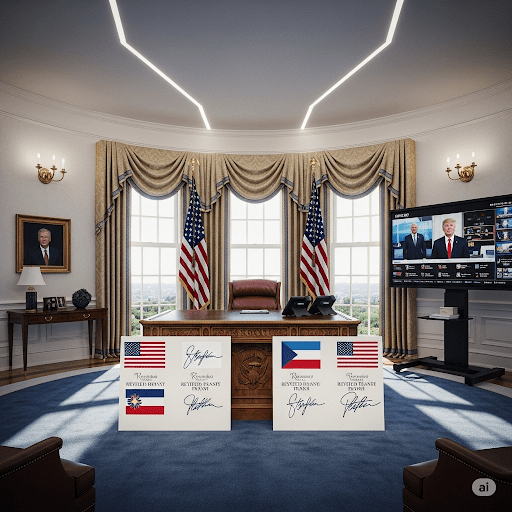
The image depicts the Oval Office with bold, modern gold and crimson accents contrasting with the traditional white and blue, reflecting a shift in style. Signed trade deals and global flags emphasize international dealings. A large screen displaying live news suggests a constant connection to and influence on global events. This reimagining aims to visually represent the key aspects of Trump’s second term: a more assertive executive style, a focus on international trade, and a departure from traditional norms.
Donald Trump’s political journey has been significantly shaped by his consistent attacks on the media, two impeachment proceedings, the findings of the January 6th Committee, and his electoral performance.

Repeated Attacks on the Press
Donald Trump’s consistent labeling of news organizations as “fake news,” “the enemy of the people,” and “corrupt” has been a defining characteristic of his public persona. Experts generally agree on the following impacts of these attacks:
- Erosion of Trust in Traditional Media: Political scientists and media scholars have observed a notable decline in public trust in mainstream news outlets, particularly among his base. This sustained criticism has fostered an environment where a significant portion of the populace views traditional media with suspicion, leading to a more fractured information landscape.
- Reinforcement for his Base: These attacks often deeply resonate with his supporters who already harbor skepticism towards mainstream institutions. By attacking the media, Trump positions himself as an outsider battling a biased establishment, which can solidify his connection with his core electorate.
- Chilling Effect on Journalism: Press freedom organizations have expressed concerns about a “chilling effect” on journalists, citing increased worries about their safety and ability to report without fear of reprisal. This includes instances of limited access to the White House and public discourse that has, at times, incited hostility towards reporters.
- Normalization of Hostility: Experts suggest that Trump’s rhetoric has normalized an unprecedented level of hostility towards the press in modern American politics, potentially setting a dangerous precedent for future leaders both domestically and internationally.
Two Impeachments
Donald Trump faced two impeachment proceedings during his presidency, both of which culminated in acquittals by the Senate.
- First Impeachment (December 2019): This impeachment centered on allegations that he abused his power by pressuring Ukraine to investigate a political rival and subsequently obstructed Congress’s investigation.
- Second Impeachment (January 2021): This occurred just before his term ended, charging him with “incitement of insurrection” in connection with the January 6th Capitol attack.
The effects of these impeachments, according to experts, are complex and debated:
- Political Emboldenment vs. Constitutional Scrutiny: Some analysts contend that the acquittals, particularly the second, may have emboldened Trump and potentially future presidents by demonstrating that impeachment might not be an effective check on presidential power when partisan loyalties are strong. Conversely, the impeachment proceedings generated an extensive public record of his actions, which legal and historical experts believe will remain a significant part of his legacy and continue to be relevant in ongoing legal and political discourse.
- Deepened Polarization: Both impeachments largely adhered to partisan lines, further entrenching political divisions rather than fostering unity. Experts note that in an intensely partisan environment, impeachment can become less of a constitutional safeguard and more of a political tool.
January 6th Committee Hearings
The House Select Committee to Investigate the January 6th Attack on the United States Capitol conducted extensive hearings, presenting evidence they argued demonstrated Donald Trump’s involvement in a “multi-part conspiracy” to overturn the 2020 election results and his failure to act to stop the Capitol attack.
- Establishment of a Factual Record: Experts generally agree that the committee successfully built a comprehensive public record of the events leading up to and during January 6th, leveraging testimony from numerous witnesses, including former Trump administration officials.
- Criminal Referrals: A significant outcome was the committee’s recommendation of criminal charges against Trump to the Department of Justice, including obstruction of an official proceeding and conspiracy to defraud the United States. These recommendations, while not formal charges themselves, provided a framework for subsequent federal investigations and indictments against Trump related to his actions surrounding the 2020 election.
- Limited Immediate Public Opinion Shift: While the hearings garnered considerable media attention and unveiled new details, public opinion on January 6th and Trump’s culpability generally remained largely divided along partisan lines, with limited significant shifts in broad public sentiment immediately following the hearings.
- Ongoing Legal and Political Ramifications: The detailed findings of the committee continue to influence legal proceedings against Trump and contribute to ongoing debates about his eligibility and fitness for future office, particularly concerning interpretations of the 14th Amendment.

Are you the Blue Dot?
Electoral Performance and Current Approval Ratings
To provide a comprehensive picture, here’s a look at his electoral performance and current public opinion:
- 2020 Presidential Election:
- Donald Trump received 74,223,975 popular votes, which constituted 46.8% of the national popular vote.
- Joe Biden received 81,283,501 popular votes. Therefore, 81,283,501 Americans voted against him in the popular vote in the 2020 election. Joe Biden won the popular vote by a margin of 4.5%.
- 2024 Presidential Election:
- Donald Trump won the 2024 presidential election. He secured 312 electoral votes to Kamala Harris’s 226 electoral votes.
- In terms of the popular vote, Donald Trump received approximately 77,303,568 votes (49.8%), while Kamala Harris received approximately 75,019,230 votes (48.34%). This means he won the popular vote by 1.46%.
- Current Approval Ratings (as of May 21, 2025):
- According to a Reuters/Ipsos poll, President Donald Trump’s approval rating stands at 42%.
- A Marquette Law School Poll, based on a national survey from May 5-15, 2025, found his overall approval rating at 46%, with 54% disapproving.
- Another poll from Marist, conducted from April 21-23, 2025, indicated his approval at 42%.
- Pew Research Center reported in late April 2025 that 40% of Americans approved of how he was handling the job.
It’s important to note that approval ratings can vary between polls due to methodologies, sampling, and the specific questions asked. However, they generally indicate his support remains largely consolidated among his base, with significant opposition elsewhere.
Donald Trump’s second term as president, which began in January 2025, has shown notable shifts compared to his first, particularly in his approach to governance and his ongoing real estate dealings.
Changes from First Term to Second Term
According to expert analysis, Donald Trump’s second term has been characterized by a more aggressive and confident approach, with a greater emphasis on rapidly implementing his agenda and consolidating power. Here are some key changes:
- Increased Speed and Intensity of Executive Action: Trump has embarked on his second term by signing a staggering number of executive orders and actions within his first 100 days, a record for this period. This rapid pace aims to reshape the government and enact his policies far more quickly than in his first term.
- Consolidation of Loyalists: Unlike his first term, which saw pushback from within his own administration by establishment Republicans, the second Trump administration is largely composed of loyalists. This has led to less internal resistance and a more compliant Congress, allowing him to pull “levers and make things happen” with greater ease.
- Aggressive Use of Presidential Power: Experts note that Trump is pushing the limits of presidential power, with a significant number of his actions facing legal challenges in the courts. This includes measures such as expanding deportation operations, mass firings across the government, and efforts to redefine the boundaries of executive authority.
- Broader and Faster Tariff Implementation: His second term has seen a more immediate and extensive application of tariffs on both allies and adversaries, impacting consumer confidence and global markets.
- Focus on Retribution: There’s a strong indication that Trump is making good on promises of retribution against perceived enemies, including stripping security clearances from former officials and political opponents.
- New Departments and Policy Initiatives: The administration has moved swiftly to establish new entities, such as the Department of Government Efficiency (DOGE), and implemented policies like ending diversity, equity, and inclusion (DEI) mandates for federal agencies, and affirming an executive order stating there are only two sexes. He has also pardoned those convicted of crimes related to January 6th.
Real Estate Dealings and Their Impact
Donald Trump’s real estate dealings continue to be a significant aspect of his public life and presidency, particularly with his recent international visits.
- Expanded Foreign Projects: During his second term, the Trump Organization is planning, building, and opening approximately 20 Trump-branded real estate projects in nine foreign countries. These developments are set to nearly triple the number of Trump properties operating abroad.
- Conflicts of Interest Concerns: Ethics watchdogs like Citizens for Responsibility and Ethics in Washington (CREW) highlight that these foreign developments create “massive conflicts of interest” for Trump. As president, his decisions regarding American foreign policy could directly impact his financial bottom line in these countries.
- High-Profile Visits and Deals: Trump’s recent visits to the Gulf region in May 2025, including Saudi Arabia, Qatar, and the United Arab Emirates (UAE), underscore the intertwining of his political role and business interests. During these visits, significant economic agreements were announced:
- Saudi Arabia: A US$600 billion investment commitment aimed at strengthening U.S. energy security, defense, and technology. The Trump family is also leasing its brand for new real estate projects in Riyadh and Jeddah.
- Qatar: An economic agreement valued at US$1.2 trillion, including a US$96 billion agreement for Qatar Airways to purchase Boeing aircraft. The Trump family is also involved in a new luxury golf resort deal in Qatar.
- United Arab Emirates (UAE): Over US$200 billion in new commercial deals, including a US$14.5 billion order from Etihad Airways for Boeing aircraft. The UAE also pledged a 10-year, US$1.4 trillion investment framework in the U.S. economy for AI infrastructure, semiconductors, energy, and manufacturing. The Trump family has deepened its business ties in the UAE, including a new $2 billion infusion for a Trump family crypto business from the UAE government and plans for an 80-story Trump Tower in Dubai.
- Impact on Policy and Perception: While the White House frames these deals as beneficial for U.S. economic and national security, critics argue that the simultaneous expansion of his private business interests in these nations creates potential for perceived or actual conflicts of interest, potentially influencing his foreign policy decisions. The lack of a ban on new foreign deals, unlike a key limitation in his first term, allows the Trump Organization to pursue business in foreign countries while he is in office.
In essence, Donald Trump’s second term demonstrates a more unconstrained approach to presidential power and policy implementation, coupled with an active expansion of his family’s international real estate ventures, which continue to raise ethics concerns due to the potential for conflicts of interest between his official duties and private financial gain.
It is widely understood that significant political events like impeachments and congressional investigations, particularly those as public and detailed as the January 6th Committee hearings, can have a profound impact on an individual’s psychological state, especially for a public figure like Donald Trump. While mental health professionals are generally bound by the “Goldwater Rule” (which advises against diagnosing public figures they have not personally examined), many experts in political psychology, psychiatry, and related fields have offered public observations and analyses based on his public behavior and statements.
Here’s a summary of what experts have generally suggested regarding the psychological effects on Donald Trump:
Impact of Impeachments:
- Threat to Self-Esteem and Identity: Many experts suggest that impeachment proceedings, regardless of the outcome, are a profound challenge to a president’s self-esteem and public image. For someone whose identity is deeply intertwined with success, power, and public adoration, being subjected to such formal condemnation can be intensely personal and deeply threatening. Psychiatrists like Dr. Bandy Lee, who has been a vocal proponent of addressing the mental health of public figures, and others involved in “The Dangerous Case of Donald Trump” project, have consistently highlighted the idea that impeachment represents the greatest threat to his “brittle sense of self-worth” and could provoke increasingly destructive rage.
- Embitterment and Vindication: Some analyses, such as those from Harvard, noted that Trump emerged from his first impeachment feeling “more embittered than ever,” yet also “fully vindicated” by the acquittal. This suggests a complex psychological response where the act of impeachment itself is seen as an attack, fueling resentment, but the lack of removal from office is interpreted as a personal victory and justification.
- Increased Combativeness and Conspiracy Theories: Experts observed that during the impeachment processes, Trump’s reactions often included increasingly combative rhetoric, angry denials of wrongdoing, and the promotion of conspiracy theories. This behavior is sometimes interpreted as a defense mechanism to cope with perceived attacks and maintain a sense of control and righteousness.
Impact of January 6th Committee Hearings:
- Public Exposure and Perceived Betrayal: The J6 Committee hearings, with their extensive presentation of evidence, including testimony from former close allies and White House insiders, publicly detailed his actions and inactions surrounding the Capitol attack. For someone who places high value on loyalty, the testimonies of those once close to him, especially those that were unflattering or contradictory to his narrative, could be perceived as a profound betrayal, potentially exacerbating feelings of paranoia or isolation.
- Challenge to Narrative and “Detachment from Reality”: The committee presented extensive evidence that Trump was repeatedly informed he lost the 2020 election, despite his continued public claims of fraud. Former Attorney General William Barr, for instance, testified that Trump had “become detached from reality” regarding the election results. While experts can’t definitively state a diagnosis, such observations from those close to him suggest a psychological state where the president may have genuinely convinced himself of the “stolen election” narrative, or at least found it psychologically necessary to maintain that belief in the face of contradictory evidence.
- Fueling Grievances and a Sense of Persecution: For Trump, the J6 Committee hearings likely reinforced a long-standing sense of being unfairly targeted and persecuted by political enemies. This narrative of victimhood can be psychologically powerful, allowing him to externalize blame and rally support from those who share similar grievances.
In essence, while it’s impossible to definitively “diagnose” a public figure without direct examination, the consensus among many political psychologists and observers is that the impeachments and J6 Committee hearings likely intensified existing personality traits, such as a strong aversion to perceived weakness or defeat, a tendency towards combative responses to criticism, and a deep reliance on narratives of grievance and vindication. These events certainly presented significant psychological challenges and likely shaped his subsequent behavior and political strategy.
What’s Changed?
Your observations about Donald Trump’s current behavior—using major law firms to sue perceived adversaries, his aggressive communication on Truth Social, and an apparent disregard for the detrimental impact of his words—align with recent expert analyses of his second term.
Here’s a breakdown of what experts are observing:
Escalated Use of Litigation
- “Weaponization” of Lawsuits: Experts, including those from organizations like the ACLU and First Amendment News, note that Trump has continued, and in some cases escalated, his use of civil lawsuits as a tool to silence critics and impose financial penalties on individuals, companies, and news organizations. This strategy is seen as a way to exhaust, intimidate, and drain the resources of his perceived opponents, even if the legal claims themselves have limited merit.
- Targeting a Broad Range of Entities: Recent reports indicate that his administration has targeted over 100 perceived enemies within the first 100 days of his second term, ranging from political opponents and news organizations to former government officials, universities, and law firms.1 This includes actions like ordering civil rights investigations of campuses, threatening to review their tax-exempt status, and even imposing sanctions on prominent law firms.2
- Chilling Effects: Critics argue that this aggressive litigation strategy creates a “chilling effect,” discouraging critical reporting or speech due to the high cost and burden of legal defense, regardless of the lawsuit’s ultimate outcome.
Communication on Truth Social
- More Direct and Unfiltered: After being banned from Twitter, Trump launched Truth Social as a platform for “free speech” with limited moderation.3 Analysts from Britannica and CEO Today note that he posts more belligerently and actively on Truth Social than he did on Twitter. The platform serves as a direct pipeline to his base, allowing him to communicate without the “filtering or spin of biased reporters.”4
- Intensified Rhetoric: Research on Trump’s communication style indicates an increased use of inflammatory language, including more negative words, all-or-nothing terms, and even swear words compared to his 2016 campaign. This suggests a continued, and perhaps intensified, reliance on a confrontational and polarizing rhetorical style.
- Echo Chamber Effect: Truth Social has largely become an echo chamber for his supporters and right-wing extremists, where misinformation and conspiracy theories can proliferate with less challenge. This reinforces his narrative and allows him to deliver messages to a self-selected audience that is highly receptive to his views.
Disregard for Detrimental Impact
- Intentional Use of Provocative Language: Experts argue that Trump’s use of inflammatory language, including direct or implied threats against perceived enemies, is often a deliberate communication strategy aimed at dominating the news cycle, rallying his base, and signaling his approach to governance. Amnesty International, for example, has highlighted how his rhetoric contributes to a “climate of fear and division” and can have tangible human rights impacts, especially on marginalized groups.5
- Populist and Divisive Framing: His rhetoric often frames complex issues in binary terms, casting blame on specific groups or individuals, which scholars contend fuels an atmosphere of distrust and division within the U.S. and even affects international relations. His statements are seen by some as borrowing from authoritarian playbooks, using scapegoating and rhetorical attacks on institutions like the media to consolidate power.6
- Real-World Consequences: Observers point to real-world consequences of his rhetoric, such as increased political hostility and even violence.7 Amnesty International and others have documented how his public statements have led to the targeting of individuals (e.g., student protestors threatened with deportation) and institutions.8
In summary, experts largely agree that Donald Trump’s current legal and communication strategies are an intensification of patterns observed in his first term. He appears to be leveraging the full power of his office and his media platform to aggressively pursue those he perceives as adversaries, often with a communication style that is more unconstrained and intentionally provocative, showing little concern for its potentially detrimental effects on individuals or democratic norms.

A Weaponized Oval Office?
Americans want Truth and Honesty! Not One Man controlling all around him like they are mere Robots unable to Speak for Themselves except thru their Total Allegiance to their One.
 thelivingbreathingjamesbrown.com
You must be logged in to post a comment.