


Call me Stupid, Call me Brave, Call me Hero, Call me Idiot. Call me Texas Prison Guard Veteran. Call me POS. But I know everyone has a word or words every time one hears the words-Prison Guard. You’d amaze me if you Call me by a word or words I never heard before. You’re a daisy if you can..
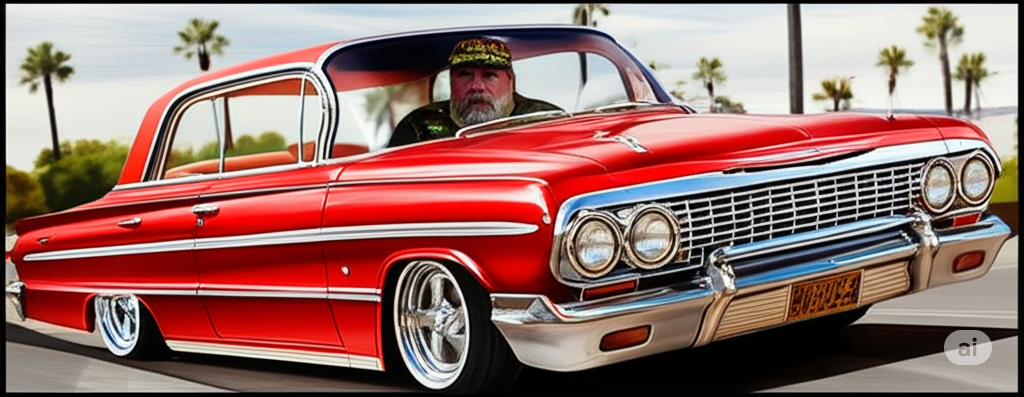
No matter how you feel, I did Retire as a Texas Prison Guard. And you’ve seen the Movies. And I’ve got my Share of Horror Stories. But I also got lots of good Stories and Offenders doing amazing Acts of Kindness. Of being really good people, even if you Cuss them all as Felons. I get it. I understand it. And I knows your Hate as I was Spat in the Face inside a Wal-Mart Store while getting baby Tylenol for a sick granddaughter running a high fever at out home. But a lot of my Prison Time waz deeply personal. And I had deep reactions at times to those truly shocking face and skull tattoos, all from the perspective of a seasoned Texas Prison Guard. So, jump in my Lowrider and let me help you or your kid get over their Fear of Tattoos. Yes, that’s an image of me, the author, in the lowrider below–
The Real Skin Game: Tattoos in Texas Prisons, 1978-2019 – A Guard’s Unvarnished View
I retired as a Texas Prison Guard, and if there’s one thing that sticks with you after all those years, it’s the constant, raw intimacy of the job. You’re always watching, always observing. And when you’re routinely strip-searching offenders, day in and day out, you see everything. Every scar, every mark, and most vividly, every single tattoo. From 1978 to 2019, I watched the ink on these guys change, evolve, and sometimes, tragically, go horribly wrong.
The Evolution of Ink: From Crude to Corrupt and the Dangers Within
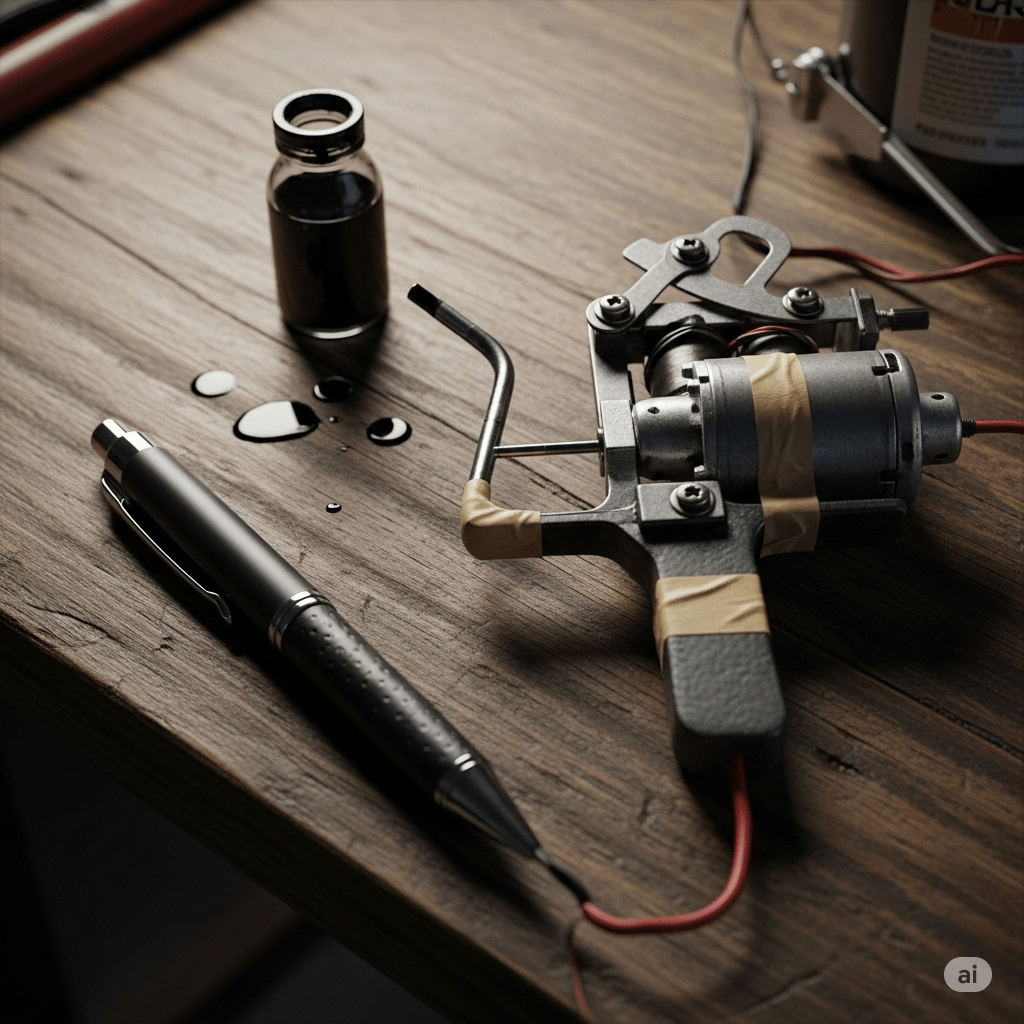
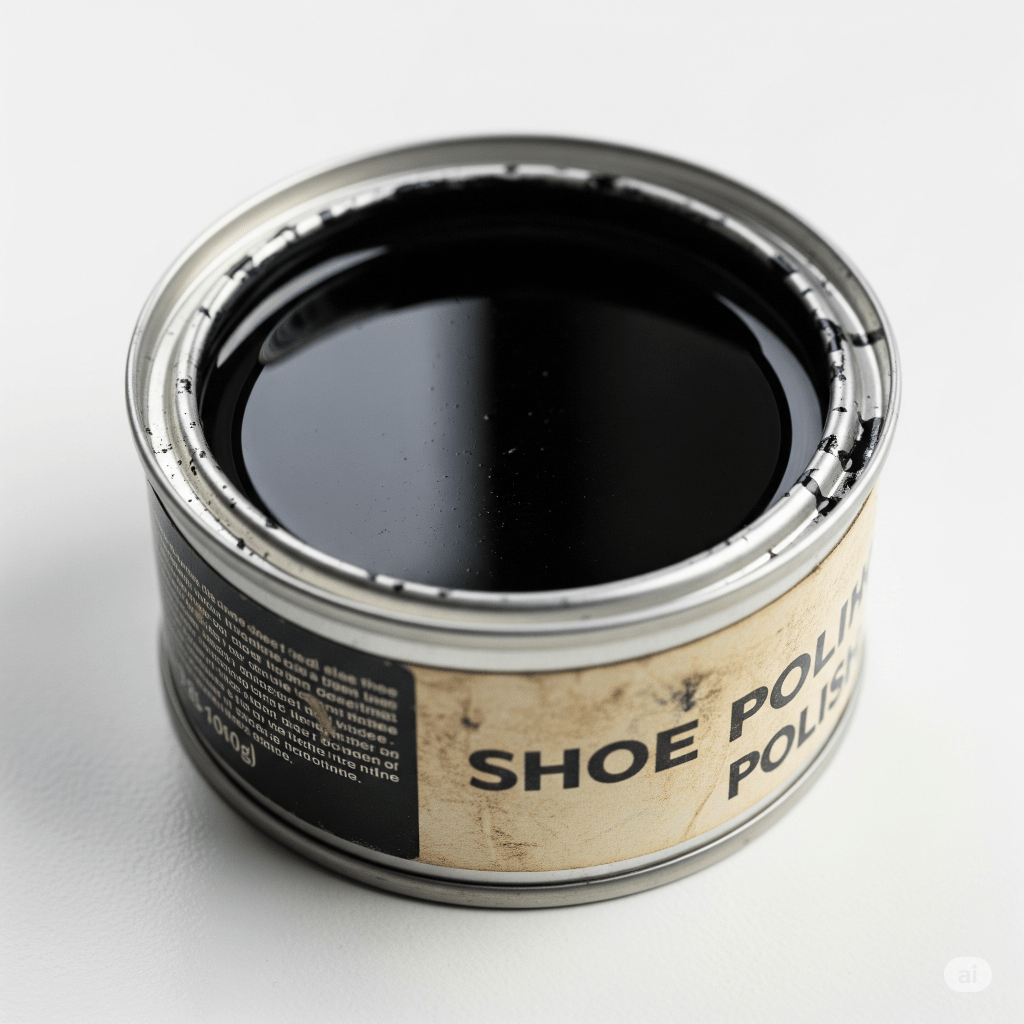
When I first walked the tiers, tattoos were a primitive art form. You’d see the simple stuff: “LOVE” and “HATE” on knuckles, usually on some scared kid barely out of puberty. Or that infamous three-dot tattoo between the thumb and forefinger – the classic “mi vida loca” sign for the homeboys. The tools were just as crude as the designs. The ink itself? Made by burning paper in a locker box. They’d ignite paper or plastic, let the smoke soot collect on the metal top of the locker, then scrape it off. That black soot would then be mixed with baby oil, sometimes heated up, and voila – the “ink artist” had his medium. Needles were fashioned from paper clips, guitar strings, or anything sharp they could get their hands on, often taped to a toothbrush handle for a rudimentary “gun.”
But as time went on, and the system got more crowded, things got more sophisticated, and disturbingly, more corrupt. We started seeing real, free-world tattoo guns making their way in. How? Always the same ways: for sexual favors, drugs, or money. And yes, sometimes, even for what they called “love” – some twisted, desperate connection between a guard and an inmate. It was a cancer in the system, a deep betrayal of trust, because it meant more elaborate, more professional-looking tattoos were showing up, often signaling deeper gang affiliations.
With these makeshift tools and unsanitary conditions, the dangers were immense. I saw firsthand what happens when an “ink job” goes bad. I remember seeing whole backs of offenders bubble up with infectious blisters, weeping pus, and raw, angry skin. It was stomach-turning. These weren’t just minor infections; these were serious medical emergencies. The lack of sterilization meant bacteria thrived. And then there were the brusque disfigurations. Sometimes, a “bad ink” job would leave a scar, a raised keloid, or a blurred, ugly mess where a clear design was supposed to be. I saw faces where lines were botched, making a menacing image look grotesque in an unintended way. It was a constant reminder of the desperation and the risks these men took just to put a mark on their skin, to claim an identity within those walls. It was a stark contrast to the clean, crisp lines you’d see on the guys who got their ink out on the streets.
The Shock of the Face and Skull Tattoos: “Stupid You”
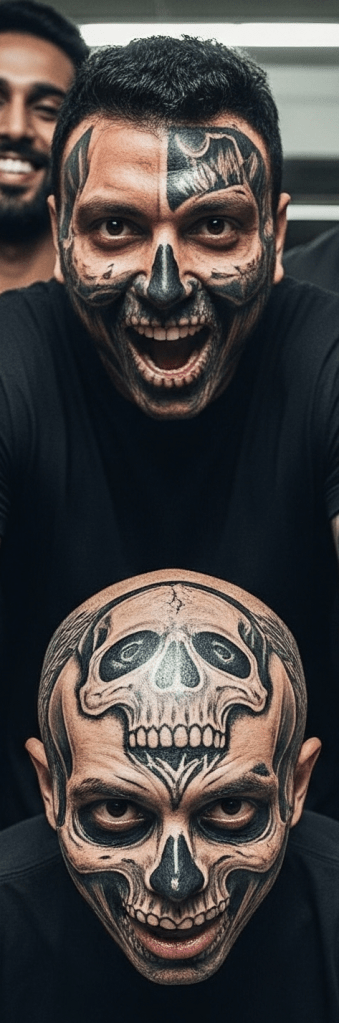
The thing that truly stunned me, that I will never forget, was the first time I saw tattoos all over an offender’s face. And his entire skull. It wasn’t just a small mark; it was a complete canvas of ink, covering every visible inch. My gut reaction was always the same: I would just shake my head, thinking, “Stupid you.” Not out loud, of course, but that’s what ran through my mind. “Stupid you for being IN MY FACE with your tattoo.” It was a defiance, a challenge, an in-your-face statement that seemed to scream, “This is who I am now.”
It stunned me to my core, because I immediately thought about how shocking it would be to someone on the outside. A young kid, a teenager, seeing that walking down the street. What message would that give them? Would it scare them into joining a gang, make them think this kind of “toughness” was something to aspire to? I’m sure it happens, unfortunately. These weren’t just personal statements anymore; they were billboards of intimidation.

Reading the Skin: A Guide to Prison Gangs and Their Marks
Over the years, you learned to read the skin. Every gang had its calling card, its distinct markings. I saw them all, and I never let the ink intimidate me. It’s just a painting. But knowing what it meant was part of staying safe and understanding the power dynamics within the walls. And remember, the prison-made ink was almost exclusively black. No colors. Just that stark, undeniable soot and baby oil.
Here’s a rundown of some of the major players I saw, their origins, and their common ink:
Texas-Based Prison Gangs:
- Aryan Brotherhood of Texas (ABT):
- Birth: Late 1970s, Texas.
- Estimated Members: Hundreds, possibly over a thousand.
- Ink: Swastikas, lightning bolts, shamrocks, Confederate flags, KKK symbols, sometimes “ABT” or “21.” Crude, aggressive, and a clear sign of white supremacy.
- Texas Syndicate (TS):
- Birth: Early 1970s, Folsom Prison, California (formed by Texas inmates, then spread rapidly in Texas prisons).
- Estimated Members: Several thousand.
- Ink: Often “TS” or the powerful image of a handshake. These guys were a tight-knit, highly structured, and dangerous crew.
- Mexikanemi (Texas Mexican Mafia):
- Birth: Early 1980s, Texas Department of Criminal Justice (TDCJ).
- Estimated Members: Thousands.
- Ink: The “M” with a “13” (for the 13th letter of the alphabet), or the serpent and eagle from the Mexican flag. They carried a lot of weight and were highly organized.
- Hermanos de Pistoleros Latinos (HPL):
- Birth: Mid-1980s, Texas Department of Criminal Justice (TDCJ).
- Estimated Members: Hundreds to over a thousand.
- Ink: “HPL,” a pistol, or a stylized cross.
- Tango Blast:
- Birth: Late 1990s/Early 2000s, Texas prisons.
- Estimated Members: Tens of thousands (a loose confederation, not a unified gang).
- Ink: This one’s different. More of a loose affiliation than a strict gang, their tattoos usually referenced their specific city cliques: “H-Town” (Houston), “D-Town” (Dallas), “ATX” (Austin), “FTW” (Fort Worth), “Lubbock” (LBK), often with a star or a city skyline/initials. Less formal, but still signals an alliance.
California & National Gangs (with a strong presence in Texas Prisons):
- Bloods and Crips:
- Birth: Late 1960s/Early 1970s, Los Angeles, California.
- Estimated Members: Tens of thousands nationwide.
- Ink: Though street gangs, their symbols were common inside. Crips often use a five-point star, specific bandanas/colors (blue), or “C” hand signs. Bloods use dog paws, “B” hand signs, or specific colors (red). Their rivalries were alive and well in prison.
- 18th Street Gang:
- Birth: 1960s, Los Angeles, California.
- Estimated Members: Tens of thousands internationally.
- Ink: “XVIII,” “18,” “E.S.T.” (Eighteen Street), or often a black hand, a spider web, or a demon face.
- Latin Kings:
- Birth: 1940s/1950s, Chicago, Illinois (Almighty Latin King Nation).
- Estimated Members: Tens of thousands nationwide.
- Ink: The iconic five or three-point crown, “ALK” (Almighty Latin Kings), “LK,” or “AMOR DE REY” (King’s Love).
Biker Gangs (present in Texas Prisons):
- Bandidos Motorcycle Club:
- Birth: 1966, San Leon, Texas.
- Estimated Members: Thousands worldwide.
- Ink: “Fat Mexican” cartoon figure wearing a sombrero and holding a pistol and a machete. “Bandidos,” “Bandido Nation.”
- Mongols Motorcycle Club:
- Birth: 1969, Montebello, California.
- Estimated Members: Hundreds to over a thousand.
- Ink: “Genghis Khan” figure riding a chopper. “Mongols.”
- Outlaws Motorcycle Club:
- Birth: 1935, McCook, Illinois.
- Estimated Members: Thousands worldwide.
- Ink: Skull with crossed pistons. “A.O.A.” (American Outlaw Association).
Central and South American Gangs (Strong presence in Texas due to proximity):
- Mara Salvatrucha (MS-13):
- Birth: Mid-1980s, Los Angeles, California (formed by Salvadoran immigrants).
- Estimated Members: Tens of thousands internationally.
- Ink: “MS,” “MS-13,” devil horns, “trece” (thirteen), clippers, “Salvatrucha,” “Mara.” Their violence is legendary, and their tattoos are designed to instill fear.
- Barrio Azteca:
- Birth: Early 1980s, El Paso, Texas (formed by Mexican-American inmates).
- Estimated Members: Thousands.
- Ink: “BA” or an Aztec pyramid/warrior.
- Sureños and Norteños:
- Birth: Early 1960s, California (based on North vs. South California rivalry).
- Estimated Members: Tens of thousands throughout California and beyond.
- Ink: “13” for Sureños (representing Southern California’s link to the Mexican Mafia), often “Sur.” “14” for Norteños (representing Northern California’s link to Nuestra Familia), often “Norte.” Specific regional symbols or numbers.
The Human Element: Empathy and the Unseen Stories
But here’s the human part of it, the part that doesn’t make the news. Beneath all the gang signs, the crude homemade ink, and the shocking disfigurements, were human beings. Some of those tattoos, while scary looking, were just a shield, a way to survive in a brutal environment. Some were crude declarations of love for a mother, a child, or a lost love. Some were simply bad choices made young, forever etched onto skin.
I saw the good and the bad. The raw human desire to belong, even if it was to a gang. The desperate attempt to express individuality, even if it was with a needle and soot. The sheer resilience of bodies that endured infections and crude procedures. You learn to compartmentalize. You see the dangerous gang affiliations, yes, but you also see the person beneath the ink, the one who’s just trying to get through the day, same as you.
Ultimately, after seeing thousands upon thousands of these tattoos, my belief solidified: NEVER FEAR A TATTOO. You see it. You process it. You understand what it might represent. But it’s just ink on a person. It’s not a weapon. It’s not a curse. Don’t let it intimidate you. You look at it, you’ve seen it, and then you let it go. Don’t stare. Don’t give it power. You’re the one in control, and a drawing on someone’s skin doesn’t change that. It’s just a painting. And I’ve seen enough of them to know that for sure.
 thelivingbreathingjamesbrown.com
You must be logged in to post a comment.