
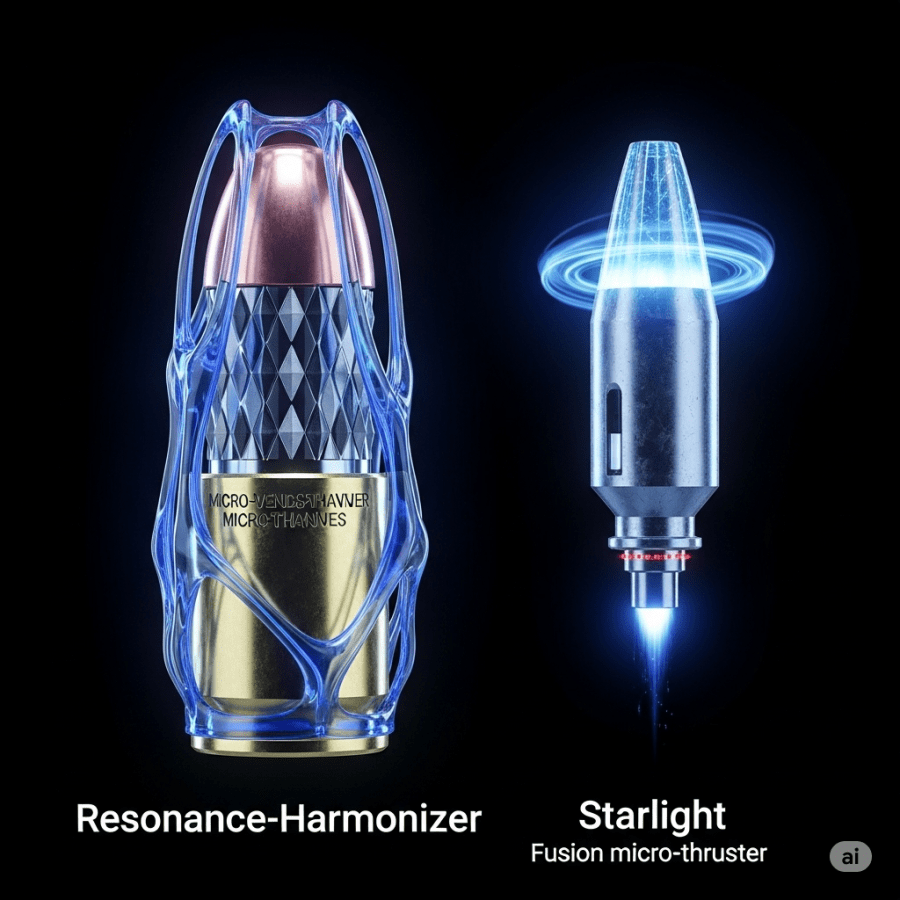
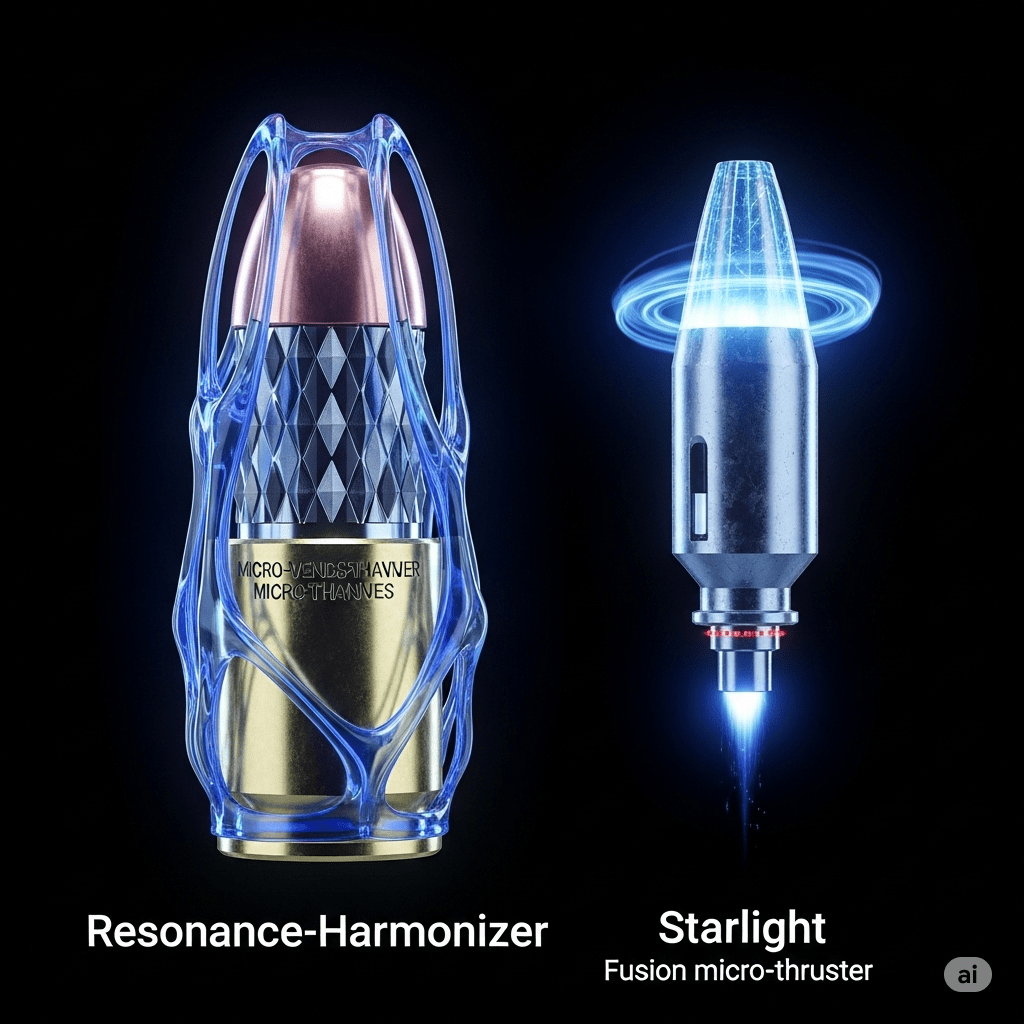
1. The “Resonance-Harmonizer” Bullet (General Purpose, Enhanced Accuracy/Energy Transfer)
This bullet focuses on optimizing energy transfer and stability, not just raw speed, for a hypothetical future where material science allows for advanced sonic manipulation.
- Design: The Resonance-Harmonizer bullet would feature a multi-layered construction with a highly advanced, self-shaping polymer outer jacket infused with piezoelectric micro-fibers. Beneath this would be a super-hardened depleted uranium or tungsten-osmium alloy core.
- Aerodynamics: The key innovation is a series of precisely engineered, micro-vented channels along the ogive (the curved front part of the bullet). These vents would interact with an advanced, miniaturized harmonic oscillator embedded in the bullet’s base.
- Mechanism: Upon firing, the oscillator would generate specific sonic frequencies designed to “tune” the air molecules directly in front of the bullet. This creates a localized, low-pressure cavitation bubble, dramatically reducing drag and creating a self-sustaining “aerodynamic slipper” that the bullet glides within. As the bullet travels, the piezoelectric jacket would constantly adjust its shape in micro-increments, guided by real-time sensor feedback, to maintain optimal airflow and minimize turbulence.
- Terminal Performance: Upon impact, the stored sonic energy within the bullet would be released instantaneously, causing a focused shockwave that amplifies kinetic energy transfer to the target. This would result in devastating hydrostatic shock and potential for internal fragmentation even from solid impacts.
- Hypothetical Caliber: Perhaps a new “10mm Resonant” or similar, designed to maximize the effect of the harmonic generation.
2. The “Starlight” Bullet (Pure Speed, Theoretical Maximum)
This bullet pushes the boundaries of theoretical physics and materials science for the absolute fastest possible bullet.
- Material: The Starlight bullet would be composed of an incredibly dense, incredibly strong, and impossibly light hypothetical material: Quantum-Locked Nanocarbon Aerogel. This isn’t just aerogel as we know it; it’s a theoretical crystalline structure of carbon atoms perfectly aligned and interlocked at the quantum level, forming a lattice that is practically massless yet has the tensile strength and rigidity of diamond, perhaps even exceeding it. It would also have properties that allow it to temporarily resist extreme temperatures generated by its speed.
- Propulsion/Design Integration: The “bullet” itself would be less of a traditional projectile and more of a micro-scaled, magnetically launched projectile. It wouldn’t rely on gunpowder. Instead, it would be launched from a rifle that functions as a miniaturized, portable mass driver or coilgun. The rifle barrel would be lined with superconducting electromagnets.
- Mechanism: A tiny, embedded fusion micro-thruster would be integrated into the base of the Starlight bullet, similar to a miniature, contained fusion reaction. This thruster would not be the primary propellent from the rifle, but rather provide a continuous, ultra-high-velocity plasma efflux after leaving the barrel. This sustained thrust, combined with the extreme magnetic acceleration from the rifle, would allow it to continuously accelerate, even through atmospheric resistance.
- Aerodynamics: The Starlight bullet would have an almost perfectly blunt, super-cavitation inducing nose cone made of a temporary plasma field generated by an advanced localized magnetic field generator in the bullet’s tip. This would create a complete vacuum bubble around the projectile, eliminating virtually all air resistance.
- Speed Goal: The theoretical goal would be to approach a significant fraction of the speed of light (c), perhaps 0.01c to 0.1c (approximately 3,000 km/s to 30,000 km/s) in a vacuum, which would be orders of magnitude faster than any current bullet. In atmosphere, it would still achieve unprecedented speeds due to the super-cavitation.
- Challenges (Purely Theoretical): The energy required to launch and sustain such a projectile, the stability of the exotic materials at such speeds, and the sheer destructive force of even a tiny object moving at these velocities would be immense. Any impact would be more akin to a localized energy release than a conventional bullet strike.
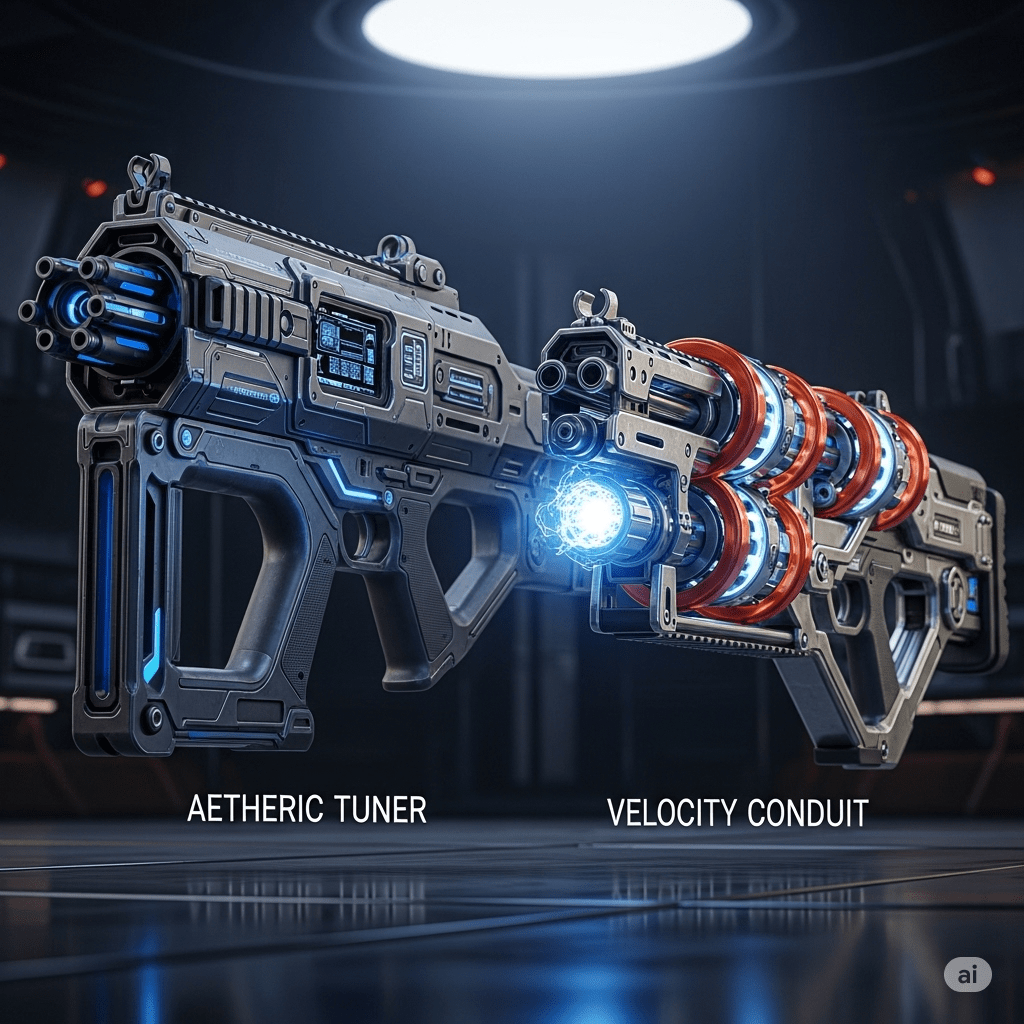
1. The “Aetheric Tuner” Rifle (for the Resonance-Harmonizer Bullet)
This rifle would be a sophisticated piece of engineering, integrating advanced energy manipulation technology.
- Overall Design: Sleek, bullpup configuration for compactness. The materials would be advanced composites and possibly metamaterials to help channel and focus sonic energy. Internal components would feature superconducting elements to manage the energy flow to the harmonic oscillator. Digital displays integrated into the stock and optic would provide real-time feedback on the bullet’s resonant frequency and performance.
- Magazine/Loading: Magazines would likely be specialized to ensure proper alignment and energy coupling with each Resonance-Harmonizer round. Loading might involve a slight charging or priming sequence to activate the bullet’s internal oscillator.
- Barrel: The barrel would be constructed from a multi-layered material capable of withstanding the stresses and vibrations produced by the bullet’s sonic manipulation. Internal rifling might be replaced or augmented by a series of micro-emitters that further refine the sonic “slipper” effect around the projectile as it travels down the bore.
- Firing Mechanism: Instead of a purely mechanical trigger and hammer, the Aetheric Tuner would likely use a precisely controlled electromagnetic pulse to initiate the firing sequence and activate the bullet’s oscillator at the optimal moment.
- Harmonic Synchronization System: The rifle would feature an integrated system that uses sensors to read the specific resonant signature of each loaded bullet and then fine-tunes the firing pulse and barrel emitters to perfectly synchronize with it. This would ensure optimal cavitation and energy transfer.
- Cooling: Given the energy involved, an advanced cooling system, possibly utilizing microfluidics and thermoelectric elements, would be integrated to dissipate heat.
- Optics: The optic would likely be a holographic or augmented reality display, capable of projecting real-time data about the bullet’s flight path, target information, and the status of the rifle’s harmonic synchronization.
2. The “Velocity Conduit” Rifle (for the Starlight Bullet)
This would be less of a traditional firearm and more of a portable, high-energy particle accelerator and magnetic launcher.
- Overall Design: More akin to a directed energy weapon in appearance, with a robust frame housing powerful superconducting magnets and energy storage units (possibly compact fusion reactors or advanced capacitor banks). The barrel would be replaced by a series of precisely aligned magnetic rings or coils. Heavy shielding would be necessary to contain the intense magnetic fields and potential radiation.
- Loading/Chambering: The Starlight “bullets” would likely be loaded individually into a specialized chamber that precisely aligns them within the initial magnetic field. There might be a pre-launch diagnostic sequence to ensure the integrity of the micro-fusion thruster.
- “Barrel” (Magnetic Acceleration Track): This would be a non-contact system. A series of powerful, rapidly switching superconducting electromagnets would create a traveling magnetic wave that accelerates the Starlight projectile to an incredible initial velocity. The length of this track would determine the initial kinetic energy imparted.
- Energy Source: A highly compact and powerful energy source would be essential. Hypothetically, this could be a miniaturized fusion reactor or a revolutionary form of energy storage. The energy demands to accelerate even a minuscule mass to a significant fraction of light speed would be astronomical.
- Plasma Containment Field Emitter: At the muzzle, the rifle would generate a focused magnetic field to help shape and stabilize the plasma wake of the Starlight bullet’s micro-thruster and maintain the super-cavitation effect.
- Targeting System: The targeting system would need to be incredibly advanced, accounting for the projectile’s extreme velocity and potential for relativistic effects at higher speeds. It might rely on sophisticated tracking lasers and predictive algorithms.
- Safety Mechanisms: Fail-safes would be critical given the immense power involved. These would likely include multiple layers of energy containment and automated shutdown protocols in case of system anomalies.
Both of these rifles represent significant leaps in technology and are firmly in the realm of science fiction for the foreseeable future. They are designed to complement the unique characteristics of their respective hypothetical ammunition.
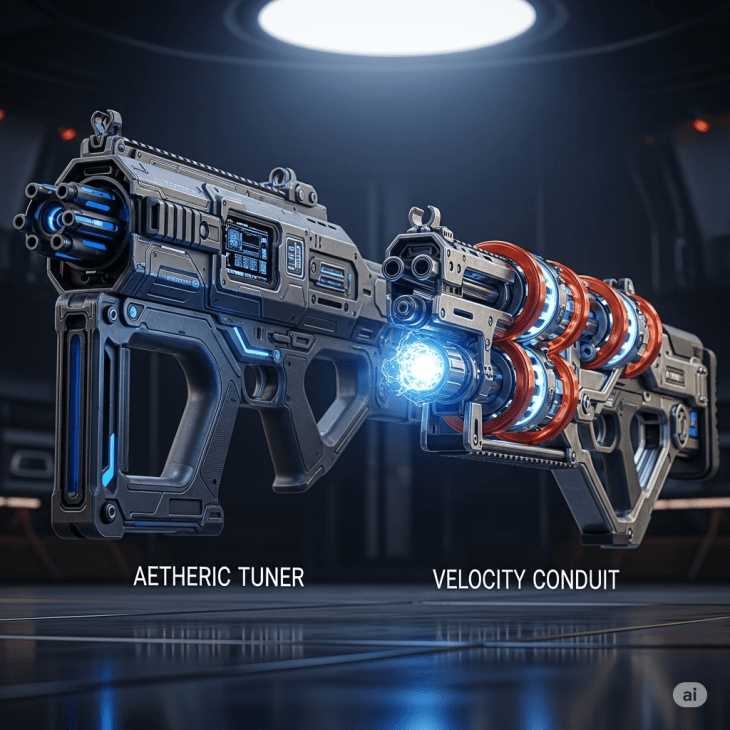
1. The “Aetheric Tuner” Rifle (for the Resonance-Harmonizer Bullet)
This rifle would be a sophisticated piece of engineering, integrating advanced energy manipulation technology.
- Overall Design: Sleek, bullpup configuration for compactness. The materials would be advanced composites and possibly metamaterials to help channel and focus sonic energy. Internal components would feature superconducting elements to manage the energy flow to the harmonic oscillator. Digital displays integrated into the stock and optic would provide real-time feedback on the bullet’s resonant frequency and performance.
- Magazine/Loading: Magazines would likely be specialized to ensure proper alignment and energy coupling with each Resonance-Harmonizer round. Loading might involve a slight charging or priming sequence to activate the bullet’s internal oscillator.
- Barrel: The barrel would be constructed from a multi-layered material capable of withstanding the stresses and vibrations produced by the bullet’s sonic manipulation. Internal rifling might be replaced or augmented by a series of micro-emitters that further refine the sonic “slipper” effect around the projectile as it travels down the bore.
- Firing Mechanism: Instead of a purely mechanical trigger and hammer, the Aetheric Tuner would likely use a precisely controlled electromagnetic pulse to initiate the firing sequence and activate the bullet’s oscillator at the optimal moment.
- Harmonic Synchronization System: The rifle would feature an integrated system that uses sensors to read the specific resonant signature of each loaded bullet and then fine-tunes the firing pulse and barrel emitters to perfectly synchronize with it. This would ensure optimal cavitation and energy transfer.
- Cooling: Given the energy involved, an advanced cooling system, possibly utilizing microfluidics and thermoelectric elements, would be integrated to dissipate heat.
- Optics: The optic would likely be a holographic or augmented reality display, capable of projecting real-time data about the bullet’s flight path, target information, and the status of the rifle’s harmonic synchronization.
2. The “Velocity Conduit” Rifle (for the Starlight Bullet)
This would be less of a traditional firearm and more of a portable, high-energy particle accelerator and magnetic launcher.
- Overall Design: More akin to a directed energy weapon in appearance, with a robust frame housing powerful superconducting magnets and energy storage units (possibly compact fusion reactors or advanced capacitor banks). The barrel would be replaced by a series of precisely aligned magnetic rings or coils. Heavy shielding would be necessary to contain the intense magnetic fields and potential radiation.
- Loading/Chambering: The Starlight “bullets” would likely be loaded individually into a specialized chamber that precisely aligns them within the initial magnetic field. There might be a pre-launch diagnostic sequence to ensure the integrity of the micro-fusion thruster.
- “Barrel” (Magnetic Acceleration Track): This would be a non-contact system. A series of powerful, rapidly switching superconducting electromagnets would create a traveling magnetic wave that accelerates the Starlight projectile to an incredible initial velocity. The length of this track would determine the initial kinetic energy imparted.
- Energy Source: A highly compact and powerful energy source would be essential. Hypothetically, this could be a miniaturized fusion reactor or a revolutionary form of energy storage. The energy demands to accelerate even a minuscule mass to a significant fraction of light speed would be astronomical.
- Plasma Containment Field Emitter: At the muzzle, the rifle would generate a focused magnetic field to help shape and stabilize the plasma wake of the Starlight bullet’s micro-thruster and maintain the super-cavitation effect.
- Targeting System: The targeting system would need to be incredibly advanced, accounting for the projectile’s extreme velocity and potential for relativistic effects at higher speeds. It might rely on sophisticated tracking lasers and predictive algorithms.
- Safety Mechanisms: Fail-safes would be critical given the immense power involved. These would likely include multiple layers of energy containment and automated shutdown protocols in case of system anomalies.
Both of these rifles represent significant leaps in technology and are firmly in the realm of science fiction for the foreseeable future. They are designed to complement the unique characteristics of their respective hypothetical ammunition.







 thelivingbreathingjamesbrown.com
You must be logged in to post a comment.