
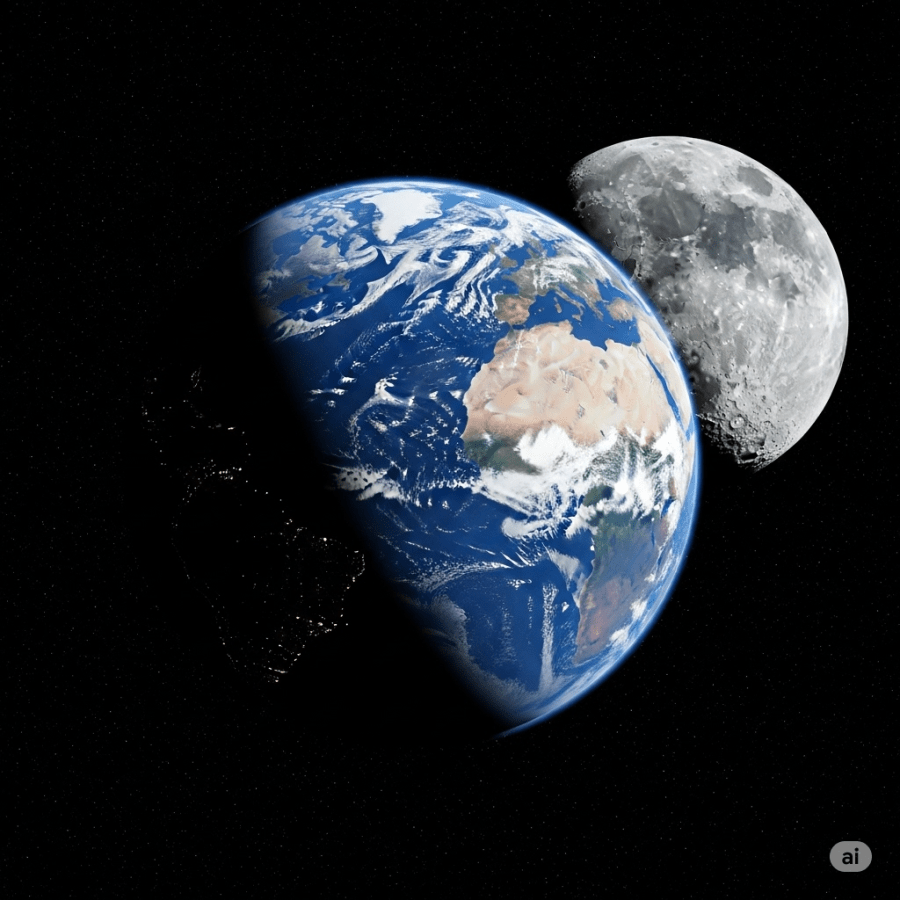

What if Earth was the only planet in our solar system that developed complex, multicellular life, and the Moon played a critical, unique role in enabling it?
This scenario highlights Earth’s particular circumstances and elevates the Moon’s significance beyond just tides.
- Plausibility: We currently have no definitive proof of complex multicellular life anywhere else in our solar system, making Earth unique in this regard from what we know. The Moon’s role is also increasingly understood as crucial.
- Stabilizing Earth’s Tilt: The Moon’s relatively large size for a natural satellite acts as a gravitational anchor, stabilizing Earth’s axial tilt. Without it, Earth’s tilt would wobble much more dramatically over geological timescales, leading to extreme and erratic climate swings. Such instability could have prevented the long periods of consistent environmental conditions necessary for complex life to evolve and diversify.
- Tides and Early Life: The Moon’s strong gravitational pull generates ocean tides. These tides are thought to have been vital in the early stages of life, creating intertidal zones where water and land met. This dynamic environment could have facilitated the mixing of chemicals, the concentration of organic molecules, and provided a “training ground” for early life forms to adapt to both aquatic and terrestrial conditions, potentially speeding up the transition of life from the oceans to land.
- Slowing Earth’s Rotation: Early Earth rotated much faster than it does today. The Moon’s gravitational drag has gradually slowed Earth’s rotation over billions of years, lengthening the day. Longer days likely allowed for more stable conditions for early life, perhaps reducing harsh daily temperature fluctuations.
- Implications:
- The Moon as a “Life-Giver”: This reframes the Moon not just as a celestial companion but as a fundamental enabler of life on Earth. It would be seen as an indispensable component of our planet’s habitability.
- Uniqueness of Earth-Moon System: It would suggest that the specific formation and subsequent co-evolution of the Earth-Moon system (possibly from a giant impact) created a highly unique set of conditions that were exceptionally rare, making Earth’s complex life an even more improbable outcome.
- Focus on Systemic Habitability: When searching for life elsewhere, scientists would prioritize finding exoplanetary systems with large, close-orbiting moons, understanding that a stable axial tilt and strong tidal forces might be more crucial for complex life than previously thought.
What if the Moon, early in its formation, briefly possessed a very tenuous, temporary atmosphere from volcanic outgassing, which then quickly dissipated due to its small size and lack of a strong magnetic field?
This scenario acknowledges what we know about the Moon’s history and geology while still allowing for a brief atmospheric phase.
- Plausibility:
- Volcanic Activity: The early Moon was far more volcanically active than it is today, evidenced by its vast ancient lava flows (the maria). Volcanic outgassing releases gases like water vapor, carbon dioxide, and sulfur compounds.
- Temporary Atmosphere: It’s plausible that this outgassing could have temporarily created a very thin, short-lived atmosphere – perhaps hundreds of millions of years ago when the Moon was still geologically active. This would be a tenuous atmosphere, far from breathable for humans, but enough to create a very brief, localized “fog” or hazy layer.
- Rapid Loss: Due to the Moon’s low gravity, small mass, and lack of a significant global magnetic field to deflect the solar wind, any such atmosphere would have been quickly stripped away into space, likely over tens of millions of years, not billions. This aligns with our understanding of how bodies like Mars lost their atmospheres. It would never have been “breathable” in the human sense.
- Implications:
- Brief Surface Water/Ice Stability: Even a thin atmosphere, combined with ancient volcanic heat, could have allowed for brief periods where liquid water might have existed on the surface in specific, protected areas, before it sublimated into space or froze solid. This could have facilitated the formation of subsurface ice deposits we see today.
- Redefining Lunar “Weather”: For a very short time, the early Moon might have experienced incredibly rudimentary “weather” – perhaps hazes, light frosts, or even brief cycles of sublimation and deposition of volatiles, rather than the utterly airless environment it quickly became.
- Implications for Astrobiology (Extremely Low Probability): While highly unlikely to support complex life, it raises the tiniest hypothetical possibility that extremely simple, hardy extremophiles could have briefly existed in protected niches if the conditions were just right and if life could have arrived via panspermia. However, the window would have been too short and the conditions too harsh for indigenous life to evolve.
- Geological Insight: Studying evidence of such a brief, early lunar atmosphere (e.g., specific mineral alterations in ancient rocks) could provide even more detailed insights into the Moon’s early thermal and geological evolution.
These refined scenarios stay grounded in established science while still allowing for fascinating “what if” discussions about our cosmic neighborhoods.
 thelivingbreathingjamesbrown.com
You must be logged in to post a comment.