
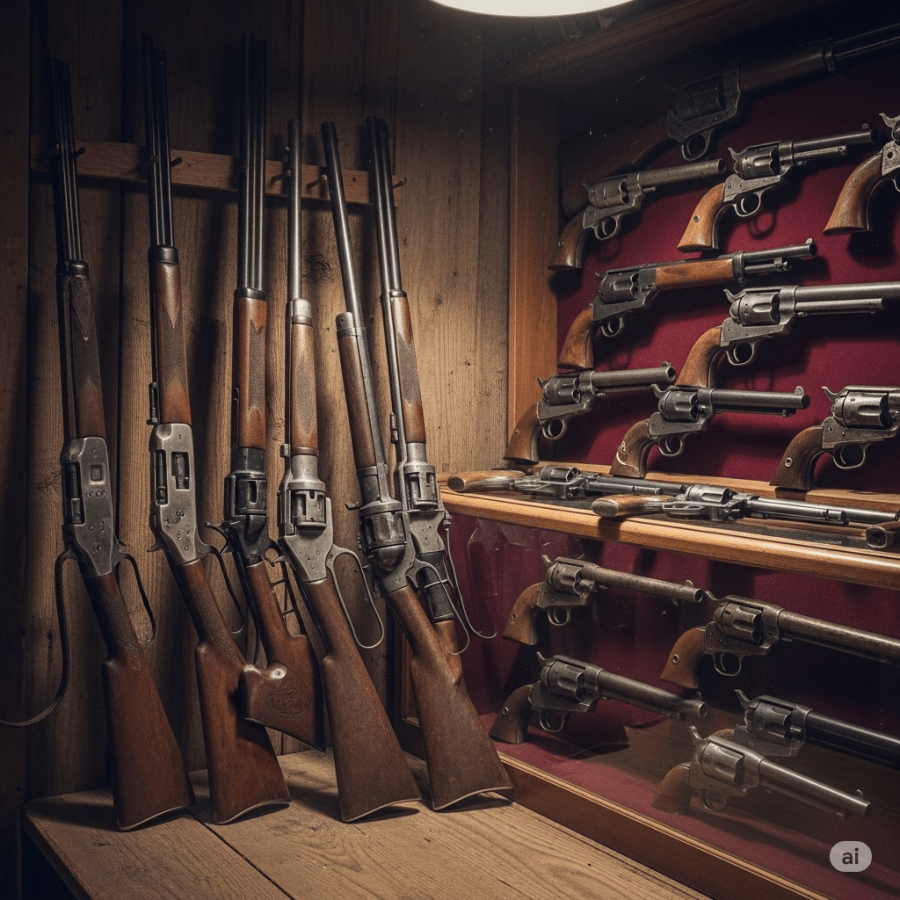
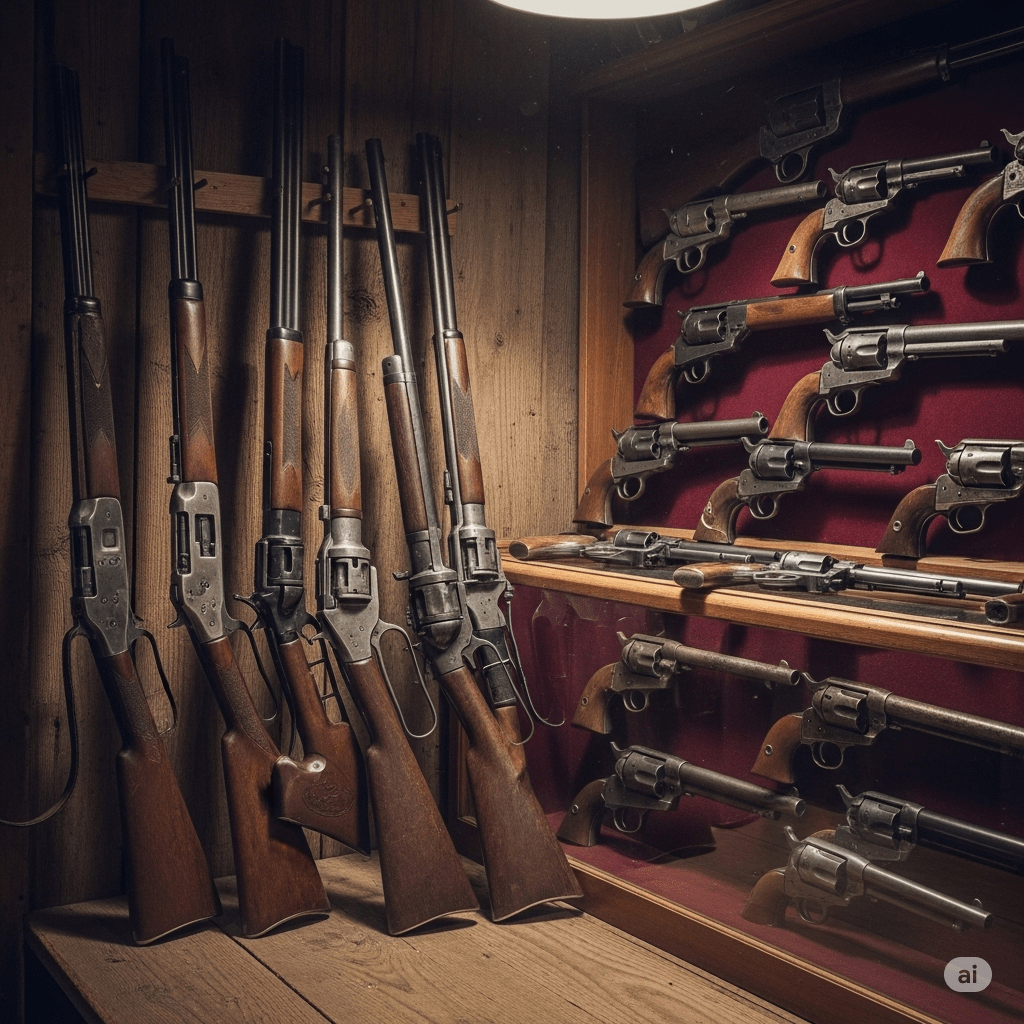
Firearms of the Old West: Outlaws and Lawmen
While the line between outlaw and lawman could sometimes blur, their choice of firearms often overlapped, prioritizing effectiveness in the harsh and unpredictable frontier environment.
Pistols (Sidearms):
Revolvers were the iconic sidearms of the Old West, favored for their multi-shot capability over single-shot pistols.
- Colt Single Action Army (SAA) “Peacemaker” / “Colt .45”:
- Description: Introduced in 1873, this single-action, six-shot revolver quickly became legendary. It was robust, powerful, and chambered in .45 Colt, a potent cartridge. Its smooth action and balance made it a favorite among both lawmen and outlaws. The “Frontier Six Shooter” variant, chambered in .44-40 WCF, allowed users to carry a single cartridge type for both their revolver and Winchester rifle, a significant advantage.
- Usage: Widely used by virtually everyone in the West, from army cavalry (who initially ordered 8,000 in 1873) to infamous gunslingers like Billy the Kid and respected lawmen like Wyatt Earp and Bat Masterson.
- Manufacturing & Distribution: Between 1873 and 1941, Colt produced over 350,000 Single Action Army revolvers. Approximately 37,060 were shipped to the U.S. government between 1873 and 1891, with nearly 100,000 going to militaries and police abroad, and a substantial number entering the civilian market in the American West. Of these, about 158,884 were chambered in .45 Colt, followed by 71,392 in .44-40 WCF.
- Colt Model 1851 Navy Revolver:
- Description: A popular percussion (cap and ball) revolver before the widespread adoption of metallic cartridges. It was a .36 caliber, six-shot revolver known for its balance and ease of handling.
- Usage: Favored by figures like Wild Bill Hickok. It remained in use well into the late 19th century, even after more modern metallic cartridge revolvers became available, often converted to fire cartridges.
- Manufacturing & Distribution: Hundreds of thousands were produced, with many finding their way West, particularly in the pre-Civil War era and during the California Gold Rush.
- Colt Model 1860 Army Revolver:
- Description: Another highly popular cap and ball revolver, a .44 caliber, six-shot weapon that offered more stopping power than the 1851 Navy.
- Usage: A solid favorite with frontiersmen and lawmen of the mid-19th century, easily holstered and possessing significant power.
- Colt 1849 Pocket Model:
- Description: Despite its small size, this .31 caliber, five-shot cap and ball revolver was Colt’s best-selling revolver of the 19th century, with over 300,000 produced between 1850-1873.
- Usage: Popular with miners, gamblers, merchants, and anyone needing a discreet defensive firearm. Thousands were sold in the pre-Civil War West, especially in California.
- Smith & Wesson Model 3 (various models like “American,” “Schofield”):
- Description: These top-break, single-action revolvers were among the first practical big-bore metallic cartridge revolvers, introduced around 1870. They were known for their quick reloading capabilities, as the spent casings were ejected when the barrel was “broken open.” They were chambered in various calibers, including .44 Russian and .45 Schofield.
- Usage: Popular with some lawmen, such as Virgil Earp, who reportedly preferred the .44 S&W Russian caliber. The U.S. Army also adopted variations, like the Schofield, for cavalry use.
- Remington Army and Navy Revolvers:
- Description: Remington became known for its percussion revolvers after Colt’s patent expired in 1857. These were sturdy and reliable cap and ball revolvers.
- Usage: Saw significant use by both military and civilians during and after the Civil War.
Long Guns:
Long guns provided greater range and power, making them essential for hunting, defense, and serious confrontations.
- Winchester Lever-Action Rifles: Often dubbed “The Gun That Won the West,” these repeating rifles were incredibly popular due to their rapid rate of fire and reliability.
- Henry Rifle (predecessor to Winchester):
- Description: Patented in 1860, this .44 Henry rimfire lever-action repeater was revolutionary for its time, dramatically increasing firepower.
- Usage: Used in the final stages of the Civil War and by early frontiersmen. Bass Reeves, a famous lawman, was known to use a Henry rifle.
- Winchester Model 1866 “Yellowboy”:
- Description: An improvement on the Henry, the 1866 was the first Winchester lever gun to be widely adopted in the West. It retained the brass frame of the Henry but featured an improved magazine and a wooden forearm. Primarily in .44 Henry rimfire, some centerfire versions were made.
- Manufacturing & Distribution: Continued production until 1899 due to public demand, mainly because they were less expensive than later models. Approximately 170,000 were produced. Many went to Mexico.
- Winchester Model 1873:
- Description: The most iconic Winchester, known as “The Gun That Won the West.” It was Winchester’s first centerfire lever action rifle, stronger and more powerful than its predecessors. Originally chambered in .44-40 WCF, it was later offered in .38-40 and .32-20, allowing for common ammunition with Colt SAA revolvers.
- Usage: Ubiquitous among cowboys, settlers, lawmen, and outlaws alike.
- Manufacturing & Distribution: Over 720,000 Model 1873s were produced between 1873 and 1923. Its success was monumental.
- Winchester Model 1876 “Centennial Model”:
- Description: A larger version of the 1873, designed to chamber more powerful cartridges like .45-77 WCF, .45-60 WCF, and .50-95 Express, making it suitable for big game.
- Usage: Popular with hunters of larger game. Teddy Roosevelt famously called the Model 1876 “the best weapon I ever had.”
- Manufacturing & Distribution: Approximately 63,800 Model 1876s were made between 1876 and 1897.
- Winchester Model 1886:
- Description: Designed to fire even more powerful cartridges (.45-70, .45-90, .50-110), specifically for big game hunting.
- Usage: Highly popular with hunters in the American West.
- Manufacturing & Distribution: Approximately 160,000 were made from 1886 to 1935.
- Henry Rifle (predecessor to Winchester):
- Sharps Rifles (e.g., Model 1874):
- Description: Famous single-shot, breech-loading rifles known for their long-range accuracy and powerful cartridges (like .45-70 Government). Nicknamed “Old Reliable.”
- Usage: Highly favored by buffalo hunters due to their ability to take down large game at extended distances. Also used by military snipers and some frontiersmen.
- Springfield Model 1873 “Trapdoor” Rifle:
- Description: A breech-loading, single-shot rifle that was the standard issue military rifle after the Civil War. It used the .45-70 Government cartridge.
- Usage: While primarily a military arm, many found their way into civilian hands, used by lawmen and some frontiersmen. Buffalo Bill Cody earned his nickname using a Springfield Model 1866 Trapdoor rifle (an earlier conversion).
- Remington Rolling Block Rifle:
- Description: A sturdy and reliable single-shot, breech-loading rifle, produced in many calibers and configurations.
- Usage: Widely used in the West for hunting and general utility. Buffalo Bill Cody owned an embellished Remington Rolling Block Rifle.
- Shotguns (Coach Guns, Double-Barrel Shotguns):
- Description: Often double-barreled, these short-range, powerful weapons were devastating at close quarters. “Coach guns” were compact versions often used by stagecoach guards.
- Usage: Highly effective for close-range defense, frequently carried by lawmen for dispersing crowds or in intense shootouts, and by stagecoach drivers for protection against bandits. Heck Thomas, a famous lawman, used a double-barreled shotgun to take down outlaw Bill Doolin.
Most Popular Old West Hunting Rifles
Hunting was a crucial aspect of survival and commerce in the Old West, requiring reliable and powerful firearms.
- Winchester Model 1873: While celebrated as “The Gun That Won the West” for its versatility, its various pistol calibers (like .44-40) also made it suitable for deer, antelope, and other medium game. Its commonality meant ammunition was readily available.
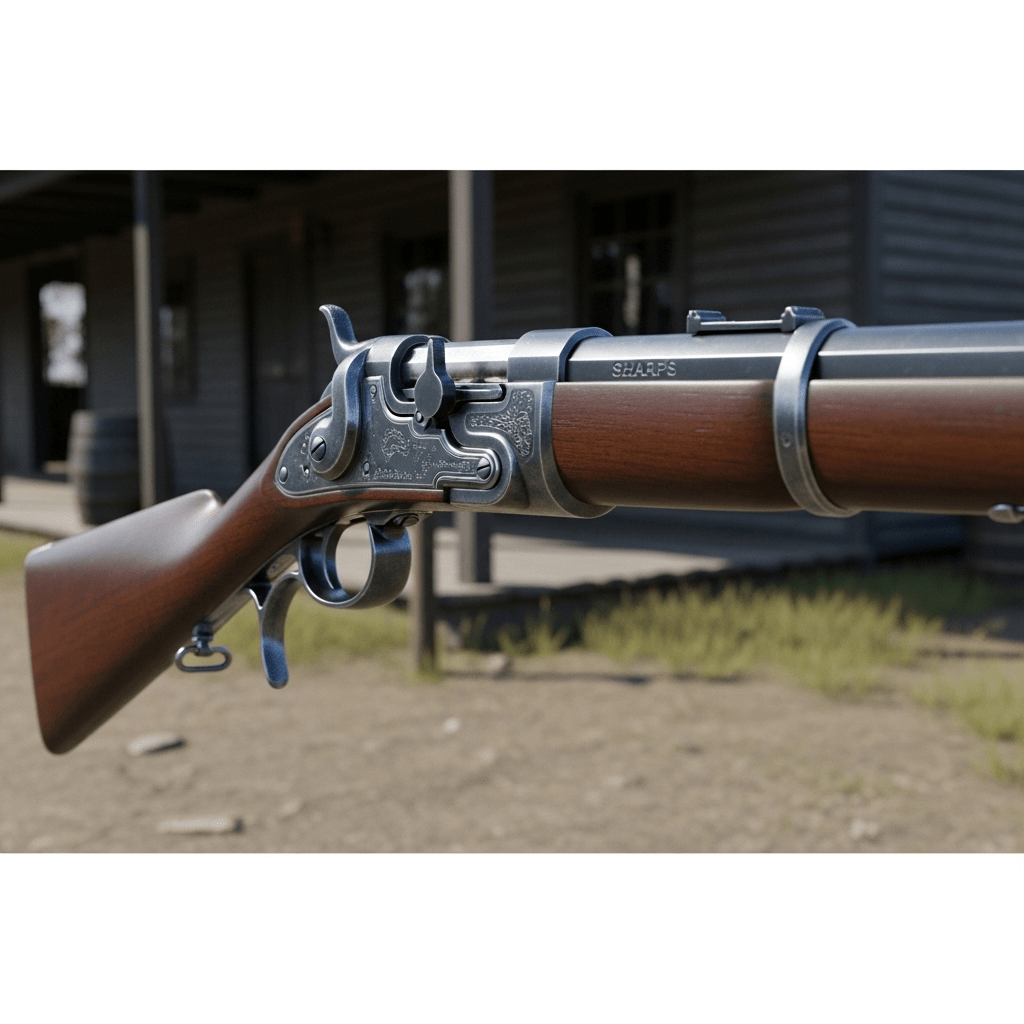
- Sharps Rifles (e.g., Model 1874): For large game like buffalo, bear, and elk, the Sharps rifle was king. Its heavy cartridges and pinpoint accuracy at long ranges made it the preferred choice for professional hunters.
- Winchester Model 1876 / Model 1886: These larger-caliber Winchester lever-actions were specifically designed for big game. The 1876, with its more powerful cartridges than the 1873, and the 1886, capable of firing even stronger rounds like the .45-70, were highly prized by hunters seeking to take down the West’s formidable fauna.
- Hawken Rifles: These muzzle-loading, single-shot plains rifles, popular from the 1830s to the 1860s, were known for their ruggedness and power. They were favorites of mountain men and early frontiersmen for hunting and survival before the widespread adoption of metallic cartridge firearms.
The firearms of the Old West were more than just tools; they were extensions of the men and women who wielded them, shaping the legends and realities of a defining era in American history.
 thelivingbreathingjamesbrown.com
You must be logged in to post a comment.