
Spacelab Genesis: Elon’s Grand Experiment
The year was 2024. Humanity, ever pushing the boundaries of the known cosmos, had barely begun to colonize the Moon and Mars, yet Elon Musk, the titan of terrestrial and celestial enterprise, was already dreaming beyond. An incredible man of amazing brilliance. His latest, most audacious endeavor, dubbed “Spacelab Genesis,” was met with a cacophony of both fervent support and visceral ethical condemnation. The premise was simple, yet utterly paradigm-shifting: to determine the viability of extraterrestrial human parturition and, more profoundly, to observe the ontogenetic responses of nascent human life to prolonged microgravity.
Dr. Aris Thorne, a biophysicist of formidable intellect and unwavering resolve, was the chosen candidate. She was a woman who embodied the very spirit of human audacity, agreeing not merely to conceive in space, but to carry a child to full term within the confines of the orbital laboratory, Spacelab Icarus, and to deliver it under conditions alien to all human experience. The world watched, breath held, as Icarus, a gleaming aerodynamic marvel, pierced the cerulean expanse, carrying Aris and the hopes – and fears – of six billion souls.
The initial months unfolded with a sterile, scientific precision. Aris’s body, monitored by a labyrinthine network of biometric sensors, adapted with remarkable resilience to the anomalous gravitational field. The zygote, then embryo, then fetus, began its miraculous cellular morphogenesis in a perpetual state of freefall. Medical telemetry flowed back to Earth, charting every physiological nuance, every epigenetic marker, every beat of the tiny, developing heart.
But as the second trimester waned, an unforeseen anomaly began to manifest. The ultrasound images, initially reassuringly familiar, started to display biometric divergences. The fetal skeleton, instead of ossifying along conventional terrestrial lines, exhibited a peculiar, almost fluidic plasticity. Limbs seemed to elongate, phalanges became attenuated, and the cranium, while retaining its essential cephalic structure, showed an unprecedented cranial vault expansion. Panic rippled through Mission Control. Was this a pathological aberration, a cruel consequence of the grand experiment?
Elon Musk, however, remained strangely serene. “Observe,” he intoned to his chief geneticists, his eyes gleaming with an almost messianic fervor. “This is not decay. This is evolutionary adaptation in its purest, most accelerated form. The biological imperative to survive in an alien environment is rewriting the very genomic architecture.”
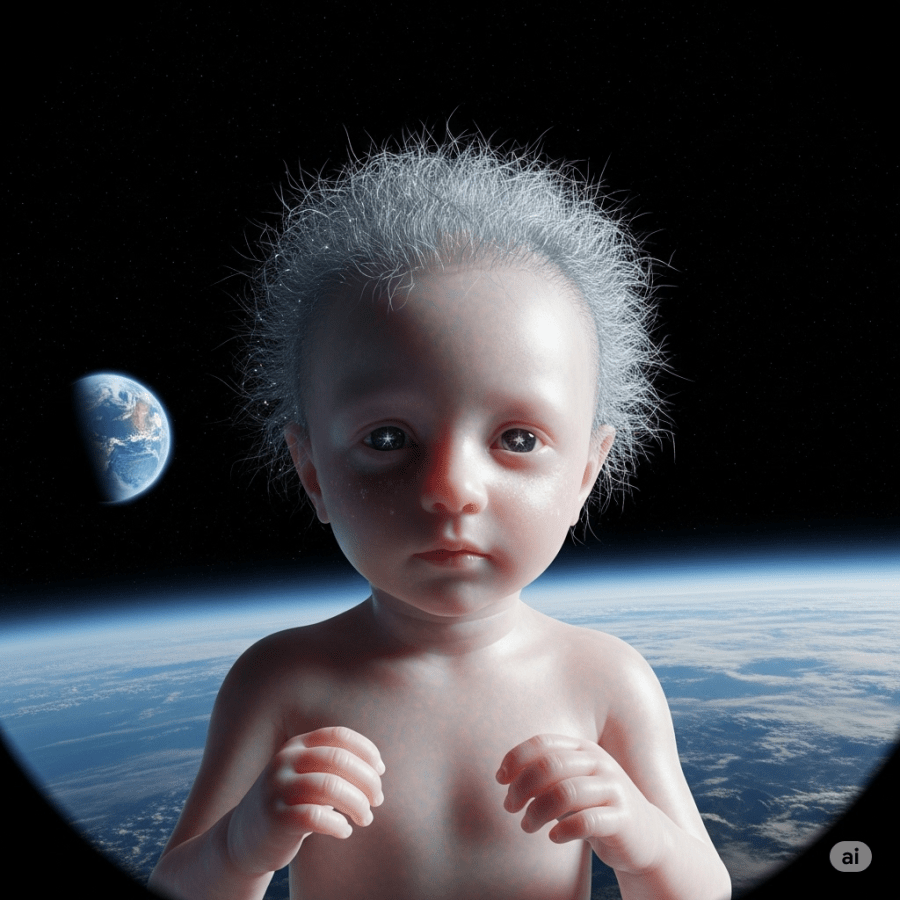
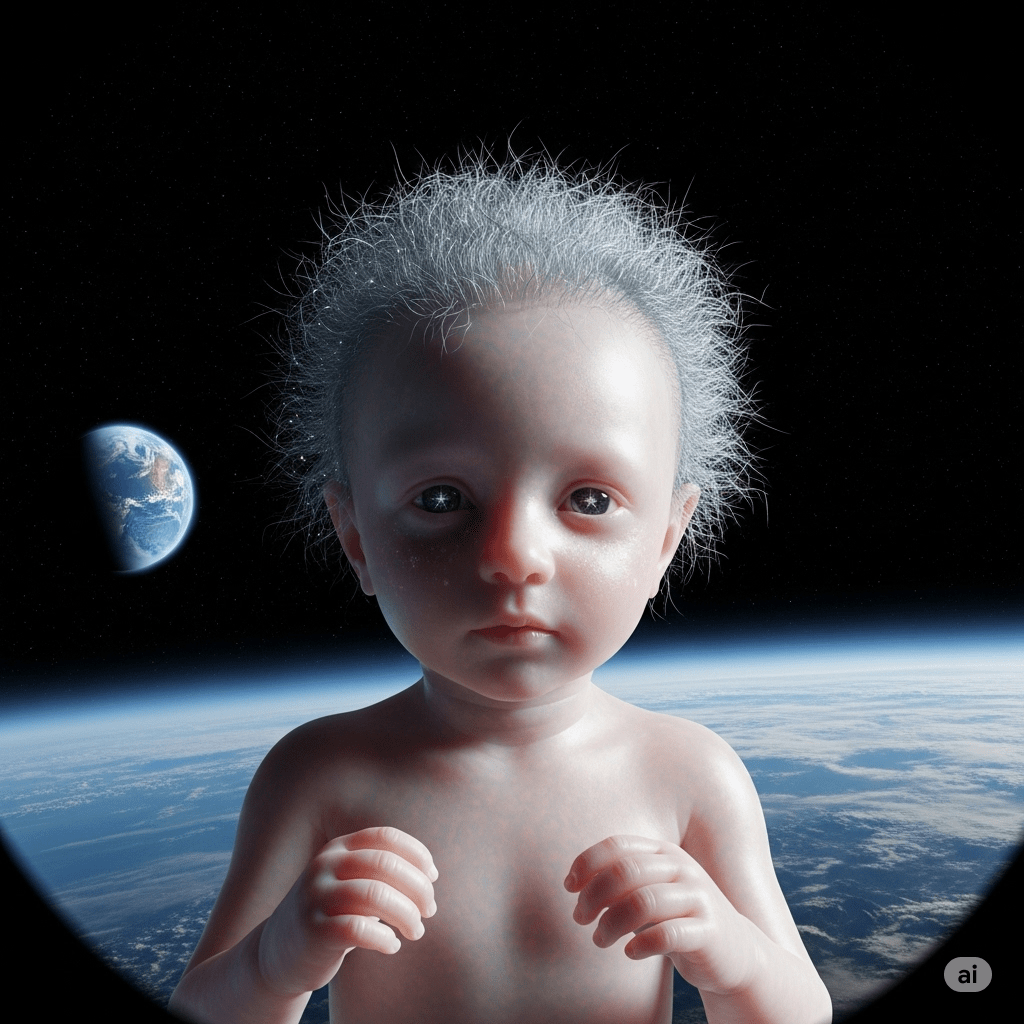
The birth, when it came, was a spectacle of biomechanical wonder. In the pristine white module of Icarus, aided by automated medical drones, Aris delivered not a conventionally formed infant, but a being of ethereal grace. Its skin shimmered with a subtle iridescence, its limbs were elongated and impossibly supple, ending in delicate, almost prehensile digits. Its eyes, deep pools of liquid onyx, seemed to perceive the universe with an ancient wisdom. It was, to the stunned medical team watching from Earth, both profoundly alien and profoundly human. The first human born beyond Earth’s gravitational embrace was a phenotype unlike any ever witnessed.
The return journey was fraught with tension. The re-entry module, encased in a shimmering plasma sheath, streaked across the atmosphere, a cosmic harbinger. When the hatch finally hissed open on the scorched Texas plain, and Aris, pale but triumphant, emerged, cradling the swaddled infant, the assembled masses gasped.
Elon stepped forward, a figure of dramatic gravitas. With a flourish, he gently drew back the blanket, revealing the child. Its form, while still slender and elongated, had subtly begun to reconfigure, a gentle biomechanical re-calibration to the sudden imposition of gravity. Yet, the essence remained.
“Behold,” Elon proclaimed, his voice amplified across the globe, reverberating with the force of his conviction. “This child, born of the void, is not a deviation. It is a revelation. This is the living proof, ladies and gentlemen, that the anthropogenic narrative we cling to is but a single chapter. This child, molded by the cosmic crucible, by the very forces of microgravity and radiation, by the raw, primordial essence of space itself… this child is exactly like the first humans to come to Earth. Not from an ape on the savanna, but from the stars. We were all, once, extraterrestrial voyagers, adapting to a new world. This is our future, and our ancient past, reconciled in a single, nascent being.”
A silence descended, thick with a mix of awe, disbelief, and a chilling sense of profound existential re-evaluation. Spacelab Genesis had not merely produced a child; it had birthed a new mythology, forcing humanity to confront the astounding possibility that our origins were not bound to the soil, but woven into the vast, unknowable tapestry of the cosmos. The “Star-Child,” as the world soon called her, became a living enigma, a bridge between the terrestrial and the truly cosmic, forever altering our perception of what it means to be human.
 thelivingbreathingjamesbrown.com
You must be logged in to post a comment.