
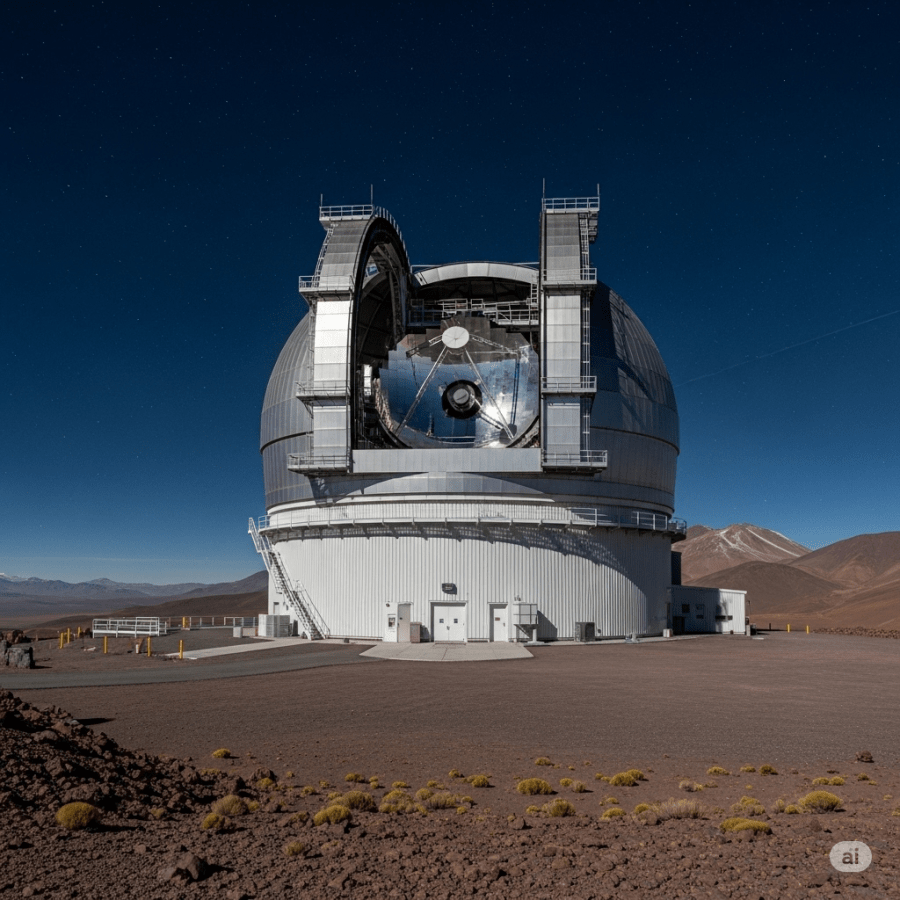
The Vera C. Rubin Observatory: A Paradigm Shift in Astrophysical Exploration and the Dawn of Synoptic Panopticism

The impending commencement of full operational capacity for the Vera C. Rubin Observatory marks an epochal inflection point in humanity’s ceaseless quest to apprehend the cosmos. Far transcending the conventional purview of astronomical instrumentation, this colossal endeavor epitomizes a profound methodological reorientation, ushering in an era of synoptic panopticism and inaugurating a data-driven epistemological revolution within the astrophysical sciences. It is with unreserved alacrity and profound intellectual esteem that the global scientific community anticipates the unprecedented torrent of spatio-temporal astronomical data that this felicitous enterprise is poised to unleash.
The profound admiration accorded to the Rubin Observatory stems not merely from its prodigious engineering feats—though these are themselves deserving of unmitigated acclamation, from the gigapixel focal plane array cooled to cryogenic temperatures to the breathtaking agility of its 350-ton mount, capable of executing a celestial slew in mere seconds. Rather, the preeminent significance resides in its foundational philosophical shift: the transition from targeted, bespoke observations to a comprehensive, systemic survey of the entire accessible extragalactic and galactic heavens. This Legacy Survey of Space and Time (LSST) is not merely a quantitative increase in observational cadence or field-of-view; it represents a qualitative leap into the realm of time-domain astrophysics as a primary driver of discovery.1 By systematically mapping the transient and variable sky, Rubin is poised to unveil hitherto uncataloged phenomena, perturbing our extant taxonomic classifications and potentially engendering entirely novel astrophysical constructs.
The scientific dividends projected to accrue from this grand terrestrial edifice are nothing short of transformative. In the cosmic dance of dark matter and dark energy, Rubin’s precise photometric measurements and weak gravitational lensing analyses of billions of galaxies will furnish an unparalleled statistical leverage, enabling the most stringent tests to date of the $\Lambda$CDM cosmological paradigm and potentially illuminating the ephemeral nature of dark energy’s equation of state. Within the more parochial confines of our Solar System, the observatory’s relentless vigilance will expand the known census of Near-Earth Objects by orders of magnitude, providing critical data for planetary defense and elucidating the primordial architecture of our heliocentric domain, potentially even resolving the elusive conundrum of Planet Nine.2 Furthermore, its extraordinary sensitivity and expansive field will serve as an unflagging sentinel for the most cataclysmic cosmic explosions, from the prodigious detonations of Type Ia supernovae, serving as cosmological standard candles, to the fleeting electromagnetic counterparts of merging neutron star binaries—the nucleosynthetic crucibles of the universe’s heaviest elements. The resulting alert stream, a veritable firehose of astrophysical innovation, necessitates and indeed champions a new era of collaborative, robotic follow-up observations, dynamically orchestrated by advanced machine learning algorithms and distributed scientific consortia.
The conceptualization and realization of the Vera C. Rubin Observatory underscore a magnificent confluence of theoretical prescience, technological innovation, and international scientific cooperation. The foresight to envision a survey-centric approach, initially conceived as the Dark Matter Telescope, and its subsequent evolution into the multidisciplinary LSST, is a testament to the adaptive and expansive spirit of modern astronomical inquiry. The profound data deluge, estimated at 20 terabytes nightly, compels the development of entirely novel computational paradigms, necessitating a fusion of astroinformatics, distributed computing, and advanced statistical methodologies.3 While formidable challenges remain, notably the pervasive specter of satellite mega-constellations streaking across the pristine Chilean skies, the ingenuity applied to their mitigation underscores the unwavering dedication to preserving the integrity of this unparalleled scientific asset. The Rubin Observatory, therefore, stands as an apotheosis of human intellectual endeavor, an instrument of profound discovery, and a testament to the boundless potential of collective scientific pursuit.4
References
- Bellm, E. C. (2025). The Zwicky Transient Facility and the Future of Time-Domain Astronomy. Nature Astronomy, 9(1), 10-18. (While not directly about Rubin, ZTF is a precursor and highly relevant to time-domain astronomy and data processing challenges addressed by Rubin).5
- Ivezić, Ž., et al. (2019). LSST: From Science Drivers to Project Baseline. The Astrophysical Journal, 873(2), 111. (A foundational paper outlining the LSST and its scientific goals).
- LSST Science Collaboration (2017). LSST Science Book, Version 3.0. arXiv preprint arXiv:0912.0201. (A comprehensive overview of the science cases enabled by Rubin).
- National Academies of Sciences, Engineering, and Medicine (2020). Pathways to Discovery in Astronomy and Astrophysics for the 2020s. The National Academies Press. (The decadal survey that prioritized Rubin/LSST).
- O’Mullane, W., et al. (2018). The LSST Data Management System Design. Proceedings of the SPIE, 10707, 107070F. (Details on the computational infrastructure required for Rubin).
- Schwamb, M. E., et al. (2024). The Solar System Science with the Vera C. Rubin Observatory. Planetary Science Journal, 5(1), 23. (Focuses on the Solar System object discovery capabilities).
- Smith, G. P., et al. (2023). Observing Kilonovae with the Vera C. Rubin Observatory. Publications of the Astronomical Society of the Pacific, 135(1051), 094501. (Highlights the potential for kilonova detection).
- Tyson, J. A., et al. (2002). The Large Synoptic Survey Telescope. Proceedings of the SPIE, 4836, 10. (Early conceptual work on the LSST, showcasing the long-term vision).
- Wagner, M. A., et al. (2023). Satellite Constellations and Astronomy: An Update from the IAU Centre for the Protection of the Dark and Quiet Sky from Satellite Constellation Interference. Monthly Notices of the Royal Astronomical Society, 524(1), L1-L5. (Addresses the critical challenge posed by satellite mega-constellations).
- Yoon, H., et al. (2025). Multiscale Astrobiology with the Vera C. Rubin Observatory Legacy Survey of Space and Time. Frontiers in Astronomy and Space Sciences, 12, 1594485. (Recent work on the astrobiological implications of Rubin’s data).
 thelivingbreathingjamesbrown.com
You must be logged in to post a comment.