
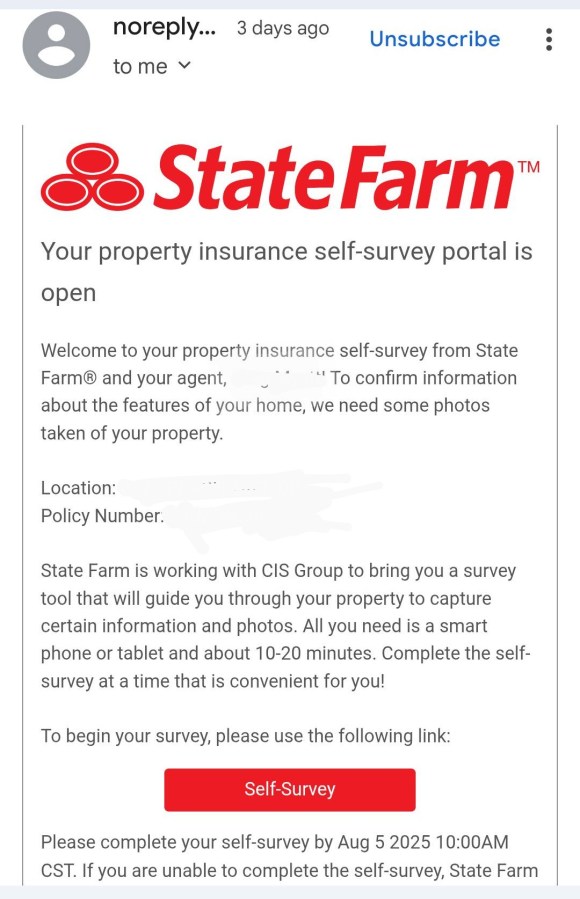
Did you just get a Notice from your Insurance Company for a Self Survey of your Property. I did. And I finished it yesterday? Below is what I got-
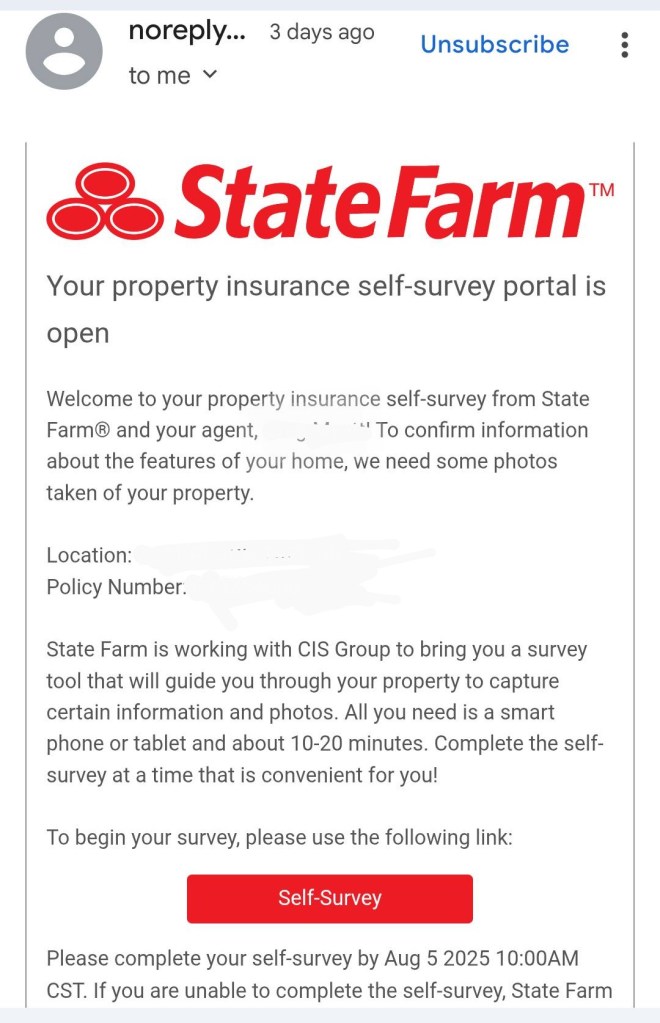
When you are ready to do your Self Survey, you just “click” on “Self Survey” and it’ll walk you thru what you need to do. And I read some things to watch out for on the Internet. Then I asked GEMINI AI about it and the following is what AI found.
It’s completely understandable that you’re feeling apprehensive about this self-survey request from State Farm, especially given the “bad stuff” you’ve read online and the fear of policy cancellation. This is indeed a relatively new approach for many homeowners, and the lack of clarity can be unsettling. Let’s break down everything about CIS Group’s Capture Q and insurance self-surveys.
CIS Group Capture Q and Insurance Self-Surveys
CIS Group is a company that provides risk analysis and valuation solutions to insurance companies. Capture Q is their product specifically designed for “Insured Self Surveys,” meaning it’s a platform that allows policyholders (like you) to conduct their own home inspections by taking and submitting photos and answering questions via a web-based application.
Why are insurance companies asking for self-surveys?
Insurance companies are increasingly adopting self-surveys for several reasons:
- Cost Reduction: Traditional in-person inspections are costly and time-consuming. Self-surveys can significantly reduce these operational expenses for insurers.
- Efficiency and Speed: Policyholders can complete surveys on their own time, often leading to faster data collection and policy adjustments. This can be beneficial for both new policies and renewals.
- Data Collection and Risk Assessment: The photos and information gathered through self-surveys provide insurers with up-to-date data on the condition of a property. This allows them to more accurately assess risk, determine appropriate premiums, and ensure the property’s replacement value is correctly insured.
- Customer Experience (purported): Insurers claim it offers a more convenient and less intrusive experience for policyholders compared to scheduling an in-person inspection.
The “Scary” Aspects and Common Concerns
Your feelings of fear and anxiety are widely shared among homeowners. Here’s why this is a “scary subject” for many:
- Fear of Policy Cancellation or Non-Renewal: This is arguably the biggest fear. Homeowners worry that if the self-survey reveals issues, even minor ones, their insurance company might cancel their policy or refuse to renew it.
- Reality: While insurance companies can cancel or non-renew policies based on property condition, they typically provide notice and an opportunity to fix issues. However, significant hazards or misrepresentations can lead to more immediate action.
- Increased Premiums: Discovery of issues or perceived increased risk through the survey could lead to higher premiums.
- Discovery of “Hidden” Issues: Homeowners worry about unknowingly submitting photos that reveal pre-existing conditions or issues they weren’t aware were problematic, leading to adverse outcomes. For example, your concern about showing “no mold” or having the “yard mowed” suggests an awareness of how perceived maintenance or subtle issues can be interpreted.
- Privacy Concerns: Submitting numerous photos of your home, inside and out, can raise privacy questions about how this data is stored, used, and shared.
- Lack of Expertise: Homeowners are not professional inspectors. They worry about missing something important or not accurately capturing the required information, leading to unintended consequences.
- Subjectivity of Interpretation: What looks “good” to a homeowner might be interpreted differently by an underwriter or a software program designed to detect specific risk factors.
- Technology Barrier: Not everyone is comfortable with or has access to the technology required to complete these surveys.
Positive Aspects (from the insurer’s perspective and some homeowner benefits)
While the concerns are significant, there are some perceived positives:
- Convenience: For those comfortable with technology, it can be more convenient than scheduling an in-person appointment and taking time off work.
- Empowerment (limited): Some homeowners might feel more in control of the process by directly providing the information.
- Potential for Discounts: If the survey reveals positive risk mitigation features (e.g., new roof, updated electrical, security systems), it could theoretically lead to discounts, though this is less commonly highlighted.
- Identification of Necessary Repairs: In some cases, the survey prompts might highlight areas of your home that genuinely need attention, which could prevent larger, more costly issues down the line.
Negative Aspects and Real-World Experiences
The “bad stuff” you read online is not uncommon. Here are some of the negative experiences and potential downsides:
- Mandatory Repairs: As you mentioned, people being required to get a new roof or fix a porch is a very real outcome. If the self-survey reveals deficiencies (e.g., an aging roof nearing the end of its lifespan, structural issues, or outdated systems like knob-and-tube wiring), the insurer might mandate repairs within a certain timeframe to maintain coverage. Failure to comply can lead to cancellation or non-renewal.
- Coverage Limitations or Exclusions: Certain findings might lead to specific exclusions on your policy. For example, if a self-survey identifies an old, unpermitted addition, the insurer might exclude coverage for that part of the property until it’s brought up to code.
- Increased Scrutiny on Claims: The photos submitted become part of your policy record. If you later file a claim, these photos can be used by the insurer to assess the condition of the property before the damage, potentially impacting claim outcomes if there are discrepancies.
- Stress and Uncertainty: The entire process can be stressful, leaving homeowners feeling vulnerable and unsure of the outcome.
Key Things Insurance Companies Look For
When reviewing self-survey photos and data, insurers are primarily looking for:
- Roof Condition: Age, visible damage (missing shingles, sagging), moss, or excessive wear. This is a major factor as roofs are a common source of claims.
- Exterior Condition: Siding, paint, foundation cracks, signs of water damage, proper drainage, and general maintenance. Your board work would be seen as a positive sign of maintenance.
- Plumbing: Visible leaks, type of piping (e.g., galvanized vs. PEX), and the condition of water heaters.
- Electrical: Type of wiring (e.g., aluminum, knob and tube, modern copper), condition of the electrical panel, and signs of outdated or unsafe systems.
- HVAC Systems: Age and apparent condition.
- Safety Features: Smoke detectors, carbon monoxide detectors, security systems, railings on stairs/porches, pool fencing, and overall property hazards.
- General Housekeeping/Maintenance: While not explicitly about “mold” or “mowed yards” as immediate cancellation triggers, a poorly maintained property in general suggests a higher risk of future claims. A well-maintained property, like yours with the faceboard work, indicates a lower risk.
- Unreported Structures/Features: Pools, sheds, trampolines, and other structures that might increase liability risk.
What to Do and Best Practices
You’ve already done some good things by addressing the faceboard work and ensuring no visible mold. Here are some general best practices for homeowners facing a self-survey:
- Read Instructions Carefully: Understand exactly what photos are required and what questions need to be answered.
- Be Honest and Accurate: Provide truthful information. Misrepresentation can lead to policy voidance.
- Take Clear, Well-Lit Photos: Ensure photos are in focus and show the required areas clearly. Daytime photos are usually best for exterior shots.
- Don’t Hide Issues, But Don’t Exaggerate: While you shouldn’t intentionally conceal major problems, also avoid highlighting minor, cosmetic flaws that don’t pose a significant risk. Focus on what is asked.
- Address Obvious Maintenance: Before taking photos, address any clearly visible maintenance issues if possible (e.g., loose gutters, overgrown bushes touching the house, minor debris). Your mowing the lawn and fixing faceboards fall into this category.
- Document Everything: Keep a copy of all photos and information you submit. This is crucial for your records.
- Ask Questions: If anything is unclear, contact State Farm directly for clarification.
- Understand Your Policy: Familiarize yourself with your policy terms, especially regarding cancellation, non-renewal, and required maintenance.
Conclusion: A Balancing Act
Self-surveys like Capture Q represent an evolving landscape in the insurance industry. For insurers, they offer a more efficient way to gather current risk data. For homeowners, they can be a source of significant anxiety due to the potential for negative outcomes (premium increases, mandated repairs, or even policy changes/cancellations).
The key is to approach it methodically, provide accurate information, and understand that while insurers are looking for risks, they also want to continue providing coverage to well-maintained properties. Your proactive steps in addressing maintenance issues before the survey were wise and demonstrate responsible homeownership.
References
- CIS Group of Companies – Capture Q: https://www.cisgroup.net/underwriting/renewal-inspections (Official site detailing Capture Q services for insurers)
- Kin Insurance – What to look for in a self-inspection: https://www.kin.com/blog/home-inspection-checklist/ (Provides a homeowner’s perspective on what to photograph during a self-inspection, common with similar platforms)
- Progressive – Home Insurance Inspection: What to Expect: https://www.progressive.com/answers/home-insurance-inspection/ (Discusses what insurers look for in inspections, including self-inspections, and potential outcomes like rate increases or cancellation)
- Bankrate – What to do if Your Homeowners Insurance is canceled: https://www.bankrate.com/insurance/homeowners-insurance/homeowners-insurance-canceled/ (Explains reasons for cancellation/non-renewal, including failed inspections, and policyholder rights)
- Nolo – My Homeowners’ Insurance Was Canceled: Now What?: https://www.nolo.com/legal-encyclopedia/my-homeowners-insurance-was-canceled-now-what.html (Covers reasons for policy cancellation/non-renewal and what homeowners can do, including issues related to property condition)
- Experian – 10 Factors That Impact the Cost of Homeowners Insurance: https://www.experian.com/blogs/ask-experian/factors-that-impact-homeowners-insurance-costs/ (Mentions home inspections as a factor influencing premiums based on property condition)
- Texas Department of Insurance – Home Insurance Guide: https://www.tdi.texas.gov/pubs/consumer/cb025.html (General guide for Texas homeowners, discussing factors influencing premiums, non-renewal reasons, and consumer rights, relevant to your location)
- ICAT – Self-Service Inspection Guide for Homeowners: https://www.icat.com/about/tools-resources/blog/self-service-inspections-for-homeowners.html (Another insurer’s guide on self-service inspections, outlining processes and what to look for)
- SuperSurvey – 55+ Essential Home Insurance Survey Questions: https://www.supersurvey.com/LPJ-home-insurance (While a survey template for collecting feedback, it offers insight into the types of questions and risk factors insurers are interested in regarding home condition and maintenance)
- Office of the Insurance Commissioner (Washington State) – Insurance tips for homeowners: https://www.insurance.wa.gov/insurance-resources/home-insurance/how-home-insurance-works/insurance-tips-homeowners (General advice on home insurance, including maintaining records and property condition)
 thelivingbreathingjamesbrown.com
You must be logged in to post a comment.