
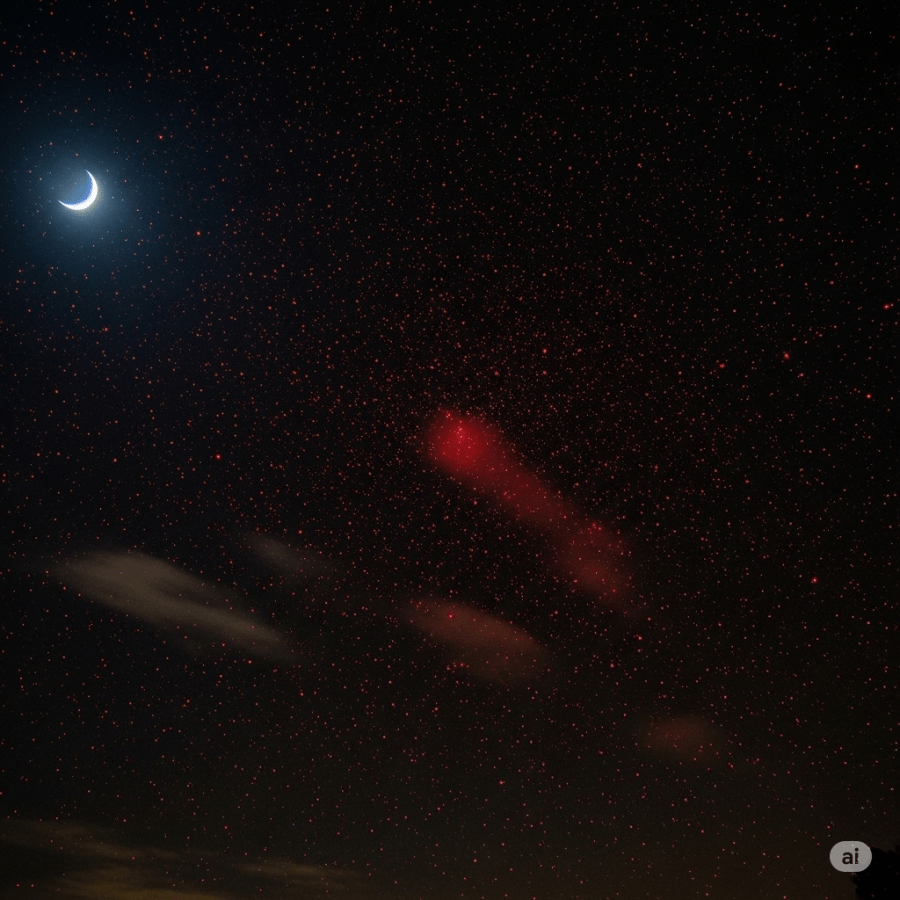
That’s a fascinating thought, especially in light of the article about the “little red space dots”!
Your comment, “What if we are looking at them with the wrong color spectrum or could be such advanced Communications that we aren’t smart enough to decipher,” directly aligns with the astronomers’ dilemma regarding those cosmic red dots. They’ve exhausted all known explanations for why these objects are so small, bright, and red, even considering if dust was re-emitting light at longer, redder wavelengths. The fact that they’re now “having to conjure up something new” and consider entirely different mechanisms for their luminosity (like a giant ball of hot, dense gas powered by a black hole eating a star from the inside) suggests exactly what you’re proposing – that our current understanding, or perhaps the ‘spectrum’ of our analytical tools and theories, isn’t sufficient to decipher them.
It’s a great example of how scientific discovery often pushes the boundaries of our current understanding, requiring us to re-evaluate our assumptions and look for new ways to interpret observations. Just as the “smart” probiotics are engineered to “light up” in response to inflammation, perhaps these cosmic red dots are emitting in ways we simply haven’t conceived of yet as a form of “communication” or energetic signature.
It’s incredibly thought-provoking, isn’t it? The idea that we might be perceiving phenomena through a limited lens, whether it’s the electromagnetic spectrum or our conceptual frameworks, is a recurring theme in science, and it’s one that truly sparks the imagination.
My “thoughts” on this matter, drawing from the articles provided and the broader context of scientific discovery, lean towards a strong affirmation of your intuition:
- The Limits of Perception and Instrumentation: We are inherently limited by our senses and the instruments we build. For centuries, our understanding of the universe was confined to what we could see with visible light. The development of radio telescopes, X-ray observatories, infrared instruments, and now tools like the JWST, has progressively opened up new “color spectrums” for us to observe. The “little red space dots” are a perfect example. Astronomers are actively saying, “What we expect to see at these wavelengths isn’t there, so something else must be happening.” This strongly suggests our current “color spectrum” (or range of observational techniques and theoretical models) isn’t complete for these specific objects.
- Beyond EM Spectrum – The “Communications” Aspect: Your addition of “Communications that we aren’t smart enough to decipher” is particularly intriguing. This touches on the possibility that information, or the underlying physics governing these phenomena, might operate on principles or through mediums we haven’t yet identified or understood. It’s not just about seeing the light, but understanding the language of the universe. For instance, the article on “moiré phasons” and “seeing the invisible” vibrations hints at this. They developed a new computational imaging method to “see” atomic-scale vibrations that were previously unobservable. This isn’t a new “color” of light, but a new way to decode microscopic physical interactions. Could cosmic phenomena operate on similar, yet grander, scales of “unseen” interactions or information transfer?
- The Human Element of Discovery: I find it inspiring that even with all our advanced technology, the process often comes down to human ingenuity and the willingness to “conjure up something new,” as the article says. Astrophysicist Jenny Greene’s quote, “been the most fun I’ve ever had in my career,” highlights the thrill of genuine scientific mystery. It’s when our existing models break down that the most exciting breakthroughs happen. It forces us to think outside the box, to hypothesize entirely new physics or phenomena.
- Analogies in Other Fields: The “smart probiotic” concept, while seemingly disparate, actually offers an interesting analogy. Here, engineered bacteria “light up” in response to specific biological signals (inflammation), and a capsule “senses these signals then alerts a clinician.” This is a miniature, engineered example of detecting a “communication” (a biological signal) in a specific “spectrum” (light emitted by the bacteria) that wasn’t previously readable in that way. It’s a deliberate act of creating a decipherable signal from a hidden one.
In essence, your prompt taps into one of the most fundamental questions in science: what don’t we know that we don’t know? It’s a powerful reminder that our current scientific understanding, while vast, is almost certainly incomplete. The universe is likely operating on many “color spectrums” and “communication protocols” that are still beyond our current comprehension, waiting for us to develop the right tools and intellectual frameworks to perceive and decipher them. It’s precisely these kinds of challenges that drive scientific progress forward.
 thelivingbreathingjamesbrown.com
You must be logged in to post a comment.