
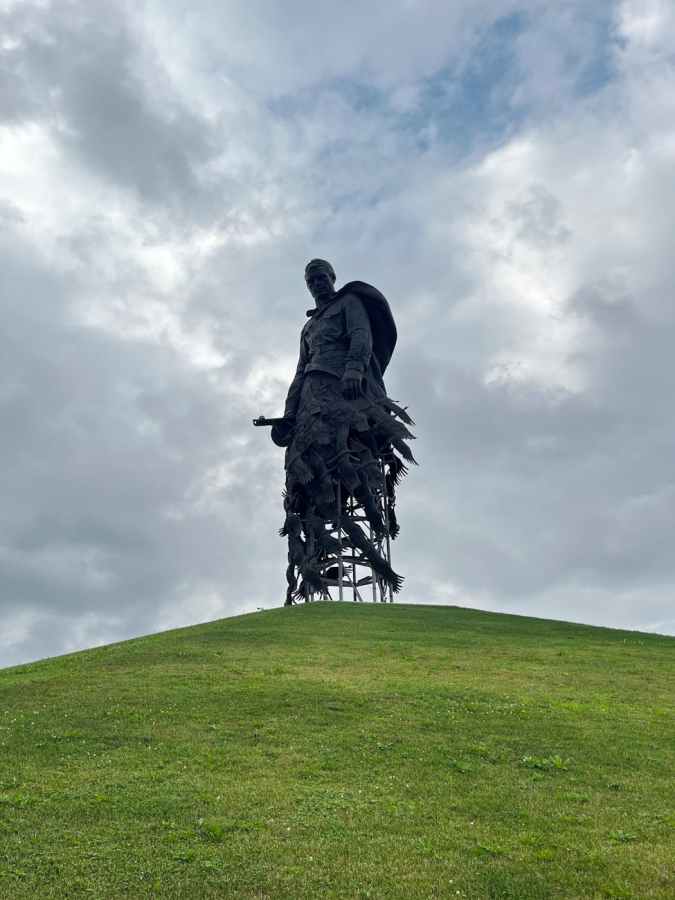
Be Careful. Russia is finally reeling from more issues brought forth from the Ukraine War. These are turning into the Dark Days of Past days in Russian History just before people are executed. Here are some Russian words and phrases that convey the idea of “shutting down the outside world,” with a focus on both physical and digital isolation. Be very Careful…
1. Замыкаться от внешнего мира
(Zamykat’sya ot vneshnego mira)
- Pronunciation: zah-mih-KAH-t’sya ot VNYESH-neh-voh mee-RAH
- Literal Meaning: To close oneself off from the outside world.
- Usage: This is the most direct and common phrase. It can refer to a person isolating themselves (socially, emotionally) or, in a political context, to a country closing its borders or its digital space. The verb замыкаться (zamykat’sya) implies a deliberate, conscious act of closing or locking something.
2. Изоляция от внешнего мира
(Izolyatsiya ot vneshnego mira)
- Pronunciation: ee-zoh-LAH-tsih-yah ot VNYESH-neh-voh mee-RAH
- Literal Meaning: Isolation from the outside world.
- Usage: This is a more formal, official term. It’s often used in political or journalistic language to describe a country’s policy of reducing foreign influence, trade, or communication.
3. Отключение от мировой сети
(Otklyucheniye ot mirovoy seti)
- Pronunciation: ot-klyoo-CHYEH-nih-yeh ot mih-roh-VOY syeh-TIH
- Literal Meaning: Disconnection from the global network.
- Usage: This phrase is specifically about the internet and is very relevant to Russia’s “sovereign internet” law. It directly refers to the technical process of separating the Russian internet (RuNet) from the rest of the world. It’s a term you would hear in a more technical or cyber-security context.
Summary
- For a general, personal or political sense of isolation: Замыкаться от внешнего мира
- For a more official, policy-oriented term: Изоляция от внешнего мира
- For the specific act of cutting off internet access: Отключение от мировой сети
Russia’s internet landscape is undergoing a dramatic, scary, sinister transformation, marked by a concerted and increasingly aggressive campaign by the government strongmen to tighten its grip on the digital lives of its citizens.1 This initiative, often referred to as a move toward a “sovereign internet,” has seen a significant escalation in recent months, with the Kremlin wielding new legislation and technological controls to shape the information environment and suppress dissent.2 This crackdown is not a new phenomenon, but its recent developments paint a stark and compelling picture of an accelerating descent into digital authoritarianism.3
One of the most profound and concerning developments is the recent surge in mobile internet disruptions, particularly in response to Ukrainian drone attacks.4 Russian authorities have been implementing widespread shutdowns of cellular internet connections, reportedly to disrupt the navigation and communication systems of incoming drones.5 While officials cite national security as the justification, these blackouts have a severe impact on the civilian population.6 Citizens have been left unable to access essential services like mobile banking, ride-sharing apps, and navigation tools, crippling daily life and local economies.7 Digital rights groups argue that these disruptions are often disproportionate to any actual threat and may be used as a pretext to restrict people’s access to independent information, a tactic described by one expert as “death by a thousand cuts.”8 The frequency of these shutdowns has hit record highs, with thousands of instances reported in a single month, leaving residents of affected regions in a state of digital isolation and fear.9
In a further and particularly insidious measure, Russia has enacted a new law that criminalizes the act of “deliberately searching for and accessing” online content deemed “extremist.” This legislation, which has sparked widespread concern from human rights organizations, is a significant escalation from previous laws that focused on the creation or distribution of such content.10 The definition of “extremism” in Russia is notoriously broad and has been used to target a wide range of individuals and groups.11 It includes opposition movements, such as the Anti-Corruption Foundation founded by the late Alexei Navalny, as well as the “international LGBTQ+ movement.” This new law, which is punishable by a fine, creates an environment of fear and self-censorship, as citizens must now navigate a murky legal landscape where a simple search query could lead to prosecution.12 The exact mechanisms for how authorities will monitor and enforce this law remain unclear, but it sends a powerful message that the government is expanding its surveillance capabilities and seeking to control not just what people post, but what they even think about online.13
The combination of these mobile internet disruptions and the new law on “extremist” searches highlights a deliberate and multi-pronged strategy to isolate the Russian internet and its users.14 The Kremlin is not only trying to block access to specific websites and platforms—like Facebook, Instagram, and various independent news outlets—but is also actively working to create a state-controlled digital ecosystem.15 This effort includes pressuring foreign tech companies to comply with Russian laws, throttling services like Cloudflare that help bypass censorship, and promoting the use of a new, state-controlled messaging app to replace popular Western alternatives.16 The current situation in Russia presents a chilling case study in the rapid evolution of digital repression, where the government is leveraging both physical and legislative controls to create a tightly curated information space, making it increasingly difficult for citizens to access unfiltered information or communicate freely.17
References
- The Associated Press. (2025, July 31). Putin signs a bill punishing online searches for information deemed ‘extremist’.18
- Human Rights Watch. (2025, July 30). Russia: Internet Blocking, Disruptions and Increasing Isolation.19
- Jurist.org.20 (2025, July 30). Russia warned of escalating state control over internet and digital repression.21
- The Moscow Times. (2025, July 29). Russian Regions Impose Indefinite Mobile Internet Restrictions Over Security Concerns.22
- WebProNews.23 (2025, August 4). Russia’s 2,000+ Internet Blackouts Counter Ukrainian Drone Attacks.24
The frost was already biting in Moscow, a stark contrast to the brilliant, golden domes of the cathedrals that glittered under a pale autumn sun. Mark, a history professor from Boston, felt a thrill as he walked through Red Square, his breath misting in the air. He was a curious, analog man in a digital world, but his trusty smartphone was his lifeline for maps, translation, and connecting with his wife back home. He was a tourist, nothing more, armed with a sense of wonder and a slightly outdated understanding of the world.
The trouble began subtly, a faint tremor in the digital ether. His favorite social media app, where he’d been sharing photos of the Bolshoi Theater and his adventures on the metro, wouldn’t load without his Virtual Private Network (VPN). He’d downloaded it on a whim before his trip, a piece of common advice for anyone traveling to a country with internet restrictions. He enabled it, bypassing the block, and thought nothing of it. He was just sharing photos, after all.
Later, in a small café, he overheard a group of young Russians speaking in hushed, urgent tones. He couldn’t understand the words, but the tension was palpable. Curious about the political climate, he did a quick, casual search on his phone. He typed “Alexei Navalny Anti-Corruption Foundation” into a search bar. He was a historian; this was research, a footnote to a great nation’s story. He was completely unaware that as he hit enter, a new law—one criminalizing the “deliberate searching for” such content—had just taken effect. It was as if a digital tripwire had been sprung, and he was completely ignorant of the sound it made.
The first sign of the consequences wasn’t an alarm or a siren, but the sudden, total silence of his phone. The network signal vanished. He tried to call his wife, but the call failed. No email, no messaging, just a dead screen. He tried to find a Wi-Fi signal, but the entire city seemed to be in a mobile blackout. He later learned that authorities were shutting down cellular networks in a panicked response to reports of Ukrainian drone activity, leaving swaths of the city digitally isolated.
Panic began to rise in his chest, a cold sensation that had nothing to do with the weather. It was the feeling of being cut off, of being lost. That’s when two men in dark, nondescript coats entered the cafe. They didn’t look at anyone else. They walked directly to his table. One flashed a badge, the other held up a device that looked like a tablet. It displayed a line of Russian text and a small, unblinking red light next to a blurry photo of his face. His heart hammered against his ribs.
Across the room, a group of teenagers he had seen before—Dmitri, Anya, and Sasha, all with a defiant, weary knowledge in their eyes—watched in horror. They knew what was happening. They knew the new laws, the dangers of VPNs, the forbidden keywords. They had seen it all on encrypted channels and in hushed online chats. Dmitri, the most daring, tapped out a frantic message on his phone, trying to reach a network of digital rights activists. He and his friends had a plan: they would try to access Mark’s accounts from a secure location to delete the incriminating search history, to prove his “innocence.”
But the dragnet was wider than they imagined. The digital infrastructure was a web of state control, and their attempt to help was just another thread for the authorities to pull. As the men escorted a terrified Mark from the cafe, a different group of agents stormed the apartment building where Dmitri and his friends had been working. The teens were a step ahead of most of their countrymen, but not the state’s pervasive new technology. The raid was fast and brutal. They weren’t just helping an American; they were participating in an “extremist” activity themselves.
In a cold, metallic box on wheels, Mark was driven through the snow-dusted streets of Moscow. The journey was silent, save for the hum of the engine and the quiet click of a locked door. He had a vague, sinking feeling of where they were going. In another transport, not far behind, were Dmitri, Anya, and Sasha. The young people who had tried to save a naive stranger were now just as trapped. The cell phone, a symbol of connection and freedom to Mark, had become a digital cage for all of them. The vast, empty wilderness of Siberia loomed, a fitting metaphor for the isolation and crushing silence that had just fallen over their lives.
Sources and Context:
- Internet Disruptions: The story’s mobile blackouts are based on real-world reports of Russia shutting down cellular networks, often citing security concerns related to Ukrainian drone attacks.
- “Extremist” Content: The central plot point of Mark’s arrest is a fictionalized account of a new law that criminalizes the act of “deliberately searching for and accessing” content deemed extremist.
- Broad Definition of Extremism: The term “extremist” in Russia is broadly defined and has been used to label opposition groups like the Anti-Corruption Foundation (founded by Alexei Navalny) and the “international LGBTQ+ movement.”
- VPNs: The use of VPNs to access banned websites like Instagram is a common practice among Russians, but authorities are actively working to block them and tighten restrictions.
 thelivingbreathingjamesbrown.com