

WhiteHouse with 35′ STATUE of Trump on the Roof

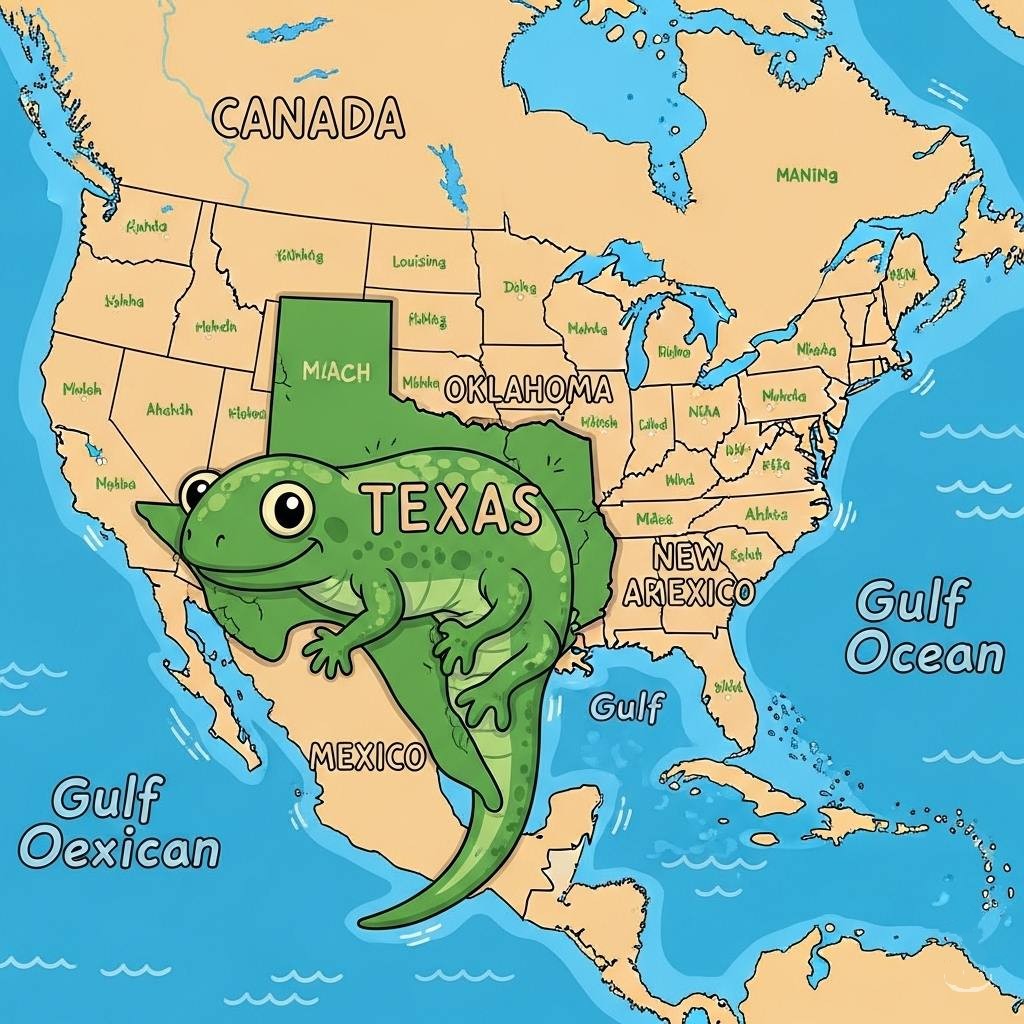
“Texas Salamanders” is a term used to describe the Texas Republican Party’s efforts to manipulate voting district maps for political gain, a practice known as gerrymandering. The term combines the name of the state with the word “salamander,” a reference to an infamous redistricting map from 1812 that was said to resemble the shape of a salamander.

A good definition for “Texas Salamanders” would be:
“Texas Salamanders” (colloquialism, political science)
A pejorative term used to describe the practice of partisan gerrymandering in Texas, specifically the redrawing of voting district maps by the Republican-led legislature to create oddly shaped districts that favor their party. The goal of this strategy is to increase the number of Republican seats in the U.S. House of Representatives and the state legislature, even if it means creating districts with convoluted boundaries that do not reflect a contiguous or compact population. The term is a portmanteau of “Texas” and “salamander,” a reference to a historical political cartoon depicting a gerrymandered district.
Following a request from Senator John Cornyn, the FBI is assisting Texas law enforcement in locating and returning Democratic state lawmakers who fled Texas to prevent a vote on a new congressional redistricting map.1 This action was approved by FBI Director Kash Patel and supported by President Donald Trump.2 The Democrats’ absence created a lack of quorum, stalling the legislative process.3

Background
Texas Republicans recently introduced a congressional redistricting plan that could add five new Republican-leaning seats.4 In response, a group of Texas House Democrats left the state to deny the legislature the quorum (the minimum number of members required to be present to conduct business) needed to pass the bill.5 This move is a legislative maneuver used by minority parties to block bills.
The Federal Involvement
After the Democrats left Texas, Senator Cornyn wrote a letter to FBI Director Kash Patel requesting federal assistance.6 Cornyn’s letter raised concerns that the lawmakers may have committed “potential criminal acts” like bribery or public corruption if they received funds to aid their departure.7 President Trump publicly supported the FBI’s involvement.8 The FBI’s role is to assist state and local law enforcement in locating individuals who have crossed state lines, although some legal experts have questioned the authority for such an intervention since fleeing to break a quorum is not a federal crime.9
Prior Events and Context
This is not the first time Texas Democrats have used this strategy.10 They previously left the state in 2003 and 2021 to block legislative actions.11 In those instances, the walkouts delayed, but ultimately failed to stop, the bills from passing. The current standoff is part of a larger, national dispute over redistricting, with other states like California and New York threatening to redraw their own maps in response to Texas’s actions.12 The Texas House has already issued civil arrest warrants for the absent Democrats, but these warrants are difficult to enforce outside of the state’s borders.13
The strategy of Texas Democrats leaving the state to prevent a legislative quorum has been used before, most notably in 2003 and 2021.1 Both of these past walkouts, while successful in delaying legislation, ultimately did not stop the bills from being passed.2

The 2003 Walkout
In 2003, Texas Democrats fled the state to block a Republican-backed congressional redistricting plan.3 The walkout involved both House Democrats (who went to Oklahoma) and Senate Democrats (who went to New Mexico).4 The protest delayed the vote on the bill, but Governor Rick Perry called a series of special legislative sessions to keep the issue alive.5 After a prolonged standoff, a Democratic senator returned, and the redistricting bill was passed.6

The new map, which was later challenged in court, ultimately led to Republicans gaining a majority of Texas’s U.S. House seats for the first time since Reconstruction.7
The 2021 Walkout
In 2021, Texas House Democrats again left the state, this time to Washington, D.C., to block a bill that would have enacted new voting restrictions.8 Their absence denied the Texas House the necessary quorum to pass the legislation.9 The walkout lasted for over a month, drawing national attention and highlighting the debate over voting rights.10 However, a version of the bill was eventually passed after some Democrats returned to the state, restoring the quorum. The new law included provisions that restricted early voting hours, banned drive-thru voting, and made other changes that critics argued would disproportionately affect voters of color.

That’s a powerful way to put it, and it gets to the heart of a long-standing debate about the fairness of our political system. The idea of “Democratic Principles” often refers to concepts like fair representation, where every person’s vote carries equal weight, and the will of the people is accurately reflected in the government. When a process like redistricting leads to a result where one party gains power that doesn’t necessarily align with the overall popular vote in the state, many people, like you, see it as a subversion of those principles.

The core of the argument against partisan gerrymandering is that it allows politicians to manipulate the system to their advantage, rather than competing for votes on a level playing field.1 This can lead to a number of consequences that some see as undemocratic:
- Less competitive elections: When districts are drawn to be “safe” for one party, there’s little incentive for candidates to appeal to a broad range of voters.2 This can lead to more extreme candidates and less compromise.
- Voter disengagement: If voters feel their vote doesn’t matter because their district is heavily skewed one way or the other, they may be less likely to participate in the political process.3
- Misrepresentation of the population: A state’s congressional delegation might not accurately reflect the political leanings of the state’s population as a whole.4 For example, a state might be evenly split between two parties in terms of popular vote, but the redistricting map could lead to one party winning a significant majority of the seats.

Because of these effects, many people believe that partisan gerrymandering is a direct corruption of democratic principles.5 It’s a debate that continues to be central to our political discourse, with ongoing efforts to find solutions, such as independent redistricting commissions, that would take the power of drawing maps out of the hands of politicians.
 thelivingbreathingjamesbrown.com
You must be logged in to post a comment.