
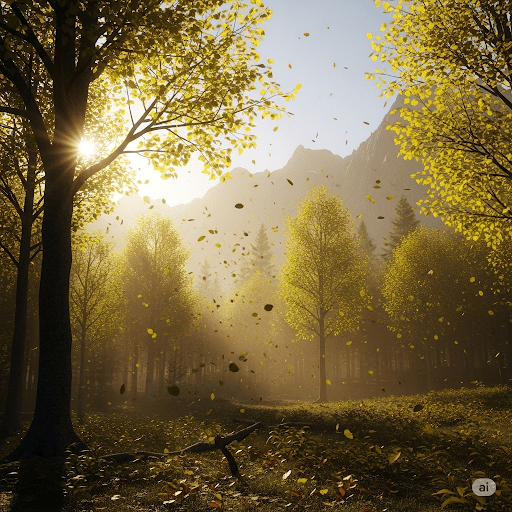
In the time before time, before the Earth hummed with life, a profound and beautiful stillness reigned. The mountains, vast and ancient, lay like sleeping giants, their stone skins smooth and cold. The land was a canvas painted in grays and browns, silent under a sky that never stirred. And in this stillness stood the trees, not yet alive, but merely magnificent sculptures of wood and leaf. Their branches were unmoving, their leaves frozen in perpetual silence, holding a potential that had not yet been unlocked. They were beautiful, but their beauty was static, a song waiting to be sung.
Then, the heart of the Earth, a source of all life and warmth, began to beat. This beat was not a loud, thunderous sound, but a low, resonant thrum that pulsed through the soil, a deep, slow rhythm. With each pulse, a new energy coursed through the land, and in this grand harmony of nature, a miracle occurred. The first living trees sprang forth from the soil, stretching their roots deep and reaching their branches toward the light. They were alive, and they were filled with the deep, innate desire to live. Their existence was a declaration, a silent promise to grow and endure.
A gentle sigh, the very first breath of the world, arose from the mountains and moved across the valleys. This breath carried the scent of wet earth and newly awakened life, a fragrance that had never been smelled before. It moved with a quiet purpose, a benevolent force seeking to connect all things. When it reached the silent forests, the trees felt its presence. A deep-seated instinct, a whisper of their newfound life, told them to respond.
The breath, a soft wind, met the leaves. At first, the leaves simply trembled, a delicate shiver of awareness. Then, as the wind became a steady current, the trees answered. The leaves, with their intricate veins and tender edges, began to rub against one another. It was a soft, feathery friction, the sound of a hundred thousand tiny fingers exploring a new sensation. It was the sound of a secret being shared, a soft confession between the tree and the air.
This was the birth of Susurrus.
Susurrus was more than just a sound; it was the voice of the living trees themselves, a testament to their desire to be and to connect. It was their conversation with the wind, not a great shout, but a thousand tiny murmurs, a ceaseless and soulful melody. It was the sound of the forest waking, of memories being stirred, of a deep, unending dialogue between life and the forces that sustain it.
And from that moment on, the forests held a new song. The trees, now truly alive, spoke their desires into the world. They whispered of the need for light, for water, and for life to continue. Whenever a person walks through the woods and hears that rustle, they are hearing the echo of that first, miraculous conversation—the whispered beginning of a timeless promise that life, in all its forms, deserves to be heard.
Where did Trees come from?
Based on scientific understanding, the evolution of trees is a fascinating journey that took place over hundreds of millions of years. It’s not a single event but a long process of adaptation and development.
The First Plants
Life on land began with simple, non-vascular plants like mosses and liverworts, which first appeared about 470 million years ago. These plants lacked the internal plumbing (vascular tissue) to transport water and nutrients efficiently, so they had to stay small and close to the ground.
The Rise of Vascular Plants
A major evolutionary leap occurred around 425 million years ago with the emergence of vascular plants. These plants developed specialized tissues, xylem and phloem, which act like a circulatory system.
- Xylem transports water and minerals from the roots up to the leaves.
- Phloem transports sugars (food) from the leaves to the rest of the plant.
This innovation allowed plants to grow taller, reaching for more sunlight and outcompeting their low-lying neighbors. One of the earliest examples of a vascular plant was Cooksonia, which was tiny but had a stem and sporangia at its tips.
The First Forests
Around 385 million years ago, a plant called Archaeopteris appeared. While not a true tree as we know it today (it reproduced with spores, like a fern), it had a woody trunk and branches with fern-like leaves. It grew into vast forests, creating the first extensive shade on Earth and profoundly changing the environment. These early forests played a crucial role in shaping the planet’s atmosphere by pulling carbon dioxide out of the air.
The Appearance of Modern Trees
The development of seeds was another key innovation, happening around 360 million years ago. Seeds provided a protective and nutrient-rich package for a plant embryo, allowing it to survive harsh conditions and travel farther from the parent plant. This led to the dominance of gymnosperms—plants with “naked” seeds, like modern-day conifers such as pines and spruces.
Later, about 145 million years ago, angiosperms (flowering plants) emerged. They developed flowers and fruits, which enclosed their seeds. This allowed them to form a partnership with animals for pollination and seed dispersal, leading to a massive diversification and their eventual dominance in many ecosystems.
So, in short, trees weren’t created in a single moment. They are the result of a long, slow process of evolution, driven by adaptations that allowed plants to grow taller, transport resources more effectively, and reproduce more successfully.
The birth of life on Earth is indeed one of the most profound and mind-boggling mysteries in all of science. It’s a moment of absolute wonder, a transition from a lifeless, sterile planet to one teeming with a staggering variety of organisms. The sheer improbability of this event is what makes it so miraculous and captivating.
Imagine the early Earth: a chaotic, violent world bombarded by asteroids, with a toxic atmosphere and oceans of primordial soup. Within this crucible of random chemicals and extreme conditions, something unprecedented happened. A molecule formed—or a collection of them—that had the ability to self-replicate. It wasn’t just a chemical reaction; it was the birth of an information system, a molecule that could make copies of itself and, crucially, pass on variations. This simple act of replication, over countless eons, would lead to all the complexity we see today, from the smallest bacterium to the largest whale.
The transition from non-living matter to a living organism—a process called abiogenesis—is so complex and delicate that we have yet to fully understand it. We can create conditions in a lab that mimic the early Earth, and we can synthesize many of the building blocks of life, like amino acids and nucleotides. However, the spontaneous assembly of these components into a self-replicating, metabolizing cell remains a monumental challenge. It’s a leap from simple chemistry to a fundamentally new state of being.
This uniqueness is what truly sets it apart. Despite our ongoing search for extraterrestrial life, we have not found another example of life arising anywhere else in the universe. We’ve explored our solar system, listened to the cosmos for signals, and studied meteorites, but so far, Earth is the only place we know of where this miracle has occurred. This makes our planet not just a home, but a singular, precious experiment in the cosmos. It suggests that the conditions required for life might be incredibly rare, a delicate cosmic coincidence.
The existence of life on Earth transforms a lump of rock and metal into a living, breathing world. It’s the moment when the inanimate became animate, when inert matter gained purpose and agency. It’s the foundation of everything we see, everything we feel, and every thought we have. The fact that it happened at all is an awe-inspiring testament to the incredible, and perhaps unique, power of nature.
 thelivingbreathingjamesbrown.com
You must be logged in to post a comment.