
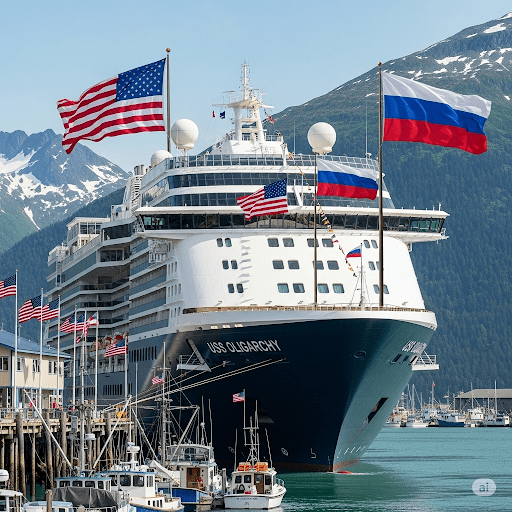
A Geopolitical Analysis of the Alaska Summit: An Expanded Case Study
Introduction: A Collision of Personal and Geopolitical Interests
The historical record of diplomacy is often a tapestry of conflicting national interests, but rarely has a single summit been so defined by the potential convergence of two leaders’ personal ambitions. In this expanded hypothetical analysis, we explore a dramatic and controversial scenario: an Alaska summit between U.S. President Donald Trump and Russian President Vladimir Putin, where the very future of Ukraine is decided. The central premise is that President Trump’s motivations are dual-fold: to secure a prestigious Nobel Peace Prize for a swift resolution to a protracted war, and to fulfill a long-standing personal ambition of constructing a Trump Tower in Moscow. Conversely, President Putin’s objective is to achieve a formal, international legitimacy for the annexed territories of Ukraine, securing their vast mineral wealth and strategic importance. This paper outlines the transactional framework of this fictional deal, its immediate fallout, and the profound long-term implications for Ukraine and the global order.
The Summit and Its Transactional Framework
The political theater leading up to the Alaska summit is thick with tension and speculation. Reports from sources such as The Telegraph suggest that the Trump administration, through key officials like U.S. Treasury Secretary Scott Bessent, has been preparing a series of economic incentives designed to entice Russia to the negotiating table. The deal, as envisioned, is not rooted in traditional diplomacy or international law, but rather in a transactional logic of “what’s in it for me.”
The core of the bargain is a strategic and symbolic exchange:
- Access to Arctic Resources: President Trump is prepared to offer Russia access to the rich natural resources of the Bering Strait, a region bordering Alaska that is believed to contain significant untapped oil and gas reserves. This concession is not just a commercial opportunity; it is a geopolitical prize. It would give Russia a stronger foothold in the Arctic, a region of increasing strategic importance as polar ice melts and new shipping routes open up. This move, in a single stroke, would create a new economic axis of cooperation between Washington and Moscow, potentially at the expense of other global powers.
- Sanctions Relief: The deal includes lifting some of the punishing sanctions on Russia’s aviation industry. Russian airlines, with fleets of over 700 planes, have been crippled by the inability to acquire critical parts and maintenance from Western manufacturers. Lifting these sanctions provides a much-needed economic lifeline to Russia and, ironically, could create new business for American suppliers like Boeing.
- The Moscow Tower: In return for these substantial concessions, President Trump secures a crucial personal objective: the long-awaited final approval and support for a Trump Tower in Moscow. This is framed as a personal and business victory, a monument to the summit’s success, and a powerful symbol of a new era of cooperation between the two nations. It provides President Trump with a tangible, visible reward that can be presented to his base as proof of his unique deal-making ability.
This transactional model, which treats nations’ resources and international sanctions as bargaining chips, is the foundation of the proposed peace deal.
The Consequences for Ukraine: A Resounding Betrayal
The most devastating impact of this hypothetical summit falls on Ukraine. President Zelenskyy and his European allies are deliberately excluded from the direct negotiations, relegated to the role of anxious bystanders. The terms of the deal—that Russia will keep the annexed, mineral-rich territories—are not part of a mutual agreement but are presented as a fait accompli.
For Ukraine, this outcome is a fundamental betrayal of trust and a catastrophic violation of sovereignty. The territories in question, particularly in the Donbas region, are not just land; they are the industrial and economic heart of the country, containing a significant portion of the world’s lithium reserves, a critical component for modern technology. The loss of this wealth cripples Ukraine’s economy and its future prospects.
From a security standpoint, the deal is a disaster. It allows Russia to legitimize its land grab and retain the strategically vital “land corridor” to Crimea. This effectively leaves Ukraine without its fortified “fortress belt” in the Donbas, leaving it more vulnerable to future Russian aggression. In this scenario, there is nothing to prevent Putin from preparing a new offensive in a few years, having been emboldened by the success of his initial conquest and the willingness of a major world power to reward his actions.
The Long-Term Implications: A Fractured Global Order
While the deal is celebrated by some as a diplomatic triumph, its long-term stability is highly questionable. It represents a dramatic break from the post-World War II international order, which was built on the principle that national borders cannot be changed by force.
- A Fragmented Alliance: The unilateral nature of the deal fractures the Western alliance. European leaders, who were sidelined and ignored, feel betrayed and are left to question the reliability of the United States as a global partner. This could lead to a deeper division within NATO and the EU, weakening their collective ability to deter future aggression.
- A “Green Light” for Autocrats: The deal sends a dangerous message to autocratic leaders around the world: that military aggression can be rewarded with territorial gains and economic concessions. This could inspire other nations with expansionist ambitions to follow a similar path, leading to increased global instability. For instance, the outcome could embolden China to be more aggressive in its claims over Taiwan.
- A Fragile Peace: The “peace” achieved by this deal is not a genuine resolution but a temporary truce. It is a peace built on an unjust foundation and the appeasement of an aggressor. It gives Putin what he wants, while leaving Ukraine and its allies in a weaker position. In this scenario, President Trump would get his Nobel Peace Prize and a tower in Moscow, but the world would be left with a much more volatile geopolitical landscape.
The deal would be a triumph of pragmatism over principle, but it is a pragmatism that is shortsighted and built on a foundation of shifting sands. The public would be deeply divided, with some hailing a decisive end to the war, while others would mourn a catastrophic failure of the international system. This case study serves as a stark reminder of the complex and often dangerous interplay between personal ambitions and the fate of nations.
 thelivingbreathingjamesbrown.com
You must be logged in to post a comment.