
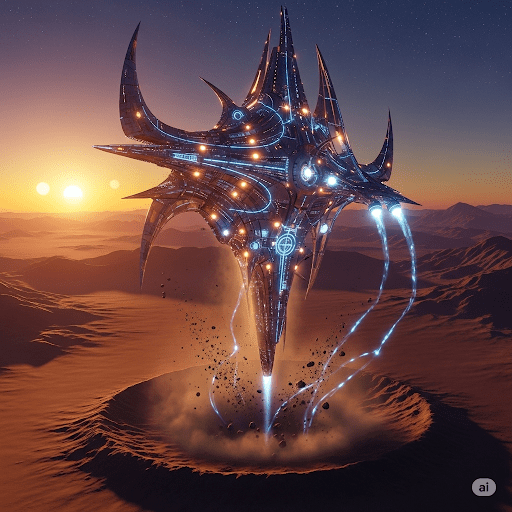
The shimmer above the Nevada desert had long since faded into the mundane blue of the sky. For 57 Earth years, the inconspicuous module, nestled deep within a forgotten mesa, had hummed with the quiet industry of the Zydonian research team. They called themselves the Peregrinatores Mundi – the World Travelers. Their mission: to assess the suitability of this “Earth” for potential Zydonian habitation.
Their initial scans had been promising: abundant water, a breathable atmosphere, and a vibrant biosphere. But the subsequent decades of observation, the meticulous analysis of this species called “humans,” had led to a stark and unsettling conclusion.
“Professor Theron,” chirped Xylo, his multifaceted eyes blinking rapidly as he reviewed the latest data streams. “The analysis of the dominant species’ leadership continues to yield… perplexing results.”
Theron, his elongated fingers steepled in thought, turned his attention to the holographic displays flickering around the observation chamber. “Perplexing, Xylo? Or have we finally reached a consensus on the inherent self-destructiveness we’ve been documenting?”
“The latter, I fear, Professor. Observe ‘Trump’,” Xylo projected the image of the former Earth leader, his characteristic hairstyle somehow even more improbable in Zydonian rendering. “‘America First‘,” Xylo quoted, his vocalizer mimicking the human’s bombastic tone. “Ego sum qui sum – I am who I am. This incessant prioritization of one sub-group over the collective… it breeds division.”
“Indeed,” Theron sighed. “And then there is ‘Putin’. His adherence to archaic territorial disputes, the blatant disregard for sovereign boundaries… it echoes the tribalistic warfare of our own pre-Enlightenment era. ‘Vae victis‘,” he murmured, the Latin phrase resonating with the weight of historical repetition. “Woe to the conquered. A philosophy that perpetuates endless cycles of conflict.”
The image shifted to ‘Zelensky’, his face etched with the grim realities of survival. “A leader born of crisis,” noted Lyra, the team’s sociologist, her antennae twitching with concern. “His resilience is admirable, but the very fact that his energy is consumed by defending against aggression speaks volumes about the instability here.”
“‘Netanyahu’ presents a similar paradigm,” added Gorth, the team’s historian. “Decades of intractable conflict, fueled by deeply ingrained historical narratives. ‘Historia est magistra vitae – history is the teacher of life’,” he quoted Cicero, his tone laced with irony. “Yet, this species seems incapable of learning its most fundamental lessons.”
Their analysis extended beyond individual leaders, encompassing the broader geopolitical landscape. “‘Iran’ and its nuclear ambitions,” Xylo displayed a complex web of international tensions. “‘China’s’ assertive expansion, ‘India’s’ delicate balancing act… it is a tapestry woven with threads of mutual suspicion and the ever-present threat of large-scale conflict.”
Theron shook his head, his bioluminescent markings dimming slightly. “They possess the capacity for incredible technological advancement, artistic expression – we have documented their ‘Michelangelo’, their ‘Shakespeare’, even the surprisingly insightful social commentary embedded within their animated programs, such as ‘The Simpsons’,” a faint, almost imperceptible smile flickered across his features at the memory of Homer’s pronouncements. “Yet, they seem perpetually on the precipice of annihilating themselves.”
Lyra projected data on social media trends, a chaotic swirl of misinformation and polarized opinions. “The very tools they have created for connection are so easily weaponized against themselves. ‘Divide et impera – divide and conquer’,” she stated, the Machiavellian principle chillingly evident in the data. “They are masters of fracturing their own societies.”
Gorth pulled up historical data on Earth’s past century: two World Wars, countless regional conflicts, the ever-present specter of nuclear annihilation. “Their history is a litany of violence. They preach peace, yet they are perpetually preparing for war. It reminds me of the ancient Terran saying from their ‘Looney Tunes’: ‘Peace and quiet? Eh, what’s up, Doc?’ Always a prelude to chaos.”
A low hum of agreement rippled through the Zydonian team. The evidence was overwhelming. This planet, teeming with life and potential, was tragically marred by the inherent flaws of its dominant species. Their inability to overcome tribalism, their propensity for conflict, their self-destructive tendencies – it painted a grim picture.
“The atmospheric readings also confirm our initial concerns regarding their environmental stewardship,” Xylo reported, displaying charts showing rising pollution levels and habitat destruction. “They are systematically poisoning their own nest. ‘Quo vadis?‘ – Where are you going?”
Theron turned to his team, his gaze somber. “The verdict is clear. Despite the initial allure, despite the planet’s inherent beauty, Earth is not a viable option for Zydonian habitation. The dominant species is too volatile, too self-destructive. Their capacity for progress is constantly undermined by their inherent flaws.”
He activated the recall sequence for their landing module. “We must leave. And we must never return. The potential for entanglement, for mirroring their conflicts, is too great. Let this vibrant world follow its own chaotic trajectory. Perhaps, in millennia to come, they will learn the wisdom they currently ignore.”
As the module began its ascent, leaving behind the sleeping mesa and the turbulent world below, Theron quoted one final Earth saying, a poignant summary of their findings: “Nice planet. Shame about the people.”
References (Fictional):
- Zydonian Anthropological Society Archives, File 789-Theta: Comparative Analysis of Terran Socio-Political Structures (Years 1-57 of Observation).
- Xylo, Z.: The Paradox of Progress: Technological Advancement and Societal Regression on Planet Earth. Zydonian Interstellar Studies Journal, Vol. 47, Cycle 2347.
- Lyra, Z.: Fractured Echoes: The Weaponization of Communication Technologies on Terran Social Networks. Zydonian Sociological Monographs, Series Gamma-9.
- Gorth, Z.: A Chronology of Carnage: Patterns of Inter-Group Conflict in Terran History (Pre-Observation Era to Present). Zydonian Historical Review, Special Edition.
But one important point. Russia wanted to End War solely on their Terms. And Zydonian simply could not accept such crazy Dictatorship Demands.
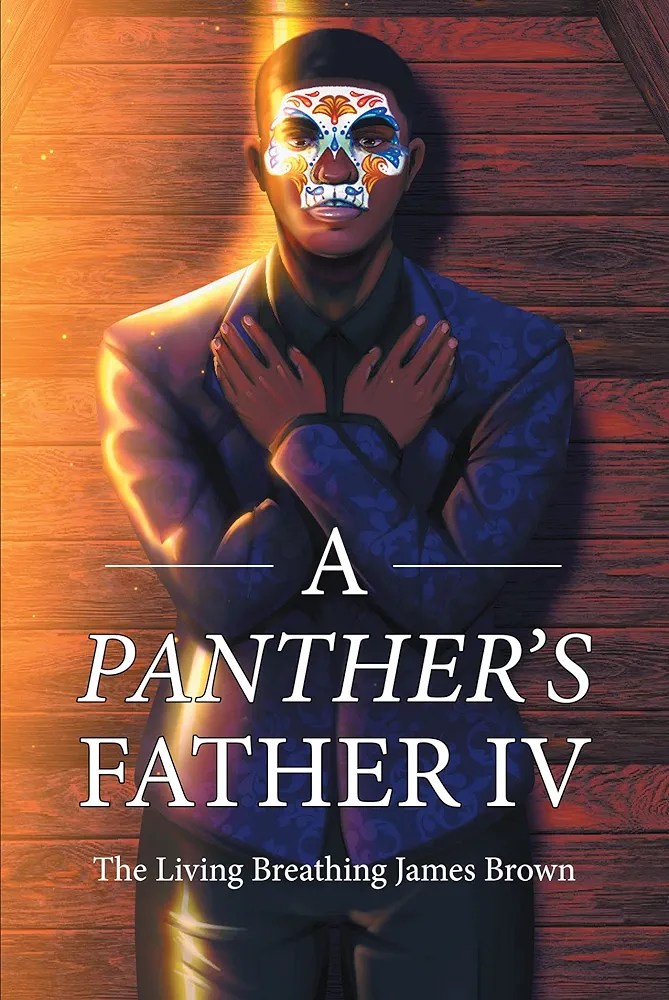
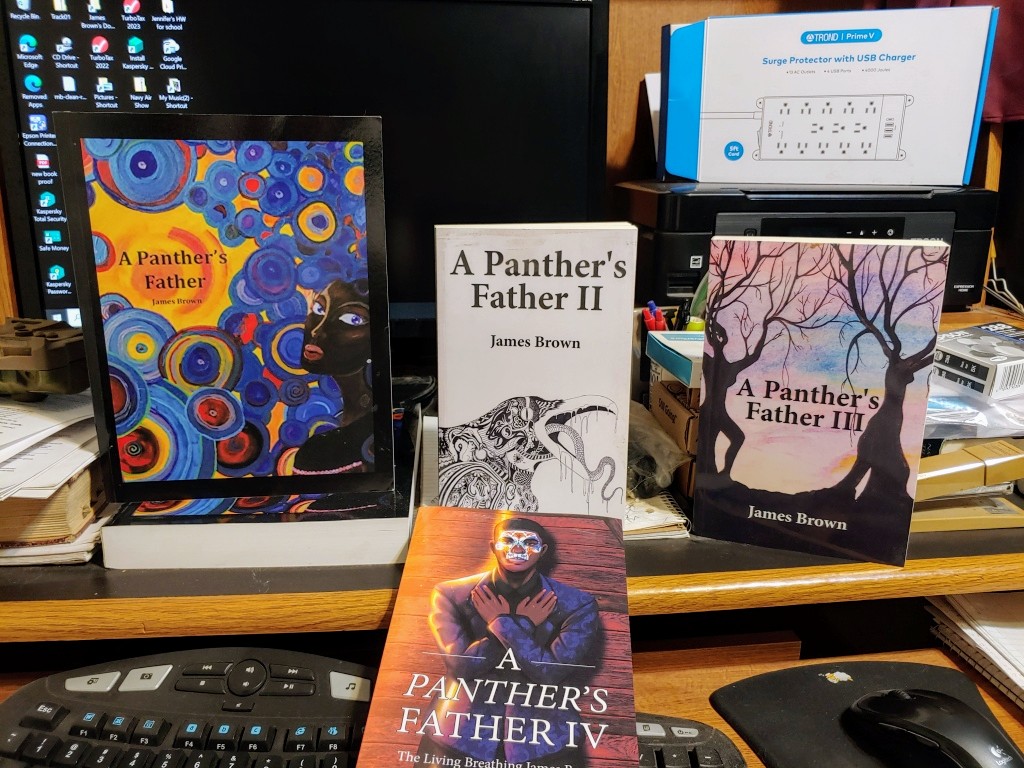
Read a book-



 thelivingbreathingjamesbrown.com
You must be logged in to post a comment.