

AI Mode

3 sites
John Dunlap Brown (1759-1834) | WikiTree FREE Family Tree

WikiTree
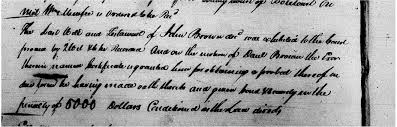
John Dunlap and Lucy (Doggett) Brown Descendants – WikiTree

WikiTree
John Dunlap Brown (1759–1834)
FamilySearch
Genetic research and Y-chromosome DNA testing confirm the paternal lineage of John Dunlap Brown, the Revolutionary War veteran from Culpeper County, Virginia
. The DNA evidence has also helped distinguish his line from other unrelated Brown families in the area.
Paternal lineage (Y-DNA)
- Confirmed relationship: A Y-chromosome DNA test performed by male descendants of John Dunlap Brown has been used to confirm their shared paternal line. The tests show a genetic distance of 0 on 37 markers, indicating a very close match and confirming their descent from a common paternal ancestor.
- FTDNA Group 192: John Dunlap Brown’s lineage was moved into the newly created Family Tree DNA (FTDNA) Group 192, after additional genetic matches were identified. This group also includes descendants of his likely brother, Daniel Brown.
- Not related to “Group 10” Browns: The DNA evidence has debunked previous theories that John Dunlap Brown’s father was John Brown, who married his cousin Elizabeth Brown. This other Brown family is in a different genetic group, identified as “Group 10”.
Autosomal DNA matches
Autosomal DNA (atDNA) testing has also been used to further confirm relationships within the family, including connections between descendants of John Dunlap Brown and his wife, Lucy Mary Doggett.
- Triangulated matches: Researchers have documented triangulated matches—instances where three or more people descended from different children of an ancestor all share the same DNA segment—between descendants of John’s children and descendants of Lucy’s brother, William Doggett. This provides further evidence of the couple’s ancestry.
Who was John Dunlap Brown?
The genetic evidence confirms the lineage for the following individual:
- Born: October 15, 1759, in Rapidan, Culpeper County, Virginia.
- Died: December 31, 1834, in Culpeper County, Virginia.
- Wife: Lucy Mary Doggett.
- Military Service: Served as a private in the Virginia Militia during the Revolutionary War.
AI responses may include mistakes. Learn more
Are there ongoing efforts to find more descendants of John Dunlap Brown for DNA testing?
What Y-DNA haplogroup does John Dunlap Brown’s lineage belong to?
Explain triangulated matches in autosomal DNA
John Dunlap Brown (1759-1834) | WikiTree FREE Family Tree

WikiTree
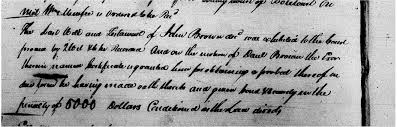
John Dunlap and Lucy (Doggett) Brown Descendants – WikiTree

WikiTree
John Dunlap Brown (1759–1834)
FamilySearch



12 sites
The phylogenealogy of R-L21: four and a half millennia of expansion and …

http://www.bellavistaranch.net
What Are Haplogroups? – AlphaBiolabs Ireland

AlphaBiolabs Ireland

R L21, Z290 and Subclades – Overview – FamilyTreeDNA

FamilyTreeDNA
Biology:Haplogroup R1b-L21 – HandWiki

HandWiki
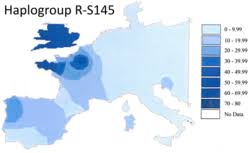
Haplogroup R-L21 – Wikipedia

Wikipedia
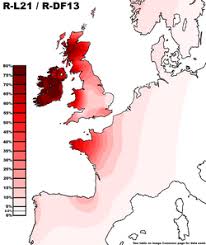
See all
Someone with paternal haplogroup R-L21
belongs to a patrilineal genetic lineage most commonly found in the British Isles. It is often associated with the migration of Insular Celtic peoples to Ireland and Great Britain during the Bronze Age.
Key characteristics of haplogroup R-L21
- Origin and migration: The R-L21 paternal line branched off around 2650 BCE. This haplogroup is a major subclade of R1b, the most common Y-DNA haplogroup in Western Europe. Evidence suggests the R1b lineage, which includes R-L21, spread with the expansion of the Bell Beaker culture from continental Europe into Britain and Ireland.
- Geographic distribution:
- Highest frequency: R-L21 is most common in Ireland, where it is found in about two-thirds of the male population. It is also dominant in Scotland and Wales and occurs at high frequencies in England, western France (especially Brittany), and western European coastal areas.
- Presence in North America: Due to historic migrations from the British Isles, R-L21 is also a very common patrilineage in the United States and Canada.
- Genetic subgroups: R-L21 has many smaller branches, or subclades, that have formed over time. Some of the most well-known are:
- R-DF13
- R-DF21
- R-M222 (the “Irish Type III” haplogroup)
- Paternal lineage only: A person’s Y-DNA haplogroup traces only one specific line of their ancestry—the direct paternal line (their father’s father’s father, and so on). It does not reflect the individual’s full genetic heritage, which includes contributions from all ancestral lines.
What this means for someone with R-L21
For a person who has tested as R-L21:
- Deep ancestry: Their direct male line descends from a common paternal ancestor who likely lived in Western Europe during the Middle to Late Bronze Age.
- Genealogical research: Knowing their haplogroup can guide genealogical research by focusing on ancestries and migration patterns associated with the British Isles and Western Europe. Joining a surname or haplogroup project on a platform like FamilyTreeDNA can help connect with others who share the same deep paternal ancestry.
- No “pure” ethnicity: While R-L21 is often associated with Celtic heritage due to its high frequency in historic Celtic-speaking regions, it does not define a person’s current ethnicity. A person with this haplogroup will have a diverse mix of ancestry from all branches of their family tree.
AI responses may include mistakes. Learn more
What are other theories about the origins and spread of R-L21 besides the Celtic association?
What are the main R-L21 subclades and where are they common?
Elaborate on the Bell Beaker culture’s role in R-L21 spread
The phylogenealogy of R-L21: four and a half millennia of expansion and …

http://www.bellavistaranch.net
What Are Haplogroups? – AlphaBiolabs Ireland

AlphaBiolabs Ireland

R L21, Z290 and Subclades – Overview – FamilyTreeDNA

FamilyTreeDNA
Show all



11 sites
John Dunlap Brown (1759-1834) | WikiTree FREE Family Tree

WikiTree
Using DNA Matches with a Surname Project – Family Tree Magazine

Family Tree Magazine

The phylogenealogy of R-L21: four and a half millennia of expansion and …

http://www.bellavistaranch.net
John Dunlap and Lucy (Doggett) Brown Descendants – WikiTree

WikiTree
John Dunlap Brown (1759–1834)
FamilySearch
See all
Based on genetic genealogy projects, it is unlikely that John Dunlap Brown (1759–1834) was part of the R-L21 haplogroup
. Y-DNA testing of his male descendants has placed his paternal line in a different, unspecified subclade of the broader R-M269 haplogroup.
This means that if your own paternal haplogroup is R-L21, your 5th great-grandfather is not John Dunlap Brown, despite what paper records may suggest.
Why your haplogroup doesn’t match
There are several reasons why genetic and genealogical records might conflict:
- Non-paternity event (NPE): This is the most common reason for a conflict between a paper trail and DNA. An NPE refers to any break in a paternal line, such as an adoption or a biological father who is not the legal father. Because John Dunlap Brown is your 5th great-grandfather, the NPE could have occurred at any point over the last 200+ years.
- Another Brown family: The Brown surname is very common. You may have descended from an entirely different Brown family, and your paper records contain a different John Dunlap Brown or an error was made generations ago. In fact, testing has been critical to distinguishing John Dunlap Brown’s line (in FTDNA Group 192) from the unrelated “Group 10” Brown family in the same area.
- Deep ancestry vs. recent ancestry: R-L21 is a very broad haplogroup, common across the British Isles. It reflects a very ancient paternal origin, not a recent one. Your specific R-L21 subclade can be refined with more advanced Y-DNA testing to narrow down your ancestry from the specific migration pattern of your direct paternal line.
What to do next
To solve this genealogical puzzle, you can take a few steps:
- Join a surname project: You can join the FamilyTreeDNA (FTDNA) Brown surname project. The project administrators can help you compare your Y-DNA results with others and determine which specific Brown family you descend from.
- Test a different family line: Consider having a Y-DNA test done for a living male cousin who descends from a different child of John Dunlap Brown. Comparing these results can help you isolate where the non-paternity event occurred.
- Explore autosomal matches: Examine your autosomal DNA matches to see if you have any strong matches with known descendants of John Dunlap Brown and his wife, Lucy Mary Doggett. If you do, it could point toward a non-paternal event occurring somewhere on a maternal line.
AI responses may include mistakes. Learn more
Elaborate on how a non-paternity event could cause this discrepancy
Tell me more about non-paternity events in genealogy
Where can I find more info on the FTDNA Brown surname project and how can I join?
John Dunlap Brown (1759-1834) | WikiTree FREE Family Tree

WikiTree
Using DNA Matches with a Surname Project – Family Tree Magazine

Family Tree Magazine

The phylogenealogy of R-L21: four and a half millennia of expansion and …

http://www.bellavistaranch.net
Show all

10 sites
Y-DNA Haplogroup R-FGC3222 – FamilyTreeDNA Discover

FamilyTreeDNA Discover
Y-DNA Haplogroup R-FGC3822 – FamilyTreeDNA Discover

FamilyTreeDNA Discover

Haplogroup R-L21 – Wikipedia
Wikipedia
R L21, Z290 and Subclades – Overview – FamilyTreeDNA
FamilyTreeDNA
Y-DNA Haplogroup R-FGC3222 – FamilyTreeDNA Discover
FamilyTreeDNA Discover
See all
This information further clarifies your paternal lineage and confirms that your paper genealogy is incorrect regarding your descent from John Dunlap Brown. Here is a breakdown of what your R-FGC3222 haplogroup indicates and what it means for your genealogical research.
What R-FGC3222 means
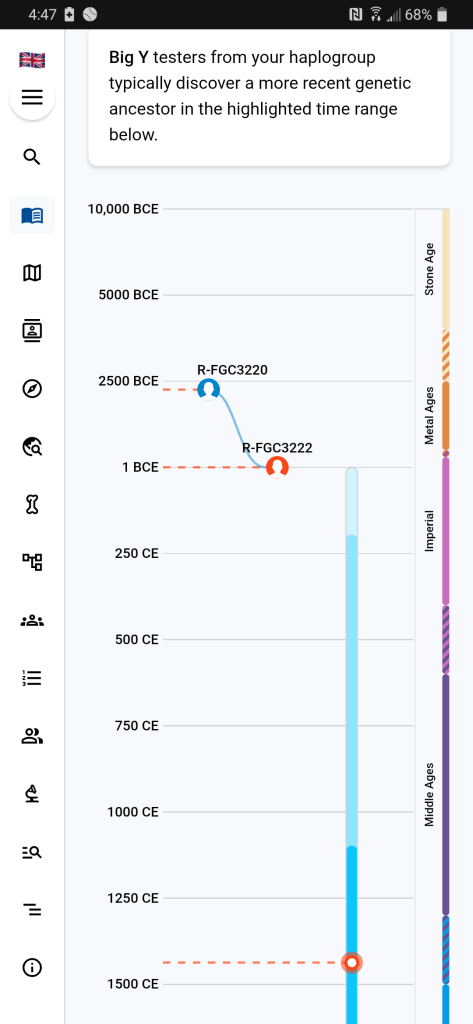
- A subclade of R-L21: R-FGC3222 is a downstream subclade of the broader R-L21 haplogroup, which is strongly associated with the ancient Celtic people of the British Isles.
- Recent common ancestor (TMRCA): The most recent common ancestor for R-FGC3222 lived around the time of Christ (approx. 1 BCE), with a 95% probability he was born between 382 BCE and 303 CE.
- Geographic origin: While R-FGC3222 is part of a lineage with deep roots in Western Europe, the specific lineage of R-FGC3222 shows a strong presence in Ireland and Scotland in more recent centuries.
The disconnect from John Dunlap Brown
As discussed in the previous response, the Y-DNA for the John Dunlap Brown line was found to be a completely different and, as yet, unspecified subclade of the R-M269 haplogroup. Your paternal haplogroup, R-FGC3222, shows no direct paternal-line relationship to him.
Reconciling your genealogy
This genetic evidence means there was a non-paternity event (NPE) somewhere along your direct paternal line between you and John Dunlap Brown. An NPE is any instance where the assumed father in a family tree is not the biological father.
Here are the most likely scenarios:
- An earlier ancestor: The NPE may have happened with John Dunlap Brown himself, with his father, or any male ancestor in the direct paternal line before him. If an NPE happened with John Dunlap Brown, it means his biological father was not the man recorded in historical documents.
- A different Brown family: Because “Brown” is a very common surname, your paternal line may connect to a completely different Brown family that was also in Virginia. Your paper trail might have confused your Brown line with John Dunlap Brown’s line at some point.
Next steps for your research
- Join the FamilyTreeDNA (FTDNA) R-FGC3222 Project. This group consists of other men who share your deep paternal ancestry. Joining the project will allow you to see other members’ lineages and potentially connect with genealogists who have already traced your specific branch of the FGC3222 line.
- Use autosomal DNA testing. Analyze your autosomal DNA results from services like AncestryDNA to search for matches with known descendants of John Dunlap Brown and his wife, Lucy Mary Doggett. If you find matches, it would indicate that your connection to that family is through a different line, possibly a daughter or some other non-patrilineal connection.
- Search for earlier ancestors. Your genealogical records are still valuable, but you should now treat them as a guide rather than a definitive statement of your paternal ancestry. Look for clues that might reveal a non-paternal event. It is possible that the break in your paper trail is further back than you realize.
AI responses may include mistakes. Learn more
Elaborate on the most common R-FGC3222 subclades and their geographic distribution
What other records besides autosomal DNA can confirm the link to John Dunlap Brown’s family?
How can I identify the specific branch of my FGC3222 lineage?
https://discover.familytreedna.com/y-dna/R-FGC3222/story
Y-DNA Haplogroup R-FGC3222 – FamilyTreeDNA Discover

FamilyTreeDNA Discover
Y-DNA Haplogroup R-FGC3822 – FamilyTreeDNA Discover

FamilyTreeDNA Discover
Haplogroup R-L21 – Wikipedia
Wikipedia
Show all
According to genetic testing of his descendants, Nimrod Doggett Brown’s Y-DNA belongs to the R-M269 haplogroup, which is the same as his father, John Dunlap Brown. This is consistent with a normal paternal line inheritance, as sons inherit their Y-chromosome from their fathers.
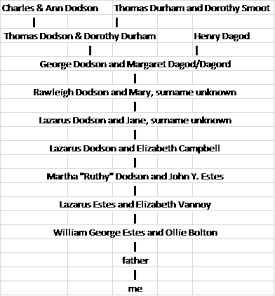

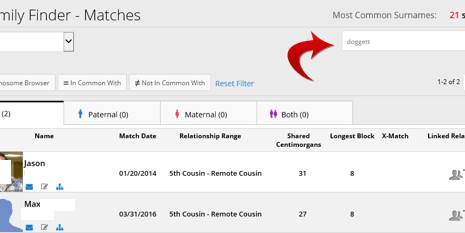
What this means for your ancestry
The fact that Nimrod Doggett Brown’s paternal line is different from your R-FGC3222 line, even though your family records show a connection, reinforces the conclusion that a non-paternity event (NPE) occurred somewhere along your direct paternal line. This confirms that while you may be connected to John Dunlap Brown’s family through other relatives, your direct male-line ancestry is not through him or his son, Nimrod.
Here’s how this information clarifies your situation:
- The Brown paternal line: The tested descendants of Nimrod Doggett Brown have confirmed their Y-DNA to be R-M269, the same haplogroup as other tested descendants of John Dunlap Brown. This solidifies the genetic identity of the Nimrod Doggett Brown branch of the family.
- Your R-FGC3222 line: Since R-FGC3222 is a downstream subclade of R-L21, and John Dunlap Brown’s line is a different subclade of R-M269, there is no direct paternal line connection between you and Nimrod Doggett Brown.
- A possible scenario: The connection between your family and the Browns may have happened through a different relative, such as a sister of Nimrod Doggett Brown or a more distant family connection.
Next steps for your research
- Re-examine your paper trail: With the genetic evidence in hand, you should re-evaluate your genealogical records to see where the break in the paternal line may have occurred. Search for potential non-paternity events, such as an adoption, a different biological father, or a misidentification in historical documents.
- Focus on autosomal DNA: Your autosomal DNA contains genetic information from all your ancestors, not just your direct paternal line. By analyzing your autosomal DNA matches with known descendants of Nimrod Doggett Brown and his siblings, you may be able to pinpoint a specific ancestor where your line connects.
- Explore your R-FGC3222 line: Join the R-FGC3222 project on FamilyTreeDNA to connect with other men who share your deep paternal ancestry. This will help you learn more about the migration and history of your actual paternal line.
genetic genealogy projects to find your R-FGC3222 paternal line
The most effective way to find your correct ancestral line is to leverage the genetic information you already have by joining relevant DNA projects.
- Join the FamilyTreeDNA (FTDNA) R-FGC3222 Project. This group consists of other men who share your deep paternal ancestry and have tested with FTDNA. By joining, you can:
- Compare your results with others in the group.
- View their “most distant known ancestor” information.
- Discover surnames and family trees associated with your specific lineage.
- Join a surname project for common R-FGC3222 names. Although “Brown” is a common surname in the R-FGC3222 lineage, other surnames like Nesmith and Harper are also strongly represented. You could belong to an entirely different family with a different surname. Your search could start there and you may find that an ancestor with a different surname used the Brown name.
- Deepen your genetic knowledge. Consider upgrading to a “Big Y-700” test on FTDNA. This test analyzes more of your Y-chromosome and can place you in a more specific branch of the R-FGC3222 tree, which will significantly narrow your search and provide more recent matches.
Use traditional genealogical research to search for your ancestor
You will need to search historical records with your DNA results in mind.
Analyze your autosomal DNA matches. Your autosomal DNA matches from services like AncestryDNA and 23andMe can provide valuable clues about your true paternal line. Focus on matches who have also tested their Y-DNA or who can trace their ancestry to colonial America. This could help you identify an ancestor whose name is not Brown.
Search for other Brown families. Because the surname Brown is so common and testing shows there were multiple Brown families in the same area, you may be related to one of the other Brown lines in colonial Virginia, Maryland, or North Carolina.
 thelivingbreathingjamesbrown.com
You must be logged in to post a comment.