

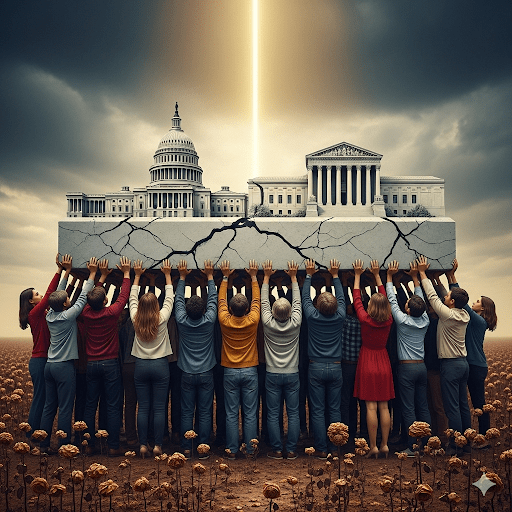
Theme of power and governance.
I. The Perceived Imbalance of Power
- A. Introduction: An overview of the idea that the balance of power in the American government, as outlined in the Constitution, has shifted over time.
- The core concept of checks and balances.
- The growing perception among the populace that power has become too centralized.
II. Executive Power: The White House
- A. “Rumblings” and “Bumbling”: The frustration with actions perceived as overstepping executive authority.
- B. Points to Address:
- Use of executive orders to bypass Congress.
- Expansion of administrative agencies and their regulatory power.
- The public’s desire for a return to a more limited executive branch.
III. Legislative Power: Congress
- A. “Rumblings” and “Mumbling”: The public dissatisfaction with congressional actions and inactions.
- B. Points to Address:
- Gerrymandering: The practice of drawing political boundaries to favor one party, and its effect on fair representation.
- Proposal for a solution, such as a process to end the practice.
- The Number of Representatives: The discussion of whether the current number of representatives is appropriate for a modern population.
- Making Stuff Up: The concern that legislation is created for political gain rather than for the good of the country.
- Gerrymandering: The practice of drawing political boundaries to favor one party, and its effect on fair representation.
IV. Judicial Power: The Supreme Court
- A. “Out of Whack”: The concern that the Supreme Court’s decisions are based on political alignment rather than legal precedent.
- B. Points to Address:
- New Interpretations: The issue of reinterpreting the Constitution in ways that seem to contradict its original intent.
- Changing Precedent: The idea that long-standing laws and legal precedents are being overturned.
- Proposal for a method to vote on changes to long-standing laws, giving power back to the states and the people.
V. The National Guard and State Sovereignty
- A. State-Level Power: The belief that states should have full, unassailable control over their own National Guard.
- B. Points to Address:
- The controversy and history surrounding the federalization of the National Guard.
- The argument that the Guard should only be used by the state for state-level issues.
VI. The People’s Power and a Path Forward-Food for Your Mind!
- A. “People Want Their Power Back”: A concluding theme that ties all the points together.
- B. Potential Solutions/Ideas:
- A call for greater public engagement and accountability.
- A discussion of checks on power to ensure that all branches are reined in.
- The importance of holding leaders and institutions accountable to the will of the people.
This outline is just a starting point, but it provides a clear structure for your arguments. You can use it to build your own great piece of writing.
The provided text is an outline for a piece of writing focused on the theme of power and governance in the American government, and it does not require further summarization. The outline already serves as a summary of the key arguments and structure, with the main points already condensed.

The outline addresses the following areas of American government:
- The perceived imbalance of power: A general overview suggesting the balance of power, as originally intended by the Constitution, has shifted over time, with power becoming too centralized.
- Executive power: Focuses on public frustration with executive overreach through actions like executive orders and the expansion of administrative agencies.
- Legislative power: Addresses dissatisfaction with Congress regarding issues like gerrymandering, the number of representatives, and the creation of legislation for political gain.
- Judicial power: Expresses concern that Supreme Court decisions are driven by political alignment rather than legal precedent, noting issues with reinterpreting the Constitution and overturning precedent.
- The National Guard and state sovereignty: Argues that states should have full control over their National Guard, criticizing federal overreach in this area.
- The people’s power and a path forward: Concludes by discussing potential solutions, emphasizing public engagement, accountability, and reining in the power of all branches of government.
Here are Hot Web Results for exploring forefront thoughts in Political Drama’s Road Dogging Topic:

Chicago Unbound·https://chicagounbound.uchicago.edu
Executive Power and the Discipline of History (reviewing Crisis and Command
1 Congress has the power to “declare War,” issue “Letters of Marque and Reprisal,” and establish “Rules for the Government and Regulation” of the army and navy, …

Center for American Progress·https://www.americanprogress.org
President Trump’s Recent Actions in Washington, D.C., Are an Abuse of …
The Trump administration’s deployment of federal forces is an abuse of power. President Trump has long sought to deploy the military at home, …

Facebook·https://www.facebook.com
Is US President Donald Trump’s National Guard Deployment In Chicago Legal?
US President Trump’s plan to deploy National Guard troops in Chicago faces fierce legal challenges from Illinois leaders.

The National Constitution Center·https://constitutioncenter.org
Module 6: Separation of Powers and Federalism | Constitution Center
At the national level, the Framers divided power between the three branches of government—the legislative branch, the executive branch and the judicial branch.

The University of Maryland, Baltimore·https://digitalcommons.law.umaryland.edu
Federalism and the Tug of War Within: Seeking Checks and Balance in the …
Federalism and the Tug of War Within explores tensions that arise among the underlying values of federalism when state or federal actors regulate within the …

Wikipedia·https://en.wikipedia.org
Unitary executive theory – Wikipedia
The unitary executive theory is a theory according to which the president of the United States has sole authority over the executive branch.

GovInfo (.gov)·https://www.govinfo.gov
– EXECUTIVE POWER AND ITS CONSTITUTIONAL LIMITATIONS
You have authority to oversee the exercise of every power, legislative, executive and judicial. Oversight means checking; not asserting it by itself, but …

History.com·https://www.history.com
Checks and Balances – Definition, Examples & Constitution – History.com
The system of checks and balances in government was developed to ensure that no one branch of government would become too powerful.

U.S. Department of Defense (.gov)·https://media.defense.gov
Military and Security Developments Involving the People’s Republic of China
The report shall address the current and probable future course of military-technological development of the People’s Liberation Army and the …

The Yale Law Journal·https://www.yalelawjournal.org
Legislative Constitutionalism and Federal Indian Law
Importantly, this case study demonstrates that stripping power from the Court may not dampen our constitutional culture or leave it to the whims …
 thelivingbreathingjamesbrown.com
You must be logged in to post a comment.