
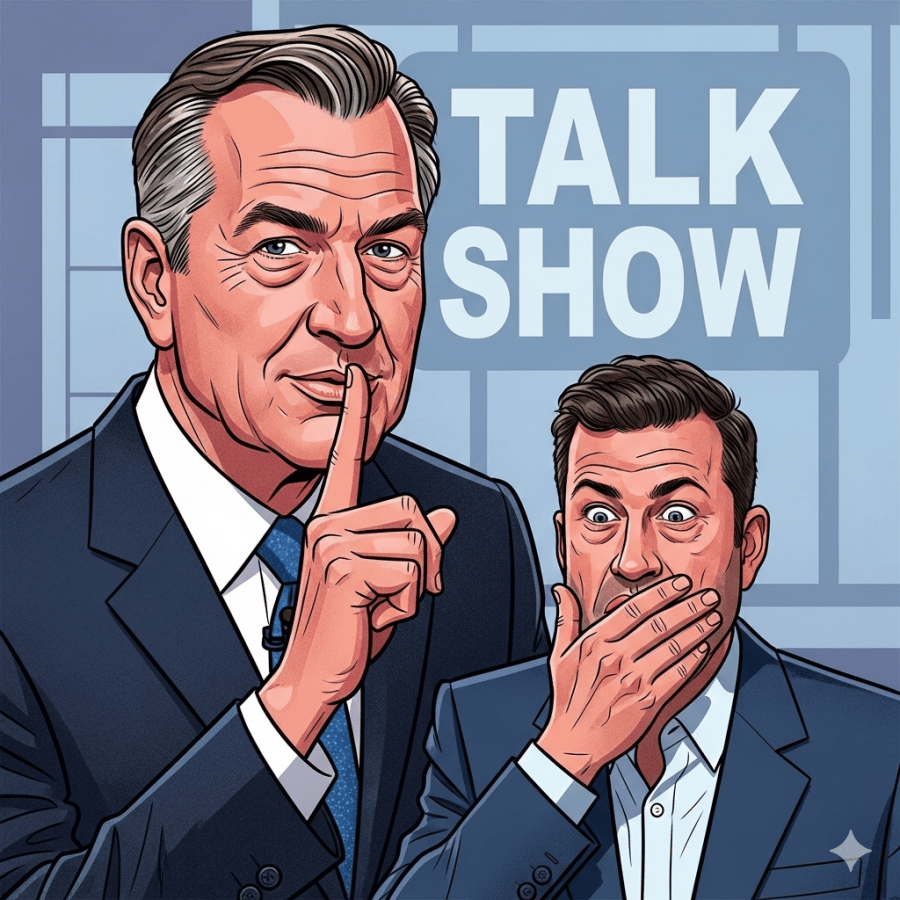
THE SUSPENSIon was a good example of overreach, but also the new Scary America where if you show happiness and laugh, you got to make sure Trump is laughing too?
Our Politicians are Now Ruining, I mean Running all of Our Fun To Watch Talk Shows, but only their Approved Talk Shows?
As GEMINI AI PRO did the research, one item I saw that I thought you, the reader, might enjoy reading. Then comes the results of a Deep AI Research. Nut a bunch was added before GEMINI AI PRO’s Report. There’s a lot to digest.
Resolving Key Conflicts
A major contradiction I was working to resolve was the apparent conflict between a President’s public threats to revoke licenses and the actual legal authority of the FCC. My research has decisively clarified this. I have confirmed that the FCC, as an independent agency, is the sole body with the power to issue and revoke licenses, and that it does so for individual stations, not national networks.
I have also found information that the First Amendment and the Communications Act explicitly limit the FCC’s ability to censor content. This directly contradicts the public statements I’ve found from presidents who have suggested they could or should pull licenses based on negative coverage. I’ve found specific examples of this, including the Nixon administration’s use of the license renewal process to pressure media outlets and more recent statements from the Trump administration.
The First Amendment and the Communications Act restrict the FCC from censoring most content, but the FCC can take action against obscene material at all times and indecent or profane material broadcast between 6 a.m. and 10 p.m. when there is a reasonable risk of children in the audience. The FCC defines indecency as patently offensive content depicting or describing sexual or excretory organs or activities, measured by contemporary community standards.
What the FCC Cannot Do
- General Censorship: The FCC is explicitly prohibited by the First Amendment and Section 326 of the Communications Act from censoring broadcast material or interfering with free expression.
- Regulate All Content: The agency’s ability to regulate content varies by electronic platform.
- Ban Indecent Content at All Times: Indecent material, though regulated, is still protected by the First Amendment and cannot be prohibited at all hours.
When the FCC Can Act
- Obscene Content: Obscene material is not protected by the First Amendment and can be prohibited at any time of day.
- Indecent or Profane Content During “Safe Harbor”: The FCC can enforce regulations against indecent and profane content only during the time when children are likely to be in the audience.
- “Safe Harbor” Hours: The FCC has set this time for audiences of children between 6 a.m. and 10 p.m.
Definitions
- Obscene Material: Content that lacks serious literary, artistic, political, or scientific value and is considered obscene under the legal standards for obscenity.
- Indecent Material: Material that, in context, depicts or describes, in a patently offensive way as measured by contemporary community standards for the broadcast medium, sexual or excretory organs or activities.
- Profane Material: Words or language that are so grossly offensive to the community that they would not be tolerated in a broadcast setting.
While FCC Chair Brendan Carr did not directly order the cancellation of Jimmy Kimmel Live!, many, including FCC Commissioner Anna Gomez and Democratic congressional leaders, argue that his public threats constituted an abuse of power and pressured ABC and its affiliates into suspending the show. The controversy concerns whether the chairman of a federal regulatory agency overstepped his authority by using the threat of government action to influence content decisions by broadcasters.
Carr’s comments and threats
- Public statements: Carr, speaking on a conservative podcast, publicly condemned Kimmel’s remarks about the killing of conservative activist Charlie Kirk, calling the comments “some of the sickest conduct possible”.
- Implied consequences: In the interview, Carr suggested there was “a path forward for suspension over this” and that ABC affiliates could preempt the show. He added, “we can do this the easy way or the hard way,” and that “we can and should be holding these licensed broadcasters accountable”.
- Political pressure: The statements were widely interpreted as pressuring the network to take action against Kimmel’s show, with Carr suggesting the FCC had “remedies” available.
Accusations of overreach
- Democratic leaders: Several House Democrats, including Minority Leader Hakeem Jeffries, signed a statement calling Carr’s actions a “corrupt abuse of power” that forced ABC to “bend the knee to the Trump administration”.
- FCC Commissioner Gomez: Anna Gomez, the sole Democratic FCC commissioner, publicly stated that the FCC does not have the “constitutional right to revoke a license because of content like” Kimmel’s remarks. She characterized Carr’s threats as “empty” but said “the threat is the point”.
- First Amendment concerns: Critics, including former President Barack Obama and the ACLU, have said the conduct ran afoul of the spirit of the First Amendment, which prohibits government action that censors speech.
- Corporate interests: Observers have noted that Nexstar and Sinclair, two major affiliate owners that dropped Kimmel’s show, had pending business before the FCC, and may have complied to avoid jeopardizing approval for their deals.
Arguments against overreach
- Carr’s defense: Carr has defended his comments, arguing that he was merely expressing his views and that the First Amendment protects his right to speak freely. He later appeared on Fox News and praised the decision by broadcasters to drop the show, arguing the networks were responding to the “market”.
- Network’s decision: Nexstar, one of the affiliate groups that pulled the show, has explicitly denied that its decision was influenced by the FCC’s pressure.
- No official action: Some argue that since no official FCC fine or licensing action was taken, Carr did not violate the letter of the law.
In summary, while there is disagreement over whether Carr’s threats were illegal, there is significant consensus among critics that his public pressure on broadcasters was an inappropriate overreach of authority that led to Kimmel’s suspension. The situation highlights the precarious position of broadcasters, who operate under the regulation of an agency whose leadership can influence programming through public threats, even without official action.
A counterargument to the provided summary is that Commissioner Carr’s public statements were not an inappropriate overreach, but rather a valid and even necessary function of his role as a public servant.
The Role of Public Pressure
Proponents of this view argue that as a regulator, an FCC commissioner has a responsibility to the public interest. Public statements are seen as a form of moral suasion, a way to encourage self-regulation by networks without resorting to formal legal action, which can be a slow and cumbersome process. This perspective suggests that the broadcaster’s decision to suspend Kimmel was not an act of a helpless victim, but a strategic and voluntary choice to mitigate public and political backlash.
The counterpoint frames the situation not as a flaw in the system, but as a feature of the public-private dynamic in which broadcasters, as custodians of a public resource (the airwaves), are expected to be responsive to public concerns and regulatory guidance.
Based on the provided information and the broader context of broadcast media law, the public pressure exerted on ABC regarding Jimmy Kimmel’s monologue is widely considered to be an overreach, and his rights as a television host are a central part of that conversation.
Was it an overreach?
Yes, from the perspective of many legal and media experts, the public threats from a federal regulator like an FCC commissioner were an overreach of authority, even if they didn’t constitute a direct violation of the law. Like when you hear a gunshot, smell the smoking gunpowder, but no gun is found. Pretty slick move to motivate The Base. Here’s why:
- Weaponizing Public Office: The FCC has a specific and narrow legal authority to regulate content, but the threats of regulatory action against broadcasters are seen as a way of bypassing the legal process. By publicly suggesting that ABC’s license could be in jeopardy, the commissioner used the power of his office as leverage to influence a private company’s editorial decisions. This is an example of what is known as a chilling effect, where speech is suppressed not by direct censorship but by the fear of legal or regulatory reprisal.
- The First Amendment: The core issue is whether the government can use its power to suppress content it dislikes. The First Amendment is designed to prevent government censorship. While the FCC has some content regulation power over broadcast media (unlike cable or the internet), that power is limited, and its direct use for political reasons would be a clear violation of free speech.
What about Jimmy Kimmel’s rights?
Jimmy Kimmel does have rights, but his situation highlights the complex tension between an individual’s right to free speech and the power of their employer.
- No First Amendment Claim Against ABC: The First Amendment protects individuals from government interference with their speech. It does not generally apply to restrictions imposed by a private employer. While the public pressure came from a government official (Commissioner Carr), the actual decision to suspend the show was made by ABC and its affiliated stations. As a private company, ABC has the legal right to decide what content to air on its network and can fire or suspend an employee for a wide range of reasons, including for making controversial comments.
- Union and Public Support: While Kimmel has no direct First Amendment claim against ABC, his case has garnered significant support from unions and free speech advocates. Organizations like the Writers Guild of America (WGA) and SAG-AFTRA have condemned the suspension as a form of “suppression” and a violation of free expression. . This suggests that while there may not be a legal remedy for Kimmel, there is a strong moral and ethical argument being made on his behalf.
A Comprehensive Analysis of American Broadcast Media: The Interplay of Networks, Regulation, and Executive Power
Executive Summary
This report provides a multi-faceted analysis of the American broadcast media landscape, tracing the parallel evolutions of major television networks, their principal regulator, and the dynamics of political influence. It establishes that the “Big Three” era was a direct consequence of early regulatory policy and technological constraints. The Federal Communications Commission (FCC), while established as an independent agency to serve the “public interest,” is shown to be highly susceptible to political and ideological shifts dictated by presidential appointments. Most critically, this analysis clarifies the profound legal and practical disparity between a President’s public threats to revoke a network’s license and the constitutional and statutory reality. It reveals that direct presidential authority over licensing is non-existent; instead, presidents have historically relied on indirect pressure and the weaponization of a legally independent agency to exert control. Finally, the report concludes that the foundational legal justifications for broadcast regulation—particularly the doctrine of spectrum scarcity—are rapidly eroding in the face of digital convergence, raising fundamental questions about the future of media oversight and the relevance of traditional power structures.
1. The Genesis and Evolution of the American Television Network Landscape
The history of American television is inextricably linked to the development of its major networks. From their origins in radio to their current state in a fragmented digital market, these networks have been shaped by a combination of pioneering technology, fierce business competition, and, most importantly, targeted government regulation. The narrative of the “Big Three” and later the “Big Four” is not merely one of corporate success but of a market structure actively molded by policy.
1.1 From Radio to the Airwaves: The Birth of a New Medium
The forerunners of America’s first television networks were a pair of formidable radio enterprises. Both the National Broadcasting Company (NBC) and the Columbia Broadcasting System (CBS) were founded as radio networks in the 1920s and began experimenting with television broadcasts in the 1930s. Following a period of significant technical innovation and patent disputes, the Federal Communications Commission (FCC) officially allowed commercial television broadcasts to begin on July 1, 1941, an event that was soon curtailed by World War II.
The American Broadcasting Company (ABC), the youngest of the original “Big Three,” has a particularly unique genesis. Its creation was a direct consequence of a deliberate regulatory action by the FCC. In 1941, the Commission issued its “Report on Chain Broadcasting,” which sought to dismantle the duopolistic control of the airwaves held by NBC and CBS by requiring NBC to sell one of its two national radio networks, the “Blue Network”. This divestment, driven by a desire to prevent a broadcasting monopoly, led to the sale of the Blue Network to Edward J. Noble, who then launched it as the American Broadcasting Company in 1943. ABC subsequently extended its operations into television in 1948, following the established paths of NBC and CBS. The subsequent merger with United Paramount Theatres in the mid-1950s under the leadership of Leonard Goldenson provided the network with the capital and management required to become profitable and challenge the dominance of its older rivals.
1.2 The “Big Three” Era of Dominance (1950s-1980s)
For most of the 20th century, the American television landscape was a de facto oligopoly controlled by NBC, CBS, and ABC. This era was solidified by the failure of the smaller DuMont Television Network, which ceased operations in 1955, leaving the market to the three dominant players for the next three decades. During this time, the “Big Three” controlled the vast majority of television broadcasting and advertising revenue. The Nielsen ratings were a near-exclusive domain for these networks, with every hit series and major feature film telecast airing on one of them.
This period of dominance was not a purely organic market outcome. Rather, it was a direct manifestation of the legal and technological constraints of the time, particularly the doctrine of spectrum scarcity. The limited number of available broadcast frequencies created a natural barrier to entry, effectively granting a handful of companies a unique opportunity to shape American culture. Television’s role in society grew rapidly, with the number of U.S. households owning sets soaring from approximately 8,000 in 1946 to 45.7 million by 1960. As the medium matured, its content evolved from the family-friendly, apolitical domestic comedies of the 1950s to more socially conscious programming in the 1970s, reflecting and influencing a dynamic American society. This powerful medium became a major social and cultural catalyst, revolutionizing how Americans learned about the world and themselves.
1.3 The Rise of the “Big Four” and Beyond
The structure of the broadcast industry remained largely unchanged until 1986, when a competitive fourth network, Fox, was founded from the remnants of the defunct DuMont network. Fox’s emergence from a distant fourth to a major network in the mid-1990s was not solely a function of its programming; it was significantly aided by a change in regulation. The implementation of “must-carry” rules allowed Fox affiliates to force their way onto cable lineups, granting the network the nationwide reach necessary to compete with the established players. The network’s success with its NFL coverage and top-rated prime-time programs solidified its status, with some analyses occasionally including it with the original three, leading to the phrase “Big Four”.
This market evolution continued with the 2009 transition to digital broadcasting, which allowed television stations to offer multiple programming streams through digital subchannels (multicasting), further fragmenting the media landscape. Today, while more than 50 national free-to-air networks exist, the largest remain the traditional players along with newcomers like The CW and MyNetworkTV. The market, however, is still dominated by the same major corporations: NBC (owned by Comcast), CBS (owned by Paramount), ABC (owned by Disney), and Fox (owned by Fox Corporation). The historical narrative of the American broadcast market demonstrates a clear and consistent pattern: regulatory interventions, rather than purely free-market forces, have repeatedly been the primary drivers of seismic shifts in the industry’s competitive structure. The FCC’s actions, from the forced divestiture of the NBC Blue Network that created ABC to the must-carry rules that enabled Fox’s rise, have fundamentally shaped the television landscape.
A Comprehensive Analysis of American Broadcast Media: The Interplay of Networks, Regulation, and Executive Power
Executive Summary
This report provides a multi-faceted analysis of the American broadcast media landscape, tracing the parallel evolutions of major television networks, their principal regulator, and the dynamics of political influence. It establishes that the “Big Three” era was a direct consequence of early regulatory policy and technological constraints. The Federal Communications Commission (FCC), while established as an independent agency to serve the “public interest,” is shown to be highly susceptible to political and ideological shifts dictated by presidential appointments. Most critically, this analysis clarifies the profound legal and practical disparity between a President’s public threats to revoke a network’s license and the constitutional and statutory reality. It reveals that direct presidential authority over licensing is non-existent; instead, presidents have historically relied on indirect pressure and the weaponization of a legally independent agency to exert control. Finally, the report concludes that the foundational legal justifications for broadcast regulation—particularly the doctrine of spectrum scarcity—are rapidly eroding in the face of digital convergence, raising fundamental questions about the future of media oversight and the relevance of traditional power structures.
1. The Genesis and Evolution of the American Television Network Landscape
The history of American television is inextricably linked to the development of its major networks. From their origins in radio to their current state in a fragmented digital market, these networks have been shaped by a combination of pioneering technology, fierce business competition, and, most importantly, targeted government regulation. The narrative of the “Big Three” and later the “Big Four” is not merely one of corporate success but of a market structure actively molded by policy.
1.1 From Radio to the Airwaves: The Birth of a New Medium
The forerunners of America’s first television networks were a pair of formidable radio enterprises. Both the National Broadcasting Company (NBC) and the Columbia Broadcasting System (CBS) were founded as radio networks in the 1920s and began experimenting with television broadcasts in the 1930s. Following a period of significant technical innovation and patent disputes, the Federal Communications Commission (FCC) officially allowed commercial television broadcasts to begin on July 1, 1941, an event that was soon curtailed by World War II.
The American Broadcasting Company (ABC), the youngest of the original “Big Three,” has a particularly unique genesis. Its creation was a direct consequence of a deliberate regulatory action by the FCC. In 1941, the Commission issued its “Report on Chain Broadcasting,” which sought to dismantle the duopolistic control of the airwaves held by NBC and CBS by requiring NBC to sell one of its two national radio networks, the “Blue Network”. This divestment, driven by a desire to prevent a broadcasting monopoly, led to the sale of the Blue Network to Edward J. Noble, who then launched it as the American Broadcasting Company in 1943. ABC subsequently extended its operations into television in 1948, following the established paths of NBC and CBS. The subsequent merger with United Paramount Theatres in the mid-1950s under the leadership of Leonard Goldenson provided the network with the capital and management required to become profitable and challenge the dominance of its older rivals.
1.2 The “Big Three” Era of Dominance (1950s-1980s)
For most of the 20th century, the American television landscape was a de facto oligopoly controlled by NBC, CBS, and ABC. This era was solidified by the failure of the smaller DuMont Television Network, which ceased operations in 1955, leaving the market to the three dominant players for the next three decades. During this time, the “Big Three” controlled the vast majority of television broadcasting and advertising revenue. The Nielsen ratings were a near-exclusive domain for these networks, with every hit series and major feature film telecast airing on one of them.
This period of dominance was not a purely organic market outcome. Rather, it was a direct manifestation of the legal and technological constraints of the time, particularly the doctrine of spectrum scarcity. The limited number of available broadcast frequencies created a natural barrier to entry, effectively granting a handful of companies a unique opportunity to shape American culture. Television’s role in society grew rapidly, with the number of U.S. households owning sets soaring from approximately 8,000 in 1946 to 45.7 million by 1960. As the medium matured, its content evolved from the family-friendly, apolitical domestic comedies of the 1950s to more socially conscious programming in the 1970s, reflecting and influencing a dynamic American society. This powerful medium became a major social and cultural catalyst, revolutionizing how Americans learned about the world and themselves.
1.3 The Rise of the “Big Four” and Beyond
The structure of the broadcast industry remained largely unchanged until 1986, when a competitive fourth network, Fox, was founded from the remnants of the defunct DuMont network. Fox’s emergence from a distant fourth to a major network in the mid-1990s was not solely a function of its programming; it was significantly aided by a change in regulation. The implementation of “must-carry” rules allowed Fox affiliates to force their way onto cable lineups, granting the network the nationwide reach necessary to compete with the established players. The network’s success with its NFL coverage and top-rated prime-time programs solidified its status, with some analyses occasionally including it with the original three, leading to the phrase “Big Four”.
This market evolution continued with the 2009 transition to digital broadcasting, which allowed television stations to offer multiple programming streams through digital subchannels (multicasting), further fragmenting the media landscape. Today, while more than 50 national free-to-air networks exist, the largest remain the traditional players along with newcomers like The CW and MyNetworkTV. The market, however, is still dominated by the same major corporations: NBC (owned by Comcast), CBS (owned by Paramount), ABC (owned by Disney), and Fox (owned by Fox Corporation). The historical narrative of the American broadcast market demonstrates a clear and consistent pattern: regulatory interventions, rather than purely free-market forces, have repeatedly been the primary drivers of seismic shifts in the industry’s competitive structure. The FCC’s actions, from the forced divestiture of the NBC Blue Network that created ABC to the must-carry rules that enabled Fox’s rise, have fundamentally shaped the television landscape.
Based on the provided document, ESPN does not fit into the narrative because the report focuses exclusively on traditional broadcast television networks and their relationship with the FCC. ESPN is a cable television network.1
The report’s central argument revolves around the doctrine of spectrum scarcity, which is the limited number of available broadcast frequencies. This scarcity is the foundational legal justification for the FCC’s regulation of networks like NBC, CBS, ABC, and Fox.
ESPN, however, operates on a completely different model. It does not use public airwaves for its primary distribution. Instead, it is a subscription-based service delivered to viewers through cable and satellite providers, and more recently, streaming services.2 Therefore, ESPN’s rise to prominence was tied to the growth of the cable television industry, a separate technological and business narrative from the one detailed in the document.
 thelivingbreathingjamesbrown.com
You must be logged in to post a comment.