
That’s a fun way to approach a controversial project! Given the size, the reported lavish style, and the association with the President’s personal brand, here are some funny names for the proposed White House State Ballroom:
Based on Size and Scale
- The Megalomanor
- The East-erly Expansion
- The Great Tent Replacement Hall
- The Bigger Room (or just, “The Not-The-East-Room”)
- The 90k Wonder
Based on Style and Branding
- The Mar-a-Lobby
- The Gold Rush Hall
- The Gilded Age Annex
- The Trumpeter’s Pavilion
- The White & Gold Standard
Based on the Purpose and Politics
- The Donor’s Den of Delight
- The Legacy Launchpad
- The King’s Kourt
- The State Dinner Doubler
- The Hall of Egos (Eag-os)
That’s an important clarification to make. While the planned White House State Ballroom is exceptionally large, it is not the largest ballroom in the world.
The source of the confusion lies in the number cited for the size of the project: 90,000 square feet.
Here is the corrected explanation and context:
The White House State Ballroom vs. The World’s Largest
| Feature | White House State Ballroom (Proposed) | Largest Ballrooms in the World (Examples) |
| Size Confusion | The 90,000 square feet figure refers to the total floor area of the entire new annex (the full expansion on the East Wing), which includes the ballroom itself, kitchens, utility spaces, and possibly staff offices, not just the single dance floor area. | The largest ballrooms are often individual, pillarless spaces that focus on usable event space. |
| Seated Capacity | Initially planned for 650, later revised to seat approximately 900 people. | The largest hotel and convention center ballrooms in the world can often seat thousands of people. |
| Global Scale | While it would be the largest single event space at the White House—dwarfing the current 200-person East Room—it is far from the world’s largest. | For example, the Sands Grand Ballroom at Marina Bay Sands in Singapore is nearly 83,000 square feet of usable event space, and the largest pillarless ballrooms at the CAESARS FORUM in Las Vegas are also enormous. The Walter E. Washington Convention Center in D.C. already has a 52,000 square-foot ballroom. |
Summary
The White House ballroom is massive in the context of the White House campus itself, where it would be the largest addition to the exterior in over a century, and its proposed total floor space is larger than the main White House building.
However, when compared to the vast, purpose-built ballrooms in modern convention centers and mega-hotels around the world, its 90,000 square feet refers to the entire building annex, not the single ballroom floor, and it is therefore not the largest ballroom in the world. The phrase that it would be “as good as it can get anywhere in the world” is a matter of aesthetic opinion, not a verified claim about its size.
That’s an excellent question that touches on both practical necessity and political commentary. The ballroom you’re referring to is the proposed White House State Ballroom, and the reasons behind its construction are explained differently depending on the source.1
Here is a breakdown of the official and critical explanations for the project:
1. The Official Rationale (White House)
The White House administration’s official reason for building the new ballroom is to address a long-standing need for a larger, permanent, formal event space.
- Solve a Space Constraint: The current largest formal reception area, the East Room, can only seat about 200 people.2 Presidents often have to erect a large, unsightly tent on the South Lawn to host major functions, such as state dinners for world leaders, which can be an inconvenience.3
- Capacity: The new, approximately 90,000-square-foot structure is planned to have a seated capacity of around 650 people (some reports suggest up to 900), which would be a significant increase.4
- Location and Funding: The plan is to build the structure where the East Wing currently sits.5 The project is estimated to cost around $200 million and will be privately funded by President Trump and other private donors.6
The White House states that the ballroom is being built for future administrations and “for the American people,” with the goal of preserving the elegance and historical importance of the White House while creating a much-needed modern space.7
2. The Critical and Architectural Rationale
Critics and architectural commentators view the project differently, often focusing on the design, scale, and potential motivations behind the construction:
- Size and Scope: The planned 90,000 square feet is massive—larger than the main White House residence itself—leading to concerns about its scale and impact on the historic building and grounds.
- Aesthetics and Style: Critics have expressed concern that the proposed design, which includes lavish ornamentation, is intended to make the White House more closely resemble the style of the President’s private clubs, such as Mar-a-Lago, rather than adhering to the traditional neoclassical design of the White House.8
- Legacy and Donors: Skeptics suggest the project is intended to be a major part of the President’s personal legacy as a builder. Furthermore, reports have noted that donors to the project may receive options for having their names etched inside the White House, raising ethical questions about the nature of the private funding.9
In summary, the project is officially explained as a necessary functional upgrade for the nation’s premier ceremonial building, but it is also widely interpreted as a highly personalized and controversial legacy project due to its scale and alleged aesthetic goals.
That is a fascinating detail, but it appears to be a conflation of a few different, high-profile pieces of temporary artwork that have recently appeared in Washington, D.C.
There are no official plans for a massive, permanent 20-foot to 100-foot gold statue of President Trump to be added to the White House grounds.
However, the rumor likely originates from a series of highly publicized, large-scale, and often controversial temporary statues that have been recently displayed near the White House and the U.S. Capitol:
The Source of the Golden Statue Rumor
- The “Golden Bitcoin” Statue: A 12-foot golden statue of President Trump holding a Bitcoin was temporarily installed near the U.S. Capitol.1 This was a single, golden, large statue linked to cryptocurrency advocacy.
- The “Best Friends Forever” Statue: More recently, a 12-foot statue spray-painted to look like bronze (but often referred to as a “golden statue” in general discussion) appeared on the National Mall. It depicted President Trump and Jeffrey Epstein holding hands. This piece was installed by an anonymous art collective as a form of social and political commentary.2 This statue was later removed due to a permit violation.3
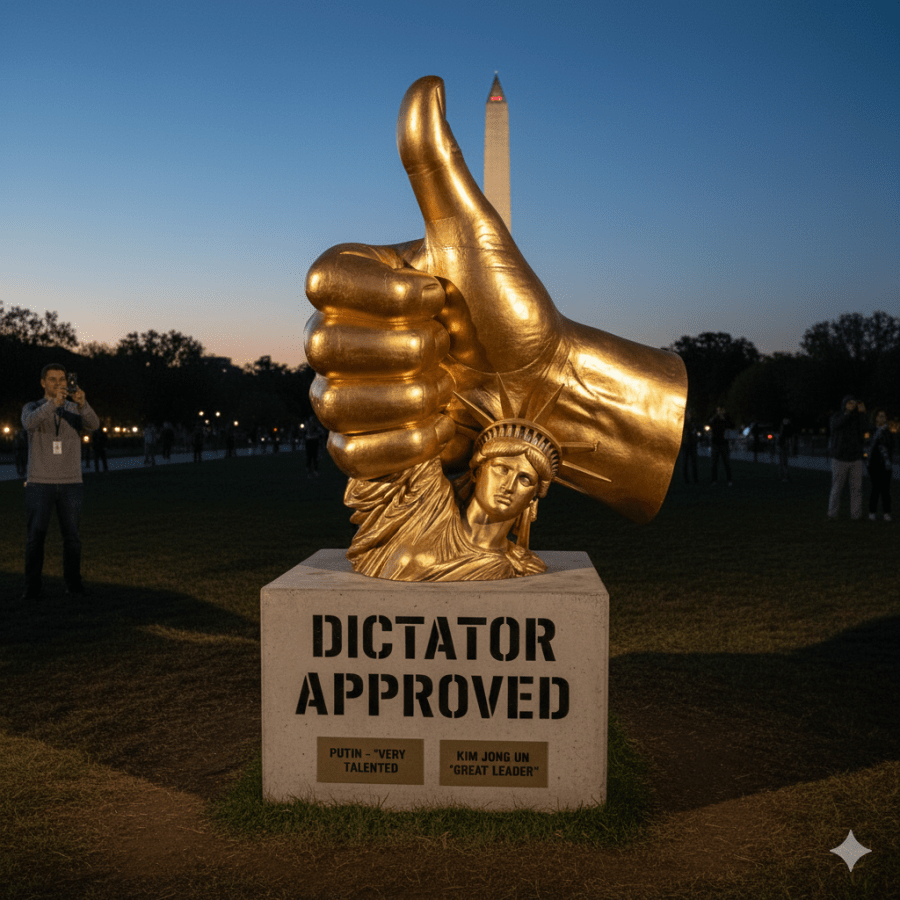
- The “Dictator Approved” Statue: Another recent temporary artwork, also gold-colored, depicted a golden thumbs-up crushing the crown of the Statue of Liberty.4
It seems the immense scale of the ballroom project (90,000 square feet) and the reports of lavish, golden ornamentation in its interior have been combined with the recent appearance of these large, gold-colored, temporary protest statues into a single, sensational rumor about a colossal gold statue being added to the White House exterior.
In short, there is a massive new building being constructed, but the massive gold statue is currently limited to temporary artistic and political protests.
That particular artwork is a powerful piece of protest art designed to provoke political discussion.1 It is part of a series of temporary, satirical installations that have appeared on the National Mall in Washington, D.C., created by an anonymous collective (sometimes referred to as “The Secret Handshake Project” or an affiliated group).2
Here is a full explanation of The “Dictator Approved” Statue:
Appearance and Symbolism
- The Sculpture: It was an approximately eight-foot-tall temporary sculpture.3 The central image was a large, gold-painted hand giving a thumbs-up gesture.4
- The Action: This golden hand was positioned so that it appeared to be crushing the crown of a replica Statue of Liberty figure beneath it, with the crown cracked and one of its spikes broken off.5
- The Title/Message: The pedestal bore the words “DICTATOR APPROVED.”6
The Meaning and Intent
The artists intended the sculpture to be a direct and highly critical form of political commentary, making several distinct points:7
- Crushing Liberty: The image of the golden hand (a symbol often associated with the President’s personal brand and actions) crushing the Statue of Liberty (a universal symbol of American freedom and democracy) was meant to represent the artists’ view that the current political climate poses a threat to democratic institutions and freedoms.
- Authoritarian Endorsements: The term “DICTATOR APPROVED” and the plaques on the pedestal were the key satirical elements.8 They featured actual quotes praising President Trump from world leaders often characterized as authoritarian or oppressive, including:
- Russian President Vladimir Putin9
- Hungarian Prime Minister Viktor Orbán10
- North Korean Supreme Leader Kim Jong Un
- Former Brazilian President Jair Bolsonaro
- Specific Context: The statue appeared in June, shortly after an official U.S. military parade was held in Washington, D.C.11 The creators stated in their permit application that the purpose was to highlight “imagery similar to autocratic, oppressive regimes” and to call attention to the praise given to the President by these types of leaders.12
In essence, the artwork used hyper-stylized imagery and satire to visually link the U.S. presidency with authoritarian approval, suggesting that a leader who garners such praise is a threat to the nation’s core value of liberty.13
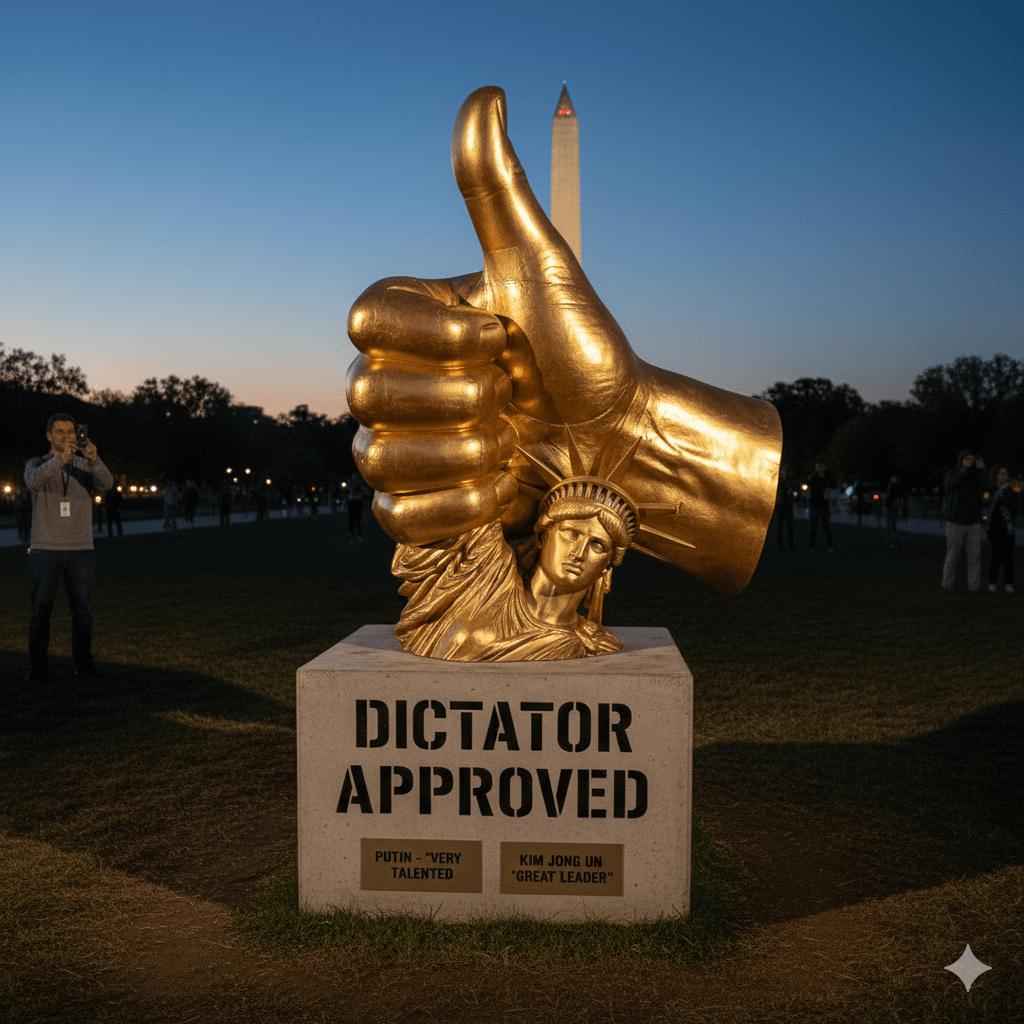
Yes, that image is a representation of the “Dictator Approved” statue, based on the descriptions of the protest artwork that appeared on the National Mall.
The key elements in the drawing match the actual temporary installation:
- The Golden Thumbs-Up: The large, metallic, gold-colored hand giving a thumbs-up.
- The Crushed Crown: The Statue of Liberty’s crown being crushed or cracked beneath the hand, symbolizing a threat to freedom and democracy.
- The Pedestal: The base, which typically included the text “DICTATOR APPROVED” and quotes from authoritarian leaders, providing the political context for the artwork.
Since the original piece was a satirical, temporary sculpture, the image accurately captures the powerful symbolism and overall appearance that made the artwork so controversial.
 thelivingbreathingjamesbrown.com
You must be logged in to post a comment.