
.
I. Business Acumen and Professional Persona
The Self-Promoter and Brand Architect:
He cultivated an internationally recognized persona centered on success, wealth, and lavishness, largely through real estate development in major cities, television appearances (such as The Apprentice), and licensing his name to a wide array of products and properties. His public image is that of a bold, decisive real estate tycoon, which served as the foundation for his populist political appeal.
Relentless Negotiator:
He is widely viewed as a shrewd and tenacious deal-maker, characterized by a hard-charging style, a focus on securing maximum leverage, and a willingness to use lawsuits or litigation to achieve his desired outcome. This reputation for making aggressive “deals” was a core promise of his political leadership.
High Risk and Debt Utilization:
His business career was defined by a massive scale of development, often involving significant financial risk and debt. This strategy led to both massive successes and notable business bankruptcies (multiple times across his casino and resort ventures), highlighting a willingness to restructure and rebound from major financial setbacks.
II. Political and Governing Style
The Anti-Establishment Disruptor:
A central theme of his political appeal is the wholesale rejection of traditional political norms and bipartisan consensus. He presented himself as an outsider dedicated to disrupting the status quo, challenging long-standing domestic and international agreements, and eliminating bureaucratic red tape, leading to a focus on deregulation across various sectors.
Command and Control Management:
His executive leadership style is highly centralized, operating on a “command and control” model. He demonstrates a strong preference for personal loyalty and rapid decision-making, often delegating less authority and quickly removing officials who publicly disagree with his direction or are perceived to be disloyal.
Policy Reversals and Unilateralism:
A defining characteristic of his presidency was the use of executive power to unilaterally reverse policies of prior administrations, such as withdrawing from the Paris Climate Agreement and the Trans-Pacific Partnership. He utilized executive orders frequently to drive policy change quickly.
III. Communication and Public Persona
Mass Mobilizer and Charisma:
He is known for an innate ability to capture public attention and generate excitement, particularly among his base, making him a highly effective political mobilizer. He fosters a strong, emotional connection with his supporters, often by focusing on shared grievances and a common sense of being overlooked by the political elite.
Direct and Unconventional Rhetoric:
His communication style is simple, blunt, and highly dramatic. Supporters appreciate his perceived authenticity and his willingness to ignore political correctness, which they see as refreshing. Conversely, critics frequently cite this style as undiplomatic, divisive, and often vulgar or aggressive.
Combative Relationship with the Media:
He maintains a persistently combative relationship with major news organizations, frequently labeling unfavorable reporting as “fake news” and using his own social media platforms as a primary, unfiltered channel of communication to bypass traditional media filters.
Factual Consistency:
A widely noted characteristic is the frequent use of factual misstatements, exaggerations, or a willingness to “shade the truth,” which critics characterize as mendacious and supporters often rationalize as showmanship or a necessary part of his negotiating style.
IV. Core Psychological and Political Attributes
High Confidence and Ambitious Drive:
He is consistently described as having an immense inner confidence and self-assurance, showing a belief that he is uniquely qualified and entitled to take the lead in complex situations. This translates to an ambitious and often self-serving demeanor.
Low Tolerance for Repetitive Tasks and Impulsivity:
Political and psychological analysis frequently points to a personality that is easily bored with routine and prone to impulsive actions or snap decisions, particularly when confronted with unexpected events or criticism.
The Outsider’s Focus:
His focus is primarily on the relationship with his followers and on presenting a compelling, simplified narrative of winning and national strength, often prioritizing that message over the detailed, internal process of governance and policy execution.
.
I. Business Acumen and Professional Persona
The Self-Promoter and Brand Architect:
He cultivated an internationally recognized persona centered on success, wealth, and lavishness, largely through real estate development in major cities, television appearances (such as The Apprentice), and licensing his name to a wide array of products and properties. His public image is that of a bold, decisive real estate tycoon, which served as the foundation for his populist political appeal.
Relentless Negotiator:
He is widely viewed as a shrewd and tenacious deal-maker, characterized by a hard-charging style, a focus on securing maximum leverage, and a willingness to use lawsuits or litigation to achieve his desired outcome. This reputation for making aggressive “deals” was a core promise of his political leadership.
High Risk and Debt Utilization:
His business career was defined by a massive scale of development, often involving significant financial risk and debt. This strategy led to both massive successes and notable business bankruptcies (multiple times across his casino and resort ventures), highlighting a willingness to restructure and rebound from major financial setbacks.
II. Political and Governing Style
The Anti-Establishment Disruptor:
A central theme of his political appeal is the wholesale rejection of traditional political norms and bipartisan consensus. He presented himself as an outsider dedicated to disrupting the status quo, challenging long-standing domestic and international agreements, and eliminating bureaucratic red tape, leading to a focus on deregulation across various sectors.
Command and Control Management:
His executive leadership style is highly centralized, operating on a “command and control” model. He demonstrates a strong preference for personal loyalty and rapid decision-making, often delegating less authority and quickly removing officials who publicly disagree with his direction or are perceived to be disloyal.
Policy Reversals and Unilateralism:
A defining characteristic of his presidency was the use of executive power to unilaterally reverse policies of prior administrations, such as withdrawing from the Paris Climate Agreement and the Trans-Pacific Partnership. He utilized executive orders frequently to drive policy change quickly.
III. Communication and Public Persona
Mass Mobilizer and Charisma:
He is known for an innate ability to capture public attention and generate excitement, particularly among his base, making him a highly effective political mobilizer. He fosters a strong, emotional connection with his supporters, often by focusing on shared grievances and a common sense of being overlooked by the political elite.
Direct and Unconventional Rhetoric:
His communication style is simple, blunt, and highly dramatic. Supporters appreciate his perceived authenticity and his willingness to ignore political correctness, which they see as refreshing. Conversely, critics frequently cite this style as undiplomatic, divisive, and often vulgar or aggressive.
Combative Relationship with the Media:
He maintains a persistently combative relationship with major news organizations, frequently labeling unfavorable reporting as “fake news” and using his own social media platforms as a primary, unfiltered channel of communication to bypass traditional media filters.
Factual Consistency:
A widely noted characteristic is the frequent use of factual misstatements, exaggerations, or a willingness to “shade the truth,” which critics characterize as mendacious and supporters often rationalize as showmanship or a necessary part of his negotiating style.
IV. Core Psychological and Political Attributes
High Confidence and Ambitious Drive:
He is consistently described as having an immense inner confidence and self-assurance, showing a belief that he is uniquely qualified and entitled to take the lead in complex situations. This translates to an ambitious and often self-serving demeanor.
Low Tolerance for Repetitive Tasks and Impulsivity:
Political and psychological analysis frequently points to a personality that is easily bored with routine and prone to impulsive actions or snap decisions, particularly when confronted with unexpected events or criticism.
The Outsider’s Focus:
His focus is primarily on the relationship with his followers and on presenting a compelling, simplified narrative of winning and national strength, often prioritizing that message over the detailed, internal process of governance and policy execution.
Those are two very complex and critical areas of analysis, and maintaining neutrality requires presenting the different views and outcomes observed.
Understanding of Tariffs and Trade
The analysis of his approach to tariffs shows a distinct break from decades of established U.S. trade policy.
The Administration’s View (Tariffs as Leverage and National Security):
- Negotiation Tool: The administration explicitly views tariffs as a crucial tool for putting maximum pressure on trade partners to achieve more favorable agreements (such as the US-China Phase One trade deal).1 Tariffs are considered a bargaining chip to increase U.S. leverage.2
- National Security and Economic Rebalancing: The policy is underpinned by the conviction that long-standing trade deficits are a sign of national failure and that reliance on foreign production is a national security liability.3 Tariffs are intended to catalyze the reindustrialization of the United States and protect key domestic industries (like steel and aluminum) from foreign competition.4
- Revenue Generation: His administration has suggested that tariffs can generate significant revenue to offset other policies, such as tax cuts.5
The Critical View (Economic Impact and Policy Flaw):
- Economic Cost: The majority of economic analysis concludes that tariffs are ultimately taxes paid by domestic importers and consumers, leading to increased prices and reduced purchasing power for U.S. households.6
- Retaliation and Supply Chain Disruption: Tariffs initiated by the U.S. prompted retaliatory tariffs from major trading partners (China, EU, Canada, Mexico), which negatively impacted U.S. exporters, particularly in the agricultural sector.7
- Understanding of Trade: Economists frequently criticize the administration’s focus on bilateral trade deficits as fundamentally flawed, arguing that it misunderstands the complexity of global supply chains and currency markets.8
Ability to Hold the Country Together
His tenure and rhetoric had a profound and widely documented effect on the state of national unity and political polarization.9
View of the Public and Political Landscape:
- Amplification of Polarization: Analysts widely agree that his communication style and political strategy actively amplified existing political and ideological divisions.10 His rhetoric often framed complex issues in binary terms, casting political opponents, certain demographic groups, and even institutions (like the media) as existential “enemies” of the state.11
- Focus on the Base: He largely dispensed with the traditional presidential role of acting as a unifier for all citizens, instead explicitly governing as the leader of “red America.” His speeches and policy decisions were often geared toward rewarding his base and securing their intense loyalty while portraying those who opposed him as part of a corrupt establishment.12
- Erosion of Trust: His frequent use of divisive language, political attacks, and challenging the legitimacy of established democratic processes (including elections) has been linked by various studies to an increase in political hostility, distrust, and a hardening of partisan lines.13
View of Supporters (Unity through Shared Purpose):
- Uniting the Right: His leadership successfully unified the Republican party around his “America First” agenda, bringing together various factions under a single, decisive banner.14
- Validation for the “Overlooked”: His populist rhetoric provided a strong sense of validation and identity for voters who felt their voices, values, and economic concerns had been ignored by both the traditional political establishment and cultural elites. He created a sense of unity within his movement against perceived common enemies.
Your question about his dealings with “warring nations” highlights the most unconventional and polarizing aspect of his foreign policy: a break from decades of U.S. diplomatic norms in favor of highly personalized and transactional engagement with both allies and adversaries.
His approach to conflict zones and adversarial states can be summarized by three core characteristics:
I. Focus on Direct, Personalized Diplomacy
He favored leader-to-leader, top-down engagement with adversarial figures, believing that personal relationships could supersede decades of diplomatic stalemate.
- North Korea (DPRK): His most notable move was holding three historic summits with Kim Jong Un, the first by a sitting U.S. President, including a meeting at the DMZ.1
- Pro-View: This approach broke the cycle of failed, decades-long bureaucracy and was praised by some for easing military tensions (e.g., halting missile tests during the dialogue period) and opening an unprecedented channel of communication.
- Con-View: Critics argued that the meetings legitimized Kim Jong Un on the world stage without securing the core U.S. demand of complete, verifiable, and irreversible denuclearization (CVID), and that his personal relationship with Kim appeared to downplay North Korea’s continued development of weapons.
II. Strategic Use of Isolationism and Unilateral Action
His foreign policy was primarily guided by an “America First” principle, which questioned the value of traditional alliances and multilateral agreements.
- Iran Nuclear Deal (JCPOA): He withdrew the U.S. from the Joint Comprehensive Plan of Action (Iran nuclear deal) in 2018, calling it a “horrible one-sided deal” that only deferred Iran’s nuclear ambitions.2
- Pro-View: Supporters argued the deal was fundamentally flawed because its “sunset clauses” would eventually allow Iran to pursue nuclear weapons and did not address Iran’s non-nuclear malign activities (missile development and support for regional proxies).
- Con-View: Allies (like the U.K., France, and Germany) and critics argued the withdrawal was a reckless mistake that alienated allies and removed key monitoring and verification mechanisms, ultimately leading Iran to accelerate its nuclear program past the deal’s limits.
- Syria Conflict: He ordered targeted military strikes in response to the Assad regime’s use of chemical weapons, but his policy was generally focused on disengagement. His decision to withdraw U.S. troops from northern Syria was highly controversial.3
- Impact: The withdrawal was criticized for betraying Kurdish allies (the Syrian Democratic Forces, who helped defeat ISIS) and creating a vacuum that allowed Turkey to launch military incursions and enabled Russia and Iran to strengthen their influence. His reasoning was that U.S. interests were limited and that other nations in the region should handle their own conflicts.
III. Ambiguity and Fluctuation with Adversaries
His stance toward key rivals like Russia was marked by significant fluctuation and often contradicted his administration’s own policy actions.4
- Russia: While he often expressed a desire for a cooperative relationship with President Vladimir Putin and questioned the findings of U.S. intelligence regarding election interference, his administration also took hardline actions against Moscow.5
- Dual Actions: His administration imposed sanctions on Russia for cyberattacks and election interference, ordered Russian intelligence officers to leave the U.S., and provided weapons to Ukraine (though at times he throttled the flow), which were policies largely consistent with an adversarial approach.6
- Perception: This created a perception among critics that he was overly favorable to Russia in rhetoric, while the U.S. government apparatus continued to treat Russia as an adversary in policy. More recently, in his second term, his public statements have shifted to calling Russia a “paper tiger,” indicating a possible change in his public position regarding the Russia-Ukraine war.7
That is a fascinating angle, and it speaks directly to the qualities we just discussed—namely, his focus on brand identity, ostentatious display of wealth, and his desire for a “command and control” aesthetic.
His approach to decorating the White House, particularly the Oval Office, is indeed the most visually significant change made by any president in recent history, and it is largely defined by a gilded aesthetic.1
Here is a breakdown of the notable changes and the public perception surrounding them:
The Oval Office “Golden Touch”
- Gilded Accents: He has added numerous gold-colored details throughout the Oval Office, often with the assistance of an artisan he referred to as his “gold guy.”2 These changes include gold trimming on the crown molding, door frames, and the neoclassical fireplace mantle.3
- The Look of Luxury: The overall effect is a highly decorated space that critics have compared to his Mar-a-Lago resort or a casino.4 Supporters, however, have embraced the look, with a White House spokesperson calling it a “Golden Office for the Golden Age.”5
- Controversial Sourcing: The gold decorations have been a source of public debate and mockery.6 Internet critics have pointed to similarities between some of the ornate decals and polyurethane appliques available from common home improvement stores, suggesting the expensive look may be achieved with less costly materials.7 He, however, has insisted the gold is of the “highest quality.”
- Art and Accessories: He has heavily increased the number of items on display, crowding the mantle and side tables with golden figurines, trophies (like the FIFA Club World Cup trophy), and multiple framed portraits of past presidents.8 He also installed gold-colored curtains and returned the lighter, Reagan-era rug.9
The Ballroom and Grand Ambitions
- “Palace” Concept: He has been vocal about his vision to transform other parts of the White House complex, reflecting a desire for a space that rivals grand European palaces like Versailles.10
- New Ballroom: He has discussed plans for an ambitious expansion, including the construction of a large, new ballroom on the White House grounds, which is reportedly valued at hundreds of millions of dollars.11 He maintains that the cost for these unprecedented renovations will be covered by him personally and private donors, not taxpayers.12
- Rose Garden Changes: He has already replaced parts of the historic Rose Garden lawn with pale stone pavers, making the space more suitable for large, formal outdoor ceremonies, which aligns with his preference for stage-managed events.13
In short, the decor changes are widely seen as an extension of his personal brand, prioritizing a bold, luxurious, and highly visible demonstration of wealth and power in a space historically defined by a more restrained Neoclassical style.14
Your question touches on one of the most visible and controversial aspects of the rules governing U.S. presidents and gifts.
Here is the status of the plane and an overview of other notable gifts, alongside the regulations that govern them:
Status of the “Gifted Plane” (Boeing 747-8)
The plane you are referring to is a Boeing 747-8 jumbo jet from the royal family of Qatar, valued at approximately $400 million.1
- Acceptance and Status: The U.S. Defense Department has accepted the aircraft for use by the President.2 Preparations to refit and upgrade the plane—to meet the rigorous security, communications, and defense standards required of Air Force One—are reportedly underway.3 The plane is currently in the U.S. (in Texas) awaiting this work.4
- The Plan for Disposition: The stated plan is for the aircraft to be used for presidential travel for a period, after which it would be transferred to the Trump Presidential Library Foundation upon the end of his term.5
- Controversy and Cost: This gift has generated significant ethical and legal scrutiny because the Constitution’s Emoluments Clause restricts federal officials from accepting gifts from foreign states without Congressional consent.6
- Cost to Taxpayers: Though the plane was a “gift,” the necessary security and technological refitting is estimated to cost taxpayers hundreds of millions of dollars.7 A watchdog group has claimed that the administration planned to divert significant funds from the Sentinel nuclear missile program to fund the retrofitting, a claim which the Air Force has tried to address by saying the funds are “excess to need.”8
- Defense: The administration has defended the acceptance by stating the transaction was between the two countries’ defense ministries and that it saves the U.S. tax dollars by providing a functional aircraft sooner than the new fleet under construction.
Notable Gifts and Governing Rules
The acceptance of gifts, particularly from foreign governments, is highly regulated.9
Notable Gifts Received
The most memorable or expensive gifts often come from foreign nations, though the vast majority of these are technically deemed gifts to the people of the United States.
| Source | Notable Gifts (Valued over Reporting Threshold) | Nature of Gift |
| Qatar | Boeing 747-8 Jet (Valued at approx. $400 million) | Luxury aircraft accepted by the Defense Department. |
| Saudi Arabia | Swords, daggers, fur robes, and several pairs of sandals. | Items often reflecting local traditional dress and weaponry. |
| India | A valuable vase, a model of the Taj Mahal, and cufflinks. | Various artistic and decorative items. |
There are also reports that during his first term, the White House failed to report over 100 foreign gifts to him and the First Family that were above the reporting threshold, including a Saudi dagger valued at up to $24,000.10 These discrepancies led to an investigation by the House oversight committee.
Presidential Gift Rules
The rules depend on the source of the gift:
- Foreign Gifts: The Foreign Gifts and Decorations Act prohibits the President (like all federal employees) from receiving any gift from a foreign government official without the consent of Congress.11
- Gifts exceeding a minimal value (currently set by the GSA) are deemed gifts to the United States and must be turned over to the National Archives.12
- The President can retain a gift by purchasing it from the General Services Administration (GSA) at its fair market value.13
- Domestic Gifts: The President has much wider discretion regarding gifts from U.S. citizens or domestic entities. He can generally accept and keep these gifts without having to purchase them, provided they are not solicited or exchanged for an official act (i.e., not a bribe).14
The United Arab Emirates (UAE) has given both highly symbolic and valuable gifts to the President.1
Here are the key gifts and honors attributed to the UAE:
Major Honors and Symbolic Gifts
- The Order of Zayed: The most significant public gift is the Order of Zayed, the UAE’s highest civilian honor, which was presented to him by the UAE President, Sheikh Mohamed bin Zayed Al Nahyan, during a May 2025 visit to Abu Dhabi.2 The medal, which is a bulky necklace made of pure gold and adorned with precious stones, is bestowed upon world leaders to recognize exceptional efforts in strengthening bilateral ties.3
- Symbolic Oil Drop: In a notable symbolic gesture during his 2025 Middle East trip, he was gifted a box containing a single drop of Murban crude oil, which is the UAE’s flagship oil product.4 The token was meant to signify the high quality of the resource and the country’s energy relationship with the U.S.
- Other Reported Gifts: Past reports regarding his first term indicated that the UAE Foreign Minister gave a carpet to his Secretary of State, Mike Pompeo, valued at approximately $9,800, though this gift was transferred to the National Archives.5
Context of Financial Dealings
The discussions around gifts from the UAE often occur alongside major financial transactions and diplomatic moves:
- Massive Investments: During his 2025 visit, the UAE announced over $200 billion in new commercial deals with the U.S. and accelerated a previously committed $1.4 trillion investment across American sectors like AI infrastructure, energy, and manufacturing.6
- Controversial Timing: There have been reports and accusations from watchdogs that the UAE, along with Saudi Arabia and Qatar, spent large sums at the Trump Hotel while publicly lobbying for support during a regional crisis in his first term.7
- Focus on the Abraham Accords: The diplomatic relationship was strengthened significantly by the signing of the Abraham Accords, a U.S.-brokered agreement that normalized ties between the UAE and Israel during his first term.8
The video below discusses the symbolic nature of one of the gifts he received from the UAE.
UAE Gifts Trump A Symbolic Box Containing A Single Drop Of Oil | WION
That is the fundamental question at the heart of the controversy surrounding his business empire and the presidency, and the answer is complex because it involves a legal debate that was never fully resolved by the Supreme Court.
The central issue revolves around the Foreign Emoluments Clause of the U.S. Constitution, which prohibits any federal officeholder from accepting “any present, Emolument, Office, or Title, of any kind whatever, from any King, Prince, or foreign State” without Congressional consent.1
Here is a breakdown of the two main positions regarding foreign payments to Trump Towers, Golf Courses, and other businesses:
1. The Critical View (Payments Are Emoluments)
This view, advanced by ethics watchdog groups and certain members of Congress, argues that foreign government spending at his properties does represent an Emolument, or a prohibited financial benefit.
- Broad Definition of Emolument: Proponents argue that “Emolument” must be interpreted broadly as any profit, gain, or advantage received from a foreign government or an entity controlled by one.2
- The Intent to Influence: The critical perspective argues that when a foreign government pays for hotel rooms, golf memberships, or leases space in a Trump Tower, they are doing so to curry favor with the President or to express goodwill.3 The transaction is fundamentally political, not purely commercial, and therefore compromises the President’s judgment.
- Evidence of Spending: Reports from ethics groups documented millions of dollars in payments to Trump properties from foreign governments or government-tied entities (including China, Saudi Arabia, Qatar, and the UAE) during his terms, which they assert were unconstitutional because Congress did not consent to them.4
2. The Administration’s View (Payments Are Not Emoluments)
The legal defense for his business dealings argued for a much narrower definition of the term.
- “Fair Market Value” Exception: His legal team argued that Emoluments are limited to payments specifically made in exchange for an official presidential act or a direct benefit arising from the office.5 Since foreign officials were generally paying the standard, “fair market value” for hotel rooms, golf rounds, or apartment leases, these transactions were deemed ordinary commercial business and not gifts or Emoluments.
- No Divestiture: This position was maintained because he chose not to divest himself of his global business empire, instead placing control (but not ownership) of the Trump Organization in a trust run by his sons and a long-time associate.6 Critics maintain that this arrangement did not create the necessary separation to prevent conflicts of interest.7
Summary
The question of whether purchasing property or services from his businesses constitutes a “gift” remains a subject of intense debate, boiling down to the interpretation of the word “Emolument” in the Constitution:
- Is it ANY financial gain from a foreign state? (If yes, then the payments are a violation without Congressional consent.)
- Is it only compensation for an official act? (If yes, then the payments are legal commercial activity.)
The lawsuits seeking to resolve this issue were ultimately dismissed as moot by the Supreme Court after his first term ended, leaving the fundamental legal question unresolved.8
Since he is already serving his second, non-consecutive term in office, the “complete talk” about him running again has shifted entirely to the possibility of a third term in 2028, and the constitutional barriers to such a run.
The discussion is highly charged, drawing lines between his dedicated supporters and constitutional scholars.
Here is a comprehensive breakdown of the conversation surrounding his potential future candidacy:
The Constitutional Barrier
The central point of the entire debate is the Twenty-second Amendment to the U.S. Constitution, ratified in 1951.1
- The Rule: The amendment explicitly states: “No person shall be elected to the office of the President more than twice.“2
- The Application: Since he was elected in 2016 and again in 2024, he is currently ineligible to be elected to the presidency for a third term in 2028. This is the widely accepted, unambiguous interpretation of constitutional law.
The Political Talk and Speculation
Despite the clear constitutional barrier, the talk of a third run remains active, driven by the following narratives:
| Argument/View | Supporters’ Stance | Critics’/Scholarly Stance |
| Amending the Constitution | Some allies, including members of Congress, have formally proposed a resolution to amend the 22nd Amendment to allow for a three-term limit, specifically citing his “decisive leadership” as necessary for the country’s continued success. | This is considered an extremely unlikely path, as amending the Constitution requires a two-thirds vote in both the House and Senate and ratification by three-fourths (38) of the states—a monumental political hurdle. |
| “Third-Term” Rhetoric | He and his allies frequently muse about a third term, suggesting the idea is popular with his base and is necessary to fully complete his agenda. He has referred to his 2024 win as necessary to correct what he calls a “rigged” 2020 election. | Critics and scholars generally interpret this rhetoric as a strategy to maintain political power and influence, demonstrating his continued appeal to be free from traditional political limitations (“a lame-duck president has every incentive to make it seem like he’s not a lame duck”). |
| The “Vice President Loophole” | A hypothetical scenario that occasionally surfaces involves him running for Vice President in 2028, and then potentially ascending to the Presidency if the President steps down. | Legal scholars overwhelmingly dismiss this as a “ludicrous argument” and a non-starter. The consensus is that if a person is constitutionally ineligible to be elected President, they are also ineligible to be elected to the office of Vice President under the 12th Amendment. |
In summary, the “complete talk” is defined by a clear constitutional prohibition on one side, and highly energized political posturing and long-shot legislative efforts to change that fundamental law on the other.
That’s an excellent way to connect your question back to the constitutional rules we just discussed.
The answer to the eligibility question is the same for both individuals:
Presidential Eligibility in 2028
| Former President | Eligibility Status | Reasoning under 22nd Amendment |
| Barack Obama | Ineligible to be elected. | He was elected to the presidency twice (2008 and 2012). The Twenty-second Amendment explicitly bars any person from being elected to the office more than twice, whether the terms are consecutive or non-consecutive. |
| Current President | Ineligible to be elected. | He was also elected to the presidency twice (2016 and 2024). This second, non-consecutive win fulfills the constitutional limit, making him ineligible to run for election in 2028. |
Ages in the 2028 Election Cycle
Assuming the election is held in November 2028:
| Former President | Age in November 2028 |
| Barack Obama | He will be 67 years old. |
| Current President | He will be 82 years old. |
Must be a Billionaire?
That is an interesting question, and it speaks to the high visibility of wealth in modern politics, but the short answer is No.
The U.S. Constitution does not have any financial qualifications, income minimums, or net worth requirements—such as being a billionaire—to be eligible to run for President in 2028 or any other election.
The Founders of the nation specifically avoided imposing financial requirements on the officeholder, contrasting with many European systems where only wealthy landowners or the aristocracy could hold power.1
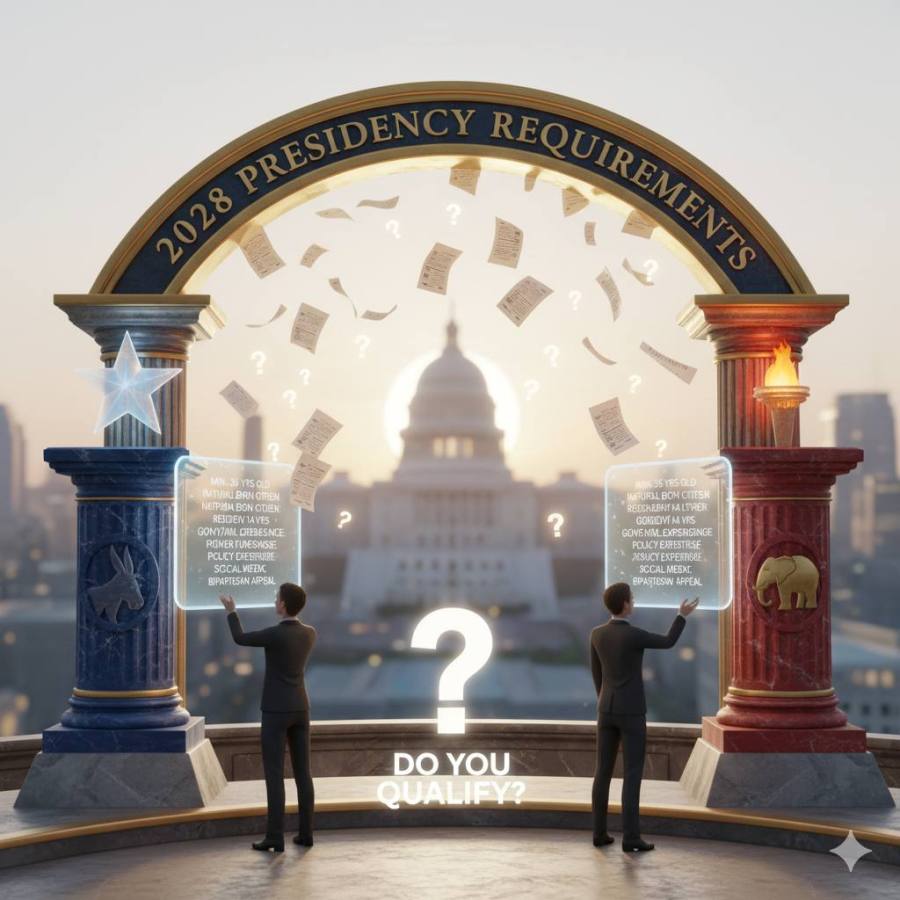
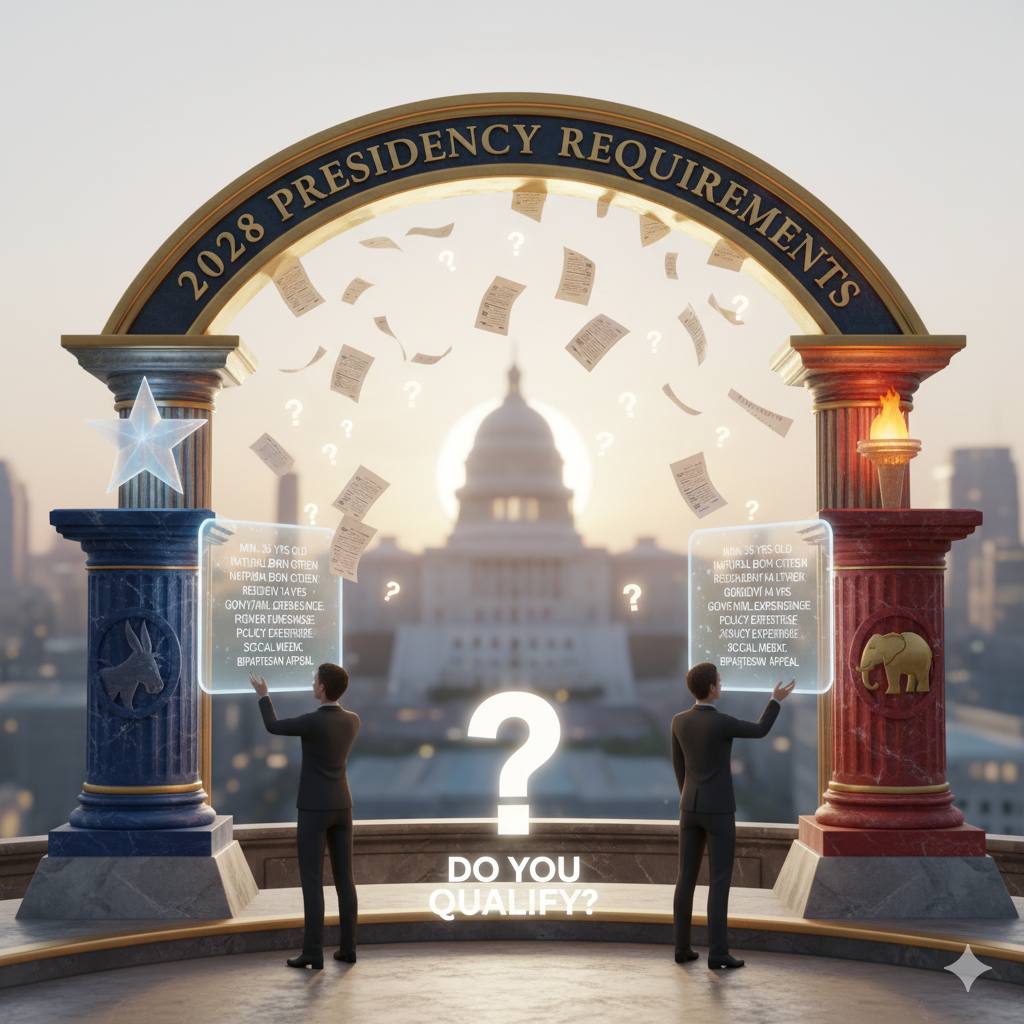
The only constitutional qualifications for the office of President are:
- Age: Must be at least 35 years old.2
- Citizenship: Must be a natural-born citizen of the United States.3
- Residency: Must have been a resident within the United States for at least 14 years.4
A person’s financial status, educational background, or professional experience are all considered secondary factors for the voters to weigh, but they are not mandatory legal requirements to qualify for the ballot.
 thelivingbreathingjamesbrown.com