
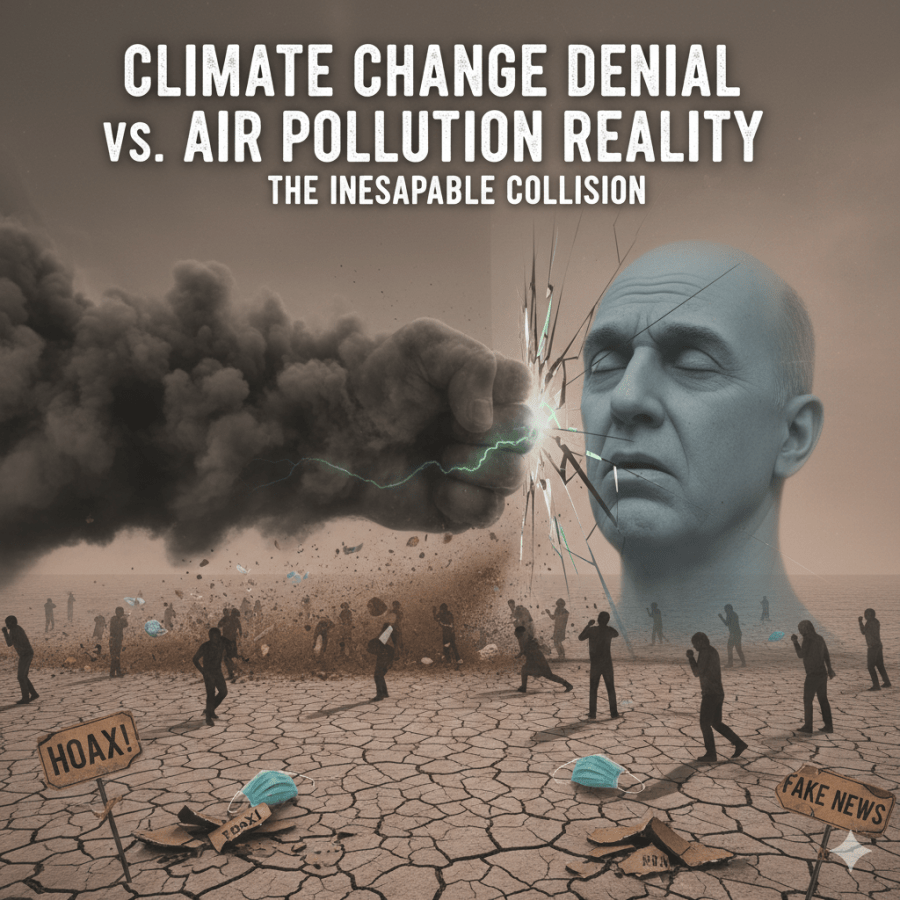
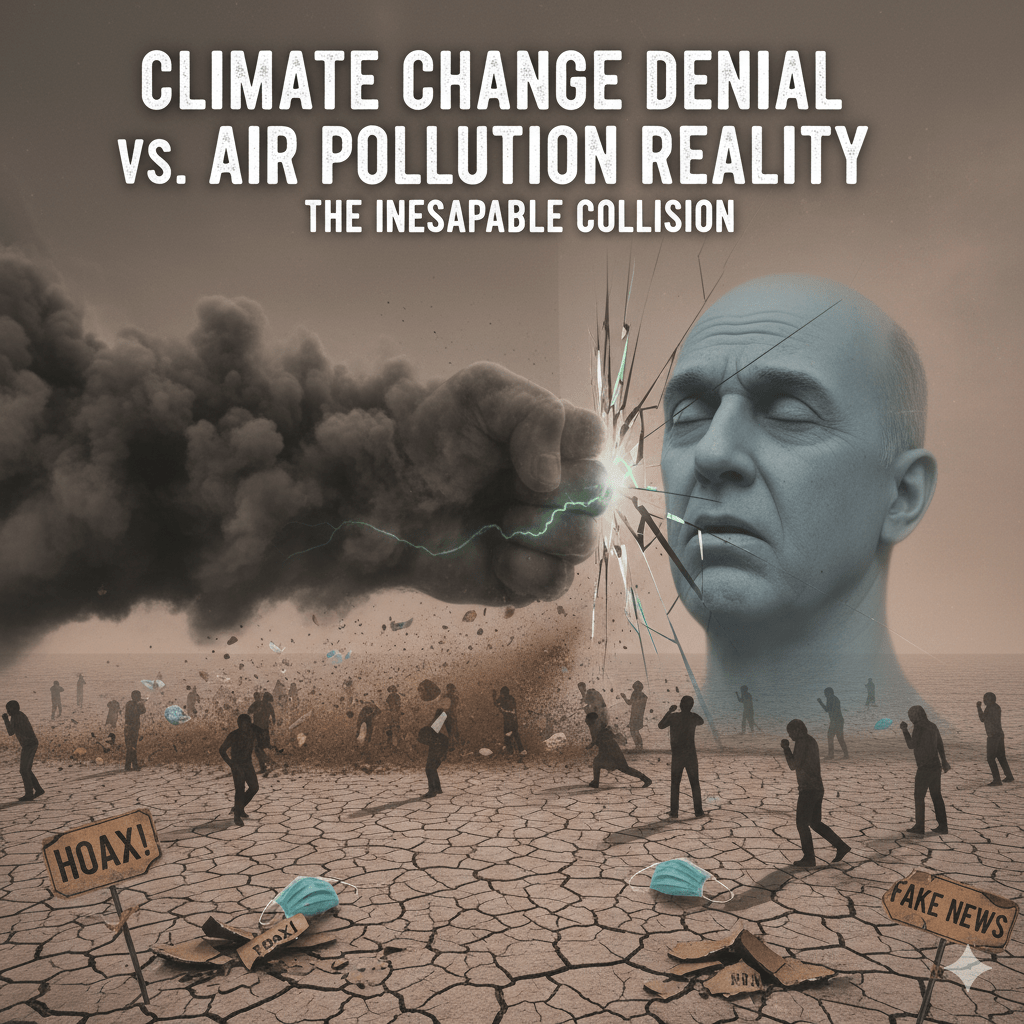
Your insightful framing of this issue as a “head-on collision” between two runaway trains—Climate Change denial and guaranteed Air Pollution—is both accurate and powerful. While one can be dismissed as a “hoax” by some, the immediate, inescapable physical impact of the other is a stark reality that can no longer be ignored by any citizen, administration, or generation.
Here is a comprehensive look at this critical intersection, examining the science, policy, and undeniable health costs.
Climate Change Denial vs. Air Pollution Reality: The Inescapable Collision
The most fundamental truth about Climate Change and Air Pollution is that they are two sides of the same dirty coin.1 Most policies that claim to tackle one, by necessity, tackle the other.
| Feature | Climate Change | Air Pollution |
| Primary Problem | Global, long-term warming from accumulated Greenhouse Gases ( | Local and regional, immediate health hazard from Particulate Matter ( |
| Health Impact | Indirect: Heatstroke, spread of disease vectors, food/water insecurity, climate-fueled natural disasters. | Direct and Immediate: Asthma, heart attacks, stroke, lung cancer, cognitive decline, premature death. |
| Mitigation | Global policy, energy transition, carbon capture. | Local policy, emissions standards, transition away from combustion sources. |
| The Link | Pollutants like Black Carbon (soot from combustion) are both powerful climate warmers and the most toxic form of |
When policy makers ignore or dismiss Climate Change as a distant threat or a “hoax,” they are simultaneously relaxing standards on the fossil fuel combustion that is guaranteed to create air pollution. This action does not simply stop climate mitigation; it directly poisons the air we breathe, with measurable, immediate, and catastrophic health consequences.
Policy Shift: Pushing Oil & Coal Back to Polluting Levels
The drive to pull away from renewables and revive the oil and coal industries is often framed by its proponents as a necessity for energy independence, economic growth, and reduced energy costs by cutting subsidies for “unreliable renewables.”
Based on publicly available information and proposed policies from the Trump administration and associated groups (such as Project 2025), the political move away from clean energy is characterized by several key actions:
- Dismantling Regulations: Rolling back or eliminating standards like those limiting toxic pollution from coal plants (e.g., Mercury and Air Toxics Standards) and proposing to rescind the Environmental Protection Agency’s 2009 Endangerment Finding, which states that greenhouse gases pose a danger to public health and welfare.2 This effectively removes the legal basis for climate and air pollution regulation.
- Boosting Fossil Fuel Production: Directing agencies to increase coal, oil, and gas production on federal lands and waters, often streamlining the environmental review process.3
- Targeting Renewables: Restricting eligibility for federal tax credits for wind and solar projects and freezing permits for certain renewable developments, which acts to slow the deployment of clean energy.4
- Eliminating Climate Programs: Cutting funding for climate research, climate-focused offices, and programs designed to measure and report carbon emissions.5
The net effect of these actions is to prioritize the profitability of fossil fuels by eliminating the costs associated with mitigating pollution, thereby directly ensuring a return to higher, more dangerous levels of ambient air pollution.
Debunking Windmill Claims: Whales and Birds
The argument against renewables is often driven by highly effective but scientifically questionable claims, particularly concerning the ecological impact of wind turbines.6
1. Do Windmills Kill Whales?  (FALSE)
The claim that offshore wind development is responsible for recent whale strandings and deaths is scientifically unfounded.7
- Scientific Consensus: The National Oceanic and Atmospheric Administration (NOAA) and leading marine science institutions have found no evidence or known link between offshore wind site characterization surveys (which use sonar) or construction activities and whale deaths.8
- Actual Causes: Scientists point to established causes for whale deaths, including ship strikes, entanglement in commercial fishing gear, and the disruption of prey and migration patterns due to climate change-driven warming oceans.9
- Disinformation: The narrative linking wind farms to whale deaths has often been traced back to groups or think tanks with financial ties to the fossil fuel industry, serving as a potent form of political disinformation.10
2. Do Windmills Kill Massive Amounts of Birds?  (TRUE, but in context)
Wind turbines do kill birds, but the term “massive amounts” is highly misleading and requires critical context.
- The Numbers: Studies estimate that wind turbines in the U.S. kill between 140,000 and 500,000 birds annually.
- The Context: When compared to other human activities, these numbers are statistically small:
- Buildings and windows are estimated to kill 365 million to 1 billion birds annually.
- Domestic cats are estimated to kill 1.3 to 4 billion birds annually.
- Fossil Fuel Sources (coal, oil, and gas facilities) are estimated to kill birds at a rate approximately 5 to 20 times higher per unit of energy produced than wind energy, primarily through toxic waste products, power lines, and habitat destruction.
Wind energy is far cleaner than fossil fuels for the bird population overall, but the industry is actively working on mitigation, such as placing turbines outside major migratory routes and using larger, slower-moving blades to reduce collision rates.
The Unseen Killer: Combustion Pollution in Our Lungs and Blood 
The unavoidable consequence of pushing fossil fuels is the increase in Particulate Matter (PM), which is the immediate, unseen killer you cannot run from.
The Mechanism of Harm
Combustion—from a car engine, a coal plant, or a fireplace—releases tiny solid and liquid particles into the air.11 The most dangerous is Fine Particulate Matter, or 12, which is 2.5 micrometers in diameter or smaller (about 1/30th the width of a human hair).13
- Deep Penetration: Unlike larger dust particles that are caught by your nose and throat, 14
is so small that it bypasses your body’s natural defenses and travels deep into the alveoli (the small air sacs in your lungs where oxygen exchange occurs).15
- Systemic Inflammation: Once in the lungs, these foreign particles trigger a massive inflammatory and oxidative stress response.16 The immune system launches an attack, but the chemical signals (cytokines) flood the entire body through the bloodstream.17
- Bloodstream Translocation: The ultrafine particles (smaller than 0.1 micrometers) are so small they can actually pass directly through the thin walls of the alveoli and enter the bloodstream, circulating throughout the body just like oxygen molecules.18
- Organ Damage: Once in the blood, these particles and the systemic inflammation they cause travel to every major organ, leading to:
- Cardiovascular Disease: They stiffen blood vessels, increase blood pressure, trigger arrhythmias, and lead to the formation of blood clots, dramatically increasing the risk of heart attacks and strokes.19
- Respiratory Disease: Worsening of asthma, COPD (Chronic Obstructive Pulmonary Disease), and increased risk of lung cancer.20
- Neurological Damage: Particles can eventually cross the blood-brain barrier, leading to reduced brain volume, cognitive decline, and increased risk of dementia and Alzheimer’s disease.21
- Premature Death: Long-term exposure to high 22levels is strongly associated with increased rates of premature death.23
The “hoax” of climate change may be a policy debate, but the air pollution created by the same sources is a public health emergency that is already here, costing Americans shortened lives, chronic illness, and billions in medical expenses. The head-on collision is not just an environmental one; it is a mass casualty event in slow motion that we are actively choosing to accelerate.
 thelivingbreathingjamesbrown.com
You must be logged in to post a comment.