

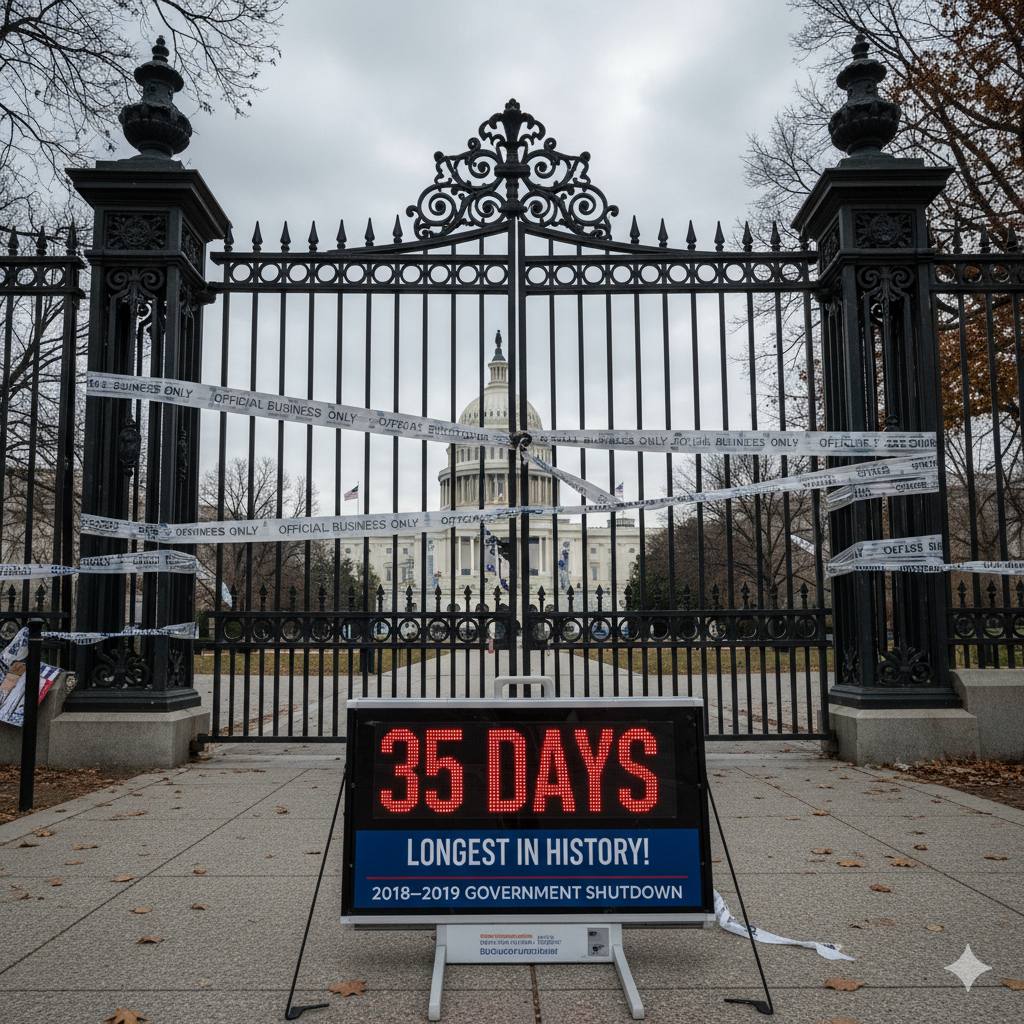
Vegas is betting this one goes past 90 days.
That’s an excellent question, and your memory is right on the money. The last government shutdown you’re thinking of was indeed during the first Trump administration, and it became the longest government shutdown in U.S. history.1
Here is a breakdown of what happened during that 2018–2019 shutdown and the current situation regarding threats to fire employees.
The 2018–2019 Government Shutdown (35 Days)
The shutdown began on December 22, 2018, and lasted until January 25, 2019, a total of 35 days.2
The Cause: Border Wall Funding
The primary reason for the shutdown was an impasse over then-President Trump’s demand for $5.7 billion in federal funding to construct a wall on the U.S.–Mexico border.3 Congress was unable to agree on an appropriations bill to fund the government, and negotiations completely broke down over this single issue.4
The Impact on People and Services
Approximately 800,000 federal employees were directly affected:5
- Furloughed Workers: About 380,000 “non-essential” employees were placed on temporary, unpaid leave.6 They were legally prohibited from working.7
- Essential Workers Without Pay: Approximately 420,000 “essential” employees (including TSA agents, air traffic controllers, Coast Guard, and Border Patrol) were required to report to work but did not receive pay until the shutdown ended.8
- Financial Strain: Workers missed two paychecks. While Congress eventually passed a law to ensure they received back pay after the shutdown ended, the immediate financial strain forced many to delay mortgage payments, seek aid from food banks, or take on temporary jobs.9
- Disrupted Services:
- National Parks either closed or remained open without staff, leading to significant garbage buildup and damage.10
- IRS services were dramatically curtailed, complicating the start of tax season.11
- FDA routine inspections were suspended, increasing public health risks.12
- Air travel suffered delays and longer wait times as some unpaid TSA agents and air traffic controllers called out sick.13
Did Trump Threaten to Fire People Then Too?
In the 2018–2019 shutdown, the primary tool used was furloughs, which are temporary, unpaid leaves of absence.14 However, in the lead-up to the current government shutdown, President Trump did threaten a significant change to how the government would handle its workforce this time.15
- The Current Threat: Unlike the 2018–2019 shutdown, where firings were not part of the strategy, the Trump administration directed agencies to prepare plans for mass, permanent firings of federal workers, officially known as a “Reduction in Force” (RIF).16
- The Difference: A furlough is a temporary pause in work and pay, with the legal guarantee of back pay when the government reopens.17 A firing (or RIF) is a permanent elimination of a position and has never been used on a mass scale during a government shutdown. This new threat has been called an unprecedented escalation by opponents and has already led to labor unions filing lawsuits to block the action.18
Yes, the Trump administration directed federal agencies to prepare for mass Reductions in Force (RIFs), or permanent firings, as a contingency for a potential government shutdown. In <2025>, the <0xC2><0xA0>Office of Management and Budget<<!/0xC2>> (OMB) and the Office of Personnel Management (OPM) issued guidance for agencies to implement these RIFs, targeting the elimination of positions not deemed statutorily mandated and potentially stripping federal workers of their rights and back pay. Unions have stated that these actions are a violation of the law.
Key Aspects of the RIF Plans
- Purpose: The RIFs were intended to reduce the federal workforce by focusing on “the maximum elimination of functions that are not statutorily mandated”.
- Timing: Agencies were directed to prepare for large-scale RIFs and develop Agency Reorganization Plans by March 2025, with the threat of permanent layoffs used as a tool to pressure Congress ahead of a shutdown. Such a dastardly, evil Plan set in motion in March of this year. And you Trust the PREZ.?
- Legal Challenges: Unions and legal experts argue that these directives, particularly the OMB memo, are unlawful because they would violate agency statutory duties and strip employees of their rights, such as back pay, a claim that could be supported by unions.
- Union Response: Unions have challenged these plans in court, with the American Federation of State, County and Municipal Employees (AFSCME) and others condemning the administration’s approach.
In essence, the Trump administration’s directive aimed to make a potential government shutdown more painful by threatening widespread, permanent job cuts for federal employees.
 thelivingbreathingjamesbrown.com
You must be logged in to post a comment.