


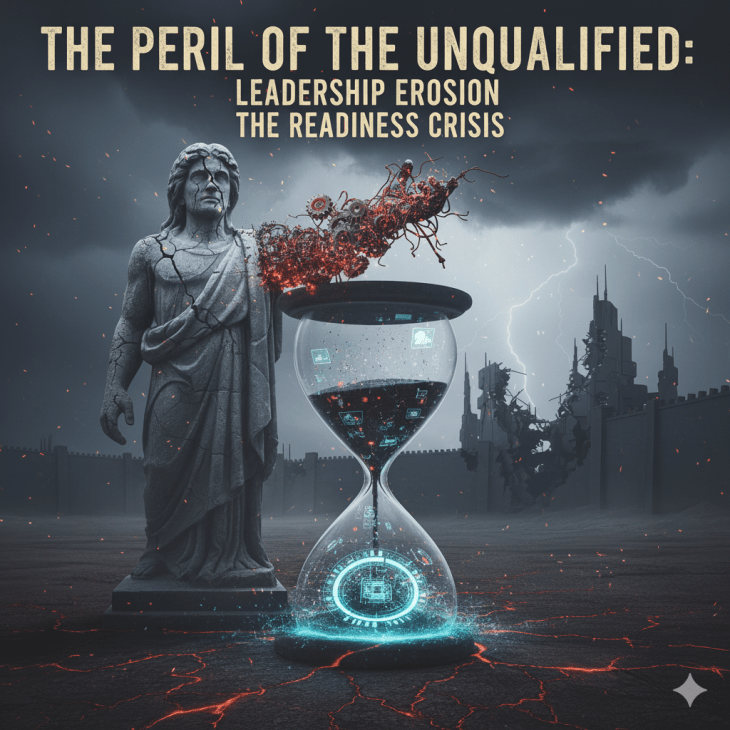
The Peril of the Unqualified: Leadership Erosion and the Readiness Crisis
The concept of a stable democracy hinges on the competence and legitimacy of its leadership, particularly concerning national defense. When figures at the highest level of executive power display contempt for, or lack the fundamental understanding of, the military establishment, it creates a crisis of confidence that endangers the nation’s ability to act coherently in wartime. This is the fear of the present incompetent: a looming reality where the delicate balance between political oversight and professional military experience is aggressively destabilized.

1. The Disrespectful Command: Breaking the Chain of Trust
The foundation of military effectiveness is respect for the chain of command and the professional expertise of its leaders. Generals and admirals are not merely political appointees; they are individuals whose judgment has been tested over decades through rigorous combat assignments, advanced education (including War College), and strategic planning roles.
When a political leader, lacking any military experience or formal strategic training, disparages or “chews out” highly decorated flag officers, it sends a corrosive message throughout the entire force: professionalism is less valued than personal loyalty or political favor. These generals represent the institutional memory of the military—its capacity for logistics, diplomacy, and sustained conflict. To undermine them publicly is to deliberately sabotage the credibility of the institutions required to manage a modern war, thereby ensuring the leaders they appoint will be respected neither by their peers nor by the enemy.

GODDAMN IT! TRUMP and HEGSETH got us into this Damn War and they can only send us on the Front Line Trump Brand Soft Toilet Paper instead of Needed AMMUNITION?
2. Strategic Vacuum: The Absence of War College Wisdom
Effective military leadership requires more than instinct; it demands a deep understanding of geopolitics, logistics, historical precedents, and the limits of power. This understanding is cultivated over years of professional military education.
The fear is rooted in a leadership that prioritizes aggressive, simplistic solutions over nuanced strategic thought—a mindset that has not matured through the crucible of a War College education. War, or the preparation for it, cannot be treated like a sporting event or a purely theatrical display. A leader who has “no stomach for fighting” outside of symbolic or televised events will fail the nation when a sustained, morally complex, and difficult conflict requires calculated endurance, not bravado. This strategic vacuum guarantees that any major crisis will be handled with impulse rather than intelligence.
3. Weaponizing Culture: Attacking the Fabric of the Force
Focusing on superficial and often irrelevant factors, such as weight standards for non-combat roles, beard policies, or arbitrary cultural grievances, is a clear indication that political agendas are superseding mission readiness.
- Beards and Rites: Disrespecting traditions like beards, which hold cultural and religious significance for service members, damages morale and creates unnecessary friction in a force that relies on cohesion.
- Weight Standards and Role: The critique of service members’ weight often ignores the complex reality of modern warfare. As you correctly point out, drone pilots, cyber specialists, and satellite operators sit for extended, high-stress missions. Their primary readiness requirements are cognitive acuity and operational precision, not necessarily the physical standards of an infantry soldier. When political figures use these minor points to attack the competence of the overall military, they alienate essential personnel and divert attention from genuine readiness challenges.
These attacks are not about improving the military; they are about taming and politicizing the military culture—poking the populace with fears of an “Enemy Within” to justify tearing the reins of power from professional, neutral hands

Conclusion: The Reality of Unqualified Warfighting
The core reality staring America in the face is the danger posed by unqualified leadership assuming the mantle of war power. The erosion of respect for military professionals and the relentless politicization of defense policy creates a state of simultaneous hubris and incompetence.
A leadership that is unwilling to respect its own generals, has not undergone professional strategic development, and attacks the internal culture of the armed forces is not only unfit to fight a war but is uniquely positioned to start one disastrously.
Recorrection at the top requires two things:
- Reasserting Professional Primacy: Public leadership must demonstrate genuine humility and respect for the constitutional role and professional expertise of the military establishment.
- Focusing on True Readiness: Defense debates must return to substantive strategic threats (cyber, naval, logistics) and abandon petty culture wars that only serve to distract from the mission of protecting the nation.
Our present fear is valid. A nation that allows its defense to be governed by those unqualified to understand or respect the nature of war is a nation that is inviting catastrophe.
 thelivingbreathingjamesbrown.com
You must be logged in to post a comment.