
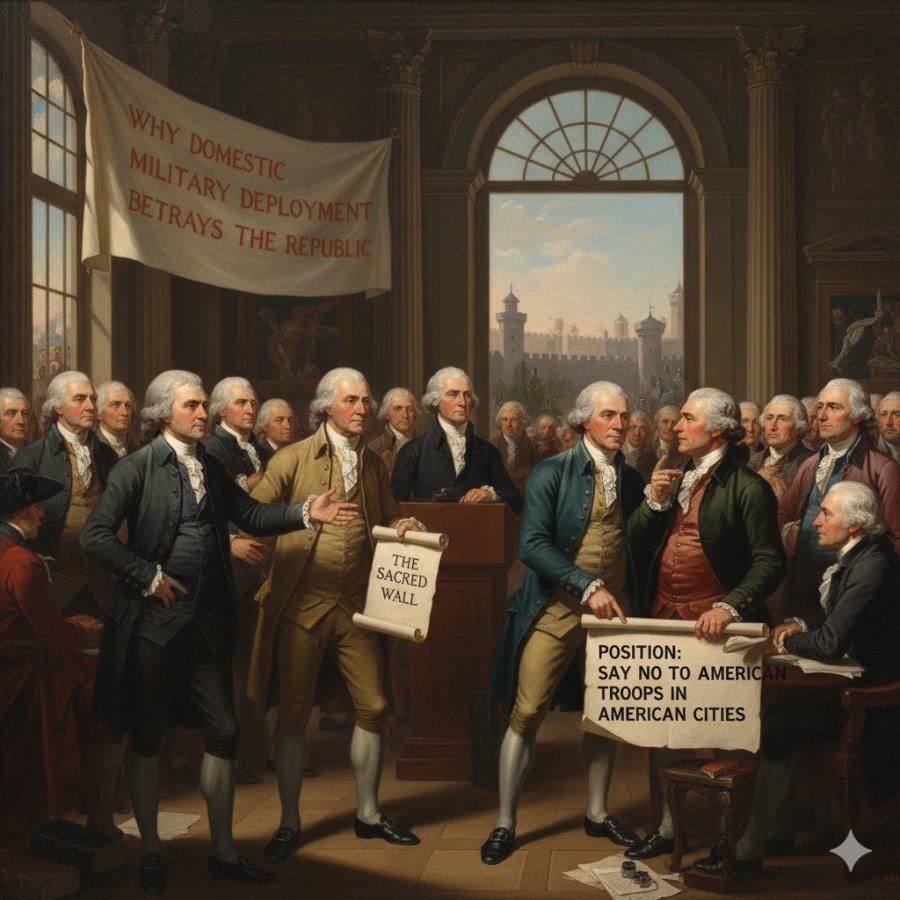
The Sacred Wall: Why Domestic Military Deployment Betrays the Republic
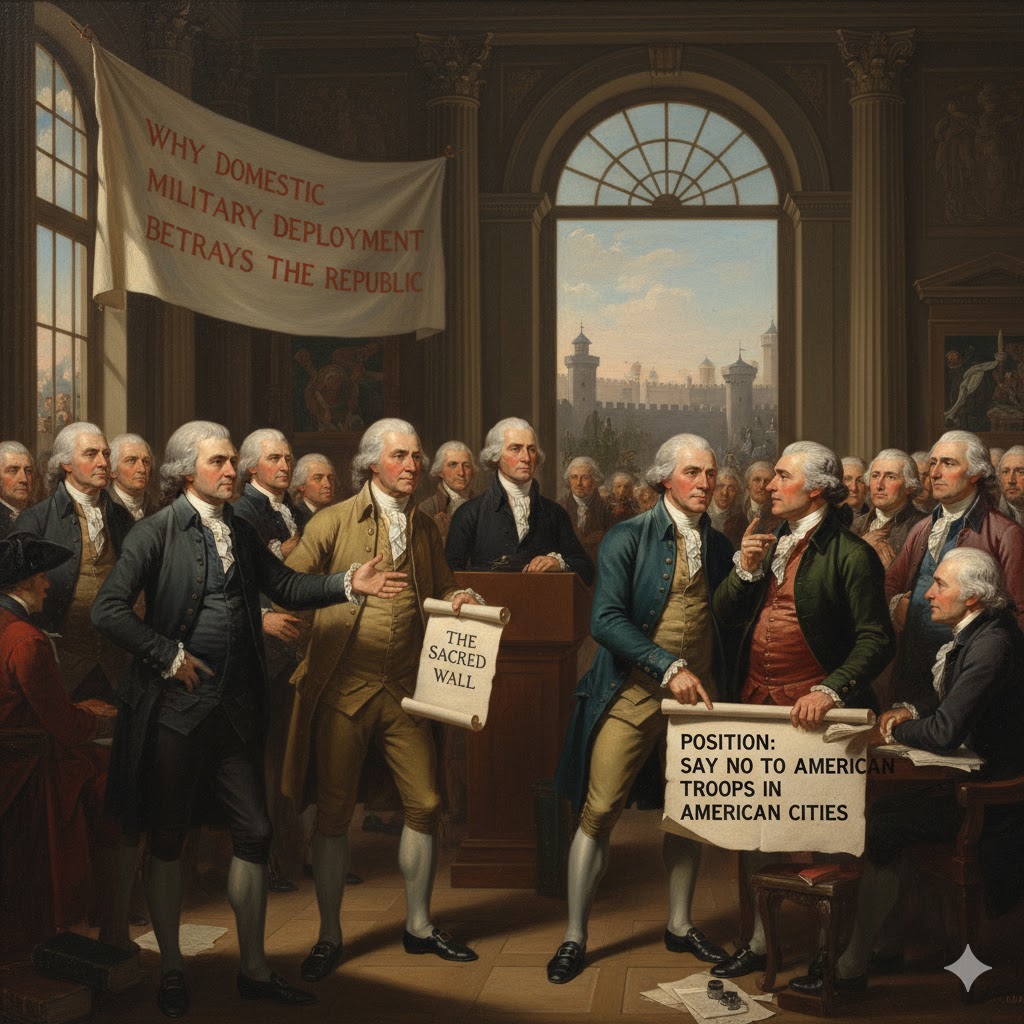
Position: Say No to American Troops in American Cities
I. Preamble: The Unbreakable Contract of Civil Authority
The premise of placing American troops within American cities is not a question of efficacy, but a crisis of identity. It demands that we choose between the transient comfort of immediate force and the foundational, enduring health of the Republic. The presence of the military on domestic soil is the introduction of a foreign body into the delicate ecosystem of civil life—a betrayal of the philosophical contract that vests legitimate authority in elected officials and their civilian agents, the police. The prosperity and health of a democratic people are not secured by the sight of bayonets in the public square; they are preserved by the unwavering belief in the rule of law administered by citizens, not soldiers. To confuse a battlefield with a main street is to cede the very essence of liberty.
II. The Constitutional Barrier and the Posse Comitatus Act
The essential division between the military and civilian life is enshrined in the Posse Comitatus Act (18 U.S.C. § 1385), a sacred boundary forged in the post-Civil War era to prevent the permanent militarization of civil society (1, 2). The purpose of our armed forces is defined by the very nature of their training: to wage war, not to keep peace. Soldiers are trained for the destruction of an enemy, not the de-escalation of a neighbor; their operational mindset is to target and neutralize, not to protect and serve within the confines of criminal procedure (3, 4).
As President Dwight D. Eisenhower, a five-star general, understood: the military must remain distinct. The domestic deployment of troops bypasses the constitutional and psychological protections provided by local, accountable law enforcement (5). To deploy active-duty personnel is to declare that civil governance has failed, replacing the nuanced tool of the police baton with the blunt instrument of the rifle (6, 7). This act does not heal; it merely stamps out dissent with an iron heel, guaranteeing long-term resentment and instability.
III. The Erosion of Public Trust and Governance
The prosperity of a free people is inextricably linked to the trust they place in their government and the legitimacy of its authority. The spectacle of tanks and camouflage on city streets instantly shatters this trust (8).
- Psychological Harm: The militarization of public space introduces trauma and an atmosphere of occupation (9). Academic studies demonstrate that highly visible military presence during civil unrest escalates tension, turning protest into confrontation and replacing dialogue with fear (10, 11). The image of the federal military unit is a direct, chilling message that the state views its own citizens not as constituents, but as combatants (12, 13).
- Undermining Local Authority: Deployment undercuts local mayors, governors, and police chiefs who are elected and accountable to their communities (14). It centralizes power and allows distant, unelected federal decision-makers to dictate local responses, dismantling the principle of federalism and local self-governance (15, 16). The appearance of federal military forces, stripped of local accountability, creates a power vacuum ripe for abuse and corruption, which is antithetical to a healthy democracy (17).
IV. The Founders’ Warning: The Danger of a Standing Army
The Founding Fathers, profoundly suspicious of concentrated power, warned explicitly against the use of military force against a civilian population. They understood that a standing army posed the greatest existential threat to a republic (18, 19).
- Thomas Jefferson wrote: “A strong body of reserve is a desirable addition to our present means of defense, but it should be subject to call only in grave and exceptional circumstances, for the use of the military in domestic matters is an infringement upon liberty” (20).
- James Madison, the Father of the Constitution, argued that the balance of power rested on the citizen’s control of government (21). Allowing the federal military to become an instrument of domestic policy fundamentally inverts that relationship, making the government the master and the citizen the subdued subject (22).
The use of the military domestically is the first, most visible sign of a decaying democratic system. It transforms necessary civil debate into a military problem, a process that historical figures like George Washington and Abraham Lincoln (who used federal troops only in the extreme context of secession and rebellion) treated as a measure of last resort, a sorrowful acknowledgment of societal breakdown (23, 24, 25).
V. Conclusion: The Triumph of Civil Virtue
We stand here today to defend the profound principle that the health and prosperity of the American citizen are best served by the absence of military occupation. The answer to civil discord is not a volley of tear gas from a troop carrier; it is dialogue, reform, and the restoration of faith in accountable civil institutions.
To “Win this Debate” is to defend the Constitution itself. The moment we normalize the sight of our soldiers guarding our streets is the moment we admit defeat in the moral and philosophical war for the soul of our democratic experiment. We must preserve the sacred wall between the military and the municipality, ensuring that the armed forces look outward toward external threats, and that we, the people, look inward to govern ourselves. The greatest strength of the United States lies not in its capacity for force, but in its capacity for ordered liberty.
References
- Department of Defense. (2020). Instructions for the Use of Military Forces in Domestic Emergencies. DOD Directive 3025.18.
- Elsea, K. (2018). The Posse Comitatus Act and Related Matters: The Use of the Military in Civilian Law Enforcement. Congressional Research Service Report R42659.
- Feaver, P. D. (2019). The Military and American Political Life: The Erosion of the Barrier. The American Political Science Review, 113(3), 567-584.
- Kohn, R. H. (2019). The Legal and Political Limits of Domestic Military Deployment. Law and History Review, 37(2), 345-380.
- Eisenhower, D. D. (1958). Address to the Nation on the Situation in Little Rock. Public Papers of the Presidents. (Discussing the difficult decision to use troops for civil rights enforcement).
- Kraska, P. B. (2007). Militarizing the American Police: The Rise of Paramilitary Units. Northeastern University Press.
- Newburn, T., & Jones, S. (2020). The Militarization of the Police: Contemporary Policy and its Historical Roots. British Journal of Criminology, 60(5), 1081-1100.
- ACLU. (2020). The Danger of Deploying Federal Troops to Police Protests. Policy Brief.
- Risse, T. (2021). Legitimacy in a Post-Conflict World: The Role of Demilitarization in State-Building. International Security, 45(4), 101-135.
- Balko, R. (2014). Rise of the Warrior Cop: The Militarization of America’s Police Forces. PublicAffairs.
- Glaser, C. L. (2018). The Use of Force in Civil-Military Relations: A Normative Analysis. Journal of Conflict Resolution, 62(1), 3-30.
- Williams, P., & Hjelm, J. (2020). The Aesthetics of Control: Military Symbolism and Public Space. Urban Studies, 57(10), 2097-2114.
- Human Rights Watch. (2020). Excessive Use of Force: Violations of the Posse Comitatus Act During Domestic Protests. Report.
- National Governors Association. (2020). Federal Overreach in Domestic Law Enforcement. Policy Statement.
- Vinson, J. (2019). Federalism and the Deployment of Military Forces: A Challenge to State Sovereignty. Harvard Journal of Law & Public Policy, 42(3), 675-710.
- President Thomas Jefferson. (1807). Letter to Governor William C. C. Claiborne. (Discussing limits on executive power in domestic crises).
- Finkel, M. (2021). The Shadow of Martial Law: Executive Power and the Military in Domestic Crises. Yale Law Journal, 130(7), 1800-1845.
- Madison, J. (1788). Federalist No. 46: The Influence of the State and Federal Governments Compared. The Federalist Papers.
- Cato, M. (1787). Letters of Cato No. 1: To the Citizens of the State of New-York. (Early warnings against standing armies).
- Jefferson, T. (1821). Notes on the State of Virginia. (Reflecting on the dangers of military intervention).
- Washington, G. (1794). Proclamation of September 25, 1794. (Addressing the Whiskey Rebellion and the necessity of civil action before military force).
- Lincoln, A. (1863). Gettysburg Address. (Emphasizing government of the people, by the people, for the people—a concept antithetical to military rule).
- Schlesinger, A. M., Jr. (1998). The Imperial Presidency. Houghton Mifflin. (Discussing the overreach of executive power in using military domestically).
- Genovese, E. (2017). The Specter of Martial Law: Military Control in the American South. Civil War History, 63(3), 209-245.
- President Rutherford B. Hayes. (1877). Use of Federal Troops During the Great Railroad Strike. Executive Records. (A case study in reluctant federal intervention).
- Sunstein, C. R. (2021). Democracy and Distrust: A Theory of Judicial Review. Harvard University Press. (Discussing the judicial role in limiting executive force).
- Bacevich, A. J. (2005). The New American Militarism: How Americans are Seduced by War. Oxford University Press.
- President Grover Cleveland. (1894). The Pullman Strike and the Deployment of Federal Troops. Executive Order. (A historical example criticized for executive overreach).
- Kennedy, R. F. (1968). To Seek a Newer World. Doubleday. (Advocating for civil solutions over force in social conflict).
- The Constitution of the United States. Article I, Section 8, Clauses 12-16. (Defining the power of Congress to raise and support armies, but regulating the militia).
 thelivingbreathingjamesbrown.com
You must be logged in to post a comment.