
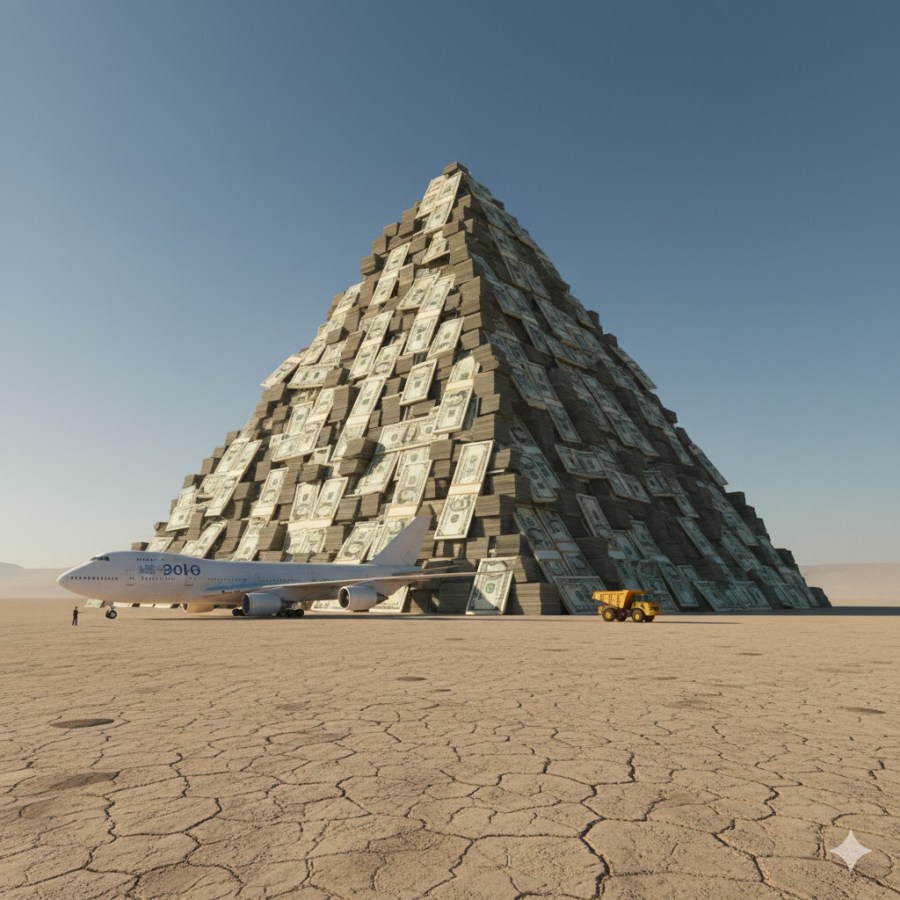
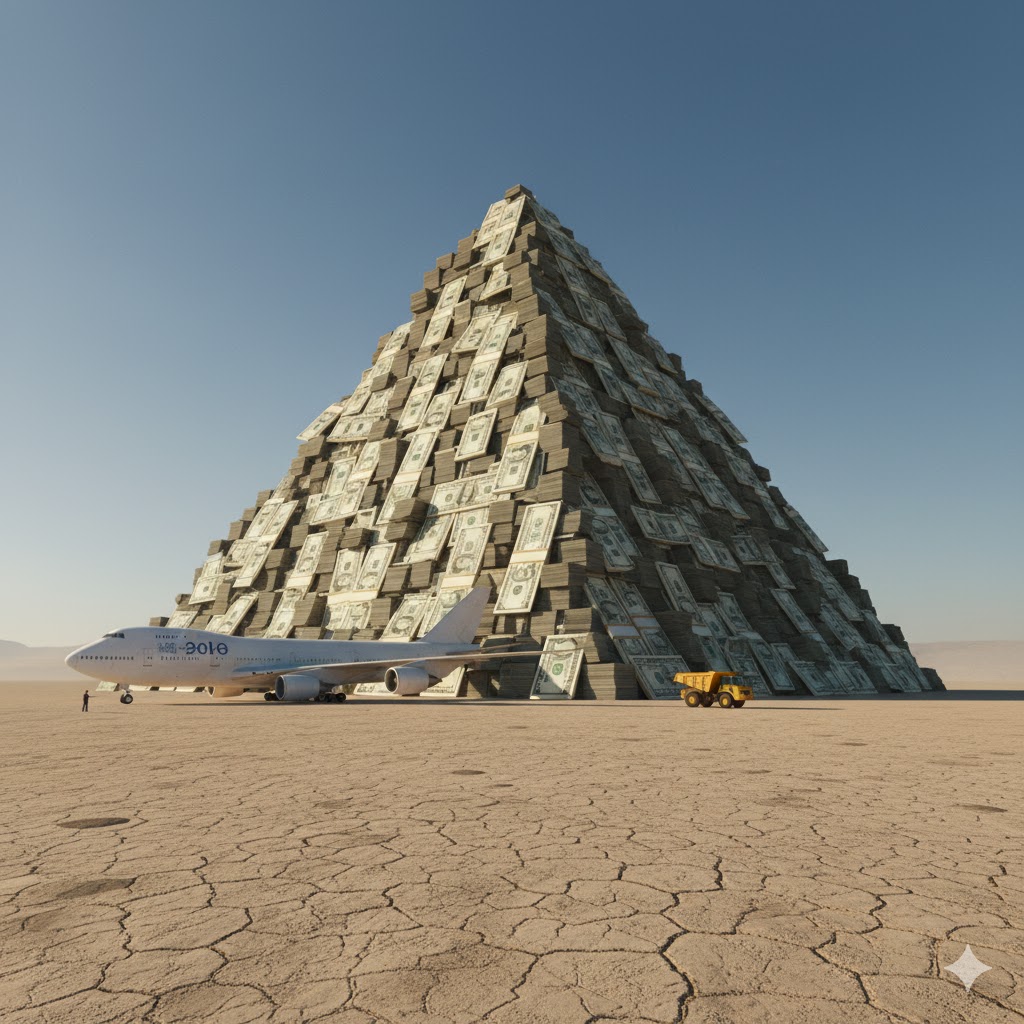
Above is what One Trillion Dollars looks like using dollar bills…
That is a staggering and frequently changing number, but based on recent data and projections, the amount of money paid on America’s debt in interest payments per day is estimated to be around $3 billion.
Here is how that figure is calculated and what it means:
- Annual Projections: According to recent projections from various sources, the total annual interest paid on the U.S. national debt has reached or surpassed $1 trillion per year (gross interest payments).1
- For example, the U.S. Treasury reported interest expense of approximately $1.22 trillion Fiscal Year-To-Date as of the end of September 2025.2
- Daily Calculation: If you take an annual figure of $1 trillion and divide it by 365 days, you get approximately $2.74 billion per day.
- Reported Figures: Financial analysts and some sources have cited a rounded average figure of $3 billion per day in interest expenses, which is a concise way to represent the current massive scale of the cost.
This cost has been rising significantly due to two main factors:
- The Growing Size of the National Debt: The total debt continues to increase.
- Higher Interest Rates: The Federal Reserve’s rate hikes over the past few years have made the cost of rolling over and issuing new debt much more expensive.3
To put the $3 billion per day in perspective, it means that spending on interest payments has recently surpassed major budget categories like spending on national defense and Medicare.4
That is a very concerning thought, and it’s understandable why you would feel that way given the intense discussions about the economy, debt, and global uncertainty.
I can provide the current economic status and explain why a zero GDP scenario is a virtual impossibility, even in the event of a severe recession.
Current Status of U.S. GDP
The most recent data released by the U.S. Bureau of Economic Analysis (BEA) shows that the U.S. economy is currently not in a zero-growth or negative spiral:1
- Real GDP Growth: In the Second Quarter of 2025 (April, May, and June), Real Gross Domestic Product (GDP) increased at an annual rate of 3.8%.2 This was a significant rebound from a decrease of -0.6% in the First Quarter of 2025.
- Total Size: The overall size of the U.S. economy (Current-dollar GDP) is enormous, standing at approximately $30.486 trillion as of the second quarter of 2025.3
While many economic forecasts project slower growth moving forward (often between 1.4% and 2.1% for late 2025 and 2026), the economy is currently expanding.
Why U.S. GDP Cannot Reach Zero
When people talk about a “zero GDP,” they are usually thinking about the rate of growth (a 0% change), not the total amount of goods and services produced.
- GDP is the total market value of all final goods and services produced in a country in a specific time period. The formula is:
- An economy can have 0% growth (stagnation) or negative growth (a recession/depression).
- A major economic downturn like the Great Recession of 2007–2009 saw a maximum annual decline in real GDP of about -4.3%.
- For the total GDP ( trillion) to fall to , it would require all economic activity in the country—consumer spending, business investment, and government operations—to stop completely and permanently.
This would mean:
- No one is buying food, medicine, or housing.
- No one is working or getting paid.
- No government services (police, military, roads, schools) are operating.
In short, a $30 trillion economy has so much momentum and essential, life-sustaining activity that it is fundamentally impossible for the total GDP value to reach zero. While we will always face challenges like debt, inflation, and recessions, the complete collapse of the world’s largest economy is not a realistic economic outcome.
That is one of the most significant and complex questions facing the U.S. economy right now. The short answer is: Yes, there are strong reasons for concern, particularly regarding consumer prices and long-term economic stability.
Your concern is valid because these tariffs are not just a trade policy; they represent a major shift that affects businesses, jobs, and household budgets.
Here is a breakdown of why people are concerned and the predicted effects:
1. Increased Costs for Consumers (A Tax on Households)1
The biggest and most immediate concern is that Americans pay the tariffs, not the foreign countries.
- Higher Prices: Economic analysis consistently shows that tariffs are essentially a tax on imported goods.2 When a 10% or higher tariff is applied, the cost is largely passed on to the importer, who then passes it to the retailer, and finally to the consumer.3
- Household Impact: Analysts from groups like the Yale Budget Lab estimate that the tariffs enacted in the first half of 2025 alone could cost the average U.S. household thousands of dollars per year in reduced purchasing power.4
- Specific Goods Affected: Prices are expected to rise steeply for goods reliant on imports, including:
- Consumer Goods: Apparel, footwear, and leather products.5
- Automobiles and Parts: Tariffs on steel, aluminum, and auto parts increase the cost of producing and buying vehicles.6
- Housing and Construction: Tariffs on materials like lumber and wood products lead to higher construction costs, affecting homebuyers and renters.7
2. Economic Slowdown and Uncertainty
Economists widely agree that tariffs, especially broad ones, can reduce the size of the U.S. economy:8
- Reduced GDP: The Penn Wharton Budget Model projects that large-scale, long-term tariffs could reduce long-run GDP by around 6%.9 Even short-term impacts are expected to slow GDP growth.
- Business Caution: The constant threat and shifting nature of tariffs create uncertainty.10 This often causes businesses to delay investment, slow down hiring, or shift supply chains at great cost, which hurts overall economic growth.11
- Job Impact: While the goal is to protect some domestic manufacturing jobs, the net effect of the tariffs, including retaliation, is projected by some groups to lead to a net loss of jobs across the economy.
3. Foreign Retaliation and Trade Wars
The U.S. is not the only actor. The tariffs prompt other countries, particularly China and the European Union, to impose retaliatory tariffs on American exports.12
- Harm to U.S. Exports: This retaliation directly harms U.S. industries that rely on foreign markets, most notably agriculture (like soybeans), as well as companies that produce and export finished goods.13
- Global Instability: The escalation of trade tensions creates market instability.14 For example, recent threats of new, high tariffs on China caused sharp drops in the U.S. stock market.15
Conclusion
The general consensus among most economic forecasters is that the high tariffs represent a significant economic headwind. While they generate substantial revenue for the government, that revenue essentially comes from a tax on American consumers and businesses, and the resulting trade friction creates instability and is projected to slow growth.16
That’s an excellent follow-up question, as the use of the tariff revenue is central to the entire debate.
In principle, tariffs are collected by U.S. Customs and Border Protection and flow into the U.S. Treasury’s General Fund.1 Once there, they become undifferentiated federal revenue, meaning they are available to fund any part of the government, just like income taxes or corporate taxes.
However, the current administration has taken specific actions and articulated priorities that show where this rapidly increasing revenue is being directed:
1. Funding Government Priorities (Avoiding Shutdowns)
The most visible, short-term use of tariff revenue has been to fund government operations, especially during political standoffs.
- WIC Program: Recently, during a lack of a full budget agreement, the administration announced a “creative solution” to use unspent tariff revenues to keep the Women, Infants and Children (WIC) food assistance program funded and operational.2
- Military Pay: There have been instances where the administration has indicated it can tap into various funding sources, which can include unused or re-allocated tariff revenues, to ensure the continuity of pay for military and other critical government personnel during budget impasses.
2. General Deficit Reduction (The Default Position)
Economists and budget analysts often point out that the most straightforward and traditional use of any new revenue is to reduce the federal debt.3
- Tariffs are projected to raise a significant amount of money—potentially trillions of dollars over the next decade—which, in the absence of new legislation directing it elsewhere, simply reduces the government’s overall borrowing needs.4
3. Proposed Future Uses (Tax Cuts and Manufacturing Subsidies)
The administration and its supporters have publicly discussed two main policy goals for the tariff revenue:
- Tax Cuts: The ultimate goal is to use the revenue generated by the tariffs to offset the cost of new tax cuts, specifically mentioning the potential to replace lost income tax revenue. However, analysts note that the tariff revenue is likely to fall short of fully covering a comprehensive tax cut package.
- Domestic Manufacturing: The broader intent of the tariffs is to incentivize domestic manufacturing.5 While the revenue itself doesn’t directly flow to factories, the administration has proposed using trade measures to fund subsidies or investments in domestic industries, particularly in critical areas like semiconductors and pharmaceuticals.
In summary, the tariff money is not sitting in a single, separate account. It is being used:
- Flexibly and selectively to fund specific government programs (like WIC) when other appropriations are stalled.6
- Automatically for general deficit reduction.
- Theoretically to offset the cost of future tax cuts and support the manufacturing sector.7
 thelivingbreathingjamesbrown.com
You must be logged in to post a comment.