

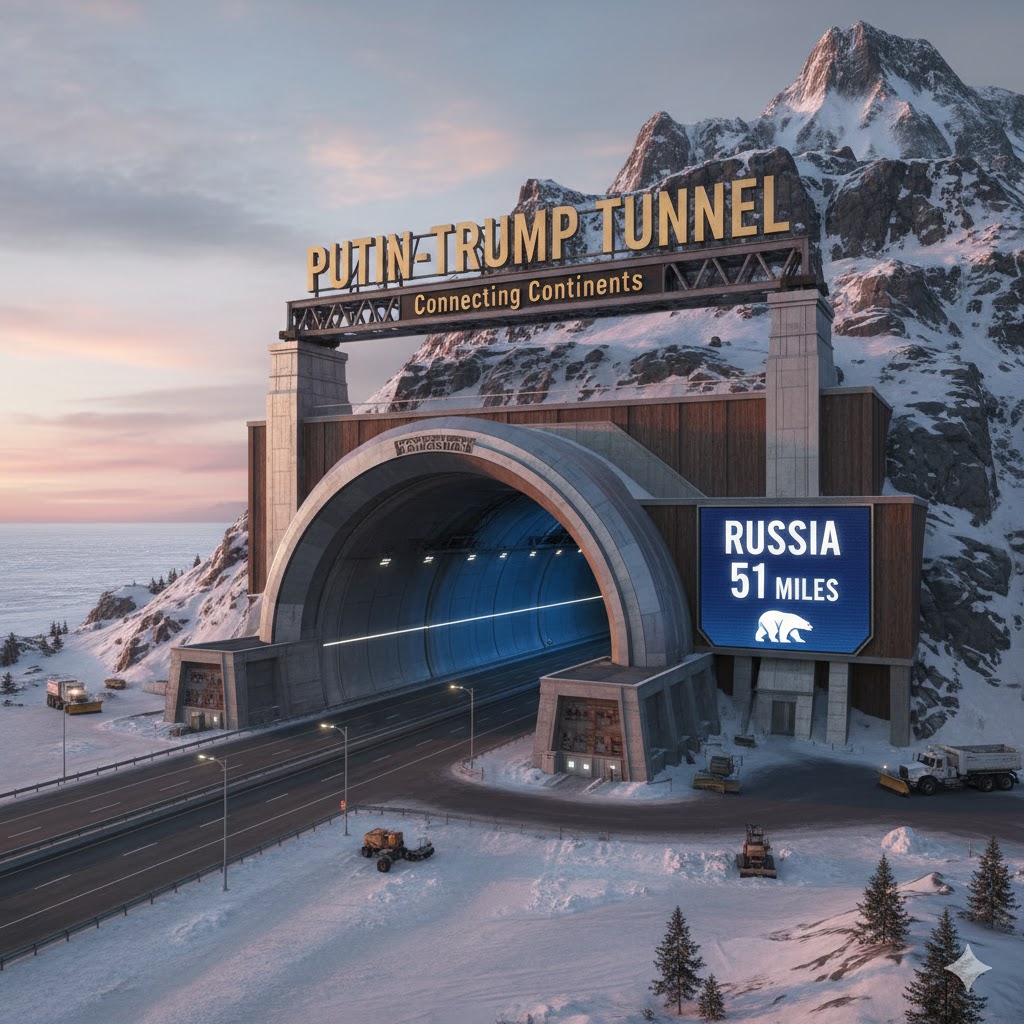
The Perilous Chasm: The Bering Strait Tunnel and the Specter of Geopolitical Subversion
By The Living Breathing James Brown
I. The Ominous Reverberation of an Atavistic Threat
The proposal for a submarine rail link—the so-called “Putin-Trump Tunnel”—across the Bering Strait is being cloaked in the euphemisms of global connectivity and peace.1 Yet, to those with an unflinching grasp of recent history and current geopolitical realities, this project represents not a dream of unity, but a seismic vulnerability for the United States. In a world where Russia, under Vladimir Putin, has demonstrated a brutal penchant for irredentism and territorial aggrandizement, the notion of constructing a permanent, arterial link directly into the American homeland must be viewed through the lens of existential national security.
The historical concept of the Bering Strait crossing has always been quixotic, stymied by insurmountable engineering costs and perpetually hostile Arctic conditions.2 The sudden, contemporary push, however, is not driven by renewed engineering feasibility but by geopolitical expediency. It is a proposal predicated on a profound and precarious level of trust—a commodity virtually extinct in U.S.-Russia relations outside of the personal amity seemingly shared between President Trump and figures like Pete Hegseth, whose recent shift in rhetoric on imposing “costs on Russia” (References 4.2, 4.3) comes against a backdrop of complex and sometimes contradictory signals regarding Moscow.
II. The Ineluctable Logic of Invasion: A Blitzkrieg Corridor
The most chilling and untenable flaw in the “unity tunnel” narrative is its military implications. A massive, dedicated, intercontinental rail tunnel transforms a natural geographic barrier—the frigid, turbulent, and sparsely populated Bering Strait—into a guaranteed avenue of incursion.
- The Velocity of Vulnerability: A railroad is designed for the rapid, massive transport of cargo. In a hypothetical, premeditated conflict, such a tunnel represents the perfect vector for a low-cost, high-speed blitzkrieg. It eliminates the need for logistically complex airlifts or vulnerable seaborne landings across hundreds of miles of hostile water and ice. Instead, armored columns, heavy artillery, and thousands of troops could be moved covertly and uninterruptedly beneath the sea, positioning them to emerge in the sparsely populated, strategically critical regions of Alaska.
- Targeting Critical Infrastructure: Alaska, the “gateway to the Arctic,” is a vital strategic hub for U.S. national security, hosting major air bases, missile defense systems, and serving as a forward operating zone for the Pacific theater (Reference 3.1).3 A tunnel would instantly render this region a direct, accessible target, potentially bypassing the formidable long-range surveillance and defense systems designed for aerial and maritime threats.
- The Denial of Deterrence: The primary deterrent for the U.S. in the Arctic has always been the sheer tyranny of distance and the unforgiving climate (Reference 2.1). The tunnel would effectively nullify this geographical protection, lowering the calculus of risk for an adversarial power to undertake a territorial strike. The strategic value of such a breach for a power seeking to project force into North America is incalculable.
III. The Unjustified Plausibility and Sanctions Lacuna
The current proposal, relying on Elon Musk’s The Boring Company for a dramatic cost reduction to a mere $8 billion, attempts to inject a sense of technological inevitability into a fundamentally unsound geopolitical project.4 This financial framing serves to distract from the core political danger:
- Manufacturing Consent: The “Putin-Trump Tunnel” branding is a calculated political move by the Kremlin envoy, Kirill Dmitriev, designed to create a narrative of shared vision where none genuinely exists outside of a select, small group. It leverages the goodwill of a former President to legitimize a Russian-initiated mega-project (References 1.4, 3.3).
- The Sanctions Paradox: The very nations most distrustful of Russia—the U.S. and its NATO allies—are engaged in an economic and political effort to isolate Moscow over its unprovoked aggression in Ukraine. Proposing a multibillion-dollar, multi-year, intercontinental infrastructure project with Russia, especially one that could be used to facilitate future military objectives, is an act of geopolitical schizophrenia (Reference 1.3). It directly undercuts the global sanctions regime and hands Russia a potent symbol of reconciliation on its own terms. No one trusts Russia, and this project does nothing to alleviate the profound skepticism that exists across the NATO and allied community.
IV. The Recapitulation of Jim Crow’s Strategic Cousin
Just as the anti-DEI movement seeks to reinstate a form of internal racial hierarchy, the Bering Strait Tunnel represents a move to fundamentally and asymmetrically alter the rules of the international security game to Russia’s long-term advantage.
This project is a Trojan Horse, marketed as a symbol of peace but engineered to be a tool of military contingency. It is a dangerous fatuity for any U.S. leader to entertain the notion of providing an open, secure, subsea artery into U.S. territory for a regime that actively uses coercion and invasion as instruments of foreign policy. The few voices willing to engage with Russia on such terms risk being seen as complacent to the existential peril this project represents.
The glimmer of hope for all who value global security is the simple, unassailable truth: the tunnel does not yet exist. Its construction must be seen as a strategic red line, recognizing that the final destination of this rail line is not global trade, but a direct, unimpeded path for an overnight blitzkrieg into the American continent.
Six Core References on Geopolitical Risk:
- Tekedia. “Trump Considers Russia’s Proposal for Elon Musk to Build $65bn Bering Strait Tunnel, Calls It ‘Interesting’.” (October 18, 2025).5 (Highlights the stark political contrast between the proposal and the ongoing U.S.-Russia tensions over Ukraine.)
- NDU Press (National Defense University). “The Bering Strait: An Arena for Great Power Competition.”6 (February 7, 2020). (Analyzes the strategic importance of the Bering Strait and the increasing militarization efforts by Russia in the Arctic.)
- ArcticToday. “With twin threats from Russia and China, U.S. military puts new focus on Alaska.” (October 14, 2025). (Discusses Alaska’s increasing role as a U.S. military priority and a potential site of future warfare.)7
- Wikipedia. “Bering Strait crossing.” (Details the extreme weather, seismic, and engineering challenges, as well as historical military concerns related to the link.)
- UNITED24 Media. “Trump and Zelenskyy Discuss… Russia–Alaska Tunnel Proposal at White House.” (October 18, 2025). (Documents the Ukrainian President’s immediate, negative reaction, underscoring the perceived threat to Western unity.)
- The SCIF. “NSI Experts in the News — All Things National Security.” (August 19, 2025). (Provides expert commentary highlighting the skeptical view of high-level meetings and the focus on Russia’s leverage.)
 thelivingbreathingjamesbrown.com
You must be logged in to post a comment.