
The Non-Linear Crisis: Analyzing the Escalating Consequences of Prolonged U.S. Government Shutdowns (30, 60, and 120+ Days)
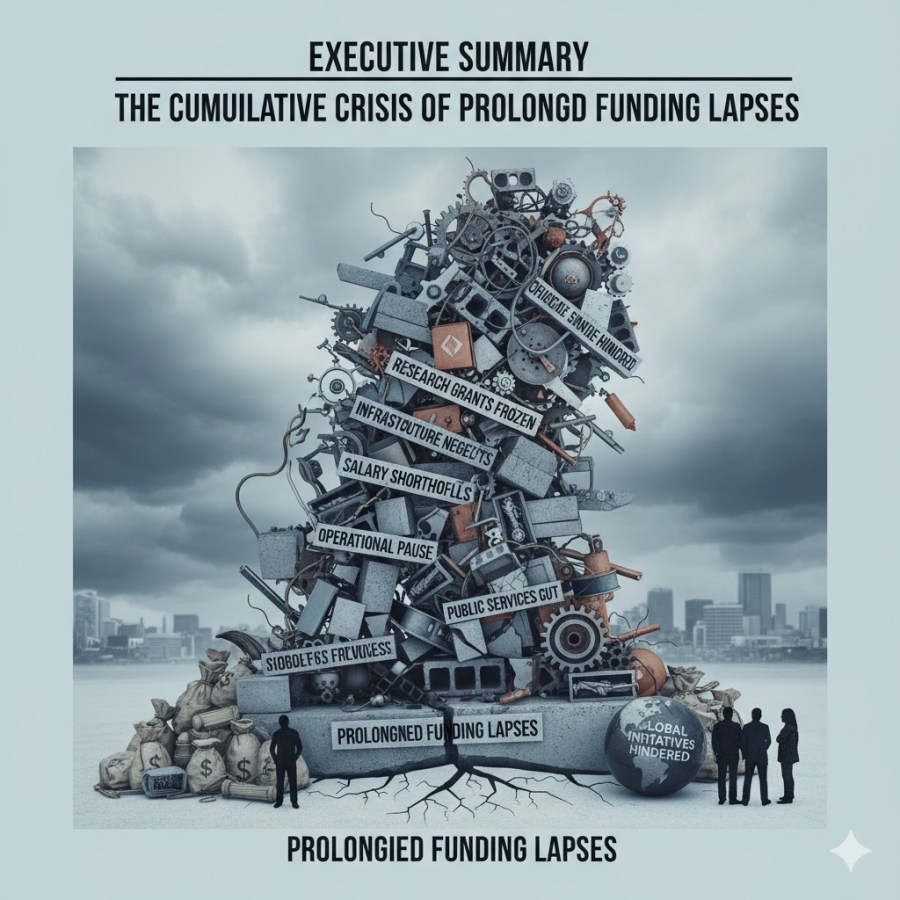
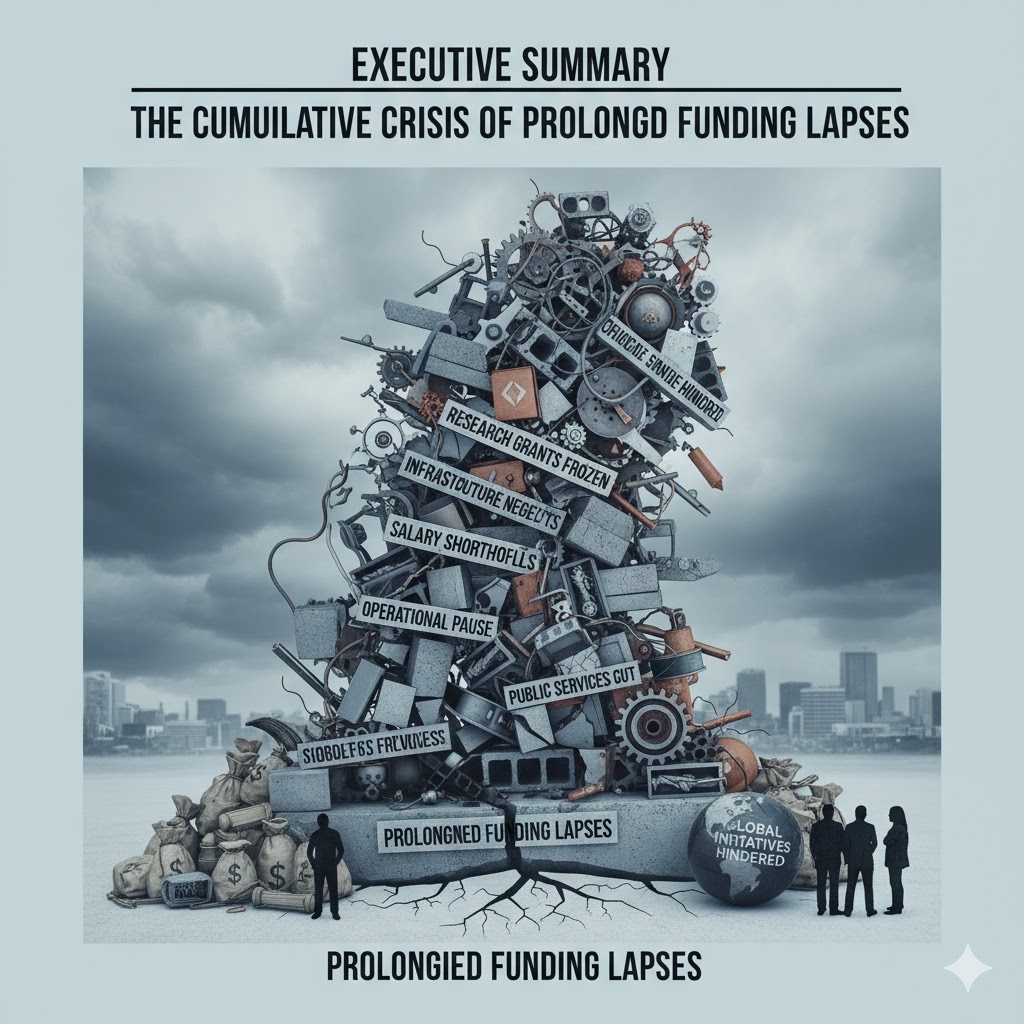
I. Executive Summary: The Cumulative Crisis of Prolonged Funding Lapses
The failure of Congress to enact necessary appropriation legislation results in a cascading administrative and economic crisis defined by the length of the lapse. An analysis of the effects across escalating timelines—30 days, 60 days, and 120 days or more—demonstrates that the cost of a shutdown is non-linear. Initially, the economic impacts are largely temporary and recoverable, primarily comprising lost output and deferred pay. However, as the lapse extends beyond the 60-day threshold, the nature of the damage shifts fundamentally toward permanent institutional degradation, causing irreparable harm to the federal workforce, national research capabilities, and the government’s capacity to execute its core missions.
A brief, 35-day shutdown (the longest in U.S. history) reduced Gross Domestic Product (GDP) by an estimated $11 billion, with $3 billion categorized as permanently unrecoverable loss. Costs such as retroactive pay for furloughed employees are recouped by the workers and circulate back into the economy. In contrast, costs resulting from permanent employee turnover, stalled scientific research, canceled contracts, and diminished international credibility represent permanent losses that cannot be recovered through later appropriations. The analysis concludes that while a 30-day lapse represents a severe inconvenience, a 60-day lapse triggers systemic failure in federally dependent social services, and a lapse exceeding 120 days threatens a catastrophic loss of institutional knowledge and compromises long-term national security infrastructure.
II. Foundational Context: The Legal and Administrative Mandate
The mechanism that triggers a government shutdown is not a discretionary decision by the Executive Branch but a mandatory requirement imposed by federal law, specifically the Antideficiency Act (ADA). Understanding this legal framework is crucial to assessing the severity of prolonged funding lapses.
A. The Statutory Requirement for Cessation: The Antideficiency Act (ADA)
The Antideficiency Act (initially passed in 1884 and amended in 1950) is the cornerstone of federal fiscal management, broadly forbidding any federal employee from obligating funds above or in advance of an appropriation. When Congress fails to enact the required 12 annual appropriation bills, federal agencies must cease all non-essential functions until funding is restored.
A critical and often misunderstood aspect of the ADA is its prohibition against accepting voluntary services to the government. This clause ensures that the designated non-essential functions are truly halted, preventing furloughed staff from working without pay, even if they are willing to maintain operations. This legal paralysis results in a rapid bureaucratic deceleration that forms the initial shock of any shutdown.
B. Defining “Excepted” vs. “Furloughed” Status
During a funding lapse, the Executive Branch, guided by Office of Management and Budget (OMB) Circular A-11, must determine which employees are “excepted” and which are “furloughed”. This determination dictates whether a federal employee must continue working without pay or must stop working entirely.
Excepted Employees are those whose duties are deemed necessary for the “safety of human life or the protection of property,” or whose activities are otherwise mandated by law. This category includes active-duty military personnel, air traffic controllers, certain law enforcement agents, and hospital staff at facilities like the National Institutes of Health (NIH). These employees continue to work during the funding lapse but do not receive payment until Congress retroactively approves funding.
Furloughed Employees (or non-excepted employees) are barred from work, representing the majority of the civil service responsible for administrative, regulatory, and research functions. This group represents the estimated 750,000 federal employees who could be laid off daily in a typical shutdown scenario.
It is important to recognize the distinction between programs funded by discretionary annual appropriations (which are subject to the shutdown) and programs funded by mandatory spending, such as Social Security, Medicare, and veterans’ benefits. These mandatory programs continue to send out checks because their underlying funding authority does not rely on annual Congressional approval. However, this creates the appearance of continuity which masks deeper issues. While checks flow, the administrative staff responsible for essential tasks—such as issuing replacement Medicare cards, providing benefit verification letters, or resolving errors—are typically furloughed, causing severe delays for the most vulnerable users and degrading the system’s capacity to function effectively.
C. The Impact on Federal Contractors
Federal contractors, who comprise a substantial part of the federal government’s operational capacity, face distinct and often more acute risks than federal employees. Unlike furloughed staff, contractors lack any guarantee of retroactive pay. The impact varies significantly based on funding source and contract type.
Contracts funded by revolving, permanent, or “no year” funds may continue, but they still face delays if required federal approvals or deliveries are halted due to furloughed staff. The greatest financial risk is borne by contractors with incrementally funded contracts or those subject to Limitation of Cost clauses. If appropriations lapse, these contractors may receive “stop work orders” or, in critical cases, be compelled to work “at risk,” performing services without any guarantee of eventual reimbursement. The length of the funding lapse directly determines the survival of these contracts; prolonged lapses lead to terminations, reducing contractor payments and resulting in furloughs or layoffs for their employees.
A prolonged lapse also creates significant, hidden administrative waste. Agencies must divert immense staff-hours (using excepted personnel, who are working without pay) to develop, execute, and communicate complex contingency plans and furlough notices. This necessary, yet unproductive, effort contributes directly to the overall financial cost of managing the shutdown and reopening processes, estimated in the billions for past short-duration shutdowns.
III. Phase I: The Short-Term Economic Shock (0 to 30 Days)
A shutdown extending up to 30 days, slightly shorter than the 35-day record set in 2018–2019 , primarily results in immediate financial distress and a rapid, concentrated halting of non-essential government services.
A. Operational Paralysis and Workforce Financial Strain
The primary impact on the workforce is the inability to receive scheduled compensation. Approximately 750,000 federal employees are furloughed, and 420,000 required to work without pay, missing their first scheduled paycheck, typically around the 14- to 21-day mark.
Furloughed employees may apply for unemployment compensation (UC) through state programs, though they must legally repay those benefits once they receive guaranteed retroactive federal back pay. Crucially, employees designated as excepted—such as air traffic controllers, Transportation Security Administration (TSA) agents, and certain law enforcement—are required to report for duty but are ineligible for UC because they are actively working.
While the Government Employee Fair Treatment Act guarantees retroactive pay for both furloughed and excepted employees once the lapse ends, the lack of immediate cash flow creates severe personal financial hardship. Federal employee benefits—including health, dental/vision, life insurance, and retirement plans (Thrift Savings Plan, or TSP)—continue during the shutdown. However, health care and life insurance premiums accumulate and are deducted in a single bulk payment from the first paycheck received after funding resumes. This acute financial pressure on excepted workers, who are mandated to work under stress with no pay, acts as a significant factor accelerating turnover in critical, specialized roles.
Active-duty military personnel continue to perform their normal duties but face delayed paychecks. Additionally, federal medical facilities often halt elective surgeries and non-critical care for military personnel and their families, impacting readiness and quality of life.
B. Immediate Economic and Business Disruption
The direct macroeconomic impact of a funding lapse is immediate. Economists estimate that a shutdown reduces U.S. economic growth by 0.1 to 0.2 percentage points per week. This initial reduction stems primarily from reduced government output and consumer demand shock due to unpaid federal salaries.
The halt of the Small Business Administration (SBA) is a major constraint on private enterprise. The SBA closes its Capital Access Financial System (CAFS) via E-Tran, freezing all new loan approvals under the 7(a) and 504 programs. This closure immediately halts approximately $860 million in weekly loans for about 1,600 small businesses.
The paralysis of specific federal services creates localized economic ripple effects greater than the sum of their parts. The halt of SBA activity, combined with the suspension of issuing or renewing flood insurance policies, immediately delays mortgage closings and real estate transactions. Furthermore, lenders cannot access IRS verification data required for loan underwriting, causing bottlenecks in commercial and residential financing. The simultaneous freezing of capital access (SBA) and key transaction facilitators (insurance/verification) imposes a compounding anti-stimulus effect on regional housing and business markets.
C. Initial Service Degradation and Risk Exposure
Within the first 30 days, government agencies experience operational slowdowns that increase risk exposure and create massive backlogs.
- Regulatory Oversight: The Environmental Protection Agency (EPA) halts routine inspections at hazardous waste sites, drinking water facilities, and chemical plants. The Food and Drug Administration (FDA) pauses routine domestic food facility inspections, though it may attempt to resume “high-risk” inspections due to public and media pressure. While core FDA missions, criminal enforcement, and outbreak response generally continue, the loss of routine surveillance introduces a latent public health risk.
- Scientific Research: Agencies that support extramural research, such as the NIH, furlough up to three-quarters of their employees. While existing grants continue to be funded, agencies cannot approve pending grant applications or issue new awards, immediately delaying the start of future research and clinical trials across the country.
- Public Access: The National Park Service (NPS) turns away millions of visitors from over 400 national parks, monuments, and historical sites, resulting in the loss of millions in user fees and damaging local tourism economies.
IV. Phase II: Critical Service Degradation (31 to 60 Days)
The period between 31 and 60 days marks a critical transition where temporary disruptions become widespread societal crises, characterized by the exhaustion of contingency funds and escalating functional erosion.
A. Exhaustion of State and Local Reserves
A shutdown exceeding 30 days begins to affect programs administered locally but funded federally, primarily housing and nutrition assistance.
- The Housing Crisis: Local housing authorities (LHAs) that administer vital programs like the Section 8 Housing Choice Voucher Program are not federal agencies and remain open. However, these entities are reliant on HUD appropriations. Many LHAs operate with only 30 to 60 days of reserve funds to cover administrative costs and rental subsidies. If the lapse continues past the 60-day mark, the failure of the federal government to replenish these funds causes rental assistance payments to landlords to stall. This immediately risks evictions for vulnerable families, seniors, and people with disabilities, and simultaneously creates financial distress for landlords dependent on these subsidies. Retroactive federal funding can restore the ability to pay, but it cannot retroactively nullify legal eviction proceedings or repair the immense damage to the credit and stability of affected citizens, demonstrating a non-reversible humanitarian toll.
- Nutrition Aid Interruption: The Supplemental Nutrition Assistance Program (SNAP, or CalFresh) and the Women, Infants, and Children (WIC) program are typically funded to ensure payments for the first 30 days. By 60 days, without new appropriations, the continuation of these benefits faces interruption or delay, leading to potential hunger crises, particularly among low-income individuals and families with disabilities.
B. Strain on Judicial and Security Infrastructure
Federal courts rely on accumulated fees and reserve funds to continue operations during a funding lapse. Historically, these funds have been sufficient for approximately 17 days, but a longer lapse quickly exhausts them.
Beyond the 60-day threshold, the federal judiciary would be forced to restrict operations to functions deemed essential for the “preservation of life and property”. This severely curtails the judiciary’s constitutional duty, causing massive delays in the processing of civil litigation and placing a crushing backlog on administrative tasks, effectively crippling the district court level. Furthermore, government counsel representing federal agencies in civil matters are instructed to seek delays, impacting private litigants and disrupting legal deadlines.
In the realm of national security, the risk accelerates. During a long shutdown, agencies like the National Nuclear Security Administration (NNSA) may furlough staff responsible for maintaining the nation’s nuclear weapons arsenal. A 60-day halt of maintenance and modernization activities poses an acute, high-level risk to military readiness and critical security infrastructure.
C. Escalating Workforce Attrition and Morale Collapse
At 60 days, exceptional employees have been compelled to work two full months without compensation. This mandated financial instability brings many to a financial tipping point. Absenteeism, particularly among highly specialized, stressed employees like air traffic controllers, is known to increase, compromising operational safety and efficiency.
The pervasive sense of uncertainty and financial exploitation fuels psychological distress. Past shutdowns have been associated with lower levels of job satisfaction, accomplishment, and recognition among affected personnel. As shutdowns become more frequent, the effect on employee morale may lessen for those who choose to stay, but this is offset by significant increases in employee turnover. The cumulative effect of delayed pay, political uncertainty, and public officials questioning the worth of the civil service fosters the perception that the government is not a reliable employer, setting the stage for future brain drain.
IV. Phase III: Unrecoverable Institutional Damage (61 to 120 Days)
Once the funding lapse extends past 60 days, the government moves from systemic strain to structural decay. The damage inflicted in this phase is overwhelmingly permanent and unrecoverable, targeting the integrity and capacity of the federal government itself.
A. Catastrophic Workforce Attrition and Knowledge Loss
The prolonged lapse triggers a mass exodus of talent. Research indicates that employees affected by previous shutdowns experienced a 31% increase in voluntary turnover. Preliminary findings suggest that a federal agency with 10,000 full-time employees could lose approximately 500 additional workers in the fiscal quarter immediately following a shutdown.
This turnover is not random; it constitutes a targeted “brain drain.” Younger, highly skilled employees with attractive private-sector options are the most likely to quit, while more experienced, higher-paid employees may opt for early retirement. This disproportionately impacts technical and managerial roles in competitive fields like cybersecurity, where federal salaries are often substantially lower than private sector pay. The loss of these experienced workers contributes to institutional knowledge loss, compromising succession planning in agencies where many employees are already retirement-eligible.
This workforce erosion results in a permanent impairment of policy implementation. The loss of experienced personnel and the demoralization of the remaining staff diminish the government’s inherent capacity to effectively execute complex mandates or deploy new programs, even once funding is restored. The government struggles to rebuild its workforce, as the constant threat of furloughs and toxic political rhetoric surrounding federal service dissuades young people from entering public careers.
B. Breakdown of the Federal Contracting Ecosystem
By 120 days, incrementally funded contracts would have long since reached their obligatory limits, leading to a massive wave of contract terminations for convenience or, potentially, default. Contractors who chose to work “at risk” without funding assurances would face unsustainable losses and widespread private sector layoffs tied directly to halted federal projects.
This breakdown irreparably damages the government’s standing as a reliable client. To hedge against the now-proven risk of a prolonged, four-month lapse, future federal contractors would be compelled to impose higher risk premiums on all subsequent federal procurements, significantly increasing the long-term cost of goods and services for the taxpayer.
C. Permanent Damage to Scientific and R&D Infrastructure
The four-month freeze on new grant approvals and the widespread furloughs lead to a cumulative, detrimental effect on U.S. scientific leadership. Scientific progress is inherently collaborative and time-dependent. Stalled projects, missed maintenance deadlines, and the cancellation of reserved time on national lab instruments degrade the federal Research & Development (R&D) infrastructure. Previous shutdowns have already led to delays in critical maintenance, such as repairs to the Hubble telescope.
The scientific workforce itself is profoundly damaged. Repeated and prolonged shutdowns signal to both domestic students and foreign-born scientists—who account for nearly a quarter of the U.S. science and technology workforce—that the field is unstable and not prioritized by the U.S. government. This disruption threatens the long-term competitiveness of U.S. research by driving essential talent to other countries that invest more reliably in their research infrastructure.
An extended closure of statistical agencies also creates a crisis of data blindness. Agencies responsible for collecting and publishing essential economic data on employment, inflation, and growth would be paralyzed. This forces critical decision-makers, such as the Federal Reserve and private economists, to operate without timely, reliable data, increasing the likelihood of poor policy choices and introducing significant, avoidable volatility into financial markets.
Table 1 provides a comparative summary of the escalating consequences across the specified time horizons.
Table 1: Cumulative Impact Tracker of a Prolonged Government Shutdown
| Area of Impact | 0–30 Days (Disruption) | 31–60 Days (Strain/Depletion) | 61–120+ Days (Systemic Degradation) |
| Macroeconomic | GDP reduced by 0.1–0.2 ppt/week. Lost output largely recoverable upon reopening. SBA loan approvals frozen. | Cumulative, unrecoverable GDP loss increases (exceeding $3 billion threshold). Consumer/business confidence drops significantly. | Permanent losses dominate. Policy uncertainty paralyzes private investment and long-term hiring; potential instability in Treasury markets. |
| Federal Workforce | Mass furloughs (750k). Excepted employees miss first two paychecks. Benefits secured, but premiums pile up. | Severe financial distress for excepted workers. Unemployment claims filed by furloughed staff. Increased early signs of voluntary turnover and burnout. | Recruitment crisis exacerbated. Mass voluntary turnover (31% increase projected); irreversible loss of critical institutional knowledge. |
| Federal Contractors | Stop-work orders common. Contractors work “at risk.” Focus on documenting costs and delays for future equitable adjustment claims. | Incremental funding exhausted. Widespread contracts working “at risk.” Substantial private sector layoff risks and supply chain interruption. | Widespread termination of contracts. Permanent loss of government reputation as a reliable business partner, leading to increased future contract costs. |
| Critical Social Services | Mandatory checks (SS, Medicare) continue. SNAP/WIC funds secure for 30 days. Housing payments generally flow on reserves. | Local housing authorities (Section 8) and WIC offices deplete cash reserves; imminent risk of missed payments to recipients and landlords. | Total suspension of most grant-dependent social services. Non-reversible humanitarian damage (evictions, increased hunger) in vulnerable communities. |
V. Scenario Analysis: 120 Days and Beyond
A funding lapse extending to 120 days or more (four months) is an unprecedented event in U.S. history. Such a failure would move the crisis from one of policy dysfunction to one that challenges the integrity of the federal state and the rule of law.
A. Constitutional and Legal Stress Points
In this extreme scenario, the federal judiciary would have completely exhausted its non-appropriated funds and reserves. Judicial operations would be strictly limited to the absolute minimum necessary to preserve life and property. This severely curtails judicial review, paralyzes non-essential criminal proceedings, and grinds civil litigation to a halt. The cessation of a major branch of government creates acute stress on the separation of powers and the legal framework, signaling a crisis of governance.
More fundamentally, a 120-day non-payment period strains the social contract between the state and its critical employees. Excepted workers are legally compelled by the Antideficiency Act to perform essential functions (FBI, CIA, Air Traffic Control). After four months of mandated service without pay, these personnel face widespread financial ruin. The promise of eventual retroactive pay loses credibility as the political system demonstrates an unprecedented, extended failure to function. This risks the erosion of the state’s implicit authority to compel essential services, potentially leading to mass resignations, organized labor actions, or compromised operational effectiveness in critical sectors like nuclear security and border enforcement.
B. Global Ramifications and Loss of Credibility
A funding lapse lasting a third of the year would inflict severe, long-term damage on U.S. international standing. The inability of Congress to manage its own fiscal affairs projects profound political instability and polarization to the world stage.
Even if the State Department keeps foreign service operations open (as planned for shorter shutdowns) , the inability to fund foreign aid, execute new international agreements, or participate fully in diplomatic forums due to stateside furloughs and lack of funding signals unreliability. A prolonged internal paralysis actively undermines international trust in American predictability, potentially pushing allies to seek more stable partners for security and economic cooperation. This political polarization and resulting uncertainty also heightens fiscal anxiety among foreign investors, potentially destabilizing the demand for U.S. debt and highlighting underlying national debt problems.
C. The Precedent of Institutional Sabotage
The ultimate consequence of an extreme shutdown extending to 120 days is the creation of a catastrophic political precedent. Such a sustained breakdown normalizes institutional decay as a viable political negotiating tool. The severe workforce attrition, the failure of federal programs, and the demonstrated capacity to withstand a massive administrative failure establishes a highly destructive template for future political disputes. Subsequent shutdowns would become more likely, more immediate in their impact, and far more damaging due to the reduced institutional resilience of the already weakened civil service.
VI. Conclusions and Recommendations
A detailed analysis of the consequences across increasing shutdown durations confirms that the systemic damage caused by prolonged funding lapses transitions from recoverable economic loss to permanent erosion of federal capacity after approximately 60 days. The primary risks of a prolonged shutdown are not merely financial, but are rooted in institutional decay: the collapse of the specialized federal workforce and the failure of essential, federally dependent social programs.
Based on this analysis, the following policy recommendations are necessary to protect the function and integrity of the federal government against future appropriations lapses:
- Decouple Pay for Essential Personnel: Legislative action is needed to ensure the immediate and uninterrupted payment of all excepted employees, including active-duty military, air traffic controllers, and critical law enforcement. Decoupling their compensation from the annual appropriations cycle would mitigate the severe financial distress and burnout that currently drives specialized workers out of public service, preserving mission integrity and national security readiness.
- Implement Multi-Year and Advance Appropriations: Congress should utilize multi-year or advance appropriations for specific, high-priority agencies critical to long-term national interest, such as public health regulatory bodies (e.g., specific FDA inspection functions), scientific research institutions (e.g., NIH and NASA infrastructure), and agencies involved in nuclear security (NNSA). This strategy would prevent catastrophic knowledge loss and maintain long-term U.S. competitiveness.
- Strategic Workforce Stabilization: Following any lapse, the Office of Personnel Management (OPM) and agency leadership must prioritize aggressive, targeted retention and recruitment strategies. These efforts should include retention bonuses for specialized staff, accelerated hiring mechanisms to counteract rescinded job offers , and robust succession planning to mitigate the severe loss of institutional knowledge caused by elevated retirement and voluntary separation rates.
 thelivingbreathingjamesbrown.com
You must be logged in to post a comment.