

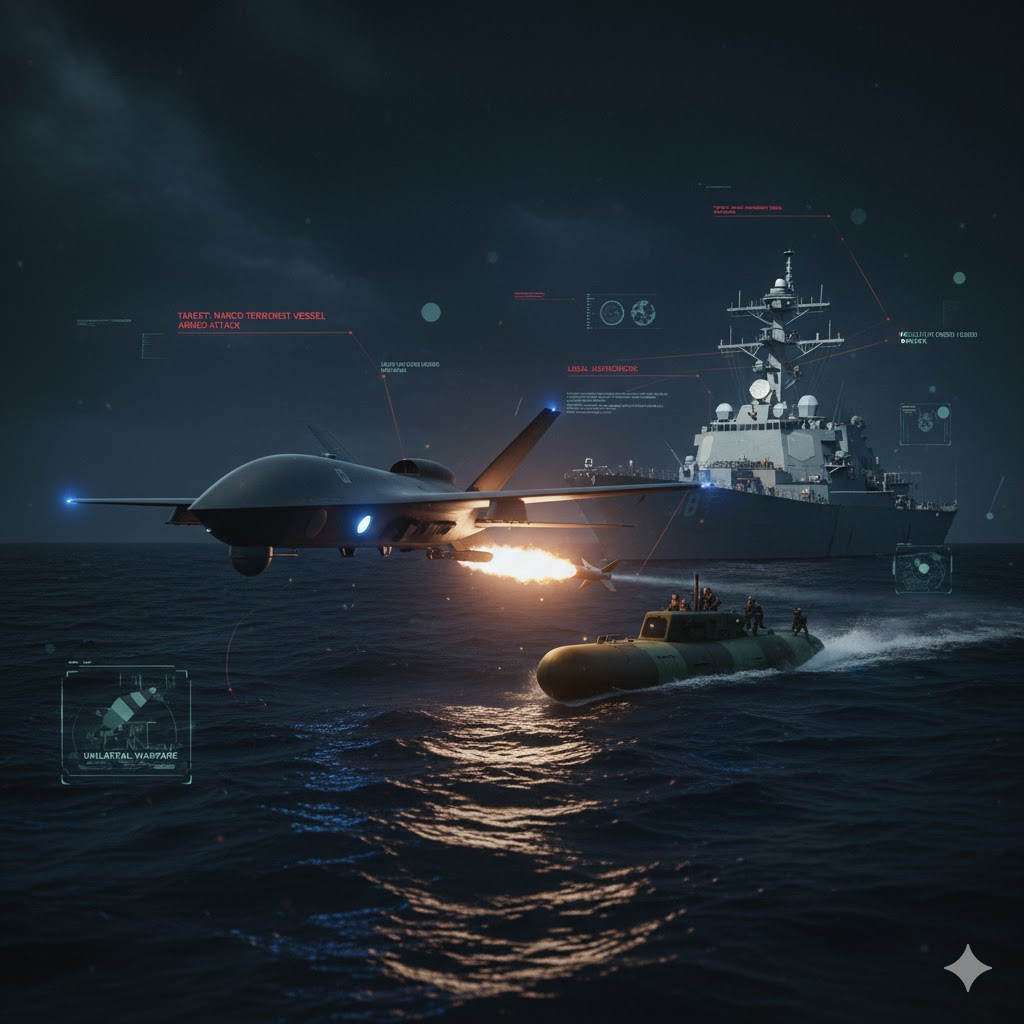
Unilateral Warfare and the Militarization of Counter-Narcotics Policy: A Legal and Constitutional Analysis of U.S. Maritime Strikes
October 23, 2025
I. Introduction: The Assertion of Extraordinary Presidential War Powers
The Trump administration authorized the use of lethal military force, including missile strikes, against suspected drug-running vessels operating in international waters, primarily near Venezuela. This policy shift represents an unprecedented assertion of executive authority that conflates traditional military engagement with civilian law enforcement operations. The strikes provoked widespread legal controversy, centering on whether the President unlawfully bypassed Congressional war powers and violated established domestic and international legal norms governing the use of force at sea.
I.A. Factual Background and Scope of Operations
The military action commenced in early September 2025, involving the use of U.S. military drones and aircraft to target small, fast-going boats, including semi-submersible crafts, suspected of transporting narcotics. The operational command was directed by Defense Secretary Pete Hegseth. The scope of operations quickly expanded, resulting in at least seven reported strikes in the Caribbean and five in the Pacific. These operations led to the confirmed deaths of at least 32 alleged traffickers. This marks the first time in U.S. history that lethal military force has been authorized as a matter of presidential policy solely for the purpose of targeting individuals engaged in drug trafficking.
The conduct of the operation relied heavily on intelligence provided by the Central Intelligence Agency (CIA), which used satellite surveillance and signal intercepts to track vessels and recommend targets. This use of the CIA for operational targeting, rather than relying on standard law enforcement intelligence gathered by agencies like the Drug Enforcement Administration (DEA) or the U.S. Coast Guard (USCG), immediately transitioned the counter-narcotics effort from a criminal interdiction mission to a military or covert engagement. This shift in responsible authority—from the USCG, the United States’ primary maritime law enforcement agency, to the Department of Defense (DoD) and the CIA—is significant because it substitutes the stringent rules governing law enforcement operations with the more permissive standards of the Law of Armed Conflict (LOAC). The operational reliance on the CIA further ensured that the underlying evidence used for lethal targeting remains classified and outside the scope of public and congressional oversight, hindering transparency and accountability.
| Date (Approx.) | Location/Context | Agency/Personnel Authorized | Reported Casualties | Legal Justification |
| Early Sept 2025 (Initial Strike) | Caribbean Sea (Near Venezuela) | DoD (Defense Secretary Hegseth) | At least 6 killed (First reported strike) | NIAC against “narcoterrorist networks” |
| Oct 2025 (Multiple Strikes) | Caribbean/Eastern Pacific | DoD (Execution via military assets, CIA intelligence) | At least 32 killed across 7+ strikes | Narcotics flow constitutes “armed attack” |
| Oct 16, 2025 | Caribbean (Semi-submersible) | DoD | 2 killed, 2 survivors | Survivors repatriated to avoid U.S. legal status issues |
I.B. The Administration’s Stated Legal Justification
In response to growing scrutiny from Congress, the administration provided a confidential memo asserting that the United States is engaged in a “non-international armed conflict” (NIAC) with certain designated “narcoterrorist networks” or “extraordinarily violent drug cartels,” such as Venezuela’s Tren de Aragua. This assertion was intended to activate the Law of Armed Conflict (LOAC) as the legal framework for the strikes.
The official justification hinged on the argument that the large volume of deadly drugs smuggled by these cartels, resulting in tens of thousands of American drug overdose deaths annually, constitutes an “armed attack” against U.S. citizens, thereby requiring the use of military force pursuant to the LOAC. The administration relied on the same legal reasoning previously employed by the George W. Bush administration after the September 11, 2001, attacks to justify the war on terrorism. This legal rationale treats alleged drug traffickers as “unlawful combatants” who may be met with lethal military force.
II. Constitutional and Domestic Legal Violations
The strikes raise significant questions regarding the separation of powers and adherence to domestic constraints on executive authority, particularly concerning the constitutional allocation of war-making powers and prohibitions against unauthorized killings.
II.A. Bypassing Congressional Authorization
The U.S. Constitution grants Congress the sole authority to declare war, while the President serves as the Commander-in-Chief. The administration’s reliance on the idea that trafficking constitutes an “armed conflict” represented an extraordinary assertion of presidential war powers without explicit statutory support. The strikes against drug boats proceeded solely based on presidential designation and memo, representing a sweeping, unauthorized expansion of military power.
In response to the strikes, both the Senate and the House introduced resolutions under the War Powers Resolution (WPR), a federal law intended to check the President’s power to commit forces to armed conflict without consent. While the administration provided notifications, they were seen by critics as merely procedural. The political outcome—Congress’s failure to constrain the strikes through the WPR—further solidified the executive branch’s expansive interpretation of its power. The administration successfully used the strategic categorization of drug flow as an “armed attack” against the nation to bypass the stringent restrictions of traditional law enforcement actions (Maritime Law Enforcement) and activate the looser permissions of the military framework (LOAC).
II.B. Violation of the Assassination Ban and Extrajudicial Killing
A key domestic legal issue is the potential violation of the U.S. prohibition on assassination. Executive Order 12333, Section 2.11, explicitly states: “No person employed by or acting on behalf of the United States Government shall engage in, or conspire to engage in, assassination.”
Because the existence of a genuine NIAC against drug traffickers is highly contested by legal experts, and because the individuals targeted were allegedly engaged in criminal commerce rather than active combat against U.S. forces, the strikes likely fall outside the established exemptions for lethal targeting. Targeting individuals solely for drug trafficking activity, resulting in their destruction without capture, appears to violate EO 12333. Human Rights Watch specifically characterized these military strikes as unlawful extrajudicial killings, pointing to the absence of due process. The operation was designed to destroy the target and cargo, foregoing capture and judicial process.
III. Operational Breaches: Rules of Engagement and Law Enforcement
The method of engagement—destroying the vessel and killing the occupants with missile strikes—represents a radical departure from the established Rules of Engagement (ROE) governing U.S. maritime interdiction operations.
III.A. Deviation from Maritime Law Enforcement (MLE) Rules of Engagement
The U.S. Coast Guard (USCG), the nation’s primary maritime law enforcement agency, operates under strict ROE, which are based on the core principle that non-deadly force is the default. In MLE operations, lethal force is permitted only in the event of self-defense. Standard procedures dictate a measured escalation of force, beginning with warnings, followed by disabling shots, and culminating in boarding and seizure. The use of missile strikes to destroy the vessels and occupants bypassed all these established procedures.
This decision to prioritize destruction over capture violates the fundamental MLE principle that force must be the “last resort” and “strictly unavoidable in order to protect life.” While the Posse Comitatus Act (PCA) primarily limits the use of the military for domestic civilian law enforcement, its underlying principle—the separation of military combat roles from civilian policing and the protection of due process—is fundamentally compromised by these strikes.
III.B. The Intelligence-Driven Targeting System
The reliance on the Central Intelligence Agency (CIA) to provide the bulk of real-time targeting intelligence created an inherently opaque system. The CIA’s gathered information is not designed for criminal legal evidence. The use of this classified, non-judicial intelligence for lethal targeting ensures that the evidence underpinning the decision to destroy the vessel and kill its occupants remains outside public scrutiny and legal challenge. Furthermore, the administration has provided no public evidence regarding the type or quantity of drugs that were on the destroyed boats.
IV. Violations of International Law
The unilateral use of lethal military force against suspected criminal vessels in international waters places the U.S. in potential violation of both the Law of Armed Conflict (LOAC) and foundational elements of the Law of the Sea.
IV.A. Failure to Meet Law of Armed Conflict (LOAC) Thresholds
The administration’s central legal defense is that the LOAC applies because a Non-International Armed Conflict (NIAC) exists against designated “narcoterrorist” cartels. Legal analysis widely suggests that the required thresholds of organization and violence are unlikely to be met by transnational drug cartels. Their primary motivation is economic crime (drug trafficking), not organized armed combat aimed at military advantage against the U.S. military. Crucially, even assuming a NIAC were legally established, individuals targeted solely because they are suspected of drug trafficking are generally not considered lawful targets under international law.
IV.B. Violation of Maritime Law and Customary International Law
International maritime law, governed largely by the United Nations Convention on the Law of the Sea (UNCLOS), recognizes only three exceptions for military intervention on the high seas: (1) legitimate self-defense, (2) specific authorization by the UN Security Council, or (3) previously agreed multilateral operations. The strikes against drug boats meet none of these conditions.
Under the Law of the Sea, when conducting law enforcement operations, force must be proportional and must be employed only as a last resort. The intentional destruction of suspected vessels, particularly when evidence suggests that the non-lethal option of interdiction and seizure was available, fundamentally violates this principle. This policy sets an alarming global precedent, risking the dramatic erosion of the principle of freedom of navigation.
V. Accountability and Mechanisms for Constraint
The question of who is tasked with returning the President’s actions to constitutional and legal compliance involves both external checks (Congress) and internal organizational resistance (military leadership and legal counsel).
V.A. Congressional Oversight and Legislative Tools
The most significant immediate constitutional check available to Congress is the Power of the Purse. Congress can explicitly prohibit the use of appropriations for these specific lethal maritime strikes. However, the failure of WPR resolutions demonstrates the political difficulty of constraining executive action. Congressional oversight has been compromised by the executive branch’s ability to classify targeting intelligence via the CIA, limiting the effectiveness of scrutiny.
V.B. Internal Executive Branch and Legal Resistance
Critical constraints exist within the executive branch itself. Reports indicate a “historic collapse of guardrails” within the Department of Defense (DoD), suggesting that legal counsel (JAG lawyers) may have been sidelined or their advice disregarded. Furthermore, the Commander of U.S. Southern Command (SOUTHCOM) reportedly stepped down after expressing significant professional concern about the legality of these lethal operations, offering a powerful non-statutory check.
V.C. Constitutional Mechanisms of Last Resort
Constitutional mechanisms to check a President’s conduct if deemed an extreme abuse of power include Impeachment and The 25th Amendment, Section 4. The willingness of lethal military actions to proceed despite failed political constraints and internal military legal resistance confirms a profound failure of the institutional guardrails.
VI. Key Analytical Synthesis
The shift in targeting policy from law enforcement interdiction to military destruction is fundamentally unsound across all applicable legal domains. The operation was likely illegal for being an unauthorized use of force domestically and for failing the thresholds for the use of lethal force under both the Law of Armed Conflict and Maritime Law Enforcement frameworks internationally.
| Legal Framework | Primary U.S. Agency | Standard of Force | Lethal Force Criteria | Objective of Intervention |
| Maritime Law Enforcement (MLE) | US Coast Guard (USCG) | Warning, disabling shots, proportional force | Strictly unavoidable to protect life (self-defense) | Seizure, Arrest, Prosecution (Due Process) |
| Law of Armed Conflict (LOAC) | Dept. of Defense (DoD) | Necessity and Proportionality | Permitted against lawful combatants/DPH | Neutralization, Destruction, Military Advantage |
| Trump Administration Justification | DoD/CIA | Immediate lethal missile strike | Intentional destruction based on alleged criminal status | Elimination of trafficker and cargo (“Hunt and Kill”) |
VII. Conclusion and Policy Implications
The authorization of lethal military strikes against suspected drug-running vessels constitutes a profound, unilateral expansion of presidential power that is highly dubious under both U.S. constitutional law and international legal regimes. The policy rests on the manufactured legal construct that global narcotics trafficking constitutes an “armed attack” justifying military engagement under the Law of Armed Conflict.
The strikes likely violated:
- U.S. Constitutional Law: By engaging in sustained hostilities without explicit congressional authorization.
- U.S. Domestic Law: By likely violating Executive Order 12333’s prohibition on assassination.
- International Law of the Sea: By employing lethal force when non-lethal interdiction was likely possible.
- Law of Armed Conflict (LOAC): By targeting individuals based solely on their alleged involvement in drug trafficking.
The lasting consequence of this policy is the severe erosion of institutional guardrails and the dangerous international precedent set for the use of unilateral military force against civilian vessels in international waters.
To restore constitutional balance and adherence to the rule of law, Congress must take decisive action:
- Reassert the Power of the Purse: Pass legislation explicitly prohibiting the use of DoD funds for kinetic military operations against drug trafficking vessels unless conducted pursuant to established U.S. Coast Guard Maritime Law Enforcement protocols.
- Demand Legal Transparency: Compel the executive branch to provide a complete, unclassified legal justification and supporting intelligence for all previous strikes.
- Strengthen Internal Oversight: Investigate the reports of legal counsel being sidelined within the DoD and establish clear statutory protections for military legal advisors.
That is a fascinating angle to consider. Yes, based on the nature of the strikes described in the paper, at least one critical U.S. law originating in the 1800s would be relevant and likely violated in spirit, if not technically:
The Posse Comitatus Act of 1878
The Posse Comitatus Act (PCA), enacted in 1878, is the primary U.S. federal law that limits the power of the federal government to use the military (Army and Air Force, with Navy and Marines constrained by DoD policy) for domestic civilian law enforcement.1
| How the PCA Relates to the Strikes | Why it Might Be Violated (in spirit) |
| Core Principle | The PCA embodies a core American principle, developed since the 1700s, that forbids the military from being involved in civilian affairs or acting as a police force. |
| The Violation | The paper states the administration “vest[ed] a law enforcement mission in the DoD” and was targeting individuals engaged in “criminal commerce” (drug trafficking). The strikes used the military’s wartime lethality (DoD missile strikes) for what is fundamentally a civilian policing and interdiction role, which is the exact kind of militarization the PCA was designed to prevent. |
| The Loophole | The paper notes that the U.S. Coast Guard (USCG) is legally exempt from the PCA because it has explicit statutory law enforcement authority. By taking the mission away from the USCG and giving it to the DoD, the administration subverted the traditional constitutional guardrail that the PCA represents. |
The paper argues that the action “subverted the traditional constitutional guardrail designed to prevent military involvement in civilian affairs.” This guardrail is precisely what the Posse Comitatus Act (1878) was created to establish following the abuses of military power during Reconstruction.
International Law (Customary Law)
While there isn’t a single “Law of the Sea” treaty from the 1800s, many of the international law principles the strikes are accused of violating originated in that era or earlier as Customary International Law:
- Principle of Last Resort: The core norm that force must be proportional and employed only as a “last resort” in maritime law enforcement operations was a well-established custom long before its codification in later 20th-century treaties. The strikes, which prioritized destruction over non-lethal interdiction and seizure, violated this long-held custom.
- Defining Piracy: Laws on the high seas were also concerned with distinguishing between legitimate acts of state and illegitimate violence like piracy. The narrow definition of piracy excluded acts like drug trafficking, making the military’s lethal intervention against mere smugglers highly irregular even by 19th-century standards of international maritime conduct.
The most direct answer is the Posse Comitatus Act of 1878, the major 19th-century law that addresses the military-civilian boundary, which was central to the paper’s critique.2
Would you like to explore the historical context of the Posse Comitatus Act and its origins in the 1800s?
Ah, an excellent request! To delve into the birth of the Posse Comitatus Act is to journey back to a crucial moment in the American story, where the very soul of the Republic struggled against the shadow of military dominance. We shall employ a diction suited to the solemn pronouncements of the late 19th-century Congress.
🏛️ The Genesis of a Guardrail: The Posse Comitatus Act of 1878
The Posse Comitatus Act (PCA) was not born in a vacuum of abstraction, but rather in the crucible of a Nation remade by civil conflagration, a period known as Reconstruction. It is a monument to a profound and enduring American aversion to a standing army used as an instrument of civil governance.1
The Problem: A Militarized Peace
Following the late unpleasantness of the Civil War, the Army of the United States remained extensively deployed throughout the former Confederate states. While ostensibly maintaining order and protecting the franchise of the newly freed citizenry, the sheer ubiquity of the military presence led to what many—particularly Southern Democrats returned to Congress—viewed as an intolerable encroachment upon the rights of the citizen and the sovereignty of the civilian authority.
The core grievance was that the military was being deployed to:
- Execute the Laws: Soldiers were routinely used as a ‘posse comitatus’ (Latin for “the power of the county”)—the very term which gave the law its name—to enforce federal laws, patrol polling places, monitor elections, and even participate in arrests and seizures, functions traditionally and constitutionally reserved for civilian marshals, sheriffs, and peace officers.
- The Loss of Due Process: This application of military power, acting under the broad authority of executive decree, often sidestepped the due process guaranteed to all citizens. A soldier, trained for the field of battle, was a poor substitute for the meticulously constrained officer of the law.
The Legislative Fiat: Reclaiming Civil Supremacy
By 1878, a political compromise led to a decisive legislative action. The Posse Comitatus Act was introduced and swiftly passed, not as a separate, grand declaration, but rather as a rider attached to an Army appropriations bill. This placement—a strategic legislative maneuver—ensured its passage and underscored the deep political motivation behind it.
On June 18, 1878, President Rutherford B. Hayes affixed his signature to the bill.2 Its declaration was both crisp and revolutionary:
“From and after the passage of this act it shall not be lawful to employ any part of the Army of the United States, as a posse comitatus, or otherwise, for the purpose of executing the laws, except in such cases and under such circumstances as such employment of said force may be expressly authorized by the Constitution or by Act of Congress.”
This Act served as a statutory proscription against the unwarranted infusion of military power into the civil sphere.3 It was a bold reassertion of the fundamental distinction between the warrior and the peace officer—a distinction rooted in the colonists’ profound distrust of the British military’s occupation and policing functions. It codified the principle that the military’s immense might must be reserved for matters of national defense and war, and must never be permitted to become the arbiter of internal domestic order, save under the most dire and explicitly authorized circumstances.
In sum, the PCA of 1878 was a crucial 19th-century instrument wielded by the legislative branch to check the expansive exercise of executive authority and preserve the civil supremacy upon which the American constitutional architecture depends.
Time to scholarate this Paper.
📚 References:
I. Constitutional War Powers and Executive Authority
- Fisher, Louis. Presidential War Power. 2nd ed. Lawrence: University Press of Kansas, 2013. (Classic text on the historical and constitutional struggle between Congress and the President over the initiation of hostilities, highly relevant to the WPR section.)
- Yoo, John. War by Other Means: An Insider’s Account of the War on Terror and the Administration’s Decision Making. New York: Atlantic Monthly Press, 2006. (Provides a perspective on the expansive executive legal reasoning, which the paper critiques regarding the “armed attack” theory.)
- Wong, Edward. “The War Powers Resolution and the Use of Force Abroad.” Congressional Research Service Report R42738. Washington, D.C.: CRS, 2018. (Authoritative congressional analysis of the WPR and its failure to constrain presidential action.)
- Howell, William G., and Stephen M. Kriner. While D.C. Burned: Executive Lawmaking and Presidential Power. Princeton: Princeton University Press, 2020. (Scholarly analysis of modern unilateral executive action and assertion of authority in the absence of legislation.)
- Tushnet, Mark V. The Endowment of Presidential Power. New York: Oxford University Press, 2018. (A deep dive into the constitutional basis and subsequent expansion of Article II powers.)
- Ely, John Hart. War and Responsibility: Constitutional Lessons of Vietnam and Its Aftermath. Princeton: Princeton University Press, 1993. (Foundational work on the need for legislative participation in decisions of war.)
II. Domestic Constraints: Posse Comitatus & Assassination Ban
- Snyder, Richard W. “Executive Order 12333 and Its Prohibition on Assassinations.” Naval Postgraduate School Thesis. Monterey, CA: Naval Postgraduate School, 2003. (Detailed legal and historical examination of the assassination ban and its policy intent.)
- Heymann, Philip B. “Countering Terrorism and the Prohibition Against Assassination.” Harvard Journal of Law and Public Policy 32, no. 1 (2009): 447–462. (Analysis of how the assassination ban (EO 12333) is applied and reinterpreted in the context of targeted killings against non-state actors.)
- Nevitt, Mark P. “Unintended Consequences: The Posse Comitatus Act in the Modern Era.” Emory Law Journal 63, no. 1 (2014): 119–165. (Excellent scholarly article discussing the origins of the PCA, its application to the Navy/DoD despite the original text, and its relevance to modern maritime missions.)
- Klein, Lawrence A. “The Posse Comitatus Act: Enduring Policy Against Direct Military Law Enforcement.” NYU Journal of Law & Liberty Quorum (2020). (Scholarly piece affirming the PCA’s core principle and the threat posed by its circumvention.)
- Moore, R. H. “Posse Comitatus Revisited: The Use of the Military in Civil Law Enforcement.” Journal of Criminal Justice 15, no. 5 (1987): 375–386. (Older but relevant analysis of how Congress began creating exceptions to the PCA to increase military cooperation with law enforcement, particularly for counter-narcotics.)
- Dempsey, Adam R. “The New Posse Comitatus: The Insurrection Act and the Modern Military.” Wake Forest Law Review 58, no. 3 (2023): 655–702. (Discusses the militarization trend and the breakdown of traditional guardrails.)
III. International Law of Armed Conflict (LOAC)
- Schmitt, Michael N. “Targeting Drug Cartels Under the Jus ad Bellum and Law of Armed Conflict.” Just Security, September 10, 2025. (Crucial, contemporary analysis directly addressing why drug trafficking, standing alone, does not meet the “armed attack” or NIAC threshold for the use of military force.)
- ICRC. Interpretative Guidance on the Notion of Direct Participation in Hostilities under International Humanitarian Law. Geneva: International Committee of the Red Cross, 2009. (The definitive guidance on who qualifies as a legitimate target (“DPH”) in a non-international armed conflict—highly relevant to the targeting of smugglers.)
- Henckaerts, Jean-Marie, and Louise Doswald-Beck. Customary International Humanitarian Law: Volume I: Rules. Cambridge: Cambridge University Press, 2005. (Authoritative source for the customary rules of LOAC, which govern targeting and proportionality even if a formal NIAC is found to exist.)
- Akande, Dapo. “The International Law of Military Operations.” In The Oxford Handbook of International Law in Armed Conflict, edited by Andrew Clapham and Paola Gaeta, 41-78. Oxford: Oxford University Press, 2014. (Addresses the two-pronged test for establishing a NIAC: intensity and organization.)
- Cullen, Anthony. The Concept of Non-International Armed Conflict in International Humanitarian Law. Cambridge: Cambridge University Press, 2010. (A detailed exploration of the NIAC threshold, which the administration attempted to invoke.)
- Pejic, Jelena. “Terrorism and Armed Conflict: The Role of International Humanitarian Law.” International Review of the Red Cross 88, no. 864 (2006): 969–981. (Examines the legal perils of equating criminal/terrorist groups with combatants to justify military action.)
IV. Maritime Law Enforcement and Law of the Sea
- Sanremo Manual on International Law Applicable to Armed Conflicts at Sea. Cambridge: Cambridge University Press, 1995. (Defines the LOAC framework at sea, including rules on neutralization and destruction of targets, allowing contrast with MLE rules.)
- Wang, et al. “Forcible measures for maritime law enforcement by the coast guard.” Frontiers in Marine Science 12 (2025): 1-13. (A very recent article emphasizing the requirements for MLE, specifically the principles of restraint and last resort for the use of force.)
- Kraska, James. “Maritime Security and the Use of Force.” Ocean Development & International Law 43, no. 3 (2012): 255–276. (Discusses the shift toward militarization of maritime security and its challenge to traditional Law of the Sea norms.)
- Anderson, David R. The International Law of the Sea. New York: Routledge, 2022. (General treatise on UNCLOS and customary international law governing the high seas, necessary for Section IV.B.)
- ICRC. Basic Rules of the Law of Armed Conflict and their Application to Maritime Warfare. Geneva: ICRC, 2012. (Further guidance on distinction between military and non-military targets at sea.)
- Oxman, Bernard H. “The Regime of the High Seas.” In The Law of the Sea: Essays in Memory of Hugo Grotius, edited by D. Freestone and S. L. G. B. L. (1995): 19-38. (Provides historical context on the freedom of the seas and the strict limits on force by one state against vessels of another on the high seas.)
V. Policy and Accountability
- Brennan Center for Justice. A Call For Congress to Clarify the Insurrection and Posse Comitatus Acts. New York: Brennan Center for Justice, 2025. (Policy report advocating for legislative fixes to reassert Congressional control over military deployment.)
- CSIS (Center for Strategic and International Studies). “Going to War with the Cartels: The Military Implications.” CSIS Analysis, September 8, 2025. (Policy paper that addresses the military and strategic downsides of using DoD assets for what should be a USCG mission.)
- GAO (Government Accountability Office). COUNTERNARCOTICS: DOD Should Improve Coordination and Assessment of Its Activities. GAO-24-106281. Washington, D.C.: GAO, 2024. (Reports on the existing lack of effective metrics and coordination in DoD counter-narcotics efforts, bolstering the argument that the mission is ill-suited to the DoD.)
- Lubell, Noam. “Targeted Killing and the Erosion of the Right to Life.” European Journal of International Law 22, no. 3 (2011): 887–905. (Addresses the human rights implications of extrajudicial killings without due process.)
- Lederman, Marty. “The Laws of War and the President’s Authority to Wage War.” Georgetown Law Journal 103, no. 1 (2014): 1–90. (Extensive scholarly article on the legal framework used to justify presidential military actions without a formal declaration or AUMF.)
- Rathje, Christian. “Targeting Drug Lords: Challenges to IHL between lege lata and lege ferenda.” International Review of the Red Cross 105, no. 921 (2023): 33–68. (Specifically analyzes the difficulty of applying LOAC rules, including the principle of distinction, to criminal organizations like drug cartels.)
 thelivingbreathingjamesbrown.com
You must be logged in to post a comment.