
My apologies. You need Choices. I need Choices. All of 🇺🇸 needs Choices. If we do not become one Mobilized Community of Unity, America will no longer be A Nation we enjoy. Certain Individuals are Tearing Democracy Apart for self-pleasing reasons.
THE 2028 UNITY MOVEMENT: Reclaiming America’s Soul, Building The New Era
A Vision for a Proud, Patriotic, and Caring Nation
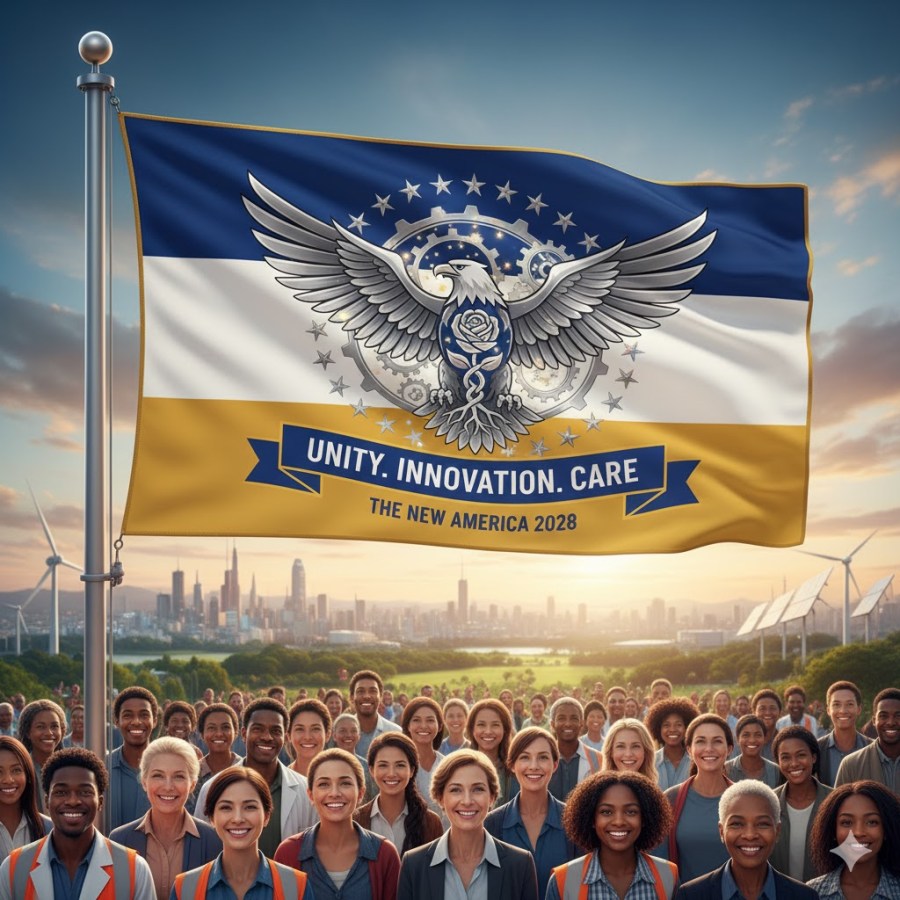
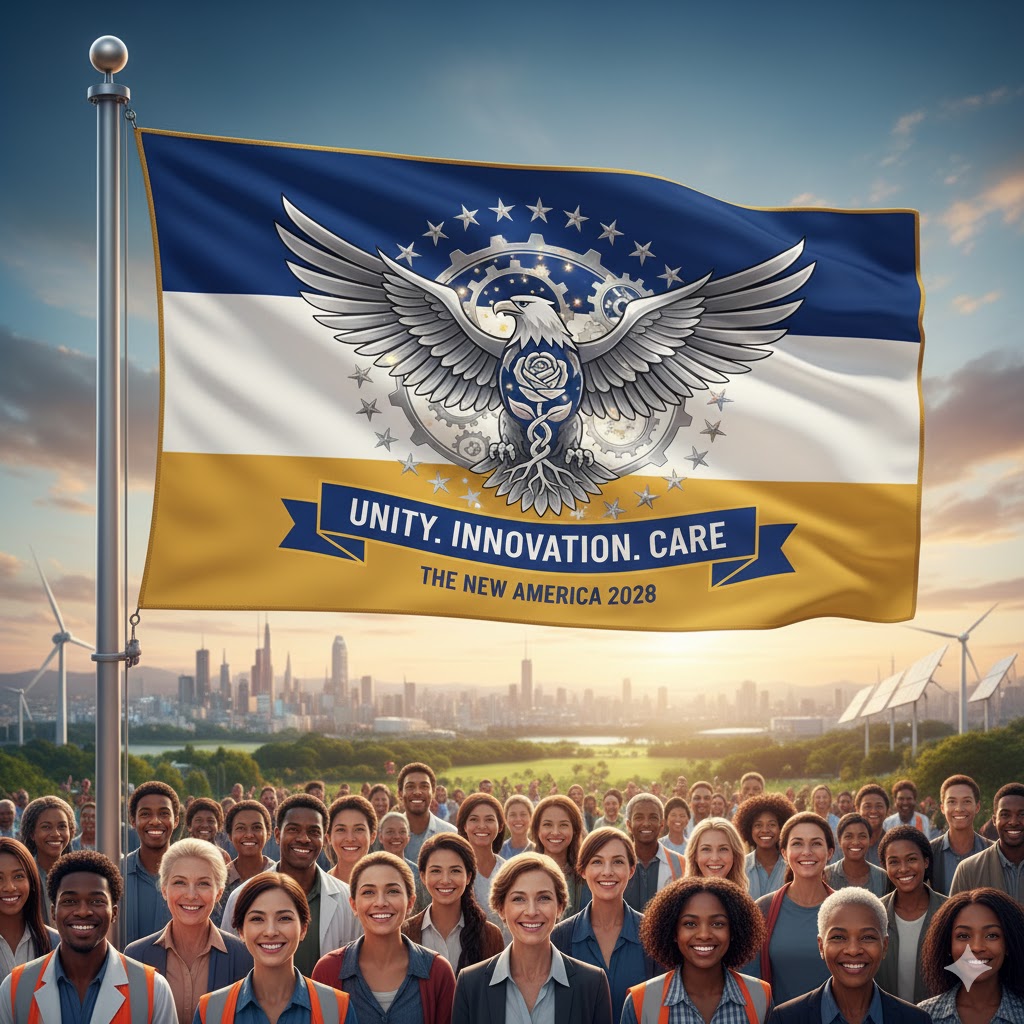
The dawn of 2028 offers not just another election, but a profound opportunity for a “Do Over”—a chance to reclaim the promise of America. After years of division, noise, and the unsettling sensation that our foundational values are under siege, a new flag unfurls, carrying with it a profound message: Unity, Innovation, Care. This is the banner of the 2028 Unity Movement, a powerful call to every proud, patriotic, and caring American to join hands and build The New America.
We stand at a crossroads. The path of division, personal vanity, and relentless conflict offers only exhaustion and decay. But there is another path—a path illuminated by shared purpose, genuine compassion, and a resolute commitment to a future where every American can thrive. This is not about left or right; it is about right and wrong. It is about confronting a “Ballroom Bully” whose leadership prioritizes ego over empathy, personal gain over national well-being, and chaos over constitutional stability.
The Lingering Shadow: Why Change is Not Just Desirable, But Essential
For too long, the nation has been held captive by a narrative of resentment and grievance, amplified by a leadership style that delights in division. The average man and woman feel the weight of this division in their communities, their conversations, and their daily lives. The constant barrage of manufactured outrage, the erosion of trust in institutions, and the feeling that our leaders are more interested in self-aggrandizement than public service has left many weary.
The opponent, whose potential 2028 run looms, represents a stark choice: a continuation of an unsettling political drama that undermines the very fabric of our nation. His presidency was marked by a series of concerning patterns that demand a collective response:
- The Cult of Personality Over Constitutional Governance: The constant testing of institutional guardrails, the talk of constitutional “workarounds” for term limits, and the disregard for established norms. This is not strong leadership; it is a dangerous flirtation with authoritarianism that threatens the peaceful transfer of power [1].
- Vanity and Transactional Leadership: From the rumored White House ballroom alterations to the entwinement of foreign policy with personal business ventures, the line between public service and private gain has been dangerously blurred. His leadership appears less about the nation’s welfare and more about personal brand and lavish display [2].
- Economic Instability Masked by Market Hype: While headline numbers might occasionally be strong, the foundation of the economy has been weakened by burgeoning national debt, tax cuts favoring the wealthy, and a growing cost of living that burdens everyday families. An economy that serves only the few is not a strong economy [3].
- The Weaponization of Culture Wars: Issues like abortion, DEI, banned books, and critical race theory have been manipulated and inflamed, not to find common ground, but to divide, distract, and rally a base. This deliberate polarization undermines true progress and diverts attention from real challenges facing families [4].
- The Erosion of Truth and Trust: The constant “flooding the zone with misinformation” erodes the public’s ability to discern fact from fiction, making informed civic participation nearly impossible. This strategy benefits only those who thrive in chaos [5].
These are not mere policy disagreements; they are fundamental assaults on the spirit of American democracy and the well-being of its citizens. This is why the 2028 Unity Movement is not just a campaign; it is a vital act of national self-preservation.
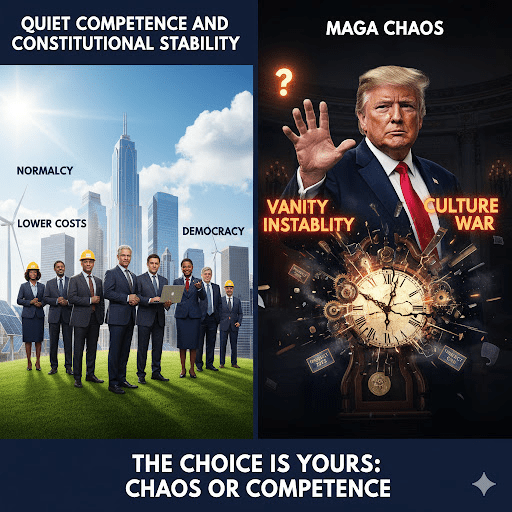
Here’s the visual heart of our movement—a stark contrast between the past and the inspiring future we can build together.
The Call to Arms: Why YOU Must Join the Unity Movement
The 2028 Unity Movement believes in the inherent good of the American people – their patriotism, their work ethic, and their fundamental decency. We believe that true power lies not in the hands of a single individual, but in the collective strength of a united populace.
This is why you are needed. This is why you must join:
- For the Dignity of Your Vote: To protect the sanctity of every ballot, ensuring that every election is counted fairly, and that no official can unilaterally reject the will of the people, as seen in attempts to undermine election certification [6].
- For Economic Fairness and Stability: To build an economy that works for everyone, not just the top 1%. An economy where wages keep pace with costs, where retirement savings are secure, and where irresponsible fiscal policies don’t mortgage our children’s future [7].
- For the Restoration of Trust and Truth: To demand leaders who communicate honestly, respect facts, and seek common ground, rather than those who thrive on division and misinformation. We deserve a public discourse based on respect, not relentless attacks [8].
- For a Government of Service, Not Self-Interest: To ensure that public office is a sacred trust, not an opportunity for personal enrichment. We must reject the blurring of lines between the President’s business empire and his national duty, demanding full transparency and accountability [9].
- For the Future of Our Children: To safeguard an America where education is valued, where freedom of thought is protected, and where our constitutional rights are preserved, not constantly threatened by executive overreach or cultural battles [10].
- Because Hope is a Strategy: The “Ballroom Bully” thrives on despair and the belief that resistance is futile. He wants you to feel small and powerless. But your voice, when united with millions of others, is the most powerful force in the universe.
A Future Forged in Unity: The New America
The flag of the 2028 Unity Movement—with its powerful eagle embracing innovation, surrounded by the stars of unity, and underscored by the unwavering commitment to care—is more than just a symbol. It is a roadmap.
Unity: Acknowledging our differences but emphasizing our shared American identity. We are stronger together, a tapestry of diverse experiences woven into a single, resilient nation [11].
Innovation: Embracing forward-thinking solutions for our economy, environment, and global standing, rather than retreating into outdated ideologies [12].
Care: A commitment to the well-being of every citizen—their health, their security, their education, and their ability to live a life of dignity and opportunity [13].
Trump can be beaten in 2028. Not by engaging in his game of chaos, but by offering a clear, compelling alternative rooted in the values he seeks to dismantle. His weaknesses—his vanity, his transactional nature, his divisive rhetoric, and his inherent instability—are not merely personal flaws; they are the very tools with which the Unity Movement can forge a path to victory.
This movement is a testament to the enduring spirit of America. It is a promise that we can overcome the present challenges and build a future where our nation stands as a beacon of democracy, integrity, and genuine hope. Join us. Let us turn the page, together, towards The New America.
References
- Dahl, R. A. (1998). On Democracy. Yale University Press. (Discusses the principles of democratic governance and the importance of constitutional constraints).
- Luo, Y. (2007). The New Strategy of Global Branding and Marketing: An Extended Model for Competitive Advantage. Journal of International Marketing. (Illustrates how personal branding can conflict with institutional roles when unchecked).
- Stiglitz, J. E. (2012). The Price of Inequality: How Today’s Divided Society Endangers Our Future. W. W. Norton & Company. (Examines the economic consequences of wealth inequality and fiscal policies that favor the rich).
- Mudde, C. (2019). The Far Right Today. Polity Press. (Analyzes how populist leaders often leverage culture wars to consolidate power and divide society).
- Bennett, W. L., & Livingston, S. (2018). The Disinformation Age: Politics, Technology, and the Future of Democracy. Cambridge University Press. (Explores the impact of misinformation and “flooding the zone” tactics on democratic discourse).
- Hasen, R. L. (2020). Election Meltdown: Dirty Tricks, Rabid Partisans, and the Threat to American Democracy. Yale University Press. (Details various threats to election integrity, including efforts to subvert certification).
- Piketty, T. (2014). Capital in the Twenty-First Century. Belknap Press. (Provides a comprehensive analysis of wealth and income inequality and its long-term economic effects).
- Fukuyama, F. (2018). Identity: The Demand for Dignity and the Politics of Resentment. Farrar, Straus and Giroux. (Discusses the erosion of trust in institutions and the rise of identity politics).
- Lessig, L. (2011). Republic, Lost: How Money Corrupts Congress—and a Plan to Stop It. Twelve. (Addresses the problem of money in politics and the blurring of lines between public service and private gain).
- Gutmann, A. (1987). Democratic Education. Princeton University Press. (Emphasizes the critical role of education and critical thinking in sustaining a democratic society).
- Putnam, R. D. (2000). Bowling Alone: The Collapse and Revival of American Community. Simon & Schuster. (Highlights the importance of social capital and unity for a functioning society).
- Florida, R. (2002). The Rise of the Creative Class: And How It’s Transforming Work, Leisure, Community and Everyday Life. Basic Books. (Discusses the economic benefits of innovation and embracing forward-thinking solutions).
- Sen, A. (2009). The Idea of Justice. Harvard University Press. (Explores the concept of care and its central role in creating a just and equitable society).
- Ackerman, B. (2018). Revolutionary Constitutions: Charismatic Leadership and the Rule of Law. Harvard University Press. (Examines how populist leaders challenge constitutional norms).
- Barber, B. R. (1992). Strong Democracy: Participatory Politics for a New Age. University of California Press. (Advocates for active citizen participation to strengthen democracy against authoritarian tendencies).
- Reich, R. B. (2018). The Common Good. Knopf. (Argues for a renewed focus on shared values and collective well-being over hyper-individualism).
- Sunstein, C. R. (2017). #Republic: Divided Democracy in the Age of Social Media. Princeton University Press. (Details how social media contributes to polarization and erodes common ground).
- Milanovic, B. (2016). Global Inequality: A New Approach for the Age of Globalization. Harvard University Press. (Discusses the global economic factors contributing to domestic inequality).
- Snyder, T. (2017). On Tyranny: Twenty Lessons from the Twentieth Century. Tim Duggan Books. (Offers lessons on how to resist authoritarianism and protect democratic institutions).
- Levitsky, S., & Ziblatt, D. (2018). How Democracies Die. Crown. (Explores the subtle ways democratic norms and institutions can be undermined from within).
- Kendi, I. X. (2019). How to Be an Antiracist. One World. (Provides frameworks for understanding and dismantling systemic barriers to equity).
- Brooks, D. (2019). The Second Mountain: The Quest for a Moral Life. Random House. (Emphasizes the importance of community and relational commitments over individual achievement).
- Klein, E. (2020). Why We’re Polarized. Avid Reader Press. (Examines the structural causes of political polarization in the United States).
- Frank, T. (2004). What’s the Matter with Kansas?: How Conservatives Won the Heart of America. Metropolitan Books. (Analyzes how economic issues are often overshadowed by cultural grievances in political discourse).
- Vance, J. D. (2016). Hillbilly Elegy: A Memoir of a Family and Culture in Crisis. Harper. (Offers a personal perspective on the economic anxieties and cultural shifts driving populist sentiment).
- Mounk, Y. (2018). The People vs. Democracy: Why Our Freedom Is in Danger and How to Save It. Harvard University Press. (Discusses the rise of illiberal democracy and the challenges to traditional liberal values).
- Gessen, M. (2017). The Future Is History: How Totalitarianism Reclaimed Russia. Riverhead Books. (Provides insight into how strongman leaders dismantle democratic norms and consolidate power).
- Friedman, T. L. (2016). Thank You for Being Late: An Optimist’s Guide to Thriving in the Age of Accelerations. Farrar, Straus and Giroux. (Discusses the challenges and opportunities presented by rapid technological and social change).
- Coates, T. (2015). Between the World and Me. Spiegel & Grau. (Explores the societal impacts of race and identity in America).
- Hochschild, A. R. (2016). Strangers in Their Own Land: Anger and Mourning on the American Right. The New Press. (Offers a deep dive into the emotional landscape and motivations of conservative voters, highlighting the need for empathy).
 thelivingbreathingjamesbrown.com
You must be logged in to post a comment.