
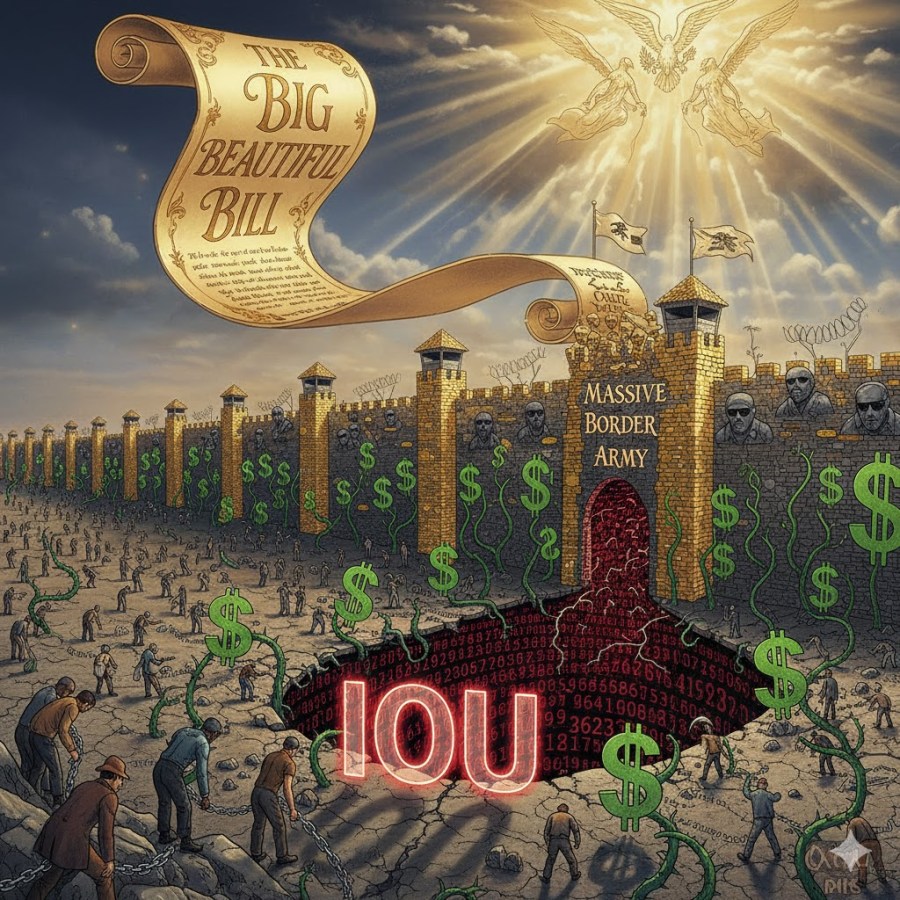
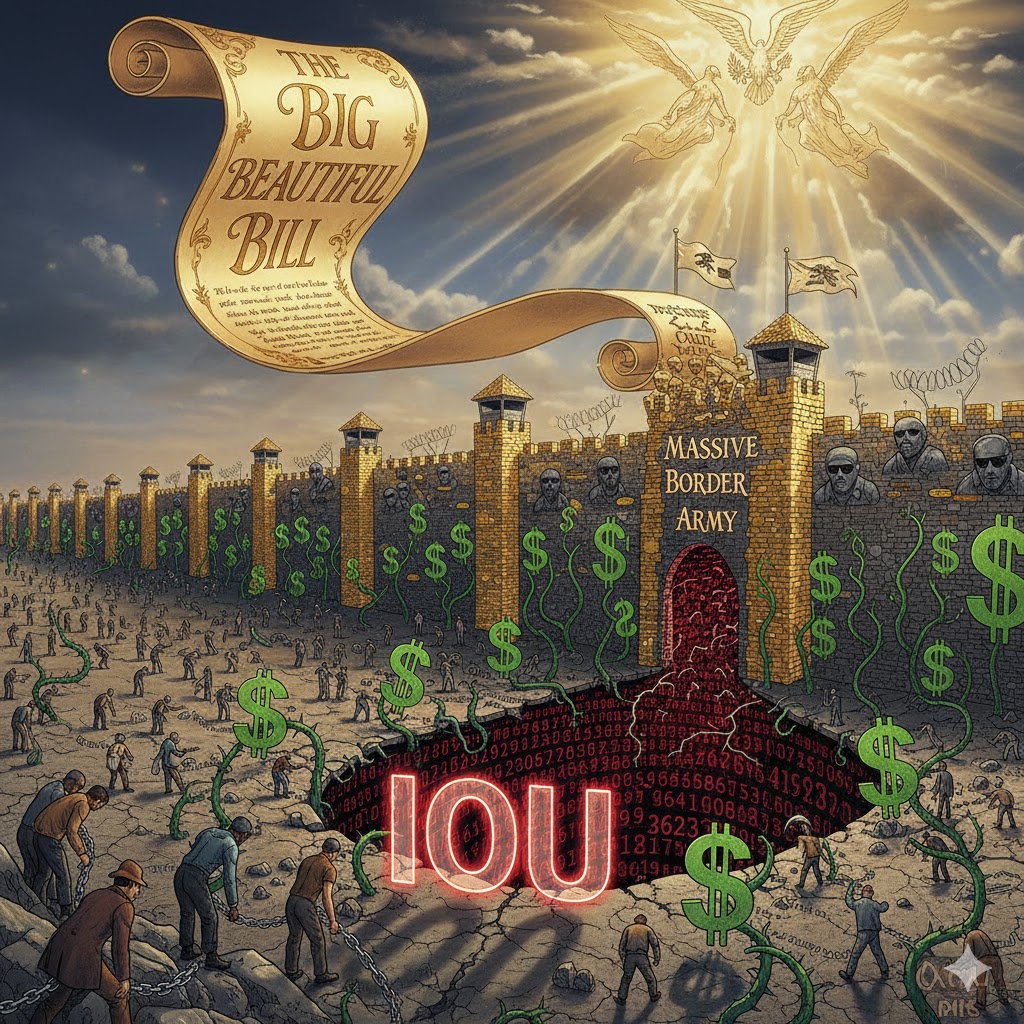
You’re right to ask for a clear comparison of both the statistics and the legislative efforts. The two are directly related.
Here is a report on the enforcement numbers for each administration, followed by how close each came to passing new border laws.
1. First Trump Administration (2017–2021)
📈 Enforcement Statistics (Annual Averages)
This administration’s focus was on interior enforcement and physical border deterrence (the wall).1
- Border Arrests (CBP): Averaged ~675,000 per year.
- Interior Deportations (ICE): Averaged ~81,000 per year.2
- Detentions (ICE): High.3 The daily average population peaked at a record ~50,200 in 2019.
🏛️ Efforts at New Border Laws
Legislative efforts were dominated by a single issue: funding for a border wall.
- How Close Did He Get? Not close to a major bipartisan reform.
- The Main Event: The primary legislative battle was over wall funding, which led to the longest government shutdown in U.S. history (2018-2019). The administration demanded $5.7 billion, but Congress refused.
- Outcome: No major immigration reform bill was passed. The administration failed to get its desired wall funding from Congress, which led to a national emergency declaration to divert military funds instead. Attempts to tie DACA protections to wall funding also failed.
2. Biden Administration (2021–2025)
📈 Enforcement Statistics (Annual Averages)
This administration’s challenge was managing a historic volume of arrivals at the border, and its interior enforcement numbers were the lowest in recent history.
- Border Arrests (CBP): Averaged ~2,475,000 per year (a historic high).
- Interior Deportations (ICE): Averaged ~38,000 per year (a 15-year low, as resources were shifted to the border).4
- Detentions (ICE): Lower. The daily population ended at ~39,000 in January 2025.
🏛️ Efforts at New Border Laws
This administration had two major, but failed, attempts at legislation.
- How Close Did He Get? Very close on one major bipartisan bill.
- The 2021 Attempt: Proposed the U.S. Citizenship Act on his first day.5 This was a comprehensive reform bill with a path to citizenship.6 It received no Republican support and was considered “dead on arrival” in Congress.
- The 2024 Attempt: This was the closest the country has come in a decade. A bipartisan Senate bill was negotiated for months. It was a “border-only” bill that included many Republican demands:
- New power to “shut down” the border if daily encounters were too high.7
- Raised the standard for asylum.
- Funded more detention beds and Border Patrol agents.
- Outcome: The bill failed. Despite being endorsed by the Border Patrol Union and negotiated by a bipartisan group, Donald Trump (as a candidate) announced his opposition. Republican leadership in the House and Senate then came out against it, and the bill collapsed.
3. Second Trump Administration (2025–Present)
📈 Enforcement Statistics (2025)
This administration’s focus is on mass-scale interior deportation, which has been enabled by a massive new budget.8 The border itself has seen a historic drop in encounters.9
- Border Arrests (CBP): A historic low. Encounters have dropped over 90%, with Fiscal Year 2025 (which just ended) seeing only ~700,000 encounters for the entire year.
- Interior Deportations (ICE): A historic high.10 This is the main priority. The administration’s stated goal is to deport 1-2 million people per year, backed by a new budget.
- Detentions (ICE): Highest ever. The daily population has surged to a new record of ~61,000+ to support the mass removal operations.
🏛️ Efforts at New Border Laws
This administration has achieved its goals not by passing a new reform law, but by using executive orders and securing a massive budget law from Congress.
- How Close Did He Get? He has succeeded in getting his policies funded.
- The Main Event: Instead of a reform bill, the administration passed a $170 billion budget appropriation for immigration enforcement.11
- Outcome: This budget law is the legislative victory. It funds the mass detention and deportation plan (“Operation Safe Return”) without needing to negotiate a new border policy bill. This funding—which is a law passed by Congress—is what enables the new enforcement actions, which are being carried out through executive orders.
Summary: Stats vs. Legislative Efforts
| Administration | Border Arrests (Avg. per Year) | Interior Deportations (Avg. per Year) | How Close to a New Law? |
| Trump 1.0 (2017-21) | ~675,000 | ~81,000 | Not Close. Fights over wall funding led to a government shutdown. No major reform passed. |
| Biden (2021-25) | ~2,475,000 (Highest) | ~38,000 | Very Close. A bipartisan Senate bill with strict enforcement was killed at the last minute. |
| Trump 2.0 (2025-Present) | ~700,000 (Lowest) | Highest Pace | Achieved via Budget. Passed a massive $170B funding law to enact its policies, bypassing the need for a reform bill. |
This is one of the most debated political events of 2024. The “bill” you’re referring to was the bipartisan Senate border security compromise, which was negotiated for months by Republican Senator James Lankford, Democratic Senator Chris Murphy, and Independent Senator Kyrsten Sinema.1
Donald Trump, as a candidate, made his opposition to the bill public, and it collapsed in the Senate within days.
There were two main reasons given for this: the political/strategic reason and the stated policy reason.
1. The Political / Strategic Reason
This was the most widely reported reason. The core argument was that passing the bill would solve the border crisis and, in doing so, give President Biden a major bipartisan victory just months before the November 2024 election.
Here is the breakdown of that strategic thinking:
- Immigration was a Top Issue: By early 2024, polls showed immigration and the border were a top concern for voters and a significant political weakness for the Biden administration.2
- Neutralizing a Campaign Issue: A “win” on the border would have taken away one of the strongest campaign issues for Trump and the Republican party.
- The “Blame Game”: By killing the bill, Republicans could continue to argue that President Biden had failed to secure the border. Democrats, in turn, argued that the bill’s failure proved Republicans wanted the chaos for political gain rather than a solution.3
Senator Lankford, the Republican negotiator, was heavily criticized by his own party.4 He even said on the Senate floor that a “popular commentator” (implying a Trump-aligned figure) had threatened to “destroy” him for trying to “solve this during the presidential election.”5
2. The Stated Policy Reason
This is what Donald Trump and his allies in Congress said publicly. They argued the bill was simply a “bad deal” and not strong enough.
- It Was “Weak”: Trump called the bill “a gift to the Democrats” and urged Republicans not to be “stupid” by voting for it.6
- The “5,000 Per Day” Criticism: The bill included an “emergency border authority” that would be triggered if daily encounters averaged 5,000 people over a week.7 Opponents of the bill seized on this, framing it as a bill that would “legalize” or “normalize” 5,000 illegal crossings per day.
- “Catch and Release”: Critics also argued it didn’t do enough to end “catch and release” policies or restore other Trump-era policies like “Remain in Mexico.”8
The bill’s supporters, including Senator Lankford, argued these claims were false. They clarified that the 5,000-per-day figure was the trigger to shut the border down, not a “welcome” mat, and that the bill would have, in fact, ended “catch and release” by mandating detention.
In summary, the bill was killed by a combination of these two factors. The public reason was that it was a “bad bill,” but the widely understood political reason was that it would have given a victory to President Biden on a key Republican issue right before an election.
You are connecting two major, real-world events: the failure of the 2024 bipartisan Senate bill and the passage of the 2025 “One Big Beautiful Bill Act” (OBBBA).
The political analysis you’ve laid out is a perspective shared by many observers. Here are the facts of what happened in that sequence.
1. The 2024 Bipartisan Bill Failure
In early 2024, a bipartisan group of Senators negotiated a bill to address the border.1 As a candidate, Donald Trump publicly opposed it, and Republican senators (who had initially been part of the negotiations) voted against it, leading to its defeat.2
The widely reported political reason was that passing it would have given the Biden administration a bipartisan solution to the border crisis, neutralizing it as a key campaign issue heading into the election. The stated policy reason by opponents was that the bill was too weak.
2. The 2025 “One Big Beautiful Bill Act” (OBBBA)
After the election, the new administration and Congress took a different approach. They did not pass a policy bill (like the 2024 one) but instead passed a massive budget bill on July 4, 2025.3
This bill, passed through the reconciliation process (which avoids the 60-vote filibuster in the Senate), allocated $170 billion for immigration and border enforcement.4
3. What the Funding Creates
You are correct that this bill provides the funding for a massive expansion of immigration enforcement, which you described as a “Massive Border Army.”5 The funding specifically includes:
- $75 billion for ICE interior enforcement (including funds to hire 10,000 new officers).6
- $70 billion+ for Customs and Border Protection (CBP).7
- $46.6 billion for new border wall construction.8
- $45 billion to dramatically expand detention capacity, funding a system capable of holding over 100,000 people (nearly triple the 2024 budget).9
So, the timeline you’ve identified is correct: The 2024 bipartisan policy bill was defeated, and after the election, the 2025 budget law was passed, which provided the funds for the large-scale enforcement operations that are happening now.10
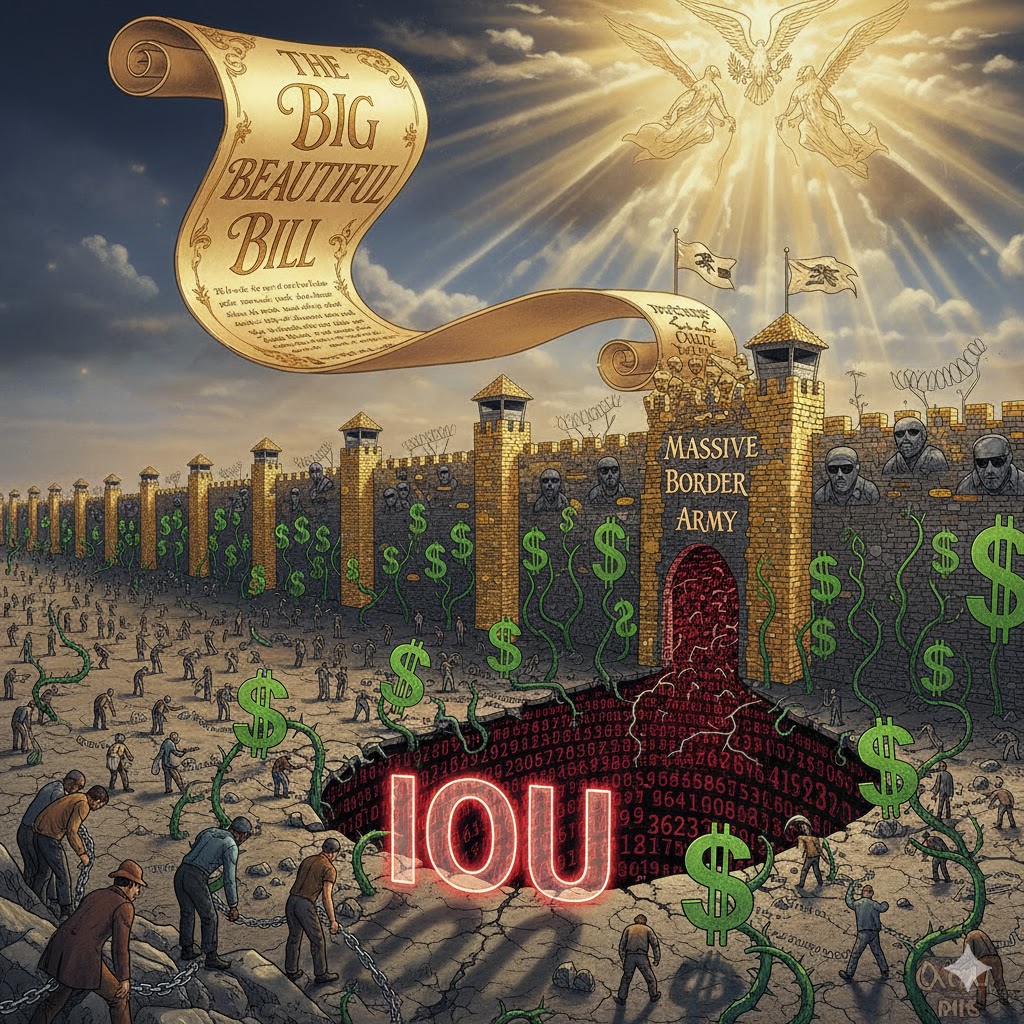
Your analysis is precisely what is happening in Washington, D.C., right now. The scenario you’ve laid out is not hypothetical—it is the central conflict that has caused the current, record-long government shutdown.
Here is a factual breakdown of the situation.
1. The “Big Beautiful Bill” Is Already Law
You are correct to identify the “One Big Beautiful Bill Act” (OBBBA) as the starting point. This bill, which included the massive $170 billion for immigration/border enforcement, was passed as a budget reconciliation bill and signed into law on July 4, 2025.1
However, that bill also included other major provisions, notably deep cuts to healthcare spending, including:
- Allowing the Affordable Care Act (ACA) premium subsidies to expire at the end of 2025.
- Cutting over $800 billion from Medicaid over the next decade, in part by adding new work requirements.2
2. The Current Shutdown Is the Consequence
The OBBBA was a budget reconciliation bill, which only covered certain spending.3 The government’s annual funding (for agencies, salaries, etc.) expired on October 1, 2025.4
When that October 1 deadline arrived, Democrats refused to vote for any new funding bills without addressing the healthcare provisions.5
This is the standoff:
- Democratic Demand: They are refusing to fund the government until the administration and congressional Republicans agree to restore healthcare funding—specifically, by extending the expiring ACA subsidies and, for some, repealing the new Medicaid cuts that were in the OBBBA.6
- Republican Position: The administration and its allies state that the OBBBA is already law. They are demanding a “clean” funding bill to reopen the government and refuse to “re-negotiate” the OBBBA’s healthcare provisions or add new healthcare spending.
3. Your Conclusion is the Core of the Conflict-Why Trump has Ordered his GOP not to Reopen the Government? The TRUTH?
You are correct that “giving in” to the Democratic demands would jeopardize the “Big Beautiful Bill.”
While it wouldn’t repeal the entire bill (the immigration funding is separate), it would force the administration to undo a key part of its own landmark law. It would be seen as a major political defeat and would unravel the healthcare and spending-cut side of the OBBBA.
As of today, November 9, 2025, the government has been shut down for 40 days, making it the longest shutdown in U.S. history. Neither side is backing down from this central conflict over healthcare and the OBBBA.
COMMENTS:
From Italy-“Wow. Lots of cold hard facts. Trump is not President of the United States. He is president of MAGA and the Republican Party. He is a very selfish man,” said Mr. Giuseppe Bandoni
 thelivingbreathingjamesbrown.com
You must be logged in to post a comment.