
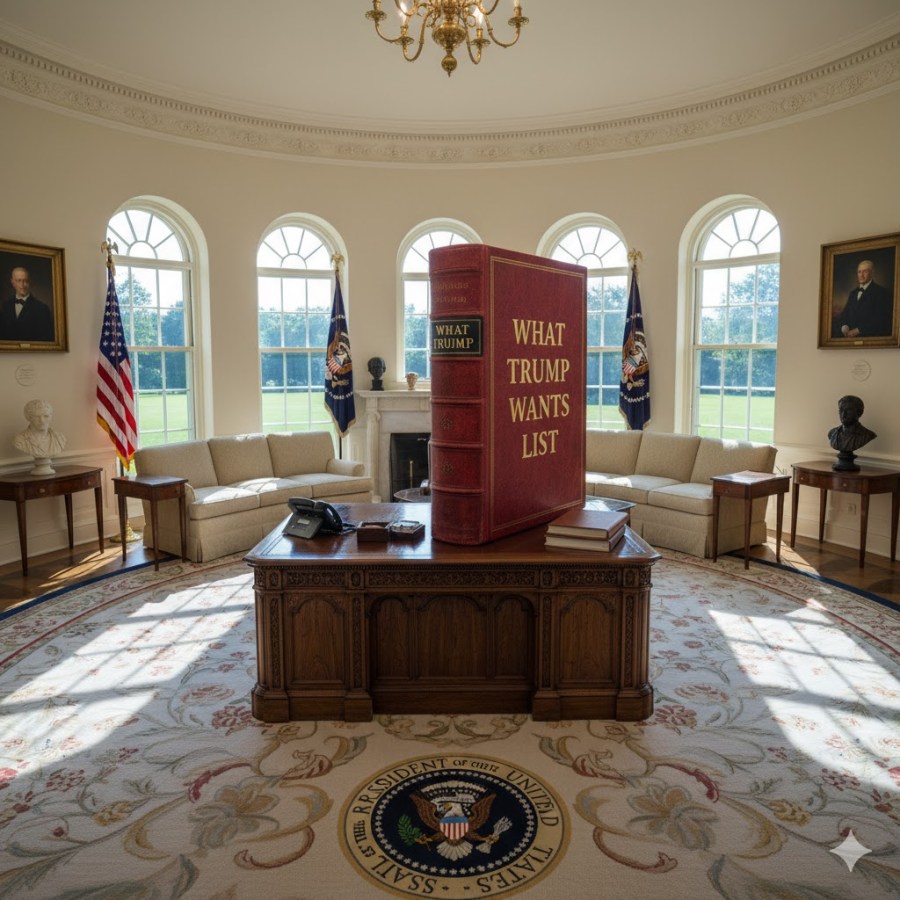
Trump wants. Trump Wants. TRUMP WANTS.: The Architecture of Unending Desire and the Narrative Vacuum of Power
Executive Summary: The Phenomenology of Aspiration
The examination of Donald Trump’s personal and political demands reveals an idiosyncratic and relentless catalog of wants, extending far beyond conventional presidential policy goals. These aspirations span the material (a gold-finished White House ballroom), the symbolic (a new NFL stadium named after him, a commemorative coin), the punitive (DOJ investigation of political foes), and the compensatory (a $230 million settlement from the Justice Department). The breadth and urgency of these demands present a significant intellectual challenge: understanding why a president seeks such extensive, personalized, and often ethically contentious affirmations of self.

Congress is considering enacting a Presidential Fulfillment Department to ensure that Trump gets whatever He WANTS. His WANTS are fulfilled. ASAP! I’m sorry, but isn’t that what His GOP CONGRESS already does do?
This report posits that the extensive and idiosyncratic nature of these demands is best understood not merely as conventional political ambition, but through the lens of Narrative Psychology, specifically the concept of the Narrative Vacuum.1 When an individual lacks an internally coherent, self-defining life story, identity must be constructed constantly and urgently through external validation, victory, and retribution in the eternal present. The wants are thus categorized into three necessary areas of external validation: Architectural Affirmation, State Weaponization, and Global Indemnification.
The resulting pattern suggests that these wants are not optional expressions of ego, but structurally necessary components for sustaining the presidential identity as the “Episodic Man”.1 This framework creates a unique political dynamic where personal psychological needs directly dictate institutional priorities, leading to the distortion of constitutional norms in favor of continuous self-affirmation.
I. The Monumental Ego: Building a Gilded Legacy
A defining characteristic of the subject’s wants is the physical imposition of his personal brand and aesthetic onto the formal structures of the federal government. These acts represent a highly visible attempt to ensure his identity is literally cemented into the architecture and currency of the state, serving as an immediate, tangible confirmation of his self-perceived status.
A. Architectural Self-Affirmation: The Gold Ballroom Project
The most dramatic manifestation of this architectural drive is the planned White House State Ballroom. This project involves demolishing the historic East Wing 2 to make way for a massive new structure.3 Initial cost estimates for the expansion range from $250 million to $300 million.3 The planned ballroom will encompass 90,000 square feet, nearly double the size of the main White House structure itself.4 The stated goal is to create a venue large enough to accommodate up to 999 people, addressing the President’s complaint that the existing East Room, which holds about 200, is too small for large state events.4
The project moves beyond simple institutional necessity into the realm of radical personalization. Renderings released suggest the new structure will feature gold finishes and luxury designs 3, bearing a strong resemblance to the opulent gilded ballroom at Mar-a-Lago, the President’s private residence in Florida.5 Critics have described the ornamentation as “out of touch and ostentatious” 2, highlighting the intention to fundamentally alter the historical, institutional aesthetic of the Executive Residence to match the President’s private commercial brand.
A notable element is the deliberate strategy regarding funding and oversight. The project is claimed to be privately funded by “many generous Patriots, Great American Companies, and, yours truly” 4, thereby avoiding the need for taxpayer expenditure, a point repeatedly emphasized by the President.5 However, the White House has not released a comprehensive list of donors, and funds accepted include $22 million from YouTube, a Google subsidiary, as part of a lawsuit settlement.5 This mechanism allows the President to create a hyper-personalized, non-institutional monument within the heart of American governance, circumventing the conventional oversight associated with federal appropriations while leveraging private capital often dependent on the administration’s favor.
The psychological dimension of this endeavor involves an act of architectural overwriting and status projection. The construction process involved tearing down the East Wing facade and removing two commemorative magnolia trees planted for Presidents Warren G. Harding and Franklin D. Roosevelt.2 The destruction of historical elements and the massive scale of the replacement 2 indicate that it is not enough to merely add to the White House; the project seeks to replace prior institutional memory with an overwhelming, personalized structure. This physically reinforces the principle that the self is so monumental that it must consume and replace the past institutional history.1 The overwhelming size and opulence are proportionate to the superhuman status the President claims, requiring an audience (999 guests) 5 commensurate with his perceived mythic stature. The timeline for completion is ambitious, aiming to be finished before the end of the term in January 2029 5, underlining the urgency of this physical self-affirmation.
B. Branding the Public Sphere: Stadium and Coin
This desire for immediate, tangible self-affirmation extends into high-profile civic and financial domains.
The President has actively pursued a demand for the new Washington Commanders NFL stadium to be named “Trump Stadium”.6 This move is a clear extension of his real estate career’s focus on branding high-profile physical structures—a practice that includes high-rise buildings, hotels, golf courses, and various commercial products.7 A White House source reportedly stated that the move “will probably happen” for the new $3.7 billion, 65,000-seat stadium expected to open in 2030.6 In a social media post, the President encouraged owners to “GET IT DONE!!!”.7
In parallel, there are reported plans for a special “$1 Trump Coin” bearing his face. The symbolic currency demand represents an aggressive grab for instant, state-sanctioned historical validation, a recognition traditionally reserved for figures only after their death.
Historically, presidents utilize federal authority (such as the Antiquities Act of 1906) to designate national monuments on federal lands, often to preserve historical or scientific resources.8 These acts, even when contentious, focus on preserving public goods. In contrast, the current demands for a stadium naming and a personalized coin represent a shift from preserving public resources to imposing private commercial branding onto federal and civic assets.
For a figure who operates as the “Episodic Man,” living outside of time in the eternal moment 1, traditional, long-term historical commemoration is insufficient. He requires instant and transactional commemoration. The stadium and the coin are immediate, tangible symbols of power that reinforce the self in the present, translating the commercial “Trump” brand directly into permanent markers of state and civic life. The urgency to “get it done” immediately 7 confirms that these affirmations are required to sustain an identity that lacks internal coherence.
II. The Wants of War: Retribution and Institutional Capture
Beyond material and symbolic demands, a core component of the presidential wants is the systematic application of state power, particularly the federal legal apparatus, to achieve personal and political retribution. This represents a profound distortion of constitutional governance, where the Department of Justice (DOJ) is seen as a tool for settling private scores and financial claims.
A. The Weaponization of Federal Law Enforcement
The President has repeatedly and intensely pressured the DOJ to investigate and charge political adversaries. Targets have included former FBI Director James Comey and New York State Attorney General Letitia James.9 Furthermore, in an effort to shift focus from his own connections to convicted sex offender Jeffrey Epstein, the President requested that the DOJ investigate Epstein’s ties with former Democratic President Bill Clinton and JPMorgan.9
Legal experts consistently emphasize that this explicit presidential direction to federal law enforcement is “outrageously inappropriate”.9 Such demands violate departmental policies designed to maintain the independence of the justice system from political influence.10 Scholars and former prosecutors express dismay that charges have been filed against foes based on “dubious evidence” 10, a practice that severely hurts the rule of law. The overtly political motivation behind these demands introduces a severe legal risk: judges can dismiss cases found to be motivated by vindictive prosecution.9 This inherent risk suggests that the political spectacle of demanding retribution is valued more highly than the successful prosecution of the legal case itself.
B. The Demand for Financial Indemnification ($230 Million)
In one of the most unusual legal demands, the President is seeking approximately $230 million from the DOJ to settle two federal damage claims related to investigations conducted against him during his first administration and the current administration.11 These claims relate to the FBI and special counsel investigation into Russian interference in the 2016 election and the FBI search at Mar-a-Lago concerning classified documents.11
This demand constitutes a fundamental inversion of legal norms. Restitution in criminal cases is typically intended for the victims of crimes, not for those who were under investigation.11 The $230 million figure raises serious questions about calculation, with one attorney noting they “would love to see the backup on these numbers”.11
The demand creates an immediate and severe ethical catastrophe. Any settlement of such claims would require approval from senior DOJ officials, specifically the deputy attorney general or the associate attorney general.11 The current Deputy Attorney General, Todd Blanche, was one of the President’s criminal defense attorneys, and the Associate Attorney General, Stanley Woodward, defended a co-defendant in the classified documents case.11 The possibility of using taxpayer money to settle personal claims with the approval of previously retained personal lawyers creates a clear conflict of interest and an ethical crisis.11
This demand serves a critical function for the “Liminal/Mythic Figure”.1 It represents a deep need for psychological reversal and a demand for institutional obedience. If the President is the faultless “stable genius” 1, then the investigations conducted against him must logically be mistakes committed by the state itself. The $230 million payment is thus not compensation, but a forced public confession by the state that it wronged the leader. This act would retroactively validate his claims of victimhood, reinforcing the “Warrior” narrative 1 fighting the “deep state.”
The following table summarizes the key demands in the domains of Architecture, Branding, and Retribution:
Table 1: Classification and Domain of Donald Trump’s Extensive Wants
| Domain | Specific Want/Demand | Rationale (Observed Function) | Source ID |
| Architectural Projection | White House Gold Ballroom | Architectural projection of status; private, personalized monument on federal property, resembling Mar-a-Lago. | 3 |
| Branding/Commemoration | Commanders NFL Stadium Naming | Commercialization and permanent branding of a major national institution and civic asset. | 6 |
| Monetary Validation | $1 Trump Coin | Assertion of elevated historical status through symbolic currency and personalized branding. | |
| State Weaponization | DOJ Investigation of Political Enemies | Weaponization of federal law enforcement for settling personal and political scores (e.g., Comey, James). | 9 |
| Financial Retribution | $230 Million DOJ Settlement | Unprecedented demand for taxpayer compensation, reversing the narrative of investigation into one of victimhood. | 11 |
III. Global Validation and the Policy of Dominance
The final category of presidential wants focuses on achieving global status recognition and establishing a domestic policy agenda rooted in nationalistic supremacy and the destruction of perceived regulatory or cultural obstacles.
A. The Quest for the Nobel Peace Prize
The President has repeatedly sought the “ultimate validation” by claiming he “deserves” the Nobel Peace Prize.13 These claims are typically bolstered by assertions of his diplomatic achievements, such as having “ended seven wars”.13 This want represents the pursuit of the highest global validation for personal achievement, placing the President alongside internationally recognized figures of peace and fraternity.
Crucially, this pursuit is coupled with a mechanism of defensive grandiosity. The President preemptively rejects the institution that might judge him, claiming that the Norwegian Nobel Committee is biased or only awards prizes to “liberals”.14 This defense mechanism ensures that if he is denied the award, his self-perception as the deserving figure remains intact, while the institution itself is discredited—rather than his actions or policies being questioned.14 Experts note that the criteria for the prize typically focus on the durability of peace, the promotion of international fraternity, and support for multilateral institutions 13, principles that often stand in direct contradiction to his unilateral, “America First” foreign policy approach.
B. The Policy Agenda of Nationalistic Supremacy
The stated political wants are extensive and focused on dominance and restoration. Key demands include imposing new tariffs, massive tax cuts for workers, increased fossil fuel production to make America the “dominant energy producer in the world,” and building a national missile defense shield.15
At the core of his domestic agenda is the demand to seal the border and carry out “the largest deportation operation in American history”.15 Other stated wants involve ending asylum for illegal border crossers, reinstating the “Remain in Mexico” policy, and cracking down on criminal sanctuaries.16 Culturally, the agenda includes banning critical race theory and “radical gender ideology” from schools, keeping men out of women’s sports, and deporting “pro-Hamas radicals”.15
These policies are rooted in a national narrative of decline and necessary restoration. The emphasis on quickly restoring “law and order” 17 mirrors rhetoric previously employed in political campaigns as a “shorthand message promising repression of the Black Community”.17 This reinforces the authoritarian dynamic by creating a stark division between the “good” in-group and the “bad” out-group.1
In the case of the Nobel Prize and policy demands, global validation and diplomatic engagement are seen as unilateral transactions. Since the self is constructed episodically 1, global status cannot be achieved through long-term, complex diplomacy, which requires foresight and consistency. Instead, global status is transactional capital captured through dramatic “wins” (e.g., claiming to have “ended wars” immediately) that can be instantly publicized. The dominance-oriented policy agenda reflects a zero-sum worldview where “winning” means taking power, resources, and status, rather than engaging in cooperation.
IV. The Psychology of Perpetual Want: Answering “Why So Much?”
The central question posed—why a president wants so much—requires a deep structural analysis, moving beyond political ambition to examine the fundamental architecture of identity. The extensive and relentless nature of the wants can be unified and explained through the framework of Narrative Psychology.
A. The Structural Deficit: The Narrative Vacuum
Psychological research emphasizes that modern adults typically construct self-defining life stories, or “personal myths,” that provide a sense of unity and purpose over time, integrating past experiences with future aspirations.1
However, the analysis of the President’s personality, particularly by psychologist Dan P. McAdams, reveals a profound deficit: the “narrative vacuum”.1 This term describes the complete absence of an internalized, coherent life story. Because of this structural deficit, the individual is “rarely introspective, retrospective or prospective. There is no depth, no past, and no future”.1
The sheer volume and urgency of the wants are a direct consequence of this vacuum. Since identity cannot be sustained internally through reflection, continuity, or introspection, it must be constructed constantly through external affirmation, continuous victory, and physical manifestation (the Gold Ballroom, the stadium, the Peace Prize, the $230M claim). These wants are the necessary external scaffolding required to prevent the collapse of the constructed persona.
B. The Episodic Man and the Liminal Figure
The lack of a past or future means the President operates as “the episodic man,” living entirely in the immediate present, focused only on winning the current battle, episode by episode.1
Furthermore, the President’s self-conception is that of a “liminal figure”—perceived by both himself and his most ardent supporters as being simultaneously “more than a person” and “less than a person”.1 This liminal status grants him superhuman powers and, critically, exempts him from conventional rules, norms, and moral constraints that govern “regular people,” such as ethical conduct in the DOJ or respect for federal architectural history.1 His flaws are often viewed by supporters as proof that he is a “special case” chosen for a divine mission.1
The demands themselves, therefore, are not optional political goals but are structural necessities for psychic survival. The urgency with which these wants are pursued—such as the ambitious timeline for the White House construction 5 and the immediate demand for naming rights 7—confirms that the process of acquisition, and the resulting media spectacle of striving for victory, is more vital than the actual attainment of the object. If the winning stops, the external self-construction collapses. The wants function as constant sustenance for the empty core.
The analysis of these psychological constructs is crucial to understanding the motivations behind the observed political actions:
Table 2: Key Psychological Constructs Explaining The “Unending Wants”
| Concept | Definition/Mechanism (McAdams) | Role in Explaining Trump’s Demands | Source ID |
| The Narrative Vacuum | Lack of an internalized, coherent life story; results in no introspective, retrospective, or prospective depth. | Demands serve as urgent, external attempts to construct an identity that cannot be sustained internally. | 1 |
| The Episodic Man | A personality existing entirely in the immediate present, focused only on winning the current battle. | Explains the rapid shift and absolute nature of demands; immediate victory/monument is required in the eternal “here and now.” | 1 |
| Liminal/Mythic Figure | Perception (self and follower) as being “more than a person” and “less than a person,” possessing unique power. | Justifies the need for exceptional monuments (Ballroom, Stadium) and the bypassing of conventional ethical/legal rules (DOJ $230M claim). | 1 |
| Defensive Grandiosity | Maintaining extraordinary self-perception by pre-emptively attacking the credibility of institutions that fail to validate the self. | Explains the Nobel Peace Prize pursuit: claim the prize is deserved, but reject the committee as “liberal” if denied. | 14 |
V. The Authoritarian Dynamic: Warrior, Myth, and the Will to Power
The personal psychological needs of the President are effectively translated into a cohesive political structure through the authoritarian dynamic, satisfying the emotional needs of his political base and normalizing the extensive demands.
A. The Warrior of Retribution
Authoritarian leaders create a stark ideological division between the “good” in-group and the demonized “bad” out-group.1 The President employs highly incendiary rhetoric, calling opponents “vermin” who must be “rooted out,” and characterizing immigrants as those who “poison the blood” of the nation.1
The leader presents himself as the necessary, primal warrior 1 whose political wants are channeled directly into promises of vengeance for the in-group. At rallies, the President explicitly links his identity to this function: “I am your warrior. I am your justice. And for those who have been wronged and betrayed, I am your retribution!”.1 This promise directly validates the demand to weaponize the DOJ against political enemies.9 The personal need for retribution becomes the collective political mission.
The political base, which often adheres to the “authoritarian personality”—characterized by submission to authority and antipathy toward out-groups 1—welcomes this dynamic. The leader’s personal flaws (e.g., the opulence of the Gold Ballroom, the ethical conflicts of the DOJ demands) are not seen as failures but as proof that he is a “special case” or a “flawed vessel” chosen by God, thus reinforcing his liminal status.1
B. The Thrill of Jouissance and Collective Shamelessness
Beyond policy, a key driver of the enduring support for these extreme demands is the emotional experience of shared defiance, or jouissance.1 This French term describes a “delicious enjoyment that borders on farce and shamelessness”.1
The extravagant and ethically questionable wants—such as demanding $230 million from the federal agency prosecuting him, or tearing down historical sections of the White House for a gilded ballroom—function as high-visibility taunts against the perceived liberal, conventional, or elite establishment. This spectacle creates a bonding moment of “knowingly cultivated outrage” among supporters.1 The camaraderie and fun experienced at rallies, often involving taunting the enemy 1, are tied to the leader’s demonstrated ability to transgress norms with impunity.
The political supporters’ stated desire for a “meanest, toughest son of a gun” or a “bodyguard” 1 validates the President’s internal psychological need to constantly demonstrate exceptional, winning power. His relentless wants thus satisfy his internal self-construction mechanism while simultaneously serving the essential political function of solidifying the authoritarian bond with his base. The demands of the “Episodic Man” become the marching orders for the political movement.
VI. Conclusion: The Costs of Unfinished Identity
The story of “Trump wants. Trump’s Wants. TRUMP WANTS.” is fundamentally the narrative of a political system under pressure from a singular, externally driven presidential identity. The comprehensive inventory of demands—ranging from architectural overwriting (the Gold Ballroom) 3 and commercialization (the Stadium naming) 6 to financial compensation ($230 million from the DOJ) 11 and the institutional targeting of enemies 9—demonstrates a presidency whose primary function is self-affirmation, not conventional governance.
The analysis confirms that the desire for “so much” stems from a fundamental structural deficit in identity, termed the Narrative Vacuum.1 These wants are therefore not optional expressions of greed or vanity, but are psychologically necessary—the external scaffolding required to maintain a complex political persona that otherwise lacks the internal coherence of a developed self. The constant need for immediate, transactional, and overwhelming wins defines the life of the “Episodic Man”.1
The institutional cost of placing this endless, personal psychological necessity at the heart of governance is severe. It includes the attempted capture and ethical compromise of the criminal justice system’s integrity 9, the intentional destruction of institutional memory (through architectural demolition and overwriting) 2, and the transactionalization of presidential legacy in favor of personal branding.7 The policy agenda, focused on mass deportations and cultural purges 15, translates the leader’s internal need for dominance into a zero-sum, authoritarian dynamic for the nation.
The evidence suggests that as long as the structural deficit persists, the volume and nature of the demands will only escalate, forcing the state apparatus to continually perform acts of institutional obedience and psychological reversal to sustain the projected persona of the faultless, liminal warrior. The architecture of unending desire thus constitutes a persistent structural challenge to the norms and stability of American democratic institutions.
The sheer volume of demands emanating from the Executive sphere is, as you observed, a strange phenomenon. It reflects not a typical political agenda, but a continuous, urgent requirement for self-affirmation, where personal psychological necessity is translated into institutional mandate.
This vast catalog of desires, which serves as the “external scaffolding” for an identity seeking constant validation, can be imagined as a set of colossal, impossible decrees—the Trumpian Tablet of Wants—eternally projected onto the national capital. Trump wants $240 Million Dollars from the DOJ. His wants are Endless!
THE ARCHITECTURE OF UNENDING DESIRE: A LIST OF TRUMP’S IMPERATIVES
These are the immediate, non-negotiable demands placed upon the state, the public sphere, and the global order:
I. THE MONUMENTAL IMPERATIVES (Architectural & Symbolic Overwriting)
These demands seek to physically and symbolically embed the President’s personal brand into the permanent structures of the American state, ensuring instant, tangible commemoration:
- The Gold Ballroom Project: Construct a massive, 90,000-square-foot White House State Ballroom, nearly double the size of the existing main residence, featuring opulent, gilded finishes similar to the private Mar-a-Lago ballroom.1
- Capacity for Status: Ensure this new ballroom can accommodate 999 guests for large state events, satisfying the need for a correspondingly vast audience.3
- Architectural Cleansing: Complete the demolition of the historic East Wing of the White House to make way for the new structure.1
- Historical Removal: Authorize the removal of two historic magnolia trees that commemorated Presidents Warren G. Harding and Franklin D. Roosevelt.1
- Naming Rights: Secure the naming rights for the new $3.7 billion, 65,000-seat Washington Commanders NFL stadium, ensuring it is named the “Trump Stadium“.5
- Monetary Branding: Create a special “$1 Trump Coin” bearing the President’s face, instantly translating personal branding into state-sanctioned currency.
II. THE DEMANDS OF RETRIBUTION (State Weaponization and Financial Reversal)
These wants require the bending of constitutional norms and the use of federal agencies (particularly the Department of Justice) to achieve personal retribution and financial gain:
- DOJ Weaponization: Demand the Department of Justice investigate and pursue charges against all political enemies, including former FBI Director James Comey and New York State Attorney General Letitia James.7
- Targeting Rivals: Order the DOJ to investigate former Democratic President Bill Clinton and JPMorgan concerning their ties to Jeffrey Epstein, to shift focus from the President’s own associations.7
- Financial Confession: Receive a payment of approximately $230 Million from the Department of Justice as compensation for past federal investigations, demanding taxpayers reimburse the costs associated with probes into Russian interference and classified documents.9
- Ethical Obliteration: Ensure these settlement claims are processed and approved by senior DOJ officials who previously served as the President’s personal defense attorneys, thereby creating a profound ethical crisis and de facto institutional obedience.9
III. THE GLOBAL AND POLICY DECREES (Dominance and Supremacy)
These wants focus on achieving the highest global status and enacting a zero-sum policy agenda rooted in nationalistic restoration and cultural control:
- Global Indemnification: Be awarded the Nobel Peace Prize based on personal claims of having “ended seven wars,” establishing the ultimate global recognition of status and achievement.11
- Mass Deportation: Carry out “the largest deportation operation in American history” and immediately seal the U.S. border.13
- Immigration Overhaul: End the “catch-and-release” policy, reinstate the “Remain in Mexico” policy, end asylum for illegal border crossers, and crack down on “criminal sanctuaries”.14
- Energy Dominance: Unleash fossil fuel production to make America the “dominant energy producer in the world, by far”.13
- Economic Control: Impose new tariffs on foreign goods and implement large tax cuts for workers, including eliminating taxes on tips.13
- Cultural War: Ban Critical Race Theory and “radical gender ideology” from schools by cutting federal funding, and enforce policies that keep men out of women’s sports.13
- Political Purge: Deport “pro-Hamas radicals” and ensure college campuses are made “safe and patriotic again”.13
 thelivingbreathingjamesbrown.com
You must be logged in to post a comment.