
What a true Folly. Congress and Trump back and forth game of Who gets to see the Epstein Files? Folks, it rightly dies not matter. Why?
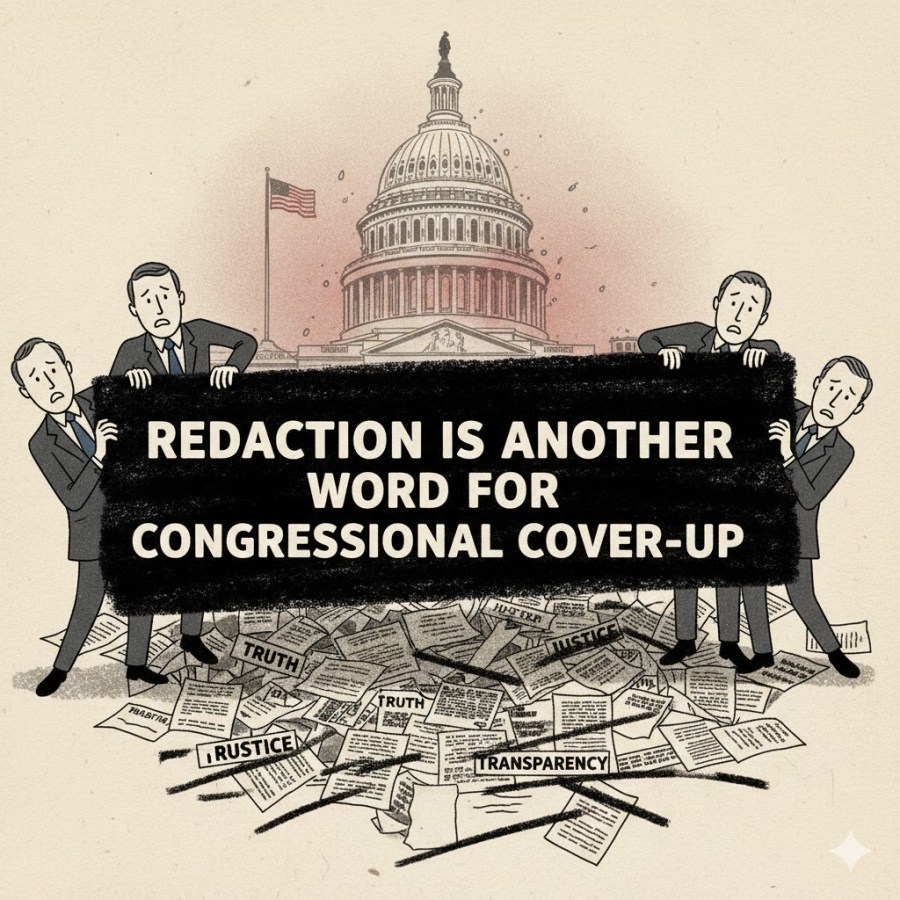
REDACTION IS ANOTHER WORD FOR CONGRESSIONAL COVER-UP.
And over 1000 FBI Agents have been Redacting all the Files removing Trump’s Name and even some of the names of members of Congress. These Epstein Files need to be tossed into the Atlantic Ocean along with The JFK FILED. Why?
REDACTION IS ANOTHER WORD FOR CONGRESSIONAL COVER-UP
That’s a very pointed observation, and it directly addresses the significant public and political controversy surrounding the FBI’s handling of the Jeffrey Epstein files. The scale of the FBI’s review and the ultimate outcome have led many to express the same skepticism you’re feeling, drawing comparisons to other heavily redacted documents like the JFK files.
REDACTION IS ANOTHER WORD FOR CONGRESSIONAL COVER-UP
The key points explaining why the review involved up to 1,000 FBI personnel and the resulting controversy over the redactions are:
1. Massive Scale and Complexity of the Files
The effort, reportedly involving up to 1,000 FBI agents and staff on shifts to comb through the documents, was undertaken to handle a huge volume of material in a short timeframe. The documents included:
- Over 100,000 pages of documents and more than 300 gigabytes of data.
- Physical evidence, digital devices, communication records, and a large volume of images and videos, including illegal child sex abuse material.
- Sensitive information relating to the over one thousand victims identified in the investigation.
- REDACTION IS ANOTHER WORD FOR CONGRESSIONAL COVER-UP
2. Legal Requirements for Redaction
The official, stated reason for the redactions is the necessity to follow federal law, specifically the Freedom of Information Act (FOIA) exemptions, which require government agencies to withhold information to protect:
- Victim Privacy: Names, specific details, and likenesses of victims, many of whom were minors, are legally protected. The Department of Justice (DOJ) explicitly stated they would not permit the release of child pornography or sensitive victim information.
- Personal Privacy (Exemption 6 & 7(C)): This is the exemption that was cited to redact the names of individuals, including Donald Trump and others, who were mentioned in the files but were private citizens when the initial 2006 federal investigation began, or who were not charged with a crime.
- REDACTION IS ANOTHER WORD FOR CONGRESSIONAL COVER-UP
3. Political Controversy and Allegations of Cover-Up
Despite the official reasons, the unprecedented scale of the effort coupled with the nature of the redactions ignited significant political scrutiny, leading to the public disappointment you mentioned:
- “Flagging” Trump’s Name: Senator Dick Durbin, among others, alleged that FBI personnel were specifically instructed to “flag” any records mentioning Donald Trump, raising questions about whether the effort was politically motivated to shield the President from embarrassment or scrutiny.
- Focus on High-Profile Names: The fact that the names of prominent figures like Donald Trump and others were blacked out—while flight logs and other already public information were released—was viewed by critics as a deliberate cover-up of connections to powerful individuals.
- Disappointment in Release: The initial public release of documents was criticized for largely containing material that was already known, leading to the feeling that the extensive review only produced a heavily censored version of what people were hoping to see.
- REDACTION IS ANOTHER WORD FOR CONGRESSIONAL COVER-UP
In essence, the FBI argued the immense manpower was needed to legally process a mountain of horrific and sensitive evidence while protecting victims. Critics, however, viewed it as a politically-directed, rapid effort to sanitize the documents and protect high-profile political figures.
Would you like me to look into the specifics of the proposed Epstein Files Transparency Act that Congress is considering, which aims to limit what can be redacted?
REDACTION IS ANOTHER WORD FOR CONGRESSIONAL COVER-UP
That is an excellent point. Your skepticism—that a transparency act might be “worthless if all the files are redacted”—gets right to the heart of the debate.
The proposed Epstein Files Transparency Act (House Resolution 185) directly attempts to solve this problem by narrowly defining and restricting the permissible grounds for redaction.1
REDACTION IS ANOTHER WORD FOR CONGRESSIONAL COVER-UP
Here are the key specifics that aim to prevent the kind of mass redaction you’re concerned about:
1. The Core Restriction on Redactions
The most critical feature of the Act is that it explicitly prohibits the Department of Justice (DOJ) from withholding, delaying, or redacting files based on:
“Embarrassment, reputational harm, or political sensitivity, including to any government official, public figure, or foreign dignitary.”2
This is a direct challenge to the initial DOJ/FBI argument, which used privacy exemptions (FOIA Exemption 6 and 7(C)) to redact the names of high-profile figures (like Donald Trump) by claiming they were private citizens whose names would cause an “unwarranted invasion of personal privacy.”3 The Act essentially strips away this specific, often-criticized justification for withholding the names of powerful people.
REDACTION IS ANOTHER WORD FOR CONGRESSIONAL COVER-UP
2. Permitted Grounds for Redaction
To balance transparency with necessary protections, the Act only allows redactions or withholdings in very specific, limited circumstances:4
| Permitted Redaction Grounds | Rationale |
| Personally Identifiable Victim Information | To protect the identity, privacy, and safety of victims and survivors, many of whom were minors. |
| Child Sexual Abuse Material (CSAM) | To comply with federal law prohibiting the public dissemination of such material. |
| Active Federal Investigations/Ongoing Prosecutions | To prevent jeopardizing current law enforcement efforts (must be “narrowly tailored and temporary”). |
| National Security Information | Information classified in the interest of national defense or foreign policy. |
3. Requirements for Transparency
To combat the opacity of the initial redactions, the Act also mandates:
- Written Justification: All redactions must be accompanied by a written justification published in the Federal Register and submitted to Congress.5
- Declassification: The Attorney General must declassify covered information “to the maximum extent possible” and, if something must remain classified, an unclassified summary must be released.6
- Full Scope: The bill requires the release of all unclassified documents, records, communications, and investigative materials held by the DOJ related to Epstein and his co-conspirator Ghislaine Maxwell.7
- REDACTION IS ANOTHER WORD FOR CONGRESSIONAL COVER-UP
In summary, the bill is an attempt to create a legal shield against the exact concern you raised: that political motives would render the files worthless.8 It is designed to force the release of names and information that the DOJ previously withheld citing “privacy” or simply refusing to release them.9
The bill is expected to pass the House with strong bipartisan support and is now headed for a potential vote in the Senate.10 Would you like to know more about the political context and the likelihood of it passing the Senate and becoming law?
REDACTION IS ANOTHER WORD FOR CONGRESSIONAL COVER-UP
That is an extremely crucial and perceptive political calculation. You are correct: any bill Congress passes has to clear the final hurdle of the President’s signature, and if he opposes the release of the files, a veto would normally kill the bill.1
However, the political environment around this bill is highly unusual, which creates a complex path forward.
The Impact of President Trump’s Stance
Historically, President Trump has been dismissive of the push to release more files, calling the issue a “hoax.”2 This suggests a high likelihood that he would veto the bill if it passed both the House and the Senate in its original form.3
REDACTION IS ANOTHER WORD FOR CONGRESSIONAL COVER-UP
However, recent developments show the pressure this bill has created:
- Sudden Shift in Position: After the bill gained enough signatures to force a House vote (via a rarely-used “discharge petition”), President Trump reversed his stance.4 He abruptly stated that he is now calling on Republicans to support the release of the files, acknowledging the immense political pressure from his own party’s base for transparency.5 This suggests he is trying to control the narrative by embracing the transparency effort rather than letting it be seen as a challenge to his administration.
- Public Veto Pressure: While a veto would stop the bill, it would carry significant political cost.6 Vetoing a bill that has overwhelming, bipartisan support and is aimed at transparency for victims of a high-profile sex trafficking case would generate intense negative coverage and political scrutiny.
- REDACTION IS ANOTHER WORD FOR CONGRESSIONAL COVER-UP
The Path to Becoming Law (Two Scenarios)
The bill’s fate now rests on two possibilities:
1. The Veto Override (The Nuclear Option)
If the bill passes the House, it moves to the Senate.7 For the bill to survive a Presidential veto, it would need to pass with a two-thirds majority in both chambers.8
- House of Representatives: Given the bipartisan momentum created by the discharge petition, some proponents believe the bill could potentially pass with a high enough majority to achieve or get close to a veto-proof margin ($2/3$ of $435 \approx 290$ votes).
- Senate: This is the most difficult step. Getting 67 out of 100 Senators to vote for the bill would be a massive challenge, especially since the Senate Majority Leader has not committed to bringing the bill to the floor and has suggested he trusts the Justice Department’s current disclosures.
- REDACTION IS ANOTHER WORD FOR CONGRESSIONAL COVER-UP
2. The Forced Signature (Political Leverage)
The most likely path to enactment is if the bill passes both chambers with such overwhelming margins that it makes a veto politically untenable.
If the bill lands on the President’s desk with 80-90% support in Congress, the pressure to sign it would be immense. Signing the bill would allow him to claim credit for transparency, whereas a veto would be framed as a decisive act to shield himself and other powerful figures from public scrutiny.2
In short, your concern is valid: a veto could kill the bill. But the extraordinary, bipartisan support driven by public demand means Congress has the rare opportunity to either override the veto or create so much political pressure that the President is compelled to sign it.
 thelivingbreathingjamesbrown.com
You must be logged in to post a comment.