
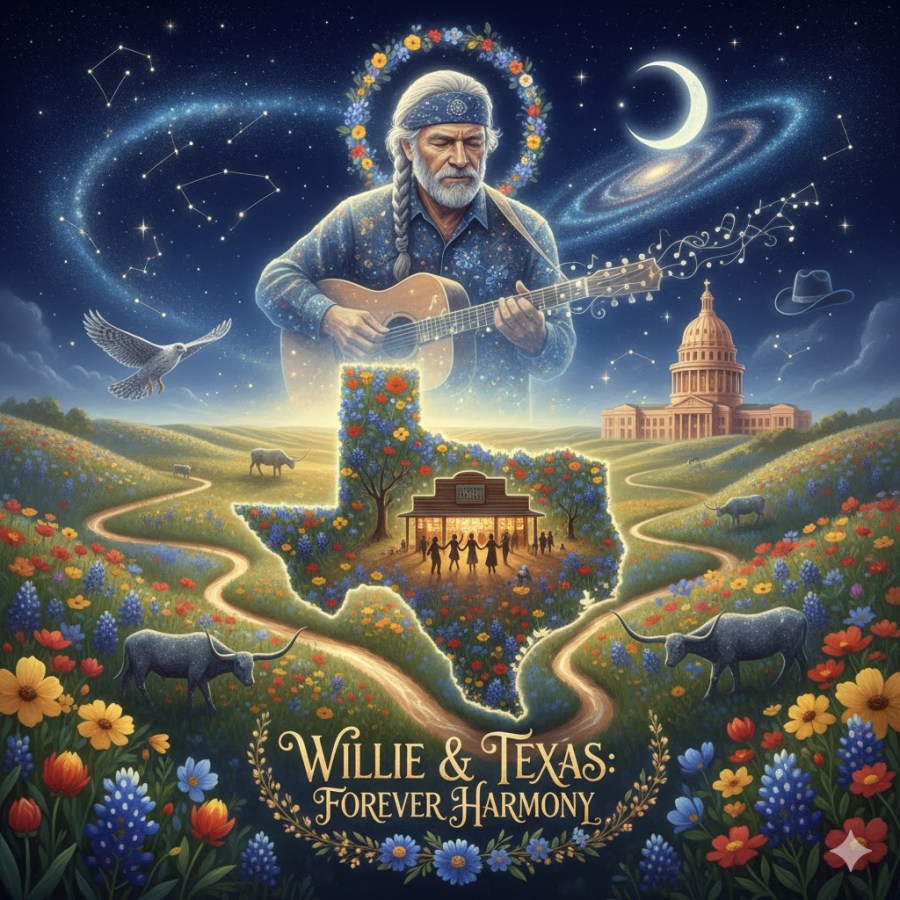
This is a Tribute to an American Country Westen Folklore Hero-Willie Nelson
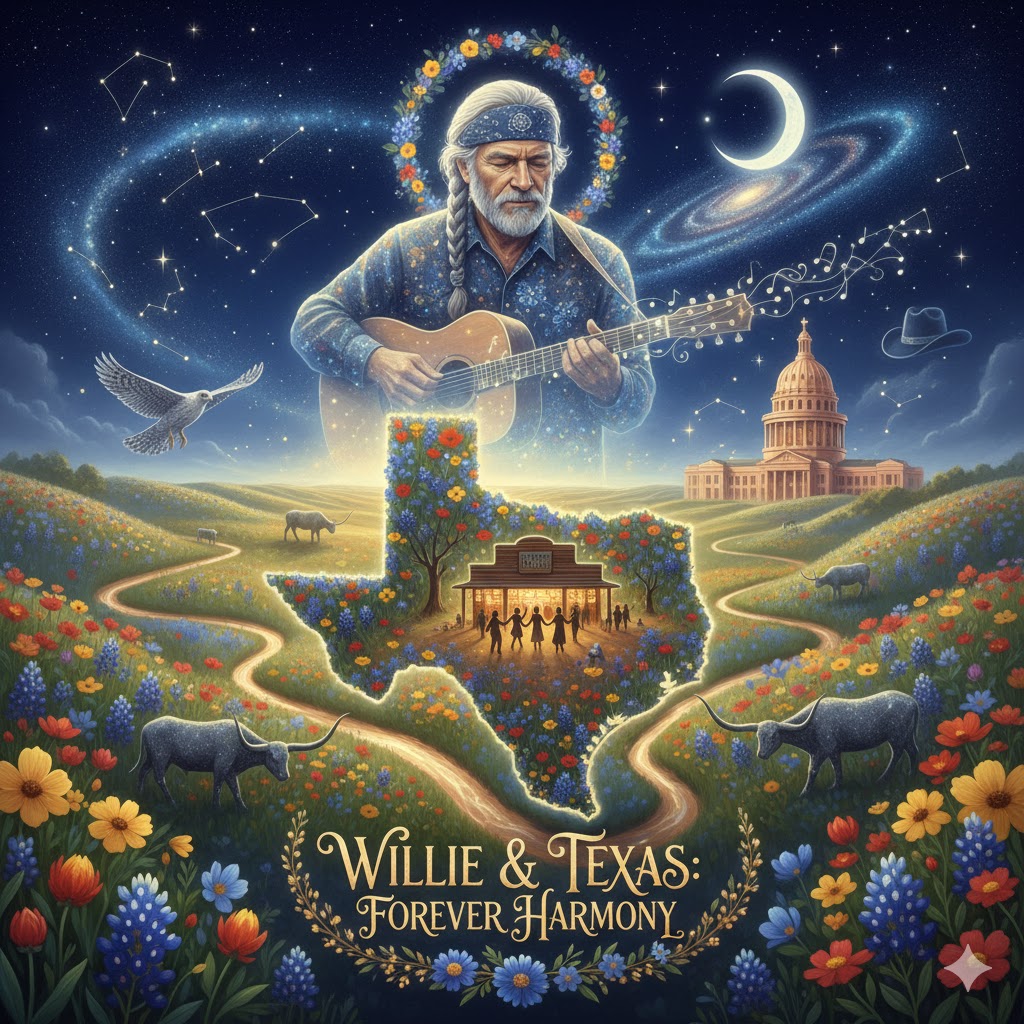
The Ballad of Willie Hugh Nelson: An American Epic of Authenticity and Hope
Willie Hugh Nelson is not merely a country singer; he is a foundational figure in the tapestry of American folklore, an enduring archetype whose biography mirrors the nation’s own sprawling narrative of resilience, rebellion, and profound redemption. His journey, stretching from the hardscrabble dust of Depression-era Texas to his current status as a global icon and octogenarian sage, is the embodiment of the American spirit: rugged individualism, uncompromising authenticity, and an eternal quest for freedom. He represents the very best of what America stands for, securing his place as an American Hero of Country Western Folklore.
The Heart of Texas: Rooted in Gospel and Grit (The Hero’s Origins)
Abbott’s Soil and The Great American Crucible
The origins of this epic journey are rooted in the struggle and ingenuity of the American heartland. Willie Hugh Nelson was born on April 29, 1933, in the tiny town of Abbott, Texas. His birth coincided with the economic nadir of the Great Depression, anchoring his story in the experience of hardship and the necessity of self-reliance that defines the working-class American narrative.
When Willie was only six months old, his parents, Ira and Myrle, divorced. His mother, Myrle Marie Greenhaw Nelson, who was three-quarters Cherokee , departed, and his father eventually abandoned the children after remarrying. Willie and his older sister, Bobbie, were taken in and raised by their paternal grandparents, William and Nancy Nelson. This familial anchoring, provided by his resilient grandparents, supplied crucial moral guidance and stability that would ground his restless spirit throughout his life.
The struggle for survival in Depression-era America was profound; the family was poor, but solace was found in faith and music. The children grew up singing gospel music in both the Baptist and Methodist churches in Abbott, learning their first songs directly from hymn books. His grandparents actively nurtured their musical talents, enrolling Willie in mail-order guitar lessons at age six. Willie wrote his first song when he was just seven years old.
The American Synthesis of Sound
Willie’s early musical exposure was a vibrant and complex cultural mosaic unique to Texas. This deeply integrated cultural foundation laid the groundwork for his later revolutionary fusion of genres. Alongside sacred gospel, he absorbed the lively, often secular, sounds of the regional dance halls, playing with local German and Czech polka bands. Crucially, he immersed himself in the Western swing of legendary figures like Bob Wills. This diversity meant that his later rebellion against the rigid, “pure” country labels of Nashville was not an abandonment of his roots, but rather a profound return to the complex, diverse reality of Texas music, affirming his representation of the “enduring, commonplace America”.
This exposure quickly transformed his musical inclination from a hobby into a practical necessity. Young Willie Hugh found his calling as an escape artist, stating plainly that he did not like picking cotton. Beginning at age 13 and continuing through high school, he played at local dance halls and honky-tonks to help earn money. This decision—using his intellect and artistry to carve out a superior form of labor rather than succumbing to the physically punishing toil of the fields—frames his artistry not just as passion, but as a mechanism of economic agency and self-respect, linking his genius to the fundamental struggles of the American working class.
At a remarkably young age, Nelson demonstrated the classic American spirit of self-reliance and entrepreneurial grit. Around the age of fourteen or fifteen, he began promoting and booking shows near his home. In an early sign of his exceptional ability to operate independently, he successfully hired his idol, Bob Wills, to play in Whitney, Texas. He recalled hauling a piano on the back of a pickup truck so Wills’s band could play and managed to take in enough money to pay the fee. This early hustle proved his inherent ability to navigate the music business outside of established networks, a foundational character trait that would define the Outlaw movement decades later.
His sister, Bobbie Nelson, became his essential, lifelong musical partner—the emotional and technical bedrock of what would become the “Family” band. Willie often referred to Bobbie as a musical prodigy, and their enduring collaboration, which began in those early churches and honky-tonks, serves as a powerful testament to shared artistic devotion and familial stability.
The Fences of Nashville: A Genius Constrained (The Struggle for Self)
Unparalleled Genius as a Staff Writer
Willie’s formal entry into the national music scene began in 1960 when he moved to Nashville. His move was spurred by the success of his composition “Family Bible,” a hit for Claude Gray. With assistance from fellow songsmith Hank Cochran, Nelson secured work as a staff writer for Pamper Music, immediately establishing himself as one of the most talented songwriters in the entire business.
During this period, Willie penned a string of standards that proved his innate ability to craft the emotional essence of country music, blending themes of love, anguish, and redemption. These compositions defined the careers of others. He scored enormous, timeless hits, including “Crazy,” which became Patsy Cline’s signature song, “Funny How Time Slips Away” for Billy Walker, and “Hello Walls” for Faron Young.
Despite his unparalleled success defining the sound of country music for others, Willie found himself locked out of the spotlight as a performer. This was the era of the “Nashville Sound” or “Countrypolitan,” a polished, highly commercialized style that demanded conformity. Record executives at RCA Victor attempted to force Willie into this restrictive mold, insisting on a conservative image—suits, a short-haired, clean-shaven appearance—that was deeply inconsistent with his nature.
The Cost of Compromise
The inherent conflict between Willie’s raw authenticity and the corporate expectation of a manufactured product led to intense frustration, financial strain, and personal dissatisfaction. His initial lack of success as a performer stemmed directly from his unwillingness to adopt the fabricated persona required by the industry. This institutional attempt to repress his true identity confirmed his status as an “outlaw” in spirit long before the movement had a name.
This period demonstrates a fundamental trade-off: while he achieved financial success by supplying material that defined the era, his artistic soul was constrained. His failure to succeed by Nashville’s terms was, in retrospect, the preservation of his true, unique artistic self. This successful resistance, though initially costly and frustrating, set the ultimate stage for his revolutionary success in Texas, affirming the long-term value of uncompromising authenticity.
The Ridgetop Fire: A Transformative Purification
The crisis of conformity reached its climax in 1970 when Willie’s house in Ridgetop, Tennessee, burned down. This catastrophic event, while marking a material loss, was a profound, purifying moment that allowed him to shatter his ties to the restrictive Nashville system.
In an act that would immediately become defining folklore, Willie risked the blaze to retrieve two things: his treasured Martin classical guitar, which he had affectionately named “Trigger,” and a pound of marijuana. This action symbolized a radical prioritization: his art and his freedom—his two essentials—over all other material possessions. Trigger, the unique instrument that he cherishes to this day, became a Destiny-Linked Artifact. Without the guitar, the next phase of his career could not have occurred in the same way. The instrument, saved from the physical purification of the fire, carries the historical weight of his struggle and rebirth, cementing its status as a sacred object in his American mythology.
This loss served as the immediate catalyst for his “Great Escape.” He rejected Music City entirely, returning to the creative liberty and cultural acceptance of Texas.
The Outlaw Frontier: Red Headed Stranger and the Rise of the Anti-Hero (Authenticity Achieved)
The Texas Renaissance and the Declaration of Independence
Upon relocating to Austin, Texas, in the early 1970s, Willie Nelson found a community receptive to his style and his call for artistic independence. Austin’s burgeoning counterculture offered the freedom that Nashville had denied him, allowing him to embrace a more personal and stripped-down style of music.
His visual transformation was the first political statement of this renaissance. He allowed his hair to grow long and braided, adopting the bandana and the casual attire that would become his trademark. This look was a visible, physical rejection of the industry’s suffocating demands, an immediate symbol of self-determination and the unbound freedom of the American frontier. This personal choice provided a necessary visual icon for the burgeoning movement, reinforcing the crucial idea that the hero’s integrity is visible and absolute.
Willie became a core architect of the Outlaw Country subgenre, which emerged in the late 1960s and 1970s as an open rebellion against the polished, conservative restrictions of the mainstream Nashville sound. This movement championed artistic freedom, personal expression, and a fusion of diverse genres, including country, blues, jazz, and the Western Swing that was part of Willie’s DNA.
Forging the Outlaw Mythology
The commercial viability of this rebellious stance was soon proven. The 1976 album Wanted! The Outlaws, a collaborative effort with Waylon Jennings, Jessi Colter, and Tompall Glaser, was a landmark declaration of independence. Its massive success resulted in it becoming the very first certified platinum album in country music history. The Outlaw movement proved that audiences preferred genuine, rough-hewn artistry over manufactured perfection, demonstrating that authenticity itself was a market disruption. Willie’s uncompromising stance, initially a source of struggle, led to an innovation that revitalized the entire genre.
This trajectory culminated in the critical and commercial triumph of the 1975 concept album, Red Headed Stranger. The record centered on the tale of Reverend Julian Shay, an itinerant figure grappling with violence, guilt, and the slow process of redemption. The album cemented Willie’s status as a modern-day mythic cowboy, an archetypal figure instantly recognizable to Americans familiar with the lore of the West. He further confirmed this persona by starring in Western-themed films, including the 1986 film version of his own album, where he played Reverend Julian Shay, and other roles such as John “Doc” Holliday in the 1986 film Stagecoach.
His mother’s three-quarters Cherokee heritage added another layer of complexity to his image, connecting his persona to the deeper, oft-mythologized identity of the American West. His signature look—the long braids, the beat-up guitar “Trigger,” and his well-traveled tour bus “Honeysuckle Rose” —became instantly recognizable across American culture, transforming his personal identity into a public symbol of untamed individualism.
The Standard Bearer: Stardust, The Highwaymen, and Crossing the Divide (The Icon’s Reach)
The Audacious Leap of Stardust
In 1978, Willie Nelson undertook what many considered an artistic folly: the release of Stardust. This album, composed entirely of American pop standards such as “Georgia on My Mind” and “Blue Skies,” was a defiant artistic risk. It explicitly challenged the industry’s “conventional wisdom,” which dictated strict genre categorization and insisted that country fans would not accept pop standards. Record executives at Columbia criticized the project, and in their skepticism, opted to release fewer copies initially.
Stardust proved them wrong in spectacular fashion. The album defied categorization, blending pop, jazz, folk, and country, yet found an enormous and enduring audience. It spent an astonishing ten years (540 weeks) on the Billboard Country Album charts. By 1984, it was triple platinum, and by 2002, it achieved quintuple platinum status, illustrating the universal appeal of Nelson’s unique, authentic interpretations.
The success of Stardust validated Willie’s entire artistic philosophy: that authentic emotional delivery, which transcends arbitrary genre boundaries, should guide creative choice. He saw the success as “damage done to narrow-minded thinking,” which ensured that he would never again have to argue with record executives about his artistic vision. This blockbuster success granted him irreversible creative autonomy—the ultimate power for the artistic hero. By demonstrating that American music is one continuous conversation, Willie dissolved the artificial walls erected by marketing departments, confirming that integrity is the best long-term strategy for artistic survival.
The Convergence of American Titans
Willie Nelson’s status as a cultural leader was further cemented by his work as part of The Highwaymen. From 1985 to 1995, he co-founded this legendary supergroup with three other titans of American music: Johnny Cash, Waylon Jennings, and Kris Kristofferson. Their collaboration represented the convergence of the Mount Rushmore of Outlaw Country.
The group released three major label albums, producing the #1 hit “Highwayman,” and their existence transcended their individual achievements. The Highwaymen symbolized a golden era of collaborative freedom, confirming that the once-radical stance of the Outlaws was now the genre’s accepted standard of excellence. The union of these four legends reinforced the power of camaraderie and demonstrated that independence does not equate to isolation, but rather the collective authority of genuine artistic integrity. This collaborative canonization is essential for transforming rebellion into lasting American folklore.
The Silver Screen Sage
Complementing his musical mastery, Nelson’s natural, laid-back charisma led him to a successful parallel career as an actor, appearing in over 30 films and television shows. He effortlessly portrayed archetypal Western figures, from Wendell Hickson in The Electric Horseman (1979) to the role of “Doc” Jenkins in Songwriter (1984) and the aforementioned Western roles in films like Barbarosa (1982) and Stagecoach (1986). These appearances solidified his public persona as the laconic, philosophical American Western hero, blending his musical narrative with the grand mythology of the cinematic frontier.
Trials by Fire: The Debt, The Farm, and The Green Road (Redemption and Service)
The Confrontation with the Leviathan
In the late 1980s and early 1990s, the hero faced his most profound test: a catastrophic financial crisis. Due to years of managerial negligence and investments in illegal tax shelters orchestrated by his previous accountants, Willie found himself owing the Internal Revenue Service a staggering sum, reported to be roughly $32 million in 1990, though other accounts place the debt initially around $2 million.
The federal government, represented by the IRS, moved ruthlessly. In 1991, they raided his properties, seizing and putting up for sale his house and ranch. This confrontation with the state machinery elevated Willie’s personal struggle into a potent piece of American folklore: the rugged individual artist pitted against the cold, implacable Leviathan of centralized authority.
In a defining act of priority, Willie ensured that his essential tool of identity was preserved. While in Hawaii, he persuaded his daughter to ship Trigger to him, thereby keeping his world-famous guitar safe from government auction. Saving the “sword” of the hero again underscored that his priorities lay not with property or wealth, but with the means of his self-expression.
The Redemption Song
Willie Nelson’s path to redemption was as unique and poetic as his music. He struck an unconventional deal with the IRS and recorded an album, The IRS Tapes: Who’ll Buy My Memories?. This album, featuring only his voice and his trusty guitar, was a compilation of his hits sold directly to the public. This deal allowed him to literally sing his way out of debt, using his raw talent as collateral and transforming his financial ruin into a powerful public narrative of resilience. Furthermore, friends and family rallied to raise funds, allowing him to repurchase some of the property seized by the IRS, demonstrating the deep community bonds that supported the folk hero in his hour of need.
The massive public debt transformed Willie from a successful celebrity into an existential symbol. He suffered, fought, and redeemed himself in the public eye, achieving a status more profound than mere wealth allows. This experience allowed him to speak to universal themes of “anguish” and “redemption” with unflinching authority , making his struggle a powerful source of hope for millions of Americans facing personal catastrophe. By overcoming this financial disaster through his art, he proved that talent and community support are ultimately more valuable than accumulated wealth.
Farm Aid: The Patriotism of Service
The IRS crisis marked a transition in Willie’s life, as his personal struggle for freedom matured into a profound sense of national responsibility. His most significant civic contribution began in 1985 with the founding of Farm Aid alongside John Mellencamp and Neil Young. This movement was launched to shine a spotlight on the severe financial struggles endured by family farmers during the 1980s farm crisis.
Farm Aid quickly transformed from a single star-studded concert into an ongoing national campaign for justice, sustainability, and food security. Over the decades, Farm Aid has raised more than $85 million, directly supporting family farmers through financial, legal, and psychological aid. Willie’s activism led to tangible legislative results, including bringing farmers before Congress, which subsequently passed the Agricultural Credit Act of 1987 to help prevent foreclosures.
Willie frames this work as an essential, ongoing mission, stating, “Farmers need us, and we will always need them.”. This commitment establishes him as a hero who uses his fame not for personal gain, but for the fundamental good of the nation. By supporting the family farmer, he is actively protecting the American land and the culture that birthed him. The shift from a personal fight for artistic freedom (in Nashville) to a collective fight for economic justice (Farm Aid) marks the moment the Outlaw becomes the Sage, utilizing his power to sustain the “commonplace America” he embodies.
The Green Road to Liberty
A consistent theme woven through Willie’s activism is his unwavering commitment to personal liberty and challenging restrictive norms. His outspoken advocacy for the legalization of marijuana and the use of biofuels, such as his use of the biodiesel bus Honeysuckle Rose V , is a political manifestation of his Outlaw ethos. As a certified cultural figure in the cannabis legalization movement, Nelson continues to advocate for education and legal reform, proving that his fight for freedom is a continuous, lifelong endeavor.
The Enduring Spirit: Nelson at 90 and Beyond (The Timeless Hero)
The Conversational Sage
Even into his early nineties, Willie Nelson remains creatively and commercially active, touring constantly and continuing to record. His longevity grants him a profound moral authority, offering a continuous message of hope to the nation.
His late-career vocal style is remarkable, having matured into the voice of a sage. His reedy tenor is “relaxed, conversational… filled with warmth and wisdom,” characterized by unique, jazz-influenced phrasing where he starts a phrase late or ends it early, yet “make[s] it seem perfect”. This voice of experience offers solace and perspective. Even after a life full of trials, he continues to find the positive path forward, singing lines that embody perseverance: “I’ve got a past that I won’t soon forget / And you ain’t seen nothing yet”.
Willie embodies the American ideal of perpetual motion and striving. As summarized by his late friend and songwriter Billy Joe Shaver, “movin’ is the closest thing to bein’ free”. His ongoing tour symbolizes not just artistic commitment, but a philosophical adherence to freedom.
A Beacon of Authenticity and Hope
Willie Nelson’s career has achieved canonical status because of his radical authenticity. By consistently refusing to conform to external pressures, Nelson secured his long-term relevance, achieving immortality while others who catered to fleeting trends faded away.
He is lauded as a “towering figure in American culture” and a “beacon of authenticity and integrity”. His music, activism, and defiance serve as a testament to the power of the human spirit. His repertoire, which seamlessly blends country, blues, jazz, and gospel, captured the essence of the “enduring, commonplace America”.
The narrative of Willie Nelson’s life—a poor boy from Texas who found his calling, challenged powerful corporations, suffered catastrophic financial ruin, and yet emerged stronger to dedicate himself to national service—is the definition of the American epic. He transformed the rebellious Outlaw into the wise Elder Statesman. Willie Nelson is not just a singer; he is a living symbol of perseverance, nonconformity, and artistic faith, ensuring his status as a timeless American Hero of Country Western Folklore and an inextinguishable source of comfort and hope for generations to come.
God Bless Willie Nelson and His Family
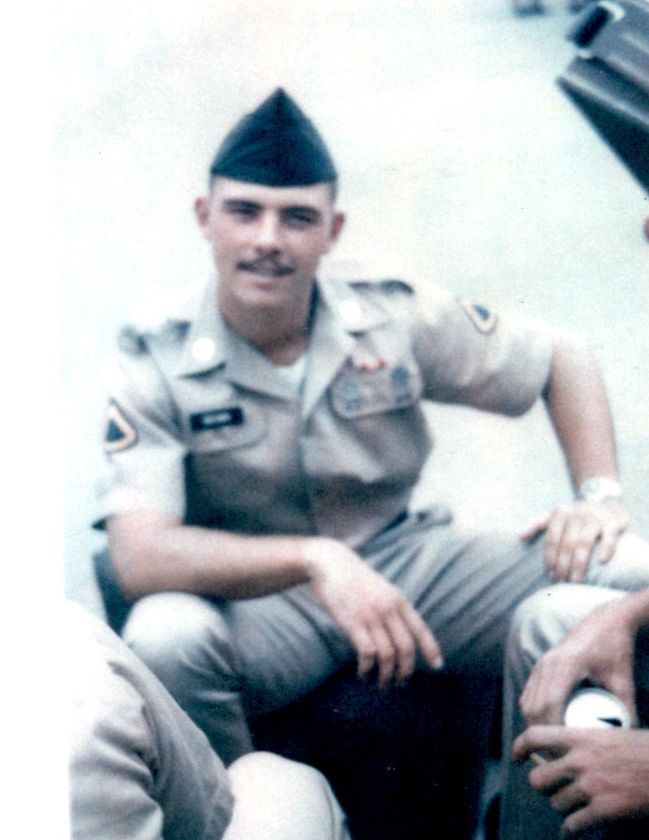
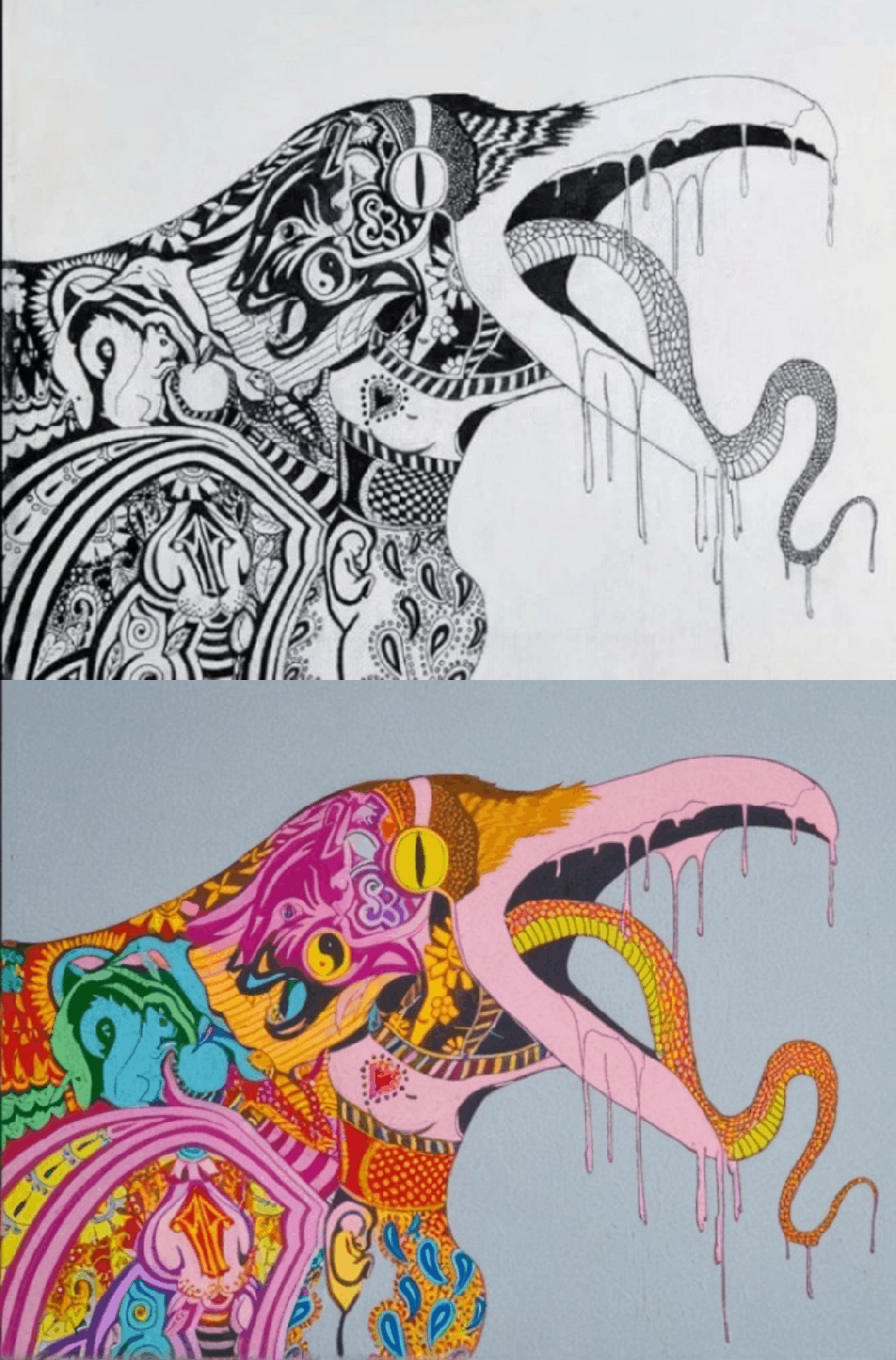
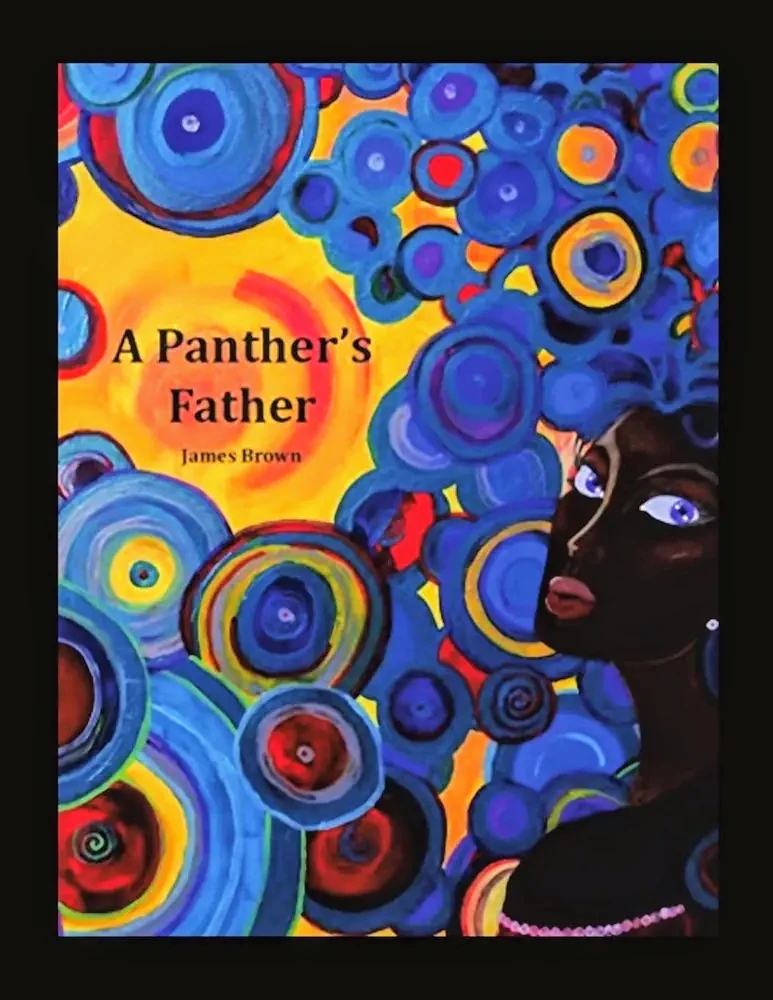
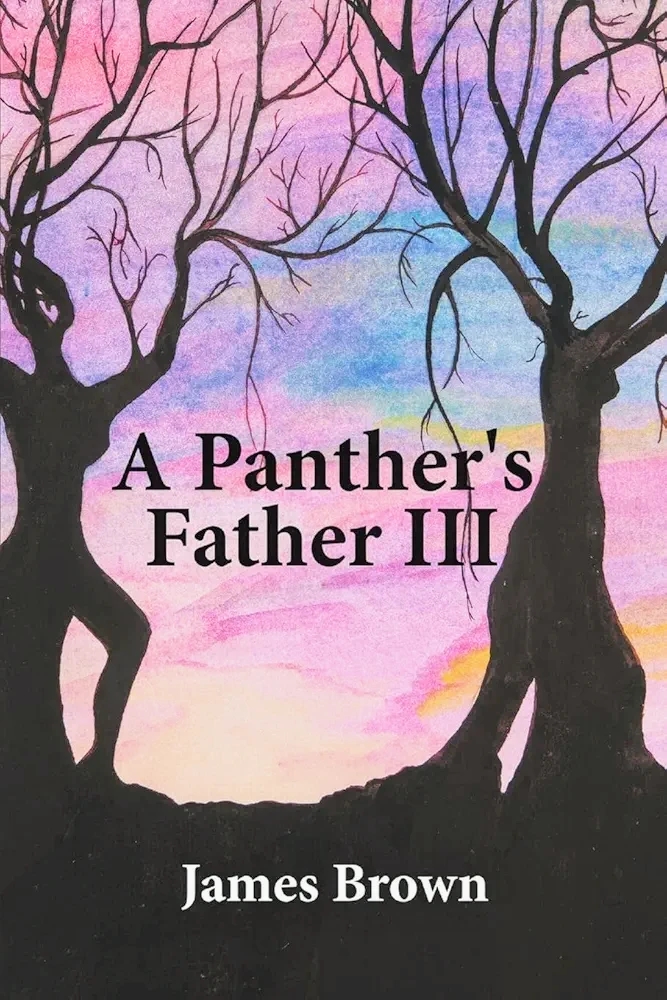
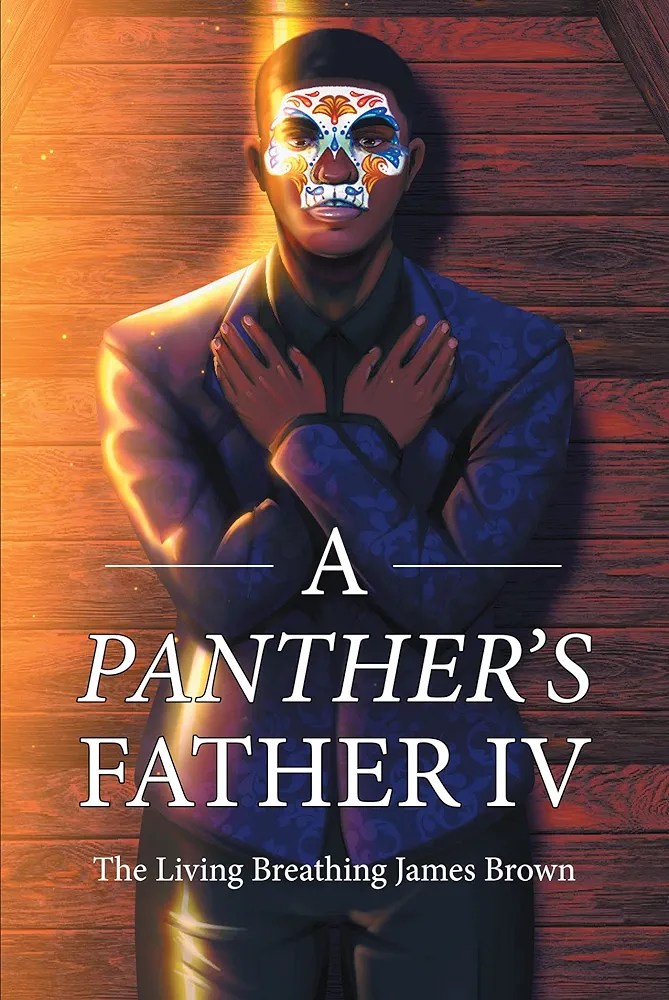
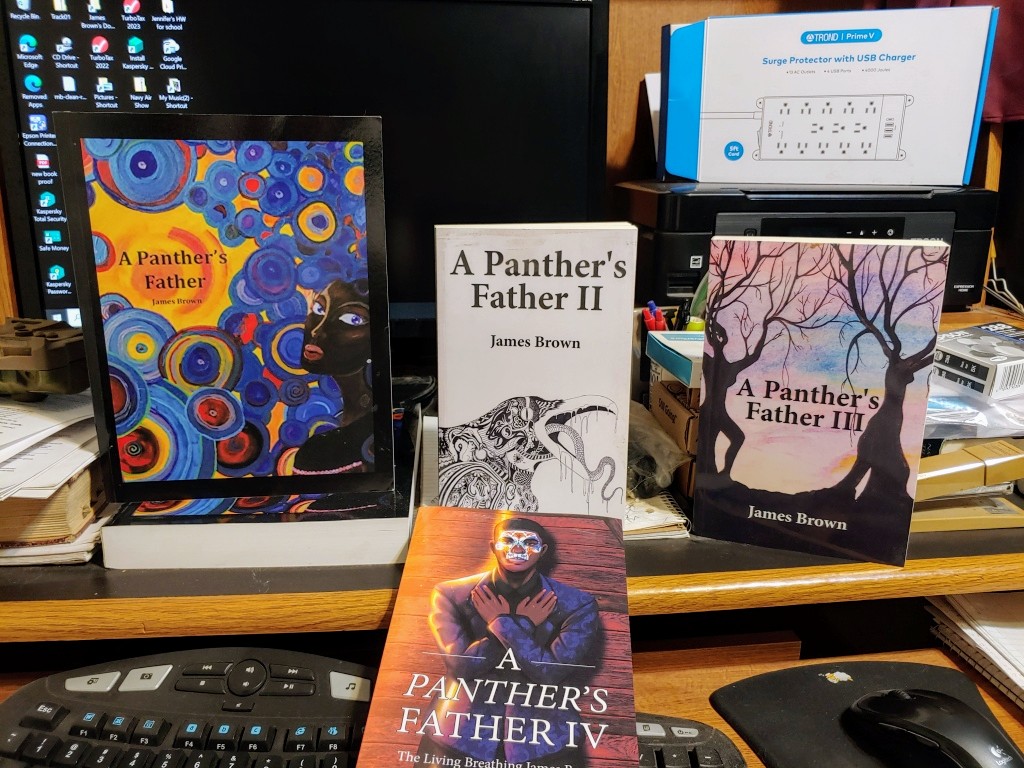
Now, here are some wonderful Books from a now old Army Veteran-




 thelivingbreathingjamesbrown.com
You must be logged in to post a comment.